

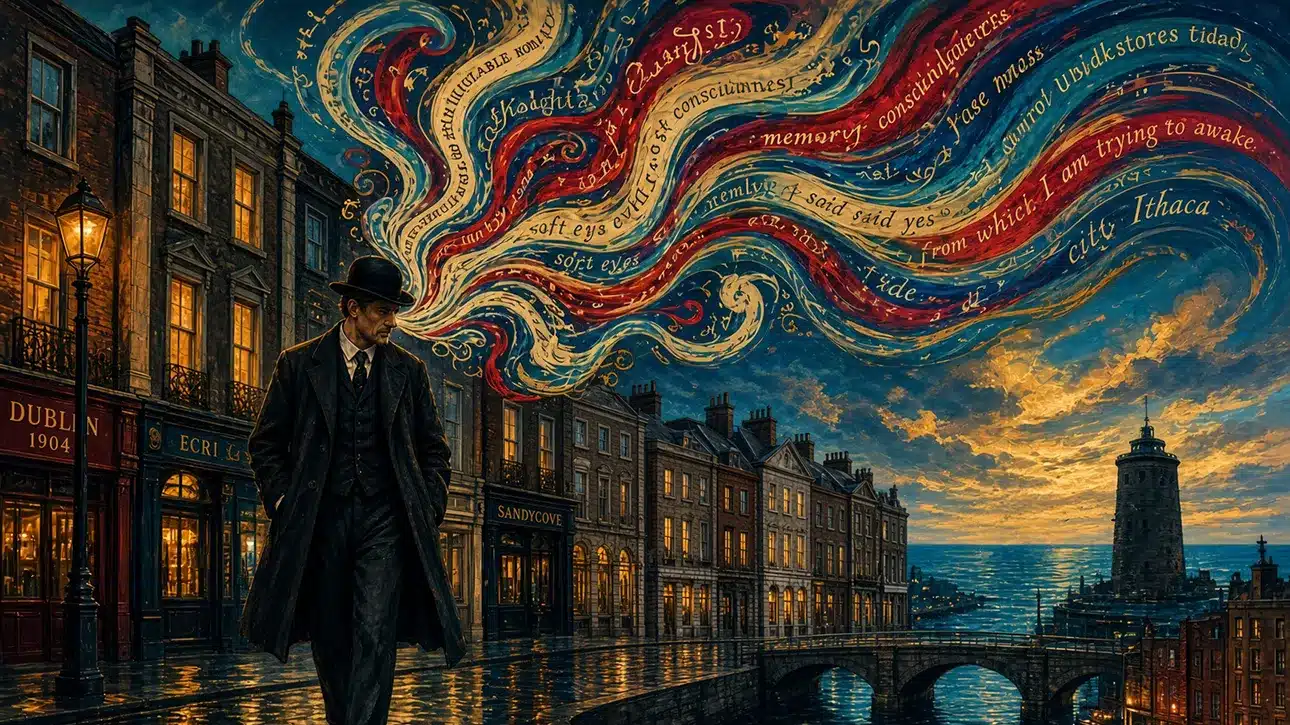
James Joyce’s Ulysses (1922) stands as the towering colossus of Western literary modernism, a text simultaneously celebrated, debated, feared, and revered for over a century. While Joyce’s earlier story collection, Dubliners (1914), and his first novel, A Portrait of the Artist as a Young Man (1916), remain accessible mainstays of modern curricula, Ulysses has long intimidated the general reading public. Joyce famously remarked to his French translator that he had embedded enough enigmas and puzzles into the text to keep professors arguing for centuries—his calculated strategy for securing literary immortality.
Yet, beneath the cryptographic layers, experimental stream-of-consciousness prose, and shifting narrative perspectives lies an approachable, profoundly human narrative. As literary criticism enters a modern era, scholars and enthusiasts alike emphasize a singular, liberating truth: you can read Ulysses, and you do not need to understand every single word, classical allusion, or linguistic quirk to do so. By relinquishing the demand for total comprehension and embracing the novel’s fluid, associative architecture, readers can embark on an unforgettable odyssey through Dublin on June 16, 1904.
Detailed Chronology: The Anatomy of June 16, 1904
The architecture of Ulysses maps out a single, densely packed day in Dublin, Ireland. Known globally to literary enthusiasts as "Bloomsday," June 16, 1904, tracks the parallel movements and internal monologues of its central figures. The narrative formally begins in the morning with the college student Stephen Dedalus—Joyce’s intellectual alter ego returning from A Portrait—and culminates in the wee hours of the next morning with Marion "Molly" Bloom’s legendary, unpunctuated soliloquy.
Morning: The Seeds of Anxiety and Mortality
The narrative anchor of the novel shifts in Episode 4 to the advertising canvasser Leopold Bloom. Bloom’s morning is characterized by domestic routine interlaced with a profound, sudden brush with mortality. He attends the funeral of his acquaintance Patrick Dignam, an event that triggers deep, existential grief. Concurrently, Bloom discovers that his wife, Molly, is scheduled to engage in an adulterous affair that very afternoon with music promoter Hugh E. "Blazes" Boylan.
As Bloom handles a letter from his fifteen-year-old daughter, Milly—who is away learning photography in Mullingar—his anxieties regarding sexuality, decay, and lineage begin to fuse. He experiences a mental tug-of-war between taking preventative action and yielding to the inevitable currents of life. Rather than intervening, Bloom exhibits a characteristic paralysis, letting life unfold according to its own natural laws.
Midday: The Drifts of Public Life and Xenophobia
From Episode 5 through Episode 13, Bloom navigates the bustling streets of Dublin, visiting a public bath, a newspaper office, a lunch counter, and a library. Throughout these excursions, his mind drifts through an associative network of ideas, linking his wife’s infidelity, his daughter’s maturation, the death of his infant son Rudy, and the ancient philosophical concept of metempsychosis (the transmigration of souls).
In Episode 12 (the "Cyclops" episode, paralleling Odysseus’s encounter with the giant), Bloom confronts blatant xenophobia and antisemitism in a local pub. Here, pushed to his limits, he makes a rare verbal stand, proclaiming the value of love and human connection over institutionalized hatred.
Night: The Nightmare of Nighttown and Epiphany
The internal and external journeys of the novel violently collide in Episode 15 ("Circe"), set in Dublin’s red-light district, Nighttown. Written in the style of a surreal, expressionistic play, this sequence externalizes Bloom’s deepest anxieties, guilt, and masochistic fantasies. Under the mocking gaze of imagined figures like the brothel-keeper Bello, Bloom confronts his deepest insecurities regarding gender, paternity, and his cuckoldry.
Purged by this hallucinatory crucible, Bloom emerges with a restored sense of reason. By Episode 17, the novel transitions into a formal catechism (a series of questions and answers) detailing Bloom’s return home alongside Stephen Dedalus. Here, Bloom’s internal processing culminates in equanimity—a profound, calm acceptance of the natural order of human existence, mortality, and change.
Supporting Context & Metrics: Navigating the Joycean Labyrinth
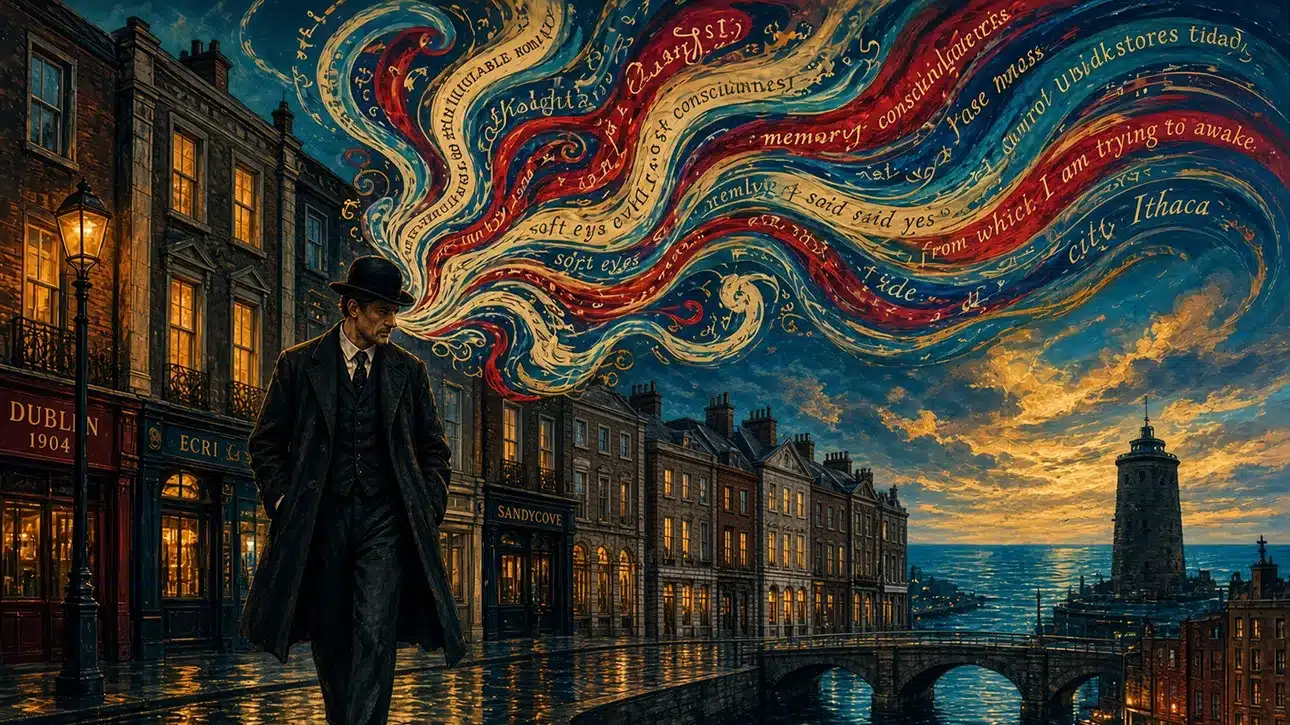
Approaching Ulysses requires a fundamental shift in readerly expectations. In conventional narrative fiction, unfamiliar words or obscure historical references can typically be unraveled with a dictionary, an encyclopedia, or footnotes. In Ulysses, however, scholars note that no amount of specialized academic expertise will unlock every single nuance.
The Phenomenological Reading Experience
Literary theorists like Wolfgang Iser (The Implied Reader, 1974) argue that a literary work does not exist solely in the ink on the page or entirely within the mind of the reader; rather, it is brought into being through the active convergence of the two. Ulysses exemplifies this theory. Because Joyce intentionally maximizes ambiguity and textual indeterminacy, the novel resists absolute closure.
Critic Hugh Kenner observed in The Mechanic Muse (1987) that Joyce’s stylistic progression aimed to "throw back on us all the implications of the fact that the signs we decipher can be maddeningly mute." Consequently, readers cannot simply digest the narrative passively. Instead, they must act as explorers, utilizing concrete details as life preservers while navigating the "blooming, buzzing confusion" of human consciousness—a phrase borrowed from psychologist William James’s Principles of Psychology (1890).
Structural Metrics of the Text
- Episodes: 18 distinct chapters, each mirroring an episode from Homer’s ancient Greek epic, The Odyssey.
- Time Span: Roughly 20 hours, beginning at approximately 8:00 AM on June 16, 1904, and ending in the early hours of June 17.
- Key Characters:
- Leopold Bloom: The modern, 20th-century "everyman" hero.
- Stephen Dedalus: The brooding intellectual artist.
- Molly Bloom: The earth-mother figure whose closing soliloquy champions unpunctuated stream-of-consciousness desire.
Official Statements and Critical Perspectives
Literary scholars and educators who have spent decades analyzing Joyce’s corpus emphasize that the intimidation factor surrounding Ulysses is largely self-perpetuating.
An editor of A Portrait of the Artist as a Young Man once remarked to colleagues that attempting to annotate excerpts of Ulysses for modern students was "the hardest thing" he had ever accomplished. Yet, this same academic pragmatism underpins the modern push to demystify the work. Scholars maintain that reading Ulysses is not a test of intellectual endurance, but an experiential encounter with language itself.
Furthermore, reactions to the novel’s frank depiction of human sexuality and scatological elements have evolved drastically since its initial publication. Once the subject of landmark obscenity trials and public censorship, Ulysses—and Molly Bloom’s closing soliloquy in particular—is now widely hailed as a foundational text of sex positivity and psychological realism. Joyce’s refusal to pass moral judgment on his characters allows readers to formulate their own ethical conclusions regarding Bloom’s equanimity and Molly’s autonomy.
Future Outlook: The Everlasting Appeal of Ulysses
As contemporary literature continues to fracture and experiment with digital-age narratives, metafiction, and fragmented perspectives, James Joyce’s 1922 masterpiece remains remarkably prescient. Ulysses anticipated the networked, associative nature of human thought long before the advent of modern psychology’s digital equivalents.
For the modern reader, the future of engaging with Ulysses lies in letting go of the terror of missing details. By treating the novel not as a cryptographic exam to be passed, but as a rich, musical tapestry of sound, image, and human vulnerability, new generations of readers can cross the threshold. Whether tracing the parallels to Homer’s Odyssey, tracking the recurring motifs of water and metempsychosis, or simply riding the rhythmic wave of Molly Bloom’s closing "yes," the journey through Ulysses remains one of the most rewarding adventures the English language has to offer.







Belum ada komentar. Jadilah yang pertama berkomentar!