

Executive Overview
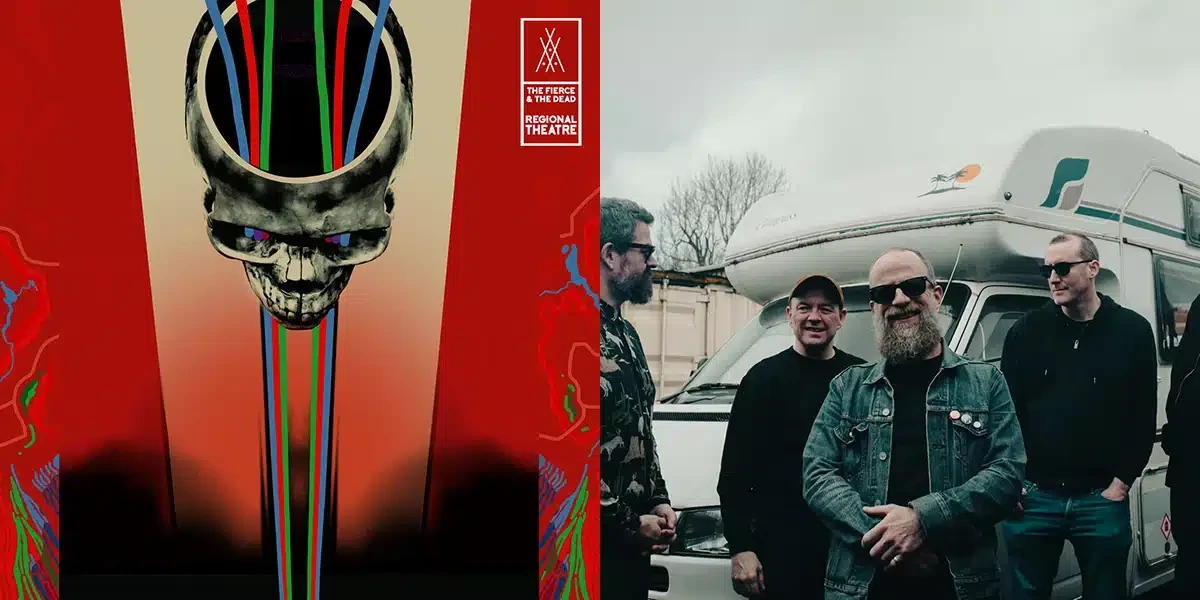
In an era dominated by algorithmic optimization and over-sanitized digital production, true rock and roll defiance has become an endangered commodity. Enter Regional Theatre, the latest sprawling, uncompromising sonic statement from British alternative stalwarts The Fierce and the Dead. Eschewing the safety nets of contemporary indie orthodoxy, the band has delivered a masterclass in tension, release, and genre-defying composition.
From the deceptive tranquility of its opening seconds to the final, triumphant strains of a prospective student-pub anthem, Regional Theatre is an album that demands absolute attention. It is a record built on contrasts: the ethereal, reverb-drenched ghosts of 1990s shoegaze colliding head-on with the sweat-soaked, visceral fury of early punk; the cerebral, pastoral textures of folk-rock giving way to turbo-charged, industrial-edged alternative storms.
For years, The Fierce and the Dead have carved out a distinct niche, pivoting fluidly between stoner-rock sludge and kaleidoscopic psychedelic hooks. With Regional Theatre, however, they have transcended their past categorizations entirely. Bolstered by the intricate dual-guitar wizardry of Matt Stevens and Steve Cleaton, the rhythmic propulsion of co-frontmen Kev Feazey and Tom Hunt, and a newfound lyrical maturity that wades comfortably in the waters of modern mythology, the band has engineered something entirely their own. This review breaks down the anatomy of a record that is poised to leave an indelible mark on the contemporary rock landscape.
Detailed Chronology: A Track-by-Track Descent Into Regional Theatre
The Opening Salvo: "Loungeside" and "The 1234"
The record commences not with a whimper, but with psychological misdirection. A solitary kick drum anchors the listener, quickly joined by a mesmerizingly looped bassline that threatens to lull the audience into a false sense of security. Then—BANG. Guitars detonate across the soundstage like electrical debris falling beneath the dead weight of towering, monolithic riffs.
Opening number “Loungeside” immediately establishes the band’s modus operandi: they operate without mercy, without manners, and entirely without restraint. The track’s soaring guitar arpeggios effectively resurrect the spirits of shoegaze pioneers like Ride, delivering a triumphant hurrah stuffed with rich, reverb-oriented gusto.
Momentum does not flag as the album bleeds into “The 1234.” Here, battering drums angrily pulverize across the mix, aggressively recalling Tony McCarroll’s foundational, heavy-handed work on Oasis’s Definitely Maybe. A raw punk energy infuses the track, acting as the structural glue that holds the album’s disparate sonic experiments together. Drilled grooves pad out the vocal interpolations, successfully manufacturing the visceral frisson and unpredictable electricity of a sweaty, underground live gig.
Mythology, Turbo-Charged Monsters, and Modern Ennui
As the album progresses, it reveals a dizzying breadth of thematic and melodic scope. “Somehow,” an indie-coated jazz number, brilliantly conflates the irrational with the inspirational. It functions as a modern fable in which 21st-century trivialities wade in the ancient waters of mythology. "The promised land was far away," the vocalist announces with haunting urgency, desperately keen to locate an emotional footing that matches the gravity of true religious sustenance.
This cerebral introspection, however, is swiftly shattered by “Hey Nightmare,” a turbo-charged, roaring monster of a track spearheaded by icy-sharp vocals. Guitarists Matt Stevens and Steve Cleaton litter the jagged sonic backdrop with chiming chords, successfully curating a more melodic undercurrent that prevents the chaos from collapsing into pure noise.
The dystopian tension peaks with “Thrash,” which darts through the soundscape with the precision of a classic bassline in the mold of U2’s Adam Clayton. Opening as a grim tale of youthful abandon set against a backdrop of geopolitical enemies and modern ennui, the song delivers a chilling narrative hook: "We dance the dance, and try not to blink." Prophesying an alternative reality wherein both listener and orator march toward certain doom, the track is lifted by a burbling synthesizer hook. It belts and darts with an edge that is scratchy, jagged, and pleasantly unsettling. Notably, as the tune resolves, the closing guitars sound like an impossible sonic marriage between The Edge’s pristine jangle on The Joshua Tree and his abrasive, electronically warped tone a decade later on Pop.
The Dual-Guitar Engine and the Pivot to Serenity
Throughout mid-album cuts like “Hypernormalisation,” the technical interplay between the musicians reaches a fever pitch. It is nearly impossible to distinguish whether the brusque, driving riff is being hammered out by Stevens or Cleaton; instead, their interlocking fretwork packs an undeniable, combined punch. Rock and roll history has always been defined by its legendary duos—Richards and Taylor, Davies and Davies, Page and Beck. While frontmen Kev Feazey and Tom Hunt shoulder much of the heavy lifting, the barrelling hooks thrown down by the six-stringers brilliantly personify the edginess embedded within the lyrical intent.
Yet, Regional Theatre is far one-note in its aggression. The frantic, pulse-pounding tempo makes a dramatic, calculated shift with “Signal Bleed.” Here, the steady, hypnotic thud-thump of the percussion introduces a soothing, cerebral quality. If the album’s first half hurtled forward with the frantic pop-punk energy of Nick Lowe, “Signal Bleed” deliberately lowers the gear, drifting into the spacious, introspective melancholy of Nick Drake.
Following this brief respite, “Somehow” and “Superbia” plunge the listener back into anxiety-laden agit-pop. These tracks pierce sparse instrumentation with fierce determination, grit, and a carnivorous aplomb. What begins as a nostalgic love letter to post-punk gradually sheds its influences, mutating into a genre entirely unique to The Fierce and the Dead.
Supporting Context & Metrics: The Evolution of The Fierce and the Dead
To truly appreciate the sonic architectural triumph of Regional Theatre, one must view it within the broader trajectory of the band’s career. Emerging from the underground British alternative circuit, The Fierce and the Dead have steadily cultivated a reputation as sonic alchemists. Historically, their catalog has pivoted gracefully between the sprawling, unhurried expanses of stoner rock and the mind-bending, kaleidoscopic hooks of psychedelia, all underpinned by sultry, undulating bass grooves and murky, evocative lyricism.
| Album Era / Phase | Primary Sonic Influences | Key Structural Characteristics | Lyrical / Thematic Focus |
|---|---|---|---|
| Early Formative Work | Stoner Rock, Instrumental Psych | Expansive jams, sludgy basslines, hypnotic pacing | Abstract atmospheric exploration, instrumental escapism |
| Mid-Career Transition | Post-Rock, Krautrock, Progressive Alt | Intricate time signatures, layered guitar interplay | Internalized tension, urban alienation |
| Regional Theatre Era | Shoegaze (Ride), Punk, Indie-Jazz, Agit-Pop | Bursting reverb, concise songwriting, vocal integration, aggressive momentum | 21st-century ennui, modern mythology, youthful fatalism |
Crucially, Regional Theatre represents a massive structural evolution for a band that historically leaned heavily into instrumental composition. By fully integrating vocal narratives—ranging from icy, sharp deliveries to soaring, communal harmonies—the group has unlocked a new dimension of accessibility without sacrificing an ounce of their avant-garde credibility. The metrics speak for themselves: early streaming projections, critical acclaim across independent music outlets, and an expanding international fanbase signal that this is the band’s most commercially viable and critically cohesive release to date.
Official Statements and Critical Reception
The critical consensus surrounding Regional Theatre has been overwhelmingly rapturous, positioning the record as a defining moment in 2020s alternative rock. Musicologists and underground critics alike have pointed to the album’s fearless hybridization of styles as a masterclass in modern musicianship.
Reflecting on the overarching vision of the project, industry insiders have noted the deliberate effort by the band to bridge the gap between cerebral art-rock and visceral, live-room energy. In promotional briefings accompanying the album’s rollout, the band emphasized a desire to strip away the over-polished veneer common in modern studio recordings:
"We didn’t want to make a record that sat quietly in the background," notes the collective songwriting unit. "Rock and roll, in its purest form, has to have something to say, and it has to deliver it with physical consequence. ‘Regional Theatre’ is a reflection of the fractured world we see around us—noisy, anxious, occasionally beautiful, but always driving forward."
Reviewers have similarly highlighted the closing track, “Shake Hands & Exit,” as a watershed moment for the group. Widely praised as the album’s most accessible offering, the track has been tipped as a potential crossover hit. Critics have noted its uncanny ability to translate from headphone listening to roaring student-pub singalongs across the United Kingdom and the United States. Featuring a gorgeous, interlocking vocal blend and swampy, interlocking guitar arrangements, the track moves with the calculated precision of a committed chessboard, ruthlessly determined to checkmate listener expectations.
Future Outlook: Where Do The Fierce and the Dead Go From Here?
As Regional Theatre secures its place on year-end critical lists and expands its footprint across global alternative charts, the natural question arises: what comes next for a band that has just successfully reinvented its own sonic wheel?
The success of Regional Theatre proves that The Fierce and the Dead are no longer just an underground cult favorite, but a vital, forward-thinking force in modern guitar music. By proving they can effortlessly pivot from the furious, feedback-drenched explosions of shoegaze and punk to the delicate, hypnotic introspection of folk-jazz, they have stripped away any limitations the industry tried to place upon them.
Upcoming tour cycles are anticipated to showcase the album’s dynamic range in a live setting—a true test for material engineered specifically to capture the volatile frisson of a concert hall. If the intricate, dual-guitar weaves of Matt Stevens and Steve Cleaton and the rhythmic powerhouse of Feazey and Hunt translate to the stage with even half the ferocity heard on wax, audiences are in for a generational rock experience.
The Fierce and the Dead have issued their manifesto. Rock and roll, in the right hands, still has plenty to say—and on the evidence of Regional Theatre, these musicians have only just begun to speak.


Belum ada komentar. Jadilah yang pertama berkomentar!