

Executive Overview
Nestled at the sprawling, verdant foot of Japan’s most iconic peak, Fuji Safari Park in Shizuoka Prefecture offers a wildlife experience unlike any other in East Asia. Spanning a vast natural expanse, this premier destination combines the raw, untamed thrill of an African-style safari with the serene, breathtaking grandeur of Mount Fuji. Home to approximately 800 animals across 60 diverse species—ranging from apex predators like lions and cheetahs to towering giraffes and lumbering elephants—the park allows visitors to observe magnificent creatures roaming in open, carefully curated habitats.
Beyond the exotic fauna, the park serves as a premier vantage point for viewing Mount Fuji, offering unique sightlines that blend the majesty of Japan’s highest mountain with the wild beauty of the animal kingdom. Whether touring the expansive terrain from the comfort of a personal vehicle, boarding a specially designed Jungle Bus, or exploring the perimeter on foot via the immersive Walking Safari, guests are treated to a dynamic interplay of nature.
![[Breathtaking views] Introducing the Mt. Fuji viewpoints at Fuji Safari Park!](https://resources.matcha-jp.com/resize/720x2000/2025/04/05-230280.webp)
However, experiencing Mount Fuji in all its snow-capped glory requires strategic timing. Weather patterns, seasonal foliage, and shifting atmospheric conditions dramatically influence visibility. This comprehensive report explores the park’s layout, analyzes the best seasonal windows for catching a clear glimpse of the iconic peak, highlights 12 of the finest viewpoints within the facility, and provides vital logistical details for travelers planning an excursion from Tokyo or Nagoya.
Detailed Chronology and Seasonal Dynamics of Mount Fuji Visibility
Understanding the microclimate around the base of Mount Fuji is essential for anyone hoping to capture the quintessential photograph of the mountain. Visibility fluctuates wildly depending on the month, temperature, and time of day.
![[Breathtaking views] Introducing the Mt. Fuji viewpoints at Fuji Safari Park!](https://resources.matcha-jp.com/resize/200x2000/2025/04/06-230283.webp)
Winter: The Golden Window (December to February)
For travelers whose primary goal is an unobstructed, crystal-clear view of Mount Fuji, winter is unequivocally the prime season. Between December and February, the region experiences lower precipitation levels and minimal humidity. Statistically, visitors enjoy a 50% to 70% probability of seeing the mountain in its entirety during these crisp winter months. The sweeping, snow-draped summit stands out sharply against deep blue skies, providing a dramatic backdrop for the park’s sprawling meadows and animal enclosures.
Spring and Autumn: Transitional Splendor (November to May)
The iconic snow cap that blankets Mount Fuji typically lingers from November through May, though exact timelines vary annually based on weather anomalies.
![[Breathtaking views] Introducing the Mt. Fuji viewpoints at Fuji Safari Park!](https://resources.matcha-jp.com/resize/720x2000/2025/06/08-235738.webp)
- Spring (Late April to Early May): This shoulder season brings a vibrant burst of color to the park. Vibrant tulip fields bloom in the central plaza near the park’s main restaurant, creating a celebrated seasonal photo composition where blazing spring florals contrast against the snow-capped volcanic peak.
- Late Autumn: As deciduous trees shed their leaves between November and December, sightlines through heavily wooded areas—such as the Lion Zone—temporarily open up, revealing glimpses of the summit that remain hidden during the leafy summer months.
Summer: The Season of Clouds (June to August)
Conversely, summer presents the greatest challenge for sightseers. From June through August, high humidity, frequent rainfall, and heavy cloud cover plague the region. During these months, clear views of Mount Fuji may drop to a scarce two or three days per month. Even on days when the early morning hours break clear and crisp, rising daytime temperatures rapidly generate moisture, causing clouds and haze to roll in and shroud the summit by midday.
Supporting Context & Metrics: Navigating the Zones of Fuji Safari Park
Operating as one of Japan’s largest and most successful open-range safari parks, the facility is strategically divided into distinct zones to maximize both animal welfare and visitor engagement.
![[Breathtaking views] Introducing the Mt. Fuji viewpoints at Fuji Safari Park!](https://resources.matcha-jp.com/resize/200x2000/2024/12/10-214444.webp)
The Safari Zone
Spanning the rugged terrain at the base of the mountain, the Safari Zone accommodates free-roaming wildlife. Visitors can navigate this restricted-access area using two distinct methods:
- Personal Vehicles: Driving through the park at an unhurried pace allows families and photography enthusiasts to linger at designated vantage points.
- The Jungle Bus: These heavily fortified, wire-mesh tour vehicles allow brave visitors to hand-feed ferocious animals such as bears and lions through specialized slots, offering an adrenaline-pumping perspective that is unavailable in standard zoos.
The Interaction Zone and Walking Safari
Pedestrian-friendly areas allow guests to disembark and interact directly with smaller or more docile species.
![[Breathtaking views] Introducing the Mt. Fuji viewpoints at Fuji Safari Park!](https://resources.matcha-jp.com/resize/200x2000/2025/01/22-220567.webp)
- The Walking Safari: A dedicated forest trail running along the perimeter of the Safari Zone. This course immerses hikers in local flora while offering unique, elevated angles of the animal enclosures set against the distant mountain backdrop.
Mapping the Masterpieces: The 12 Premier Mount Fuji Viewpoints
Fuji Safari Park has cataloged 12 premier viewpoints scattered throughout its grounds, ensuring that wildlife observation and landscape photography go hand in hand.
1. The Bear Zone (Latter Half of the Course)
As visitors navigate the first major segment of the Safari Zone, the Bear Zone transitions into a heavily wooded landscape in its latter half. Here, strategic gaps in the canopy frame glimpses of Mount Fuji, requiring sharp attention from passengers as they wind through the terrain.
![[Breathtaking views] Introducing the Mt. Fuji viewpoints at Fuji Safari Park!](https://resources.matcha-jp.com/resize/720x2000/2025/06/08-235761.webp)
2. The Lion Zone
Because this zone is densely populated with broadleaf trees, sightlines to the mountain are naturally restricted. However, during the winter months (November to April) when the trees drop their foliage, visitors can catch stunning glimpses of the mountain’s upper ridges rising above the apex predators.
3. The Cheetah Zone
Offering a stark contrast to the forested Lion Zone, the Cheetah Zone is designed as an open, sweeping grassland. This unobstructed terrain provides a wide-angle panorama of Mount Fuji. Notably, during the height of summer (July to early October), the mountain’s peak is entirely free of snow—a surprisingly barren appearance that often surprises travelers who expect a year-round white summit.
![[Breathtaking views] Introducing the Mt. Fuji viewpoints at Fuji Safari Park!](https://resources.matcha-jp.com/resize/720x2000/2025/06/08-235757.webp)
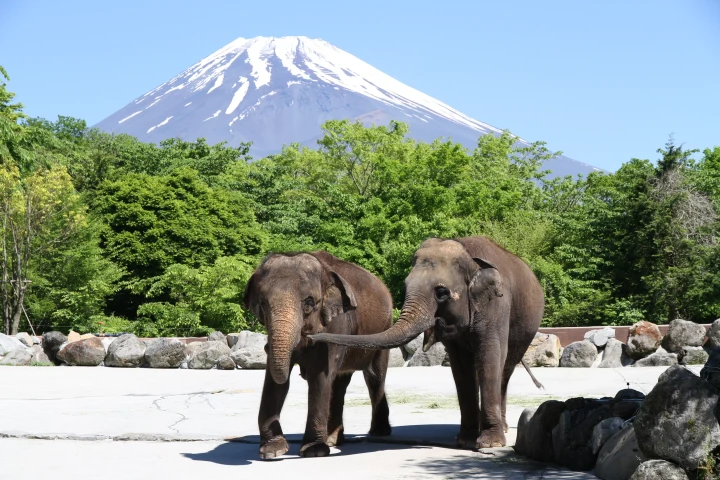
4. The Elephant Enclosure
Scale is everything at this unique vantage point. Here, visitors can frame the world’s largest land mammals—the magnificent Asian and African elephants—directly alongside Japan’s tallest mountain, creating a breathtaking composition of natural titans.
5. The Herbivorous Zone
Sprawling and expansive, the herbivorous zone is widely considered one of the park’s premier scenic locations. The lack of dense obstacles allows for unobstructed views of Mount Fuji from virtually every angle. Photographers frequently utilize this zone to capture iconic shots featuring giraffes, zebras, rhinos, and camels grazing peacefully beneath the snowy peak.
![[Breathtaking views] Introducing the Mt. Fuji viewpoints at Fuji Safari Park!](https://resources.matcha-jp.com/resize/720x2000/2025/06/08-235739.webp)
6. The American Bison Area
Sharing thematic similarities with the herbivorous expanse, the American bison habitat provides another open corridor where heavy-set megafauna roam against the backdrop of the towering stratovolcano.
7. The Second Parking Lot Meadow
For those who prefer a stationary view before entering or after leaving the main zones, the spacious meadow adjacent to the second parking lot offers a wide, uninterrupted panorama. This spot captures the majestic sweep of Mount Fuji all the way down to its expansive base.
![[Breathtaking views] Introducing the Mt. Fuji viewpoints at Fuji Safari Park!](https://resources.matcha-jp.com/resize/720x2000/2025/06/08-235741.webp)
8. The Kangaroo and Capybara Area
Blending relaxed animal encounters with world-class scenery, this zone allows visitors to observe leaping kangaroos and sunbathing capybaras while keeping one eye on the magnificent mountain towering in the distance.
9. The Restaurant Plaza (Spring Tulip Gardens)
Located directly in front of the park’s main dining facility, this public square transforms into a botanical masterpiece from late April to early May. Thousands of blooming tulips create a vibrant foreground, making it one of the park’s most popular social media and family portrait spots.
![[Breathtaking views] Introducing the Mt. Fuji viewpoints at Fuji Safari Park!](https://resources.matcha-jp.com/resize/720x2000/2025/06/08-235754.webp)
10. The Safari Shop Forecourt
Positioned near the primary retail hub, the area surrounding the Safari Shop offers a clear line of sight to the mountain, making it an ideal gathering point for visitors finalizing their itineraries or purchasing commemorative merchandise.
11. The Jungle Bus Stop
A favorite among families with young children, the Jungle Bus terminal combines the excitement of upcoming safari tours with an open-air plaza that frames Mount Fuji perfectly overhead.
![[Breathtaking views] Introducing the Mt. Fuji viewpoints at Fuji Safari Park!](https://resources.matcha-jp.com/resize/720x2000/2025/06/08-235763.webp)
12. The General Parking Grounds
Proof that one does not even need to enter the park proper to appreciate the scenery, the general parking lot delivers sweeping, unobstructed vistas of Mount Fuji, particularly during the crisp winter months from December to February.
Official Statements and Visitor Guidance
Park management continually emphasizes the unpredictable nature of the region’s climate while encouraging guests to embrace the changing seasons. In an official statement regarding the park’s year-round appeal, park representatives noted:
![[Breathtaking views] Introducing the Mt. Fuji viewpoints at Fuji Safari Park!](https://resources.matcha-jp.com/resize/720x2000/2025/06/08-235752.webp)
"Mount Fuji reveals an entirely different character with each passing season. We invite travelers to visit Fuji Safari Park multiple times throughout the year to experience these distinct transformations. Set amidst the untamed wilderness at the foot of the mountain, visitors can observe animals up close, participate in interactive feeding sessions, and enjoy a full day of multifaceted entertainment that blends wildlife conservation with unmatched natural scenery."
Logistical Guide: How to Get There
Reaching Fuji Safari Park is straightforward, with robust transit links connecting major metropolitan hubs like Tokyo and Nagoya via expressways and rail networks.
![[Breathtaking views] Introducing the Mt. Fuji viewpoints at Fuji Safari Park!](https://resources.matcha-jp.com/resize/720x2000/2025/06/08-235743.webp)
Traveling by Car
- From Tokyo: Take the Tomei Expressway for approximately 120 minutes. Exit at the Susono Interchange (IC), from which the park is located roughly 10 kilometers (a 15-minute drive).
- From Nagoya: Take the Shin-Tomei Expressway for approximately 180 minutes. Exit at the Shin-Fuji Interchange, followed by an 18-kilometer drive lasting roughly 30 minutes.
Traveling by Public Transportation
- From Tokyo via Mishima Station: Take the Tokaido Shinkansen from Tokyo or Shinagawa Station to Mishima Station (approx. 50 minutes). Transfer to a local fixed-route bus bound for Fuji Safari Park (approx. 50 minutes).
- From Tokyo via Gotemba Station: Board the Odakyu Line Romancecar from Shinjuku Station to JR Gotemba Station (approx. 100 minutes). From there, catch a local bus directly to the park (approx. 35 minutes).
- From Nagoya via Mishima Station: Take the Tokaido Shinkansen from Nagoya Station to Mishima Station (approx. 110 minutes), then transfer to the local park-bound bus (approx. 50 minutes).
Future Outlook
As eco-tourism and domestic travel continue to evolve in post-pandemic Japan, destinations like Fuji Safari Park are placing an increased emphasis on sustainable wildlife management coupled with high-value educational tourism. Future infrastructure enhancements aim to improve visitor flow around key photographic pinch points while expanding naturalistic enclosures that prioritize animal enrichment. By continuing to leverage its unique geographic advantage—sitting squarely at the intersection of world-class wildlife preservation and Japan’s most hallowed landscape—Fuji Safari Park remains an essential, must-visit destination for nature lovers and photography enthusiasts alike.







Belum ada komentar. Jadilah yang pertama berkomentar!