


Executive Overview
For decades, the personal computer gaming ecosystem has been starkly partitioned. While Windows PCs have enjoyed a near-monopoly on high-end, day-one releases of triple-A blockbusters, Apple’s Mac lineup—despite boasting immense graphical horsepower through its proprietary Silicon architectures—has historically been relegated to the sidelines. Ports often arrived months or years later, if they materialized at all, frequently suffering from poor optimization or relying on clunky emulation layers.
However, the paradigm is shifting in real time.
Next week promises to be a watershed moment for Apple hardware enthusiasts, with several new MacBook configurations slated for release. Yet, the broader tech and gaming communities are eyeing an even more significant milestone on the horizon: the March 19 launch of Crimson Desert. Developed by industry stalwart Pearl Abyss, this expansive open-world action-adventure game is not just another title making a belated leap to macOS. Instead, it is launching day-and-date alongside the PC, PlayStation 5, and Xbox Series X|S editions.
Priced at $69.99 for the Standard Edition and $79.99 for the Deluxe Edition—and available for pre-order now on Steam—Crimson Desert represents a monumental stress test and showcase for Apple’s ongoing crusade to cement the Mac as a legitimate, high-performance gaming platform. By leveraging native Apple silicon technologies like MetalFX Upscaling and hardware-accelerated ray tracing, Pearl Abyss and Apple are signaling to the industry that the Mac is finally ready for prime-time, heavy-duty gaming.
Detailed Chronology: From Concept to a Day-One macOS Reality
To understand the magnitude of the Crimson Desert macOS release, one must trace the timeline of Apple’s renewed commitment to high-end gaming and Pearl Abyss’s ambitious development cycle.

The Genesis of a Multi-Platform Giant
Originally conceived as an offshoot or prequel within the universe of Pearl Abyss’s massively multiplayer online hit Black Desert, Crimson Desert eventually evolved during development into a standalone, single-player open-world action-adventure game with massively multiplayer elements. Featuring cutting-edge visuals, photorealistic environments, and visceral, fast-paced combat, the title quickly caught the attention of the global gaming community when early trailers debuted years ago.
As development extended, Pearl Abyss utilized its proprietary BlackSpace Engine—a technology built from the ground up to render massive, seamless worlds with advanced lighting, physics, and dynamic weather systems. While console and PC players anticipated a sprawling epic set in the continent of Pywel, Mac users quietly harbored cautious skepticism regarding whether the hardware could ever natively support such a demanding engine.
Apple’s Strategic Pivot: WWDC and Beyond
The turning point in the modern era of Mac gaming arrived when Apple systematically began rolling out its custom Silicon processors (the M-series chips). Recognizing that hardware performance alone was insufficient to attract gamers and developers, Apple coupled this architectural leap with software innovations:
- The Game Porting Toolkit: Introduced to help developers easily evaluate how their Windows games could run on macOS.
- Metal 3 and MetalFX Upscaling: Apple’s proprietary graphics API designed to maximize GPU efficiency and deliver high-resolution imagery using advanced spatial and temporal upscaling techniques akin to DLSS and FSR.
Last summer, Apple formally shattered expectations by announcing that Crimson Desert would be coming to the Mac as part of a heavily curated lineup of nine major upcoming game debuts. During various showcases and developer briefings, Apple’s engineering teams highlighted how Pearl Abyss’s upcoming epic would fully harness the power of M-series chips. Specifically, the game was spotlighted for its use of MetalFX Upscaling to accelerate framerates without sacrificing visual fidelity, alongside hardware-accelerated ray tracing natively supported by the M3 and M4 chip families.
The March 19 Launch Window
Fast forward to February 2026, and the timeline converges. Pearl Abyss officially locked in March 19 as the global release date across PC, current-generation consoles, and—crucially—macOS. This simultaneous release strategy breaks a longstanding curse for Apple users, who traditionally had to wait weeks or months for optimized ports. As the launch clock ticks down, industry watchers are analyzing not just the gameplay mechanics, but the strategic alignment between Pearl Abyss’s engineering goals and Apple’s hardware rollout schedules.

Supporting Context & Metrics: Under the Hood of Crimson Desert on Mac
Transitioning a bleeding-edge triple-A video game to macOS requires a deep synchronization between high-level game engines and low-level system architecture. Crimson Desert is not a casual indie title; it is a graphical behemoth designed to push modern hardware to its absolute limits.
System Requirements and Hardware Compatibility
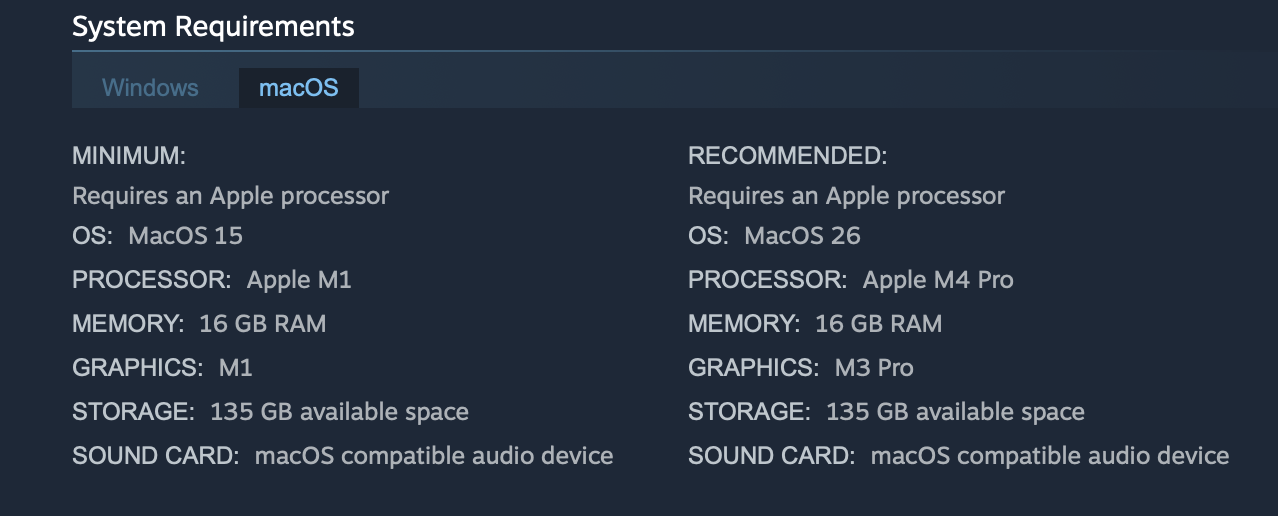
An examination of the recently published system requirements for Crimson Desert reveals the steep technological demands placed upon the host machine. While PC configurations call for high-end dedicated GPUs and robust multi-core processors, the macOS iteration relies entirely on the integrated unified memory architecture and potent GPU cores found within Apple’s high-end Silicon.
+-------------------------------------------------------------------------+
|                  CRIMSON DESERT - MAC SYSTEM PROFILE                    |
+--------------------------+----------------------------------------------+
| Operating System         | macOS Sonoma or later                        |
| Supported Processors     | Apple M3, M4 series (and upcoming M5 family) |
| Core Technologies        | Metal 3, MetalFX Upscaling, Ray Tracing      |
| Distribution Platform    | Steam (Day-One macOS Support)                |
| Pricing                  | Standard: $69.99 | Deluxe: $79.99            |
+--------------------------+----------------------------------------------+
Apple has positioned its M3 and M4 families of chips—and the imminent unveiling of the M5 Pro and M5 Max variants expected next week—as the ultimate engines for this computational load. By utilizing unified memory, the Mac version of Crimson Desert can stream massive textures and open-world assets directly without the traditional bottlenecks associated with discrete VRAM limitations on older PC architectures.
The Role of MetalFX and Ray Tracing
At the heart of the Mac performance story is MetalFX Upscaling. In a game as visually dense as Crimson Desert, maintaining a stable, high framerate during chaotic, real-time sword fights and sweeping cinematic traversals is paramount. MetalFX allows the game to render at a lower native resolution and intelligently upscale the image using temporal reconstruction, freeing up GPU cycles to power complex lighting algorithms.
Furthermore, the integration of hardware-accelerated ray tracing on M3 and M4 chips transforms how light interacts with the gritty landscapes of Pywel. Shadows cast by campfire flickers, reflections in rain-slicked armor, and global illumination filtering through dense canopies are calculated in real-time, matching—and in some cases rivaling—the fidelity experienced on high-end Windows rigs equipped with dedicated ray-tracing cards.
Official Statements and Industry Implications
The collaboration between Pearl Abyss and Apple is far more than a standard publishing agreement; it serves as a critical litmus test for the viability of the Mac as a tier-one gaming ecosystem.
Apple’s Vision for Mac Silicon
During previous developer conferences and press briefings, Apple executives repeatedly emphasized that the architectural uniformity of Apple Silicon—spanning from the entry-level MacBook Air to the ultra-powerful Mac Studio—creates a predictable, highly optimized target for developers.
"By leveraging powerful software technologies like MetalFX Upscaling to accelerate performance and deliver high-quality visuals, as well as taking advantage of the M3 and M4 family of chips with ray tracing, developers can deliver a breathtaking experience that runs natively on the Mac." — Apple Engineering Showcase
Industry analysts note that Apple’s aggressive positioning of Crimson Desert is deliberate. By tying the game’s promotional cycle directly to upcoming hardware events—such as the anticipated rollout of new MacBook models featuring M5 Pro and M5 Max chips next week—Apple is explicitly marketing its laptops not just as creative powerhouses for video editors and software developers, but as uncompromising machines for elite gamers.
Pearl Abyss’s Multi-Platform Ambitions
For Pearl Abyss, supporting macOS on day one is a calculated expansion of their total addressable market. While the PC and console spaces remain fiercely competitive, the premium Mac user base represents an affluent, highly engaged demographic that historically spends significantly on digital software and microtransactions.

By ensuring that Crimson Desert runs natively on macOS via Steam, Pearl Abyss bypasses the friction of proprietary launchers, meeting players precisely where their gaming libraries are already curated. Company representatives have expressed confidence in the BlackSpace Engine’s scalability, noting that Apple’s modern graphics APIs made porting the game a streamlined, highly collaborative process rather than an afterthought.
Future Outlook: What Crimson Desert Means for the Future of Mac Gaming
As the gaming industry looks toward the March 19 release of Crimson Desert, the broader implications for macOS as a gaming platform cannot be overstated. For years, the narrative surrounding Mac gaming was defined by resignation: beautiful hardware crippled by a lack of software support.
A Domino Effect for Triple-A Developers?
The success or failure of Crimson Desert on macOS will likely serve as a bellwether for other major publishers. If Pearl Abyss reaps strong day-one sales and positive technical reception on the Mac App Store and Steam for macOS, it proves that:
- Day-and-date releases are financially and technically viable outside of the traditional Windows/Console hegemony.
- Apple Silicon users are willing to pay standard triple-A pricing ($69.99+) for native, optimized experiences rather than settling for casual or mobile crossover titles.
- Apple’s developer toolkits (Metal 3, Game Porting Toolkit, and MetalFX) genuinely reduce the engineering hours required to bridge multi-platform source code.
Looking Ahead to Next Week and Beyond
Next week’s anticipated hardware announcements—centering on upgraded MacBook lineups powered by next-generation M-series silicon—will provide the ideal physical vessel for this software milestone. As consumers unbox machines equipped to handle hardware-accelerated ray tracing and advanced neural upscaling, Crimson Desert will be sitting right there on digital storefronts, ready to be downloaded and played on day one.
The desert may be crimson, but the future of gaming on the Mac is looking brighter—and more colorful—than it ever has before.

Are you planning to dive into the open-world expanse of Crimson Desert on your Mac, or will you be sticking to traditional platforms? Let us know your thoughts, hardware configurations, and expectations in the comments below.









Belum ada komentar. Jadilah yang pertama berkomentar!