

Executive Overview
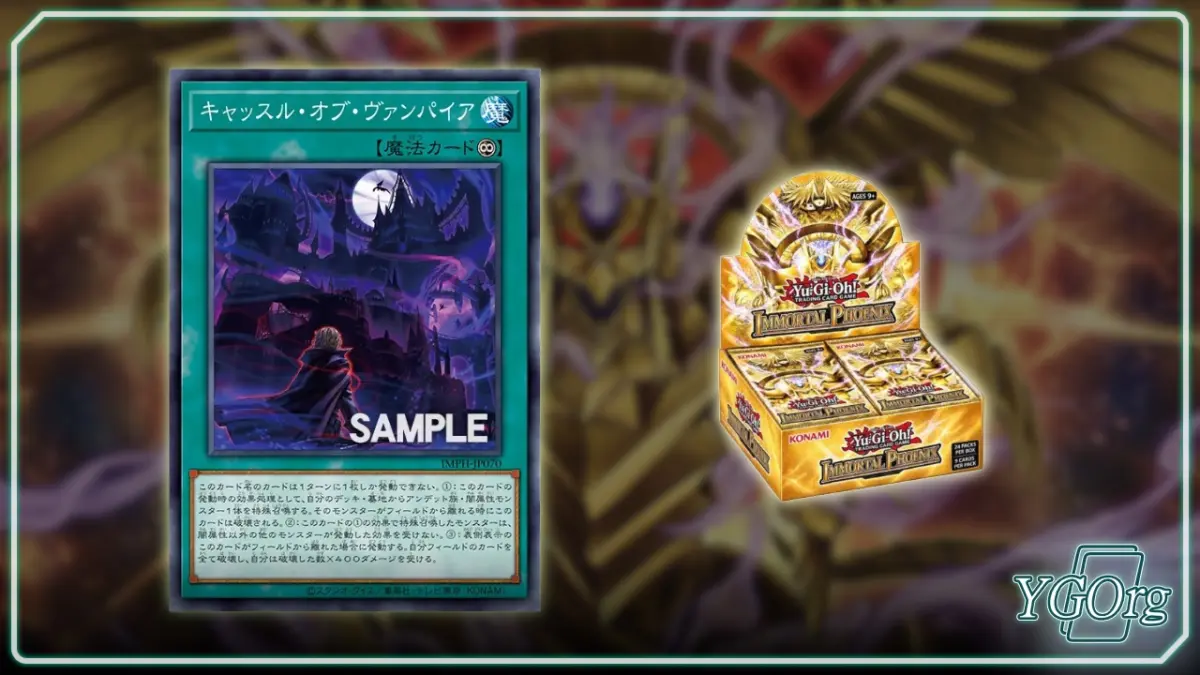
In the fast-paced, ever-evolving ecosystem of the Yu-Gi-Oh! Official Card Game (OCG), Konami periodically introduces cards that transcend standard competitive utility to serve as loving cultural touchstones, historical homages, and narrative masterpieces. The latest reveal from the OCG design studios—IMPH-JP070: Castle of Vampire—is precisely such a creation. Leaked and subsequently verified through official channels on X (formerly Twitter), this Continuous Spell card is far more than a new piece of dark support for Zombie archetypes. It is a meticulously crafted, mechanically resonant celebration commemorating the upcoming 40th anniversary of Castlevania, Konami’s legendary, genre-defining gothic horror video game franchise.
For four decades, Castlevania has captivated players with its brooding atmosphere, iconic monster hunting, unforgettable chiptune and orchestral scores, and, above all, the looming, ever-reconstructing terror of Dracula’s stronghold. With Castle of Vampire, Konami’s card designers have translated the core lore of the video game series directly into the rules of the Yu-Gi-Oh! card game. The card’s text mirrors the thematic beats of the franchise: Count Dracula rising from the shadows to reclaim his fortress upon his return, the impenetrable dark magic that shields his minions from lesser threats, and the cataclysmic, structural collapse that occurs when the dark lord is once again vanquished, bringing his entire dimension tumbling down around him.
This investigative report provides an exhaustive, granular examination of Castle of Vampire. We will dissect its operational mechanics line by line, explore the brilliant ludonarrative harmony woven into its design, analyze the broader market and meta-implications for DARK Zombie strategies within the OCG, and contextualize this release within the sweeping historical milestone of the Castlevania property. By merging the worlds of strategic trading card games and gothic video game history, Konami has delivered a collector’s item and tactical piece that demands the attention of duelists and franchise historians alike.
Detailed Chronology & Card Mechanics
To fully appreciate the significance of Castle of Vampire, one must dissect its mechanical anatomy with clinical precision. Released as part of an upcoming OCG product cycle (designated by the placeholder prefix IMPH), this Continuous Spell card brings both explosive summoning power and heavy, dramatic risk management to the field. Below is the precise text and structural breakdown of the card’s operational parameters:
IMPH-JP070: Castle of Vampire
- Card Type: Continuous Spell
- Restriction: “You can only activate 1 card with this card’s name per turn.”
- Effect (1): “When this card resolves, Special Summon 1 DARK Zombie monster from your Deck or GY. When it leaves the field, destroy this card.”
- Effect (2): “The monster Special Summoned by this card’s 1st effect is unaffected by other non-DARK monsters’ activated effects.”
- Effect (3): “If this face-up card leaves the field: Destroy as many cards you control as possible, and if you do, take 400 damage for each card established by this effect (corrected to: destroyed by this effect).”
[ Castle of Vampire ] (Continuous Spell)
       │
       ├─► (1) On Resolution: Recruits DARK Zombie from Deck/GY. (Linked via tethering rule)
       ├─► (2) Protection: Imparts immunity against non-DARK monster activated effects.
       └─► (3) Penalty: Self-destructs board wipe & burns LP if the Castle leaves the field.
Deconstructing the Mechanics
1. The Activation and Recruitment Phase
Upon resolution, Castle of Vampire acts as an immediate deck-thinning and resurrection engine. By allowing the player to pull any DARK Zombie monster directly from either the Deck or the Graveyard, the card provides immense flexibility. Whether a duelist needs to establish a combo starter, bring back a pivotal disruption piece like Bystial or Zombie World synergies, or summon a boss monster, this effect delivers instant board presence.
However, the card establishes a strict tethering mechanic: “When it [the summoned monster] leaves the field, destroy this card.” This creates an immediate dependency. The Castle cannot exist independently of its master; if the summoned entity is removed, bounced, destroyed, or banished, the architectural anchor fails, and the Spell card self-destructs.
2. The Dark Sanctuary Protection
The second effect grants the recruited monster a formidable defensive layer: it is entirely “unaffected by other non-DARK monsters’ activated effects.” In the contemporary meta, where monster-based hand traps, quick effects, and activated interruptions dominate the landscape—such as cards belonging to Light, Earth, Wind, Fire, Divine, or Water attributes—this blanket immunity is profoundly relevant. It shields the vampire lord or its thrall from the activated abilities of contemporary meta staples, forcing opponents to rely on Spell/Trap removal, monster combat, or DARK-attribute-based counterplays to deal with the threat.
3. The Cataclysmic Backlash
The third effect is where narrative flavor and mechanical penalty merge into a high-stakes gamble: “If this face-up card leaves the field: Destroy as many cards you control as possible, and if you do, take 400 damage for each card destroyed by this effect.”
If an opponent manages to successfully remove Castle of Vampire from the field (via Cosmic Cyclone, Knightmare Phoenix, or similar removal tools), the consequences are devastating. Not only does the player lose their Continuous Spell, but a chain reaction triggers that clears their entire board of controlled cards. To add insult to injury, the player suffers 400 points of damage directly to their Life Points for every single card destroyed in the collapse. This makes the card a double-edged sword: it offers phenomenal setup and protection, but leaving it unprotected or allowing the opponent to bypass your safeguards results in a catastrophic table-wipe.
Supporting Context & Metrics: Translating Castlevania Lore into TCG Rules
What elevates Castle of Vampire from a standard TCG release to a brilliant work of game design is the staggering depth of its ludonarrative harmony—the alignment between game mechanics and narrative storytelling. Konami’s design team utilized the rules of Yu-Gi-Oh! to write a playable love letter to the Castlevania mythos.
1. The Resurrection of the Dark Lord (Effect 1)
In almost every installment of the Castlevania series, the plot kicks off with the resurrection of Count Dracula. Driven by cultists, dark magic, or accidental blood sacrifices, the Prince of Darkness awakens, and with his awakening, his colossal, labyrinthine castle materializes out of the Transylvanian mist.
In Yu-Gi-Oh! terms, the resolution of Castle of Vampire mirrors this exact phenomenon. The activation of the card represents the dark rituals echoing across the land, and the subsequent Special Summon of a DARK Zombie monster from the Deck or Graveyard is Dracula himself—or one of his elite generals—stepping out of the shadows to claim the material plane. The tethering mechanic (where the destruction of the monster destroys the Castle) reinforces this dependency: the castle manifests because of the master, and the master anchors the castle to the earth.
2. The Impenetrable Gothic Fortress (Effect 2)
Castlevania is famous for being a shifting, hostile architectural nightmare filled with supernatural horrors, medusa heads, bone pillars, and unholy magic that repels ordinary mortals and holy warriors alike. The immunity granted to the Special Summoned monster against non-DARK monster activated effects captures this defensive majesty. Lesser beings, standard creatures, and miscellaneous monsters find their activated abilities completely nullified by the overwhelming, unholy aura radiating from the castle walls and its master.
3. The Collapse of the Keep (Effect 3)
Perhaps the most famous trope in the entire Castlevania franchise is the climax of nearly every game: after the hero (whether a Belmont, Alucard, or Soma Cruz) defeats Dracula in an epic final battle, the castle begins to violently shake, crumble, and collapse in upon itself. The hero must make a desperate dash for the exit as stone pillars fall, staircases shatter, and hellfire consumes the remaining structure.
Konami translated this iconic gaming trope into Effect (3) with astonishing literalism. If the Castle leaves the field—signaling the defeat or removal of the structural magic keeping it anchored—it triggers an in-game apocalypse. Every card the player controls is destroyed (representing the collapsing architecture crushing everything inside), and the player takes 400 life point damage for each destroyed card (representing the crushing debris and explosive fallout of the collapsing stronghold). It is a rare instance where a mechanical drawback is so narratively evocative that players cannot help but admire the cleverness of the design, even as their boards are wiped out.
Official Statements & Community Discourse
The announcement of Castle of Vampire sent immediate shockwaves through the global Yu-Gi-Oh! and gaming communities. Because the reveal dropped via official social media channels (X/Twitter), it bypassed standard magazine leaks and arrived with pristine high-resolution card imagery and complete text, sparking intense discussions across Reddit, YouTube, and specialized Discord servers.
Industry Reception and Designer Intent
While Konami’s card design division traditionally maintains an air of quiet professionalism, insiders and community analysts have noted a deliberate shift in recent product cycles toward celebrating the publisher’s rich video game heritage. With major milestones approaching for several of Konami’s pillar franchises—including Metal Gear, Silent Hill, and Castlevania—the inclusion of nostalgic easter eggs within the OCG has become a preferred method of honoring company history.
A spokesperson from a prominent community outlet summarized the sentiment shared by many veteran duelists:
"It’s rare to see Konami bridge their video game division and their card game division with such poetic accuracy. Castle of Vampire isn’t just a card you throw into a deck for stats; it’s a miniaturized, playable version of a Castlevania boss fight. The mechanics tell the story before you even read the lore notes."
Community Breakdown on Discord and Social Media Platforms
Within hours of the reveal, dedicated channels on the Yu-Gi-Oh! OCG Discord servers exploded with theorycrafting and nostalgic celebration. Duelists immediately began evaluating the card’s competitive viability alongside existing Zombie archetypes such as Eldlich, Mayakashi, Shiranui, and Zombie World variants.
- The Optimists: Point out that the ability to tutor any DARK Zombie monster directly from the Deck upon resolution is an extraordinarily powerful recruitment tool. In decks that can protect their backrow or capitalize on the graveyard setup, the card acts as a potent combo extender.
- The Cautionists: Highlight the immense danger posed by Effect (3). In a modern competitive meta saturated with universal backrow removal (such as Cosmic Cyclone, Twin Twisters, and Harpy’s Feather Duster), leaving a card on the field that punishes its controller with a full board wipe and life point burn is a terrifying liability. Playing this card requires careful timing, protection via Solemn Judgment or Dark Bribe, or clever exploitation of its self-destruct trigger.
- The Lore Purists: Were universally ecstatic, praising the design team for capturing the exact mechanical essence of Dracula’s resurrection and the subsequent castle collapse. Memes depicting Belmont whipping the card off the field flooded community forums within minutes of the announcement.
Future Outlook: The Intersection of TCG Design and Historical Anniversaries
As we look toward the horizon of the Yu-Gi-Oh! Official Card Game and the broader entertainment landscape, the release of Castle of Vampire offers a fascinating lens through which to view the future of Konami’s product strategies.
1. A Trend Toward Cross-Media Celebrations
Konami sits on one of the most envied vaults of intellectual property in the history of interactive entertainment. By using the Yu-Gi-Oh! OCG as a canvas to honor milestones like the 40th anniversary of Castlevania, the company opens the door for future commemorative cards celebrating other legendary franchises. Could we see a futuristic Spell/Trap card honoring Contra, or a machine-type support card paying homage to Gradius? The warm reception of Castle of Vampire strongly suggests that fans would welcome—and fiercely collect—more cross-pollination between Konami’s video game history and its premier trading card game.
2. Competitive Viability in Modern OCG Metas
From a purely tactical standpoint, Castle of Vampire occupies a fascinating niche. While its self-destruct risk makes it a high-risk, high-reward proposition for tier-one tournament play, its raw search power and targeted protection against non-DARK monster effects ensure that casual and rogue-tier Zombie strategies will experiment with it extensively. Deck builders are already exploring ways to use the card’s destruction trigger intentionally—triggering floating effects of other cards on their field while mitigating the burn damage through life-gain engines.
3. Collector Value and the Secondary Market
Beyond gameplay mechanics, commemorative cards of this magnitude invariably become crown jewels for collectors. The intersection of Castlevania‘s monumental 40th anniversary and the evergreen collectibility of Yu-Gi-Oh! OCG rarities guarantees that Castle of Vampire will be heavily sought after by collectors worldwide. Foil variants, potential collector’s rares, and first-edition printings of this card are expected to command significant attention upon release.
Conclusion
IMPH-JP070: Castle of Vampire is a triumph of card design. It succeeds on every possible level: as a functional (albeit perilous) recruitment and protection tool for DARK Zombie archetypes, as a mechanical puzzle that rewards high-risk, high-reward tactical play, and above all, as a breathtakingly clever tribute to forty years of Castlevania.
By translating the resurrection of Count Dracula, the unholy aura of his shifting fortress, and the cataclysmic collapse of his keep into the rule set of the Yu-Gi-Oh! Trading Card Game, Konami has proven that cards can tell stories just as vividly as video games or novels. As duelists prepare to sleeve up this Continuous Spell and test its limits in the crucible of competitive play, one thing remains certain: the master of darkness has returned, and his castle will cast a long, unforgettable shadow across the meta for years to come.








Belum ada komentar. Jadilah yang pertama berkomentar!