

Executive Overview
The Wikimedia Foundation has officially expanded its interactive trivia and educational gaming footprint, bringing its popular daily historical facts game, “Which came first?”, to the iPhone ecosystem. Following a successful rollout on Android devices, the feature is now integrated directly into the latest version of the official Wikipedia iOS app.
Designed to blend casual gaming with micro-learning, the feature presents users with five daily chronological challenges tied directly to historical events that occurred on the exact calendar day in history. As digital platforms increasingly lean toward gamified engagement to capture user attention, Wikipedia’s latest offering aims to transform passive encyclopedia browsing into an active, competitive, and educational daily ritual.
Available immediately via the Wikipedia app’s Explore feed, the game features built-in statistical tracking—including gameplay streaks and average scores—alongside an accessible archive for trivia enthusiasts looking to catch up on missed days. This expansion marks a significant step in how the world’s largest crowdsourced repository of human knowledge seeks to retain mobile audiences through interactive storytelling.
Detailed Chronology: From Android Genesis to iOS Expansion
The Gamification of Knowledge
For over two decades, Wikipedia has stood as the definitive digital text-based encyclopedia. However, the consumption habits of mobile users have shifted dramatically over the past ten years, favoring snackable, interactive, and rewarding digital experiences. Inspired by the massive cultural phenomena of daily puzzle and trivia games like Wordle, digital publishers have increasingly looked for ways to build daily habits into their applications.
The conceptualization of "Which came first?" began as an effort by the Wikimedia development teams to leverage their vast, date-stamped database of historical events. Rather than forcing users to search aimlessly through articles, the development team sought to curate history into bite-sized, challenging puzzles.
The Android Pilot Phase
Before touching Apple’s ecosystem, "Which came first?" debuted on Android devices. This initial rollout served as a testing ground for user engagement, UI/UX refinement, and server load management.
- Initial Reception: Android users responded favorably to the daily challenge, praising its seamless integration into the mobile reading experience.
- Data Refinement: The pilot phase allowed engineers to fine-tune the difficulty scaling of the chronological questions, ensuring they struck a balance between recognizable historical milestones and obscure, fascinating trivia.
- Feature Completeness: Core components such as streak tracking, score averages, and the historical archive were polished during this Android-first phase, establishing a robust framework ready for a cross-platform transition.
The iOS App Store Launch
Starting today, iPhone users running the latest iteration of the Wikipedia iOS application can access the game natively. Accessible directly from the app’s prominent Explore feed, the feature requires no third-party downloads or external web browsers. By embedding the game directly into the core application, Wikipedia ensures that millions of iOS device owners can seamlessly transition from reading standard encyclopedic entries to testing their temporal reasoning skills.
Supporting Context & Metrics: How "Which came first?" Works
Mechanics of the Challenge
The gameplay loop of "Which came first?" is deceptively simple yet intellectually stimulating:
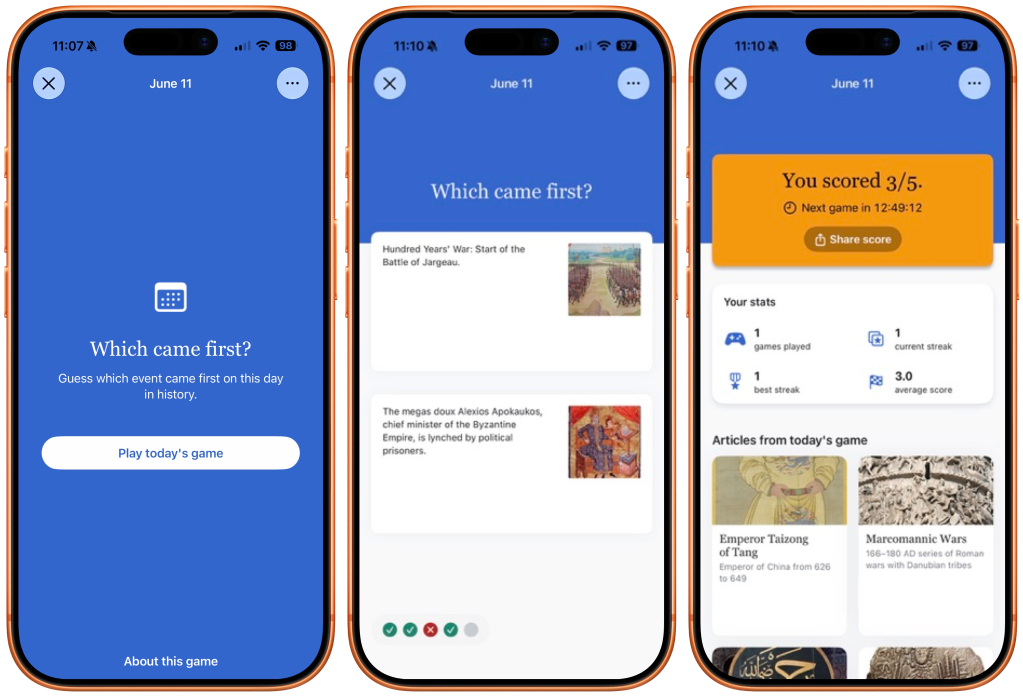
- Five Daily Questions: Each day, users are greeted with a fresh set of five chronological puzzles.
- The "On This Day" Connection: Every event featured in the daily challenge corresponds directly to something that happened on that exact calendar day across different centuries or years. For instance, a user might be asked to determine whether a specific technological patent in 1895 preceded or followed a political treaty signed in 1840 on the exact same month and day.
- Temporal Deduction: Players must rely on their historical knowledge, critical thinking, and context clues to arrange events in the correct chronological order.
Tracking Progress and Retention
To foster long-term engagement, the game incorporates robust personal metrics:
- Gameplay Streaks: Similar to language-learning apps or daily word games, players are encouraged to maintain consecutive days of playing, building a visual streak counter.
- Average Scores: Users can monitor their long-term accuracy, tracking how well they perform over weeks and months of historical inquiry.
- Comprehensive Archive: Recognizing that users occasionally miss a day, Wikipedia has included an archive feature. This allows history buffs to dive backward in time to play previous rounds, ensuring that content remains accessible rather than permanently locked away.
Impact on Mobile Engagement
Industry analysts note that embedding games into non-gaming utility apps is a highly effective strategy for boosting daily active users (DAUs). By transforming raw data into a challenge, Wikipedia lowers the cognitive barrier to learning. Users who might not otherwise open an encyclopedia app for leisure reading are enticed by the competitive nature of a five-question daily quiz.
Official Statements & Industry Perspective
While the Wikimedia Foundation has traditionally focused its public communications on fundraising, open-access advocacy, and software infrastructure, the quiet and strategic rollout of "Which came first?" speaks volumes about its modern product strategy.
Product teams within the organization have long recognized that mobile applications require features that encourage regular, repetitive interaction. In app-store release notes and developer updates, the focus has consistently been framed around discovery and delight.

Industry observers have drawn parallels between Wikipedia’s new feature and the broader trend of "edutainment" in mobile apps. Tech commentators note that platforms housing massive repositories of text must evolve to compete with short-form video and hyper-addictive social media algorithms. By offering a clean, ad-free, intellectually rewarding puzzle format, Wikipedia provides a healthy alternative that aligns with its core mission of spreading knowledge freely.
Furthermore, educators and digital literacy advocates have praised the feature for making history accessible and fun. By anchoring the trivia to "this day in history," the game implicitly teaches users that history is not merely a static collection of dates in a textbook, but a living timeline of human events that happened on every single day of the calendar year.
Future Outlook: What’s Next for Wikipedia’s Mobile Experience?
The successful deployment of "Which came first?" on both Android and iOS begs the question: what future features can mobile users expect from the Wikipedia application ecosystem?
Potential Roadmap Enhancements
- Expanded Game Modes: As user engagement metrics roll in, the Wikimedia Foundation may consider introducing specialized categories (e.g., Science & Technology, Art & Literature, Ancient History) alongside the daily general history mix.
- Social Sharing Integration: While tracking personal streaks is satisfying, the addition of friction-free score-sharing capabilities—allowing users to compare their historical intuition with friends on social media—could dramatically amplify organic app downloads.
- Localization and Global Rollouts: Wikipedia serves a global audience in hundreds of languages. Adapting "Which came first?" to feature localized historical events tailored to specific regions, languages, and cultures represents a massive opportunity for international growth.
- Deepening Article Integration: A powerful synergy for future updates would be the inclusion of direct deep links from the game’s trivia answers straight to the comprehensive Wikipedia articles covering those events, turning a casual guess into an immersive deep-dive into world history.
Conclusion
Wikipedia’s introduction of "Which came first?" to iOS is more than just a fun addition to a popular app; it represents a thoughtful evolution in how digital encyclopedias can remain relevant, engaging, and indispensable in the modern attention economy. By turning historical chronology into a daily interactive puzzle, Wikipedia continues to prove that learning about our collective past can be as entertaining as it is educational.

iPhone users can experience the challenge today by updating their Wikipedia app and heading straight to the Explore feed to test their historical instincts.





Belum ada komentar. Jadilah yang pertama berkomentar!