

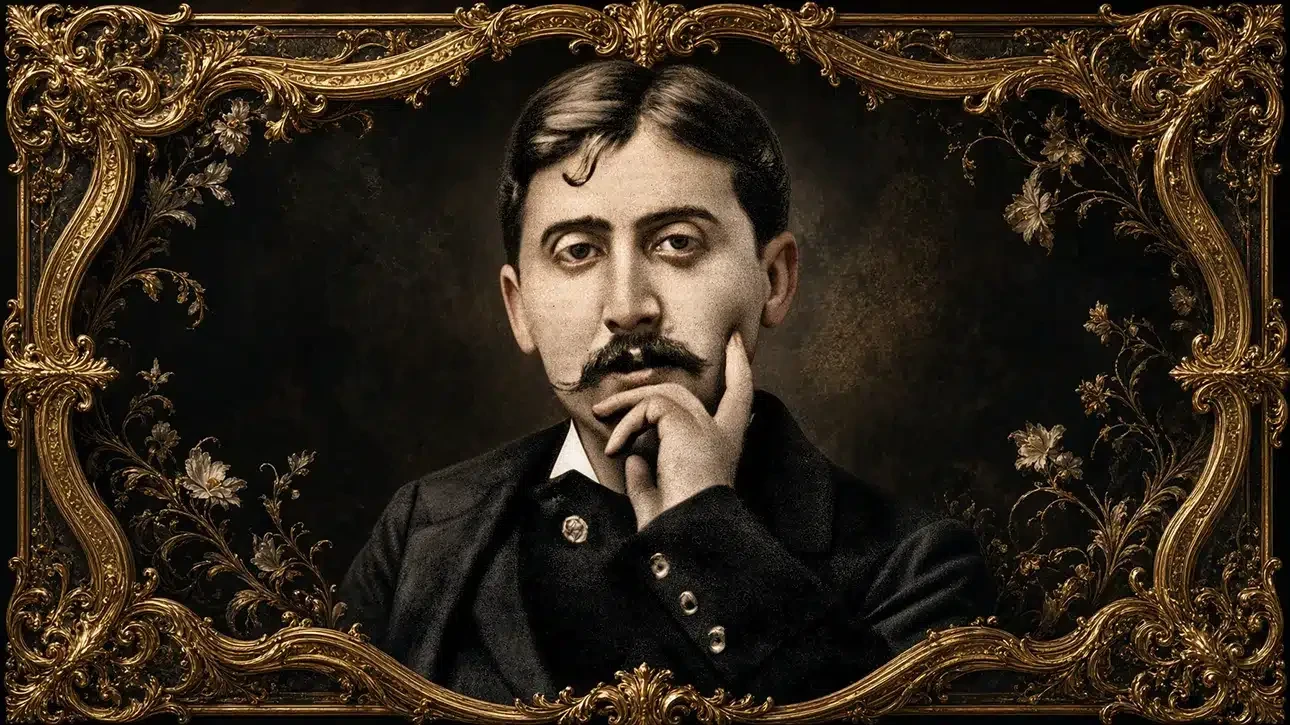
Executive Overview
One hundred years after the completion of its final volumes, Marcel Proust’s monumental In Search of Lost Time (À la recherche du temps perdu) remains the ultimate litmus test of literary endurance. Comprising seven volumes and an estimated 1.25 million words, it is frequently cited as the longest canonical novel ever written. Yet its reputation as a formidable, unyielding literary fortress—a hard nut to crack—stems less from its sheer physical magnitude than from its stylistic demands. Proust’s prose proceeds through labyrinthine, deeply embroidered sentences that loop across pages, requiring readers to abandon linear narrative expectations in favor of a meditative, contemplative cadence.
For generations, cultural memory has reduced this vast opus to a single, sensory cliché: the madeleine dipped in lime-flower tea. This iconic episode from Swann’s Way has been canonized as the definitive encapsulation of involuntary memory. However, a rigorous structural examination of the text reveals that this famous incident is a fleeting prelude, rarely revisited across the remaining six volumes until a brief echo in the closing pages of Time Regained.
Instead of resting on sensory nostalgia, the true engine of Proust’s masterpiece is a biting, deeply sociological investigation into the mechanics of social status, class displacement, and the ruthless machinery of snobbery. Far from being a peripheral personality flaw, snobbery operates in Proust’s Paris as the primary organizing principle of an entire society. By tracing how wealth transforms into marriage, and marriage into an unassailable noble title, Proust constructs an exhaustive socio-cultural map of the French upper bourgeoisie and aristocracy during a period of profound historical transition. This investigation explores how the author dismantled traditional narrative structures, integrated the philosophy of Henri Bergson, and left behind a blueprint that continues to inform sociology, psychology, and neuroscience.
Detailed Chronology: From the Combray Staircase to the Guermantes Salons
To understand the architecture of In Search of Lost Time, one must trace the gradual, generational shifts that animate its fictional universe across a span of forty years.
The Foundation of Caste (Volume I: Swann’s Way, 1913)
The epic opens in the quiet provincial town of Combray, establishing a rigid, almost feudal class structure. Here, the young narrator experiences his foundational trauma: the nightly ritual of waiting for his mother’s kiss. This emotional landscape is undercut by the shadow of social exclusion. A family guest—a stockbroker’s son—is welcomed into high-society circles in Paris, such as the Jockey Club and the company of the Prince of Wales, yet remains permanently locked outside the respectable bourgeois caste of Combray.
This volume also introduces figures like the engineer Legrandin, whose professed hatred of aristocratic fawning masks a desperate, internalized snobbery. Through these early interactions, Proust establishes that social climbing is not merely an external ambition, but an all-consuming psychological state that distorts human relationships.
The Ascent of the Interlopers (Volumes II–IV: In the Shadow of Young Girls in Flower, The Guermantes Way, Sodom and Gomorrah)
As the narrative shifts to Paris and the seaside resort of Balbec, the traditional aristocracy loses its political authority and material wealth, yet the currency of its titles paradoxically inflates. Concurrently, characters from the periphery orchestrate calculated ascents.
- Odette de Crécy, a former courtesan in the mold of Balzac’s and Maupassant’s ambitious climbers, navigates a strategic trajectory: she secures marriage to Charles Swann, transitions to a count after Swann’s death, and ultimately secures a Guermantes marriage for her daughter, permanently embedding her lineage into the heart of the Faubourg Saint-Germain.
- Bloch, maneuvering through the cultural fractures of the Dreyfus Affair, sheds his identity to become Jacques du Rozier, successfully rewriting his social pedigree.
- Madame Verdurin, who spent decades aggressively purging her bourgeois salon of "bores," executes the ultimate social coup. Following two strategic marriages and a world war, she emerges in the novel’s final scenes as the towering Princesse de Guermantes, having thoroughly erased her past identity behind an elite mask.
The "Ball of Heads" and the Final Reckoning (Volume VII: Time Regained, 1927)
The culmination of the epic occurs years later at a reception hosted by the former Madame Verdurin, now the reigning princess. Having retreated from society for decades, the narrator stumbles upon a series of physical sensations in the courtyard and an antechamber—a tripping paving stone, the clink of a spoon, a starched napkin—that trigger an explosive cascade of involuntary memory.
Entering the reception rooms, the narrator experiences what French critics term the bal de têtes (ball of heads). The characters of his youth are unrecognizable; time has brutally reshaped their bodies. Women he once pursued are heavy and aged, dukes tremble, and witty duchesses have become hollow parodies of themselves. In this devastating sequence, faces function as biological clocks, exposing the irreversible toll of elapsed time and cementing the novel’s true thematic resolution.
Supporting Context & Metrics
The structural complexity of In Search of Lost Time is best understood through its quantitative scope and its intellectual lineage, drawing comparisons to parallel masterworks of European literature.
Literary and Quantitative Metrics
- Total Word Count: Approximately 1,250,000 words distributed across seven distinct volumes.
- Character Census: More than 2,000 distinct individuals—fictional composites and real historical figures—populate the narrative ecosystem.
- The Narrator’s Anonymity: The narrator’s first name, "Marcel," is uttered only twice across the entire epic, both instances occurring indirectly in the fifth volume (The Prisoner / The Captive). This deliberate withholding emphasizes that the individual ego is secondary to the social machinery being observed.
Comparative Literary Frameworks
Proust’s sociological canvas extends the traditions established by Honoré de Balzac and George Eliot, shifting their frameworks into the modern era:
- Balzac’s La Comédie Humaine: Balzac mapped the economic and material appetites of post-Revolutionary France from the street up. Proust inherits this ambition, carrying it one generation further by bringing the map inside the aristocratic salon to analyze the socio-cultural architecture of a dying class.
- Eliot’s Middlemarch (1871–72): Set around the Reform Act of 1832, Eliot explored how capital reshaped provincial marriage, debt, and political power. Fifty years later, Proust observed that while industrial wealth could no longer buy parliamentary votes in a universal suffrage France, it remained uniquely suited to purchasing an unassailable noble name.
Intertextual Density
Reading Proust demands an extraordinary breadth of extratextual knowledge. To fully decode the allusions embedded in his prose, a reader must possess fluency in:
- Semiotics & Linguistics: Anticipating the structuralist theories of Ferdinand de Saussure, Algirdas Greimas, Roland Barthes, and Umberto Eco.
- The Arts & Sciences: Extensive familiarity with musicology (including real and imaginary composers like Vinteuil), classical mythology, painting, and botany.
Official Statements and Critical Perspectives
The cultural legacy of Proust’s masterwork has been vigorously debated and analyzed by generations of literary theorists, semioticians, and novelists.
In a letter dated April 20, 1918, to novelist Jacques de Lacretelle, Marcel Proust addressed the nature of his characters, asserting that they possessed no direct single counterparts in real life, but rather served as composite representations of eight or ten different individuals fused into a singular artistic entity.
Examining the intersection of biography and text, semiotician Roland Barthes, during his final seminar series at the Collège de France in the winter of 1980 (The Preparation of the Novel), analyzed the historical photographs captured by Paul Nadar. Barthes cross-referenced the real-life models of Proust’s characters—such as the Comtesse Greffulhe (the model for the Duchesse de Guermantes) and Charles Haas (the model for Swann)—not merely as literary curiosities, but as evidence of "the bill that time leaves on the body." Barthes noted:
"They too lived once, and now they are all dead."
Adding to the psychological dimensions of the text, behavioral psychologists Philip Brickman and Donald T. Campbell formalized the concept of the "hedonic treadmill" in 1971, describing a psychological phenomenon that mirrors Proust’s depiction of high society: every arrival at a desired social tier instantly establishes a new baseline, rendering permanent satisfaction impossible and driving endless, compulsive status-seeking.
In contemporary literary scholarship, critic Mehmet Rifat, in his comprehensive study Otantik Snoplar (Authentic Snobs, 2014), isolates the mechanism of social pretense within Proust’s characters. Rifat argues that the Proustian snob does not merely act out a role; rather, they authentically internalize the fluctuating tastes, speech patterns, and aesthetic judgments of the dominant class, trapped in an endless loop of imitation without fully comprehending the structural roots of their own desires.
Future Outlook
As In Search of Lost Time enters its second century of critical reception, its influence has expanded far beyond the traditional boundaries of literary criticism. The work continues to serve as an interdisciplinary touchstone across the modern academy:
- Neuroscience utilizes Proustian involuntary memory as a foundational model for studying how sensory triggers reactivate dormant neural pathways.
- Philosophy continues to interrogate Proust’s handling of subjective time, drawing a direct line from Henri Bergson’s durée to modern existential investigations of human consciousness.
- Sociology frequently cites the novel’s nuanced dissection of the salon as an early, highly sophisticated mapping of cultural capital and social stratification—foreshadowing the later theoretical work of Pierre Bourdieu.
Ultimately, the enduring vitality of Proust’s epic lies in its refusal to offer easy consolations. The madeleine may capture the popular imagination as a symbol of lost innocence, but the true legacy of In Search of Lost Time is its unsparing, panoramic x-ray of human vanity. By turning faces into clocks and charting the ruthless economics of the social register, Proust did not merely record a passing era; he constructed an enduring monument to the inescapable tragedy and comedy of human aspiration.




Belum ada komentar. Jadilah yang pertama berkomentar!