

Executive Overview
On the evening of August 21, 2026, a strange and thrilling inversion of rock-and-roll hierarchy played out under the open sky of Detroit’s Comerica Park. My Chemical Romance, one of the defining alternative rock acts of the 21st century, was halfway through a massive stadium tour celebrating the 20th anniversary of their monumental 2006 concept album, The Black Parade. To a casual observer, the billing was straightforward: a legendary modern arena-rock band employing a revered veteran as an opening act.
Yet, the reality on the ground was far more combustible. The special guest warming up the massive, cross-generational crowd was none of other than James Osterberg Jr.—better known to history as Iggy Pop.
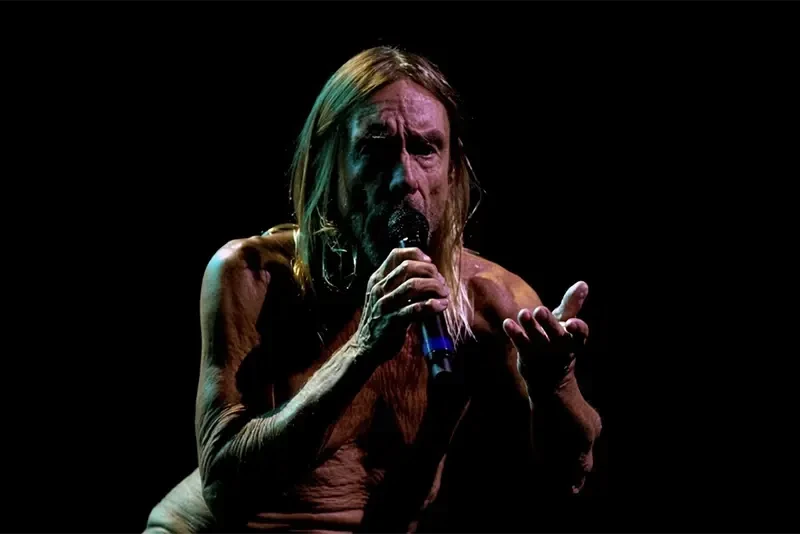
At 79 years old, the Detroit-born godfather of punk rock was not positioned on the bill as a polite historical footnote or a nostalgic museum piece. Instead, stepping onto the stage ahead of Gerard Way and his meticulously costumed cohorts, Iggy Pop delivered a 46-minute masterclass in pure, unadulterated visceral threat. While My Chemical Romance’s The Black Parade is a celebrated, grandly theatrical exercise in revisiting the emotional turmoil of the past, Iggy Pop stood as living, breathing proof of punk’s primordial genesis.
This essay examines the seismic convergence at Comerica Park—tracing the lineage of alienation from the industrial decay of late-1960s Michigan to the stadium-sized alternative melodrama of the 2000s, and exploring what happens when a living legend refuses to let his legacy turn to dust.
Detailed Chronology: The Night Comerica Park Belonged to the Stooges
The evening’s trajectory was established the moment the stadium lights dimmed and the first chords of "T.V. Eye" tore through the humid Detroit air. There was no polite preamble, no elaborate introduction, and certainly no attempt to coddle the tens of thousands of fans who had gathered to sing along to "Welcome to the Black Parade." Iggy Pop strolled onto the stage with the predatory grace of an apex predator who had spent six decades treating polite rock-star conventions with absolute contempt.
The Sonic Architecture of the Set
Rather than curating a career-spanning retrospective that touched upon his more polished or pop-oriented solo eras (such as his collaborations with David Bowie in Berlin), Pop and his backing band locked into a brutal, highly concentrated showcase of primal energy. The opening salvo was unapologetically heavy:
- "T.V. Eye"
- "Raw Power"
- "I Got a Right"
- "Gimme Danger"
This was not a setlist designed for casual radio listeners. It was a physical and sonic architecture built on repetition, volume, and menace. Seamlessly transitioning from his iconic 1970s Stooges material into defining solo anthems like "The Passenger" and "Lust for Life," Pop kept the pressure unrelenting before driving the stadium into a frenzy with "I Wanna Be Your Dog" and "Search and Destroy." The final stretch—anchored by the relentless rhythms of "1970" and "1969"—acted as an existential anchor, tying the modern audience directly to the turbulent sociopolitical climate of the late 1960s.
Crossing the Barrier
The defining moment of the set occurred during "I Wanna Be Your Dog." Eschewing the safety of the stage, Pop did what he has done since the sweat-drenched, beer-soaked days of the Chess Mate and the Grande Ballroom: he descended into the crowd.
For a modern stadium audience largely accustomed to barrier-separated spectacle, the gesture was jarring. "I Wanna Be Your Dog" does not function like a conventional pop song; its power relies on a singular, monotonous piano-and-guitar riff that refuses to politely develop. It insists, iterates, and dares the listener to resist its claustrophobic weight. By diving directly toward the barricades, Pop collapsed the vast architectural expanse of Comerica Park into the intimate, dangerous confines of a basement club. For those brief moments, the size of the venue ceased to matter.
Supporting Context & Metrics: The Lineage of Alienation
To fully grasp the historical weight of the Detroit pairing, one must examine the bloodline connecting the Stooges to My Chemical Romance.
| Era | Artist | Key Contribution to Rock Lexicon | Method of Expressing Alienation |
|---|---|---|---|
| Late 1960s / Early 1970s | The Stooges (Iggy Pop) | Proto-punk, hardcore, and alternative foundations | Distortion, physical confrontation, abrasive repetition |
| Mid 2000s | My Chemical Romance | Emo revival, grand alternative rock opera | Theatricality, marching bands, narrative world-building |
When the Stooges emerged from Ann Arbor and Detroit in the late 1960s, their records were commercial failures. They were abrasive, confrontational, and widely rejected by mainstream radio. Yet, the physical vocabulary Pop pioneered—tearing down the boundary between performer and spectator, turning self-destruction into performance art, and giving voice to the disaffected youth—became foundational.
Every subsequent wave of heavy guitar music inherited those gestures:
- Punk Rock inherited the raw speed and anti-establishment posture.
- Hardcore inherited the physical violence and crowd interaction.
- Alternative Rock inherited the emotional vulnerability masked by noise.
- My Chemical Romance, despite utilizing a vastly different musical language—complete with theatrical staging, marching uniforms, and gothic comic-book mythologies—inherited the core impulse.
Where the Stooges tried to tear rock music apart from the inside out using feedback and nihilism, My Chemical Romance transformed that same sense of out-group isolation into a grand, inclusive stadium spectacle. Both entities built safe havens for people who felt fundamentally displaced from the polite society surrounding them.
Official Statements & Critical Reception
Local and national media outlets quickly zeroed in on the profound generational interplay at play. Reviewing the event for The Detroit News, critics noted the stark contrast between the two acts while praising the seamless emotional bridge established by the performance.
"Iggy Pop did not walk onto the stage as a relic of a bygone era; he walked on as a living threat," reported The Detroit News on August 21, 2026. "By tearing through ‘Raw Power’ and ‘Search and Destroy’ with the same physical urgency he possessed fifty years ago, he reminded a stadium full of Black Parade devotees exactly where their favorite band learned how to bleed in public."
Cultural historians and musicologists pointed out that Detroit itself played an active role in the performance. Pop was born in Muskegon and raised in Ann Arbor, his artistic DNA inextricably tied to southeastern Michigan’s industrial Rust Belt mythology. When he growled the opening lines of "1969" and "1970" in the heart of Detroit in 2026, those numbers were not abstract historical dates. They carried the heavy residue of the Vietnam era, civil unrest, racial strife, and economic upheaval—contradictions that the city’s music has always transformed into vital, kinetic art.
Cultural analyst Dr. Elena Vance noted in a post-concert symposium piece:
"The phrase ‘Iggy Pop opening for My Chemical Romance’ sounds like an absurdity on paper. But it speaks volumes about the evolution of alternative culture. My Chemical Romance built a cathedral out of dark romanticism, but Iggy poured the concrete foundation fifty years earlier."
Future Outlook: What the Pairing Means for the Legacy of Rock
As the music industry continues to grapple with the aging of its founding generation, the August 2026 concert offers a vital blueprint for how legacy acts can engage with contemporary audiences.
Too often, legacy tours devolve into hollow exercises in pure nostalgia—sanitized, predictable, and designed purely for comfort. Iggy Pop’s explosive performance in Detroit proves that true rock-and-roll history does not need to be placed behind glass to be preserved. By maintaining his ferocious physical commitment and refusing to pander to safe, middle-aged complacency, Pop demonstrated that foundational art remains perpetually unfinished.
When Pop left the stage and the lights shifted to reveal the elaborate, stark-white-and-black scaffolding of The Black Parade, the true brilliance of the evening crystallized. The concert was not merely a retrospective look backward into two distinct musical eras; it was a living demonstration of cultural inheritance.
For the thousands of fans who packed Comerica Park—many of whom discovered My Chemical Romance during its 2006 peak or found it years later through digital archives—the bridge between the two bands was absolute. The noise of one generation had successfully become the emotional language of another. And for 46 glorious, deafening minutes in Detroit, the past did not look old. It looked dangerous.





Belum ada komentar. Jadilah yang pertama berkomentar!