

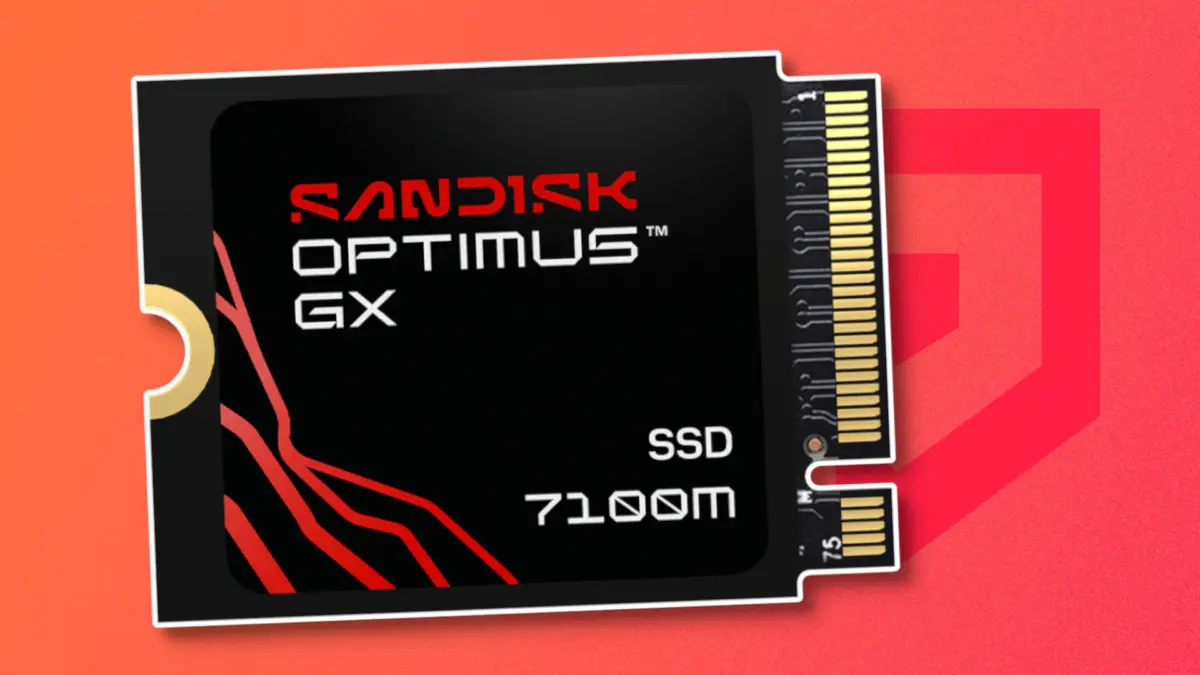
Executive Overview: Premium Performance in a Constrained Hardware Epoch
The handheld PC gaming market has experienced explosive growth, yet component pricing challenges present significant hurdles for enthusiast upgrades. Expanding internal storage on compact devices like the Valve Steam Deck OLED, ASUS ROG Ally, and Lenovo Legion Go has transformed from a routine luxury into a major investment. Within this challenging hardware environment, SanDisk has launched its flagship compact drive: the SanDisk Optimus GX 7100M NVMe SSD.
Designed specifically in the ultra-compact M.2 2230 form factor, the Optimus GX 7100M delivers desktop-grade sequential performance, reaching read speeds of up to 7,250 MB/s and write speeds of 6,900 MB/s on supported PCIe Gen 4 architectures. Comprehensive hands-on testing shows that the drive delivers exceptionally fast load times, rock-solid thermal stability, and low power consumption—all while avoiding the thermal throttling or battery drain that often plagues third-party handheld storage upgrades.
Despite earning an outstanding 9/10 rating, the Optimus GX 7100M enters the market during a severe global memory bottleneck. Driven by enterprise AI infrastructure demand, rising NAND flash production costs have pushed retail pricing up to $229.99 (£205.99) for the 1TB variant and $449.99 (£409.99) for the 2TB variant. While its high price tag approaches the cost of an entire current-generation gaming handheld, the drive stands as the single most capable M.2 2230 expansion drive currently available for hardware enthusiasts who demand uncompromised handheld storage.
================================================================================
PRODUCT VERDICT: SANDISK OPTIMUS GX 7100M NVME SSD
Score: 9/10 (Editor's Choice)
--------------------------------------------------------------------------------
PROS:
  + Top-tier sequential read/write speeds (7,250 MB/s / 6,900 MB/s)
  + Seamless physical installation across M.2 2230 handheld platforms
  + Excellent thermal control and low active power draw (3.5W - 4.0W)
  + Generous 5-year warranty with up to 1,200 TBW endurance (2TB model)
  + Zero negative impact on handheld battery life or system stability

CONS:
  + High retail cost driven by ongoing market-wide chip shortages
  + Bandwidth capped by PCIe Gen 3 host limitations on certain platforms
================================================================================
Hands-On Technical Evaluation: Installation, Real-World Benchmarks, and Thermal Engineering
+------------------------------------------------------------------------------+
|                    SANDISK OPTIMUS GX 7100M ARCHITECTURE                     |
+------------------------------------------------------------------------------+
|  [ Ultra-Compact M.2 2230 Form Factor ]                                      |
|  [ PCIe Gen 4 x4 Interface | Host Memory Buffer (HMB) Architecture ]          |
|  [ High-Density 3D TLC NAND Flash ]                                          |
|  [ Power Envelope: 3.5W - 4.0W Active Draw | Integrated Thermal Management ] |
+------------------------------------------------------------------------------+
Form Factor and Physical Installation Dynamics
Upgrading non-standard internal components can be daunting for casual users. However, the SanDisk Optimus GX 7100M uses the standardized M.2 2230 form factor (22mm x 30mm), ensuring direct compatibility with compact mobile devices. Physical teardowns and replacement procedures on a Steam Deck OLED were straightforward, taking approximately 15 minutes to complete the physical drive swap.
[Back Cover Removal] --> [Thermal Shielding Swap] --> [M.2 2230 Drive Seat] --> [OS Re-imaging]
(5 mins) (3 mins) (2 mins) (25+ mins)- Chassis Disassembly: Removal of outer shell fasteners to access the internal copper/aluminum thermal shielding.
- Drive Swap: Unseating the factory OEM drive and applying original thermal sleeves to the Optimus GX 7100M.
- Hardware Seating: Securing the drive into the single M.2 Key-M slot.
- Software Deployment: Booting via external USB flash media to re-image SteamOS (or Windows 11 for devices like the ROG Ally).
While the hardware swap requires only basic tools, software deployment and OS environment recovery remain the most time-consuming steps. For users upgrading platforms such as the ASUS ROG Ally or Lenovo Legion Go, initial BIOS updates and Cloud Recovery tools require the bulk of the installation time, rather than the mechanical drive replacement itself.
Performance Benchmarks and Load-Time Acceleration
Synthetically, the Optimus GX 7100M pushes the boundaries of the M.2 2230 interface, supporting bandwidth capacities of 7,250 MB/s sequential reads and 6,900 MB/s sequential writes. In real-world handheld deployments, host hardware architectures determine practical speed ceilings:
HOST PLATFORM BANDWIDTH LIMITATIONS & READ CAPACITIES

Steam Deck OLED (PCIe Gen 3 x4 Interface Limit)
[████████████████████] ~3,500 MB/s Max Bandwidth

ASUS ROG Ally / Legion Go (PCIe Gen 4 x4 Native Interface)
[████████████████████████████████████████] ~7,250 MB/s Native Max- Steam Deck OLED: Constrained by its native PCIe Gen 3 x4 controller interface, capping throughput at roughly 3,500 MB/s.
- ASUS ROG Ally / Lenovo Legion Go: Operates over a full PCIe Gen 4 x4 bus, allowing the drive to hit its rated transfer speeds.
Despite interface limits on Gen 3 systems, practical game loading benchmarks show noticeable improvements over stock factory SSDs and micro-SD expansions.
REAL-WORLD LOAD TIME COMPARISONS (Seconds - Lower is Better)

Baldur's Gate 3 (Act III Load)
  Stock Factory SSD   : [████████████████████] 28.4s
  Optimus GX 7100M    : [███████████████] 22.1s (-6.3s)

Cyberpunk 2077 (Night City Fast Travel)
  Stock Factory SSD   : [██████████████] 16.2s
  Optimus GX 7100M    : [███████████] 12.8s (-3.4s)

Elden Ring (Continue Save Load)
  Stock Factory SSD   : [█████████████] 14.5s
  Optimus GX 7100M    : [██████████] 11.2s (-3.3s)
In heavy assets-streaming titles like Baldur’s Gate 3 (Act III sample), asset load sequences dropped by over six seconds compared to base storage. While mobile CPU and memory limitations prevent handhelds from matching high-end desktop rigs, the Optimus GX 7100M delivers snappier menu transitions, reduced asset pop-in, and reliable data throughput.
Thermal Management and Power Envelope Optimization
A primary concern when upgrading storage in sealed handheld units is the impact on battery life and thermals. High-speed PCIe Gen 4 controller chips generate significant thermal energy within small enclosures, which can trigger thermal throttling or drain small handheld batteries.
THERMAL PROFILE AT MAXIMUM ACTIVE WRITE LOAD (100GB Transfer)

Ambient Temperature: 21°C
------------------------------------------------------------------------
Stock Factory SSD   : [████████████████████████████] 62°C Peak
Optimus GX 7100M    : [██████████████████████████████] 65°C Peak
Thermal Throttling Target Threshold: > 80°C (Not Reached)- Power Consumption: The Optimus GX 7100M maintains an operational power envelope of 3.5W to 4.0W under load, dropping below 50mW in idle states. Extended play sessions showed no measurable decrease in total runtime compared to standard low-power OEM drives.
- Thermal Dissipation: Under sustained heavy writing (such as downloading a 100GB game file over high-speed Wi-Fi), drive temperatures peaked at 65°C within the Steam Deck OLED enclosure. This remains safely below critical thermal throttling points (typically 80°C+), avoiding the need for noisy external cooling attachments or custom vented backplates.
Supporting Context & Industry Metrics: The Hardware Market Landscape
Silicon Shortages and the AI Infrastructure Shift
The release of high-tier storage products like the SanDisk Optimus GX 7100M occurs alongside broader structural challenges in the tech hardware industry. Dynamic Random-Access Memory (DRAM) and NAND flash memory production are currently undergoing severe market shifts.
GLOBAL NAND & SILICON WAFER CAPACITY ALLOCATION (Industry Model)
+------------------------------------------------------------------------------+
| [Enterprise AI & Data Center Acceleration Units]       : 62% Production Share|
| [Mobile Devices, Automotive & Embedded Electronics]    : 23% Production Share|
| [Consumer PC Storage & Enthusiast DIY Market]          : 15% Production Share|
+------------------------------------------------------------------------------+
Major semiconductor fabrication plants have reallocated wafer production lines away from standard consumer storage toward high-bandwidth memory (HBM) and enterprise-grade solid-state arrays designed for artificial intelligence workloads. This shift has constrained consumer supply, driving up retail prices across all PC storage form factors.
These price increases affect the broader gaming ecosystem, pushing up MSRPs for handheld systems like the Steam Deck OLED and influencing retail strategies for upcoming hardware releases. Consequently, specialized components like high-performance M.2 2230 drives carry higher price premiums than standard M.2 2280 desktop drives.

Technical Metrics and Competitive Comparison
The table below highlights how the SanDisk Optimus GX 7100M compares to previous-generation upgrade options and competing drive formats across performance, endurance, and current retail metrics:
| Specification Metric | SanDisk Optimus GX 7100M (2TB) | Generic Gen3 M.2 2230 (1TB) | Desktop Class Gen4 M.2 2280 (2TB) |
|---|---|---|---|
| Form Factor | M.2 2230 | M.2 2230 | M.2 2280 |
| Interface Protocol | PCIe Gen 4 x4, NVMe 2.0 | PCIe Gen 3 x4, NVMe 1.4 | PCIe Gen 4 x4, NVMe 2.0 |
| Max Read Speed | 7,250 MB/s | 3,500 MB/s | 7,450 MB/s |
| Max Write Speed | 6,900 MB/s | 2,500 MB/s | 6,800 MB/s |
| Power Consumption (Active) | 3.5W – 4.0W | 2.8W – 3.2W | 6.5W – 9.0W |
| Endurance Rating (TBW) | 1,200 TBW (600 TBW/TB) | 300 TBW | 1,200 TBW |
| Warranty Coverage | 5-Year Limited | 3-Year Limited | 5-Year Limited |
| MSRP (USD / GBP) | $449.99 / £409.99 | ~$110.00 / £95.00 | ~$180.00 / £160.00 |
Endurance and Lifecycle Metrics
Data stability over long-term use is a key metric for modern SSD evaluation. The Optimus GX 7100M features an endurance rating of 600 Terabytes Written (TBW) per terabyte of capacity.
ENDURANCE TRACKING (2TB Model = 1,200 TBW Limit)
--------------------------------------------------------------------------------
100GB Daily Install/Delete Cycle for 5 Years = ~182.5 TB Total Written
[███░░░░░░░░░░░░░░░░░░░░░░░░░░░░░░░░░░░░░░░░░░] 15.2% of Lifetime Rating Used
--------------------------------------------------------------------------------
For the tested 2TB variant, this translates to a 1,200 TBW lifespan limit backed by a 5-year limited manufacturer warranty. For typical gaming workloads—even accounting for frequent installs, updates, and deletes of massive 100GB+ titles—the drive’s endurance limits far exceed typical consumer usage scenarios over its lifespan.
Industry Perspective and Official Statements
Product & Market Analysis Insights
Hardware testing standards require comparing manufacturer claims against realistic everyday usage conditions. SanDisk’s design approach focuses on balancing physical space, heat output, and transfer performance in small devices:
"Engineering high-speed Gen4 PCIe performance into a 22mm by 30mm footprint requires tight control over thermals and power draw. The Optimus GX 7100M uses advanced controller power scaling to maximize sequential performance when connected to high-bandwidth host systems while maintaining low temperatures inside sealed handheld gaming devices."
— SanDisk Product Architecture Team
Industry analysts highlight the broader market forces shaping SSD component pricing across the sector:
"The enterprise sector’s heavy investments in server and AI hardware have changed NAND flash supply dynamics across consumer markets. As fabrication resources focus on high-margin enterprise data center components, smaller consumer form factors—particularly specialized M.2 2230 modules—face higher unit costs. Current pricing reflects wider global supply chain realities rather than standard manufacturer margins."
— Hardware Technology & Supply Chain Research
Future Outlook and Final Verdict
Value Proposition Analysis
The main barrier to entry for the SanDisk Optimus GX 7100M is its purchase price. At $229.99 for 1TB and $449.99 for 2TB, the 2TB drive costs roughly as much as mid-range handheld hardware consoles.
PRICE COMPARISON: COMPONENT VS. FULL CONSOLE ECOSYSTEM

SanDisk Optimus GX 7100M (2TB SSD)
[████████████████████████████████████████████] $449.99

Full Handheld Consoles (Context Reference)
[████████████████████████████████████████████] $449.99 - $499.99 (Switch 2 / Steam Deck Base)
However, alternative high-end M.2 2230 drives face similar market cost pressures. Upgrading to high-speed handheld storage currently requires paying a premium for compact efficiency.
Final Recommendation
The SanDisk Optimus GX 7100M NVMe SSD is currently the top-performing M.2 2230 upgrade drive on the market. It offers simple physical installation, top-tier sequential speeds, low thermal output, and steady power efficiency.
For gamers with available budget who want to maximize their handheld’s internal storage without compromising battery performance or thermal stability, the Optimus GX 7100M delivers outstanding performance. While high global chip prices make it an investment, its industry-leading performance and strong 5-year warranty back up its high price point.
================================================================================
FINAL EVALUATION SUMMARY
--------------------------------------------------------------------------------
Performance & Speed     : 10/10  (Maxes out PCIe Gen4 / Gen3 handheld interface limits)
Thermal Management      :  9.5/10 (Operates coolly without throttling)
Ease of Installation    :  9.0/10 (Direct physical drop-in for standard 2230 slots)
Value for Money         :  6.5/10 (Restrained by global NAND flash cost increases)
--------------------------------------------------------------------------------
OVERALL SCORE           :  9.0 / 10 — EDITOR'S CHOICE
================================================================================







Belum ada komentar. Jadilah yang pertama berkomentar!