

Executive Overview
As Apple continues to weave its software ecosystem into a more cohesive, cross-platform experience, the gaming sector has increasingly become a focal point of strategic importance. Following the rollout of iOS 26—which notably introduced two entirely new system-level applications to the iPhone home screen, including the dedicated Apple Games app—the tech giant has wasted little time iterating on its vision. Apple Games was originally conceived as a centralized, frictionless hub designed to unify a user’s gaming activity, library management, and social interactions across the entire hardware ecosystem, spanning the iPhone, iPad, and Mac.
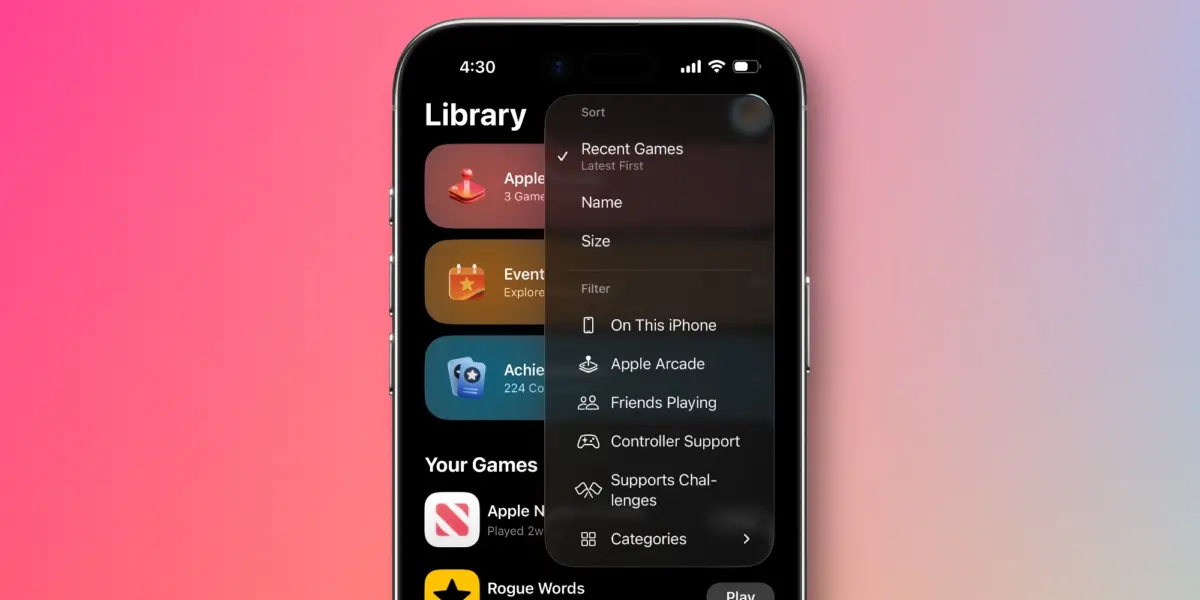
Now, with the arrival of the developer beta cycle for iOS 26.2, Apple is signaling its ongoing commitment to this nascent platform. Scheduled for an official public release next month, iOS 26.2 has just reached a major development milestone with the deployment of Developer Beta 2. While this mid-cycle update does not introduce sweeping, paradigm-shifting features, it delivers a targeted array of quality-of-life enhancements specifically tailored to the Apple Games app. Highlighted by a newly minted splash screen introduced in Beta 2—following initial groundwork laid in Beta 1—these refinements address direct user feedback regarding library navigation, filtering efficiency, and interface responsiveness.
This report provides a comprehensive analysis of the latest updates coming to Apple Games in iOS 26.2. We examine the trajectory of Apple’s gaming initiatives, break down the specific mechanical and interface improvements rolling out in the current developer beta, contextualize these changes within the broader scope of the Apple ecosystem, and evaluate what the future holds for developers and gamers alike as Apple steadily builds out its gaming infrastructure.
Detailed Chronology: The Evolution of Apple Games
To understand the significance of the iOS 26.2 adjustments, it is vital to trace the recent timeline of Apple’s software deployment strategy and how the Games app transitioned from a concept to a core pillar of the iOS interface.
The Genesis: iOS 26 and the Birth of a Dedicated Hub
For years, mobile gaming on iOS operated in a fragmented manner. While Apple Arcade successfully carved out a subscription-based curated gaming experience, and Game Center quietly handled achievements, multiplayer invitations, and profile management in the background, there was no singular, native application dedicated to organizing a user’s entire gaming library. Titles downloaded from the App Store sat alongside non-gaming utilities on the home screen or were buried inside deep settings menus.
This changed fundamentally with the launch of iOS 26. Alongside another major system-level application, Apple introduced the standalone Apple Games app. Positioned front and center on the user’s home screen, the application was built to serve as a unified command center. It brought together:
- Standard App Store titles.
- Apple Arcade subscriptions.
- Cross-platform synchronization data bridging iPhones, iPads, and macOS devices.
- Social connectivity, allowing users to track friends’ gaming activity, compare high scores, and instantly jump into multiplayer matches.
However, as with any major software architecture rollout, the initial version of Apple Games served primarily as a foundational framework. While functional, early adopters quickly identified friction points in how the application managed large libraries, filtered content, and surfaced relevant updates.
The Path to iOS 26.2: Beta 1 and Beta 2
Apple’s software engineering teams have historically relied on rapid developer beta cycles to polish system applications ahead of point releases. The development arc for iOS 26.2 exemplifies this agile methodology:
- Early November 2025: Apple establishes the release window for iOS 26.2, confirming that the update will land for the general public next month, packed with routine security patches, bug fixes, and minor feature additions.
- Beta 1 Deployment: Apple quietly seeds the first developer beta of iOS 26.2. Deep within the code and early user interfaces, developers discover the first traces of refinement intended for the Games app. These include subtle UI tweaks designed to streamline how users browse and sort their installed and cloud-enabled titles.
- Beta 2 Deployment: Released today, Developer Beta 2 brings these under-the-hood adjustments to the forefront. Most notably, Beta 2 introduces a dedicated, prominent splash screen upon first launching the updated Games app. This splash screen explicitly highlights the new capabilities, ensuring that users and developers alike immediately notice the improvements rather than having to discover them organically.
Supporting Context & Metrics: The State of Apple Gaming
To fully grasp why Apple is investing engineering resources into refining the Games app, one must look at the macro-level shifts occurring within the company’s hardware and software monetization strategies.
Bridging Mobile and Desktop Hardware
Apple’s silicon strategy—transitioning from the A-series chips in iPhones and iPads to the powerhouse M-series processors in Macs—has dramatically closed the performance gap between mobile devices and traditional gaming consoles or PCs. Technologies such as MetalFX Upscaling, hardware-accelerated ray tracing, and advanced thermal management architectures have made AAA gaming a tangible reality on Apple devices.

Titles that were once exclusive to dedicated gaming rigs—such as Resident Evil, Death Stranding, and Assassin’s Creed—now run natively on iPhones and iPads. Consequently, the volume of high-end, storage-intensive games residing on user devices has skyrocketed. A user might have a mixture of casual puzzle games, fast-paced competitive multiplayer titles, and multi-gigabyte AAA console ports spanning multiple devices. Managing this heterogeneous library requires a robust, intuitive interface, which is precisely the void the Apple Games app was designed to fill.
Quality-of-Life Refinements: What’s New in iOS 26.2
While the changes arriving in iOS 26.2 are evolutionary rather than revolutionary, they directly target the friction points experienced by power users and casual players alike. Based on the release notes and the newly activated Beta 2 splash screen, the updates focus heavily on three core areas:
- Enhanced Filtering Mechanisms: Users with extensive game libraries can now utilize more granular filter options within the app. Whether sorting by genre, installation status, platform compatibility (iPhone vs. iPad vs. Mac), or Apple Arcade membership, the new filter architecture reduces the time spent searching for a specific title.
- Streamlined Library Organization: The layout for tracking recent play sessions, achievements, and cloud saves has been optimized for quicker loading times and cleaner visual hierarchy.
- Improved Onboarding and Discovery: The inclusion of the new splash screen in Beta 2 points to a concerted effort by Apple to educate users on the app’s full capabilities, driving engagement with features that may have been overlooked in the initial iOS 26 release.
These refinements are classic examples of Apple’s design philosophy: removing micro-friction to make routine interactions feel seamless. While none of these individual tweaks are likely to single-handedly convince a non-gamer to download the app, they radically improve the daily experience for existing users, signaling that Apple views the app as a long-term, evolving project rather than a static feature launch.
Official Statements and Industry Reception
While Apple typically lets its software betas speak for themselves without extensive press briefings ahead of a point release, industry analysts and developer communities have been vocal in their assessment of the company’s gaming strategy.
In developer forums and early-access feedback channels, the reception to the iOS 26.2 Games app updates has been cautiously optimistic. Developers note that providing a more cohesive, filterable native hub helps increase organic discovery for titles that might otherwise get lost in the sprawling, algorithm-driven feeds of the traditional App Store.

"Apple is finally treating gaming not as an afterthought or a collection of disparate silos, but as a unified ecosystem," notes one prominent iOS ecosystem analyst. "By refining tools like the Games app in incremental updates like iOS 26.2, they are laying the groundwork for a platform that can comfortably scale from casual pick-up-and-play mobile titles all the way to high-end, controller-driven AAA experiences."
Furthermore, the introduction of the splash screen in Beta 2 has been praised as a smart UX choice. Software updates frequently introduce subtle backend changes that go unnoticed by the average consumer; by actively highlighting these additions upon the first post-update launch, Apple ensures that users immediately understand how to leverage the new filtering and organizational tools.
Future Outlook: Where Is Apple Gaming Headed?
As we look past the imminent release of iOS 26.2 next month and gaze toward the horizon of future software cycles (such as the eventual transition to iOS 27 and beyond), several key questions remain regarding the trajectory of Apple’s gaming ecosystem.
1. Deeper Integration with Cloud and Streaming Services
As cloud gaming infrastructure continues to mature and regulatory scrutiny surrounding app store distribution evolves, the Apple Games app is uniquely positioned to act as a universal aggregator. Whether hosting native local installs, streaming titles via web technologies, or linking to third-party game launchers, a centralized hub gives Apple a strategic advantage in guiding user engagement.
2. Expanded Social and Competitive Features
While Game Center has long handled the backend of multiplayer matchmaking and achievements, the Apple Games app provides a modern canvas to build out richer social layers. Future updates could see deeper integration with messaging apps, live activity widgets for tracking friends’ in-game progress, and more robust spectator or broadcasting tools optimized for mobile and desktop hardware.

3. Developer Tools and API Expansion
For the ecosystem to truly thrive, third-party developers must feel fully supported by Apple’s native infrastructure. Enhancements to the Games app often coincide with deeper API updates that allow developers to surface rich presence data, custom promotional events, and direct-to-library installation prompts straight from Apple’s curated hubs. Continued iteration—such as the filtering and UI enhancements seen in iOS 26.2—demonstrates that Apple is listening to developer and user telemetry to make the platform as frictionless as possible.
Conclusion
The upcoming release of iOS 26.2 may be categorized as a routine point update, but the specific attention given to the Apple Games app in Developer Beta 2 underscores a broader institutional commitment. Apple is methodically polishing the rough edges of its newly minted gaming hub, transforming it from a basic directory into a responsive, highly functional ecosystem anchor. For users navigating an increasingly rich library of mobile, tablet, and desktop games, these quality-of-life improvements are a welcome step forward—and a promising sign of what is yet to come in the world of Apple gaming.
Have you been actively utilizing the Apple Games app on your iPhone, iPad, or Mac since its introduction in iOS 26? Do the refined filtering options and interface tweaks in the iOS 26.2 beta enhance your daily gaming routine? Let us know your thoughts and experiences in the comments below.









Belum ada komentar. Jadilah yang pertama berkomentar!