

Executive Overview
The mobile gaming industry has evolved from a casual pastime into a multi-billion-dollar competitive arena, demanding hardware that rivals traditional desktop gaming rigs. Within this hyper-competitive landscape, Lenovo has consistently positioned its Legion brand at the forefront of mobile engineering. Although an anticipated January 1, 2022, launch date for the heavily teased Lenovo Legion Y90 gaming smartphone passed quietly without a commercial release, the company maintained consumer and industry interest by dropping a series of revealing teaser videos on Weibo. These promotional releases provided a meticulous look into the device’s physical design, thermal architecture, and display capabilities.
Building upon the foundation laid by its predecessor, the Legion Duel 2, the Legion Y90 signals a refinement in Lenovo’s design philosophy. Rather than reinventing the wheel, the manufacturer has chosen to optimize ergonomics, thermal management, and visual immersion. This comprehensive report examines every facet of the Lenovo Legion Y90, analyzing its external aesthetics, internal cooling mechanics, display technology, and processing power. Furthermore, we explore how this device fits into the broader timeline of mobile gaming hardware development and what its eventual market arrival means for competitors in the high-performance smartphone sector.
Detailed Chronology
Understanding the trajectory of the Lenovo Legion Y90 requires tracing the release timeline and marketing rollout orchestrated by Lenovo’s mobile division. The chronology of the device’s public debut highlights a strategic shift in how technology manufacturers manage product expectations when original deadlines are missed.
The Missed Deadline and the Pivot to Teasers
Initially, industry insiders and leaks pointed toward a definitive launch window on or around January 1, 2022. For a device expected to capture the post-holiday tech cycle, missing this target date could have signaled internal delays or supply chain hiccups. However, rather than remaining silent, Lenovo executed a well-timed pivot. On official social media channels—most notably Weibo—the company released high-production-value teaser videos that bypassed a traditional launch event to deliver hardware specifications and visual previews directly to enthusiasts.
Visualizing the Hardware: The Weibo Reveal
The release of the teaser footage broke down the device’s anatomy across several distinct promotional angles:
- The Overall Design Preview: Showcasing the rear chassis, highlighting the continuation of the centralized bump and the signature Y-shaped RGB lighting.
- The Thermal Architecture Focus: Illustrating the integration of active cooling vents positioned strategically along the frame and rear panel.
- The Front Display Showcase: Demonstrating the uninterrupted 6.92-inch E4 AMOLED panel, confirming the absence of notches or punch-hole cutouts by relocating the selfie camera.
This serialized information drop successfully sustained media coverage and community engagement throughout early January 2022, keeping anticipation high while the company finalized its official global and regional release schedules.
Supporting Context & Metrics
To truly appreciate the engineering marvel that is the Lenovo Legion Y90, one must analyze the technical specifications, architectural choices, and performance metrics revealed during the teaser campaign.
Design Evolution: Refining the Legion Duel 2 DNA
At first glance, the Legion Y90 shares a distinct familial resemblance to the Legion Duel 2. However, closer inspection reveals several ergonomic adjustments tailored specifically for landscape-oriented gaming:
- The Centralized Thermal Bump: Retaining the central island philosophy, the rear hump houses the dual-camera array, LED flash, thermal venting grills, and the iconic, fully customizable Y-shaped RGB light. This design ensures that when a gamer holds the phone horizontally in landscape mode—the native orientation for high-performance mobile titles—their fingers naturally flank the warm central core rather than directly insulating it, drastically improving comfort during extended gaming sessions.
- Button Placement and Vent Integration: Lenovo has engineered a sophisticated button layout. The power button is meticulously positioned on the right side of the device, wedged securely between two additional auxiliary thermal vents. Meanwhile, the volume rocker is situated on the left frame. This distribution ensures that physical controls remain easily accessible without interfering with the internal airflow pathways.
- The Elimination of the Pop-Up Camera: Unlike the Legion Duel 2, which utilized a motorized side-mounted pop-up camera tailored for live-streamers, the Legion Y90 opts for a more streamlined approach. The front-facing selfie camera is cleanly integrated directly into the top-right corner of the bezel. By avoiding notches, punch-holes, or mechanical pop-up mechanisms, Lenovo has ensured an utterly uninterrupted viewing and interaction experience across the entire canvas of the screen.
+-------------------------------------------------------+
|                 Top Bezel (No Notch)                  |
|                                       [Selfie Cam]    |
|                                                       |
|                                                       |
|                    6.92-inch E4 AMOLED                |
|                    144Hz Refresh Rate                 |
|                    720Hz Touch Sampling               |
|                                                       |
|                                                       |
|                                                       |
+-------------------------------------------------------+
Display Superiority: Immersive Visuals and Responsiveness
Mobile competitive gaming demands absolute visual clarity and instantaneous touch response. The Legion Y90 addresses these demands by incorporating top-tier display hardware:
- Panel Specifications: The device features a sprawling 6.92-inch E4 AMOLED panel manufactured by Samsung, renowned for its deep blacks, vibrant contrast ratios, and exceptional peak brightness levels.
- Refresh and Touch Rates: Pushing the boundaries of fluid motion, the display supports a blazing-fast 144Hz refresh rate, ensuring that high-frame-rate titles render smoothly with zero motion blur. Furthermore, a phenomenal 720Hz touch sampling rate guarantees that every micro-adjustment, swipe, and tap is registered instantaneously, reducing input latency to a fraction of a millisecond.
- Eye Safety and HDR Support: Recognizing that marathon gaming sessions can lead to ocular fatigue, Lenovo has equipped the panel with full HDR support for enhanced dynamic range in cinematic titles. Additionally, the display has earned official anti-blue light eye protection certification, mitigating harmful high-energy visible (HEV) blue light emissions without distorting the natural color gamut.
Thermal Engineering: Double Engine Air Cooling Technology
Sustained peak performance is the ultimate bottleneck for modern mobile processors. When pushed to their limits, high-end system-on-chips (SoCs) quickly generate excessive heat, triggering thermal throttling that causes frame rates to plummet. Lenovo combats this physical limitation through its proprietary Double Engine Air Cooling Technology.
This advanced thermal ecosystem combines passive vapor chamber cooling with active mechanical air ventilation. The physical vents integrated into the rear chassis and side frames work in tandem with internal micro-fans to actively exhaust heat away from the processor core. This dual-engine approach allows the Legion Y90 to maintain peak clock speeds over hours of continuous, intensive gameplay, preventing the stuttering and thermal degradation that plague ordinary flagship smartphones.
Processing Power and Software Ecosystem
Under the hood, the Legion Y90 is constructed to deliver uncompromising computational might. While official confirmation on the exact silicon varied during initial leaks, industry consensus pointed toward either Qualcomm’s powerhouse Snapdragon 888 or the next-generation Snapdragon 8 Gen 1 SoC, paired with generous configurations of LPDDR5 RAM and UFS 3.1 storage.
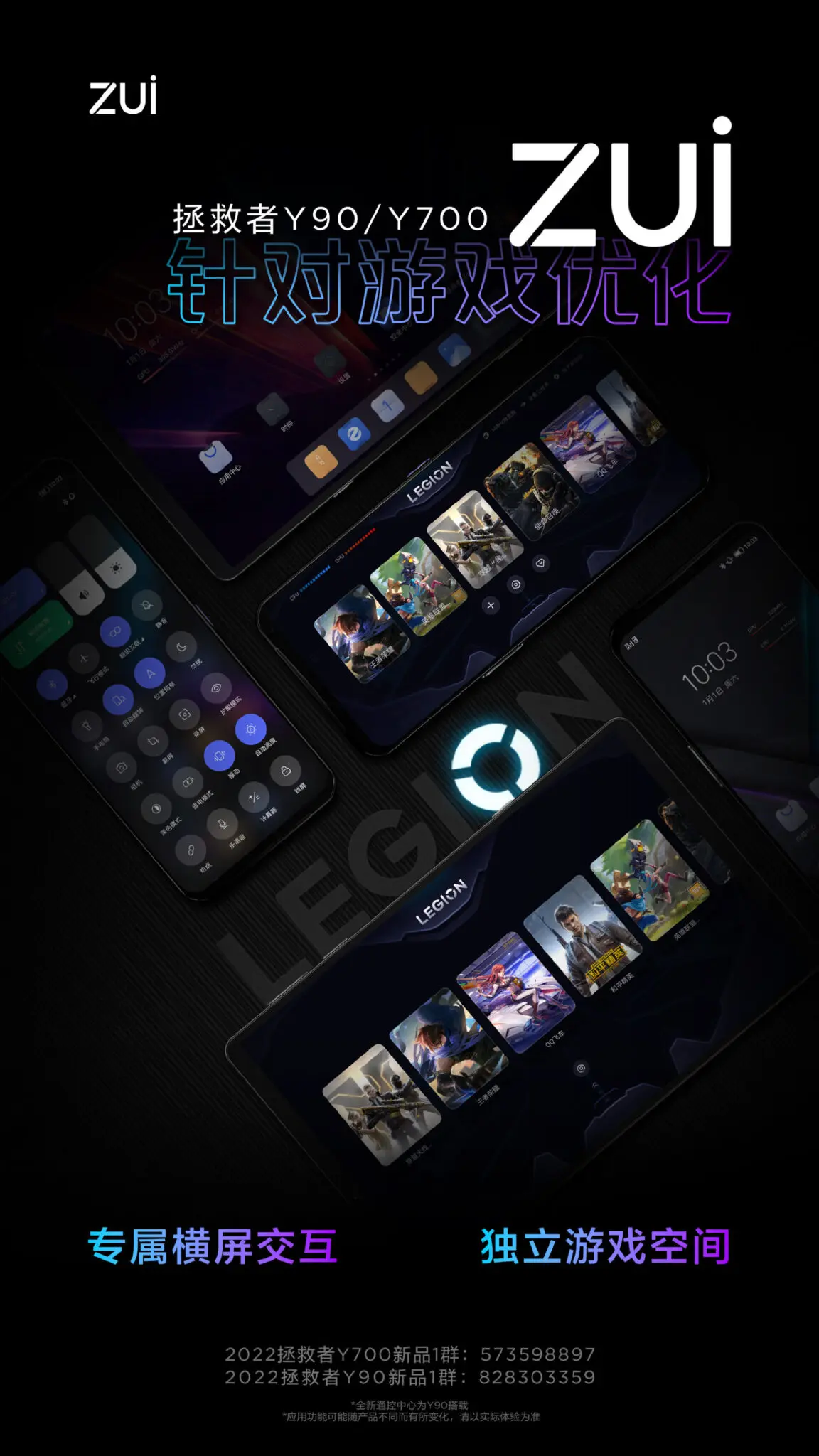
On the software front, the device runs on Lenovo’s custom ZUI 13 interface. Heavily optimized for the gaming ecosystem, ZUI 13 offers deep hardware-level controls, allowing users to fine-tune CPU and GPU performance profiles, customize the RGB lighting patterns, map shoulder triggers, and monitor real-time system temperatures and frame rates via an intuitive gaming dashboard.
Official Statements
While Lenovo opted to delay a formal physical or virtual stage event on January 1, the communications released via their official corporate channels on Weibo provided clear insight into the product’s strategic positioning.
Lenovo representatives emphasized that the Legion brand’s primary design mandate is uncompromising functional ergonomics. In official promotional briefs, the engineering team highlighted that the layout of the Legion Y90 was dictated entirely by how users physically interact with a mobile device during competitive play:
"We do not design phones to sit passively on a desk; we engineer battle stations meant to be gripped for hours in the heat of combat. Every vent, every millimeter of bezel symmetry, and every millisecond of touch response on the Legion Y90 has been calibrated to eliminate the barrier between player intent and digital execution."
Furthermore, company spokespersons reiterated that the integration of the Double Engine Air Cooling system represents a watershed moment for mobile thermals, proving that active cooling solutions can be successfully miniaturized within a sleek, pocketable form factor without sacrificing structural integrity or battery capacity.
Future Outlook
As the mobile gaming market continues its explosive growth—projected to account for over half of the global gaming revenue market—the success of devices like the Lenovo Legion Y90 will serve as a bellwether for the entire industry.
Market Positioning and Competitive Landscape
The Legion Y90 enters a fierce arena populated by dedicated gaming flagships from competitors such as ASUS (ROG Phone series), Black Shark, and RedMagic. By retaining its unique horizontal-first design language, Lenovo is doubling down on a specific demographic: hardcore mobile gamers who prioritize landscape ergonomics and thermal stamina over traditional, understated smartphone aesthetics.
What Lies Ahead
With the design and core specifications fully unmasked through Lenovo’s strategic teaser campaign, the technology community eagerly awaits the official announcement of the commercial release date, global pricing structures, and regional availability. If Lenovo can price the Legion Y90 competitively while delivering on the promise of sustained 144Hz gaming backed by its Double Engine Air Cooling technology, the device is poised to capture significant market share and set a new benchmark for mobile gaming hardware engineering in the years to come.









Belum ada komentar. Jadilah yang pertama berkomentar!