

Executive Overview
Apple is officially returning to the Game Developers Conference (GDC) in San Francisco with a dedicated presence, scheduling three distinct technical presentations for March 11. This move underscores a fundamental shift in Cupertino’s long-term strategy: transforming its entire hardware ecosystem—spanning iPhones, iPads, and Mac computers—into a tier-one destination for hardcore gamers and major game publishers.
For decades, Apple’s relationship with the video game industry was characterized by a casual coexistence. Mobile gaming on iOS dominated casual and microtransaction-driven markets via the App Store, while macOS was largely sidelined by developers due to legacy graphics APIs, proprietary hardware shifts, and a historical lack of enterprise focus on high-performance gaming. However, recent developments signal an aggressive pivot. With the introduction of the dedicated Games app in iOS 26 and macOS Tahoe, alongside continuous hardware breakthroughs via Apple Silicon (such as the M-series chips and hardware-accelerated ray tracing), Apple is signaling that it is no longer just a casual gaming platform—it wants a piece of the high-end AAA console and PC market.
At GDC 2026, a powerhouse lineup of Apple engineers, evangelists, business development leaders, and editorial curators will take the stage. Their goal is clear: convince skeptical developers, triple-A studios, and independent creators that building high-fidelity games for iOS and macOS is not only technically feasible but commercially lucrative. This comprehensive report explores the significance of Apple’s GDC 2026 sessions, examines the technical and systemic shifts driving this strategy, highlights the key personnel leading the charge, and analyzes what this means for the future of digital entertainment across Apple devices.
Detailed Chronology: Apple’s Evolutionary Leap Toward Core Gaming
To understand the weight of Apple’s GDC 2026 presence, one must trace the timeline of how the company transitioned from a mobile-first ecosystem to a serious contender in the high-performance gaming landscape.
1. The Foundation: Shifting Silicon and Metal APIs
The groundwork for Apple’s current gaming renaissance began years ago with the deprecation of OpenGL in favor of Metal, Apple’s low-overhead, high-performance graphics and compute API. By giving developers direct, low-level access to the GPU, Apple laid the technical bedrock required to run demanding, modern game engines like Unreal Engine and Unity.
The introduction of Apple Silicon (the M1, M2, M3, and M4 series of processors, alongside high-end A-series chips for iPhones and iPads) unified the company’s hardware architecture. Because iPhones, iPads, and Macs now share a foundational computing DNA, optimizations made for mobile can scale up to desktop environments with relative ease—a massive selling point for developers trying to maximize their return on investment across multiple platforms.
2. The Porting Toolkit and Early AAA Breakthroughs
At WWDC 2023, Apple introduced the Game Porting Toolkit, a watershed moment that allowed developers to evaluate how easily their existing Windows games could run on macOS. Featuring an emulation layer that translates DirectX 12 code into Metal API calls on the fly, the toolkit proved that games like Death Stranding, Resident Evil Village, Cyberpunk 2077, and Assassin’s Creed Mirage could run natively or near-natively on Apple hardware with impressive frame rates and visual fidelity.
Despite these early wins, adoption was slow. Developers remained hesitant to invest time and capital into porting their titles to an ecosystem historically dominated by mobile freemium titles. Mac users, meanwhile, grew frustrated by the gap between PC/console releases and Apple availability—often waiting months or years, or missing out entirely.
3. The Turning Point: iOS 26, macOS Tahoe, and the Dedicated Games App
Recognizing that hardware capability and developer tools alone were insufficient, Apple implemented massive structural changes to user discovery and software integration. With the rollout of iOS 26 and macOS Tahoe, Apple introduced a dedicated Games app.
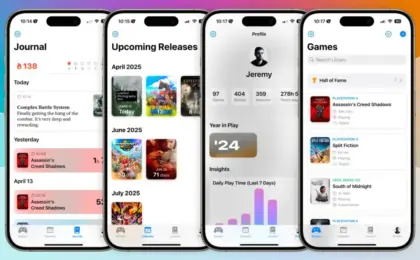
No longer buried within the sprawling App Store catalog, games now have a centralized hub reminiscent of dedicated gaming launchers on PC (such as Steam, Epic Games Store, or the Xbox app). This unified interface manages installed titles, surfaces editorial content, highlights cross-play achievements, and seamlessly integrates with hardware accessories like controllers.
Furthermore, recent months have seen an acceleration in Mac software releases, highlighted by reports of major AAA titles targeting day-one launches on macOS—a rarity in the platform’s history that points to a maturing pipeline between major publishers and Apple’s business development teams.
Supporting Context & Metrics: The Anatomy of Apple’s GDC 2026 Presence
Apple’s official agenda for March 11 at GDC 2026 features three comprehensive sessions. While the exact granular titles of these lectures are detailed within the official GDC scheduling platform, the roster of participating speakers provides a clear window into the topics Apple intends to tackle: developer advocacy, low-level graphics optimization, business expansion, and store curation.

The Speaker Lineup: Who is Representing Apple?
Apple’s delegation to San Francisco reflects a multidisciplinary approach, blending software engineering with market strategy and editorial oversight:
- Allan Schaffer (Senior Manager, Technology Evangelism): Schaffer acts as a bridge between Apple’s internal engineering teams and external developers, helping studios understand how to leverage Apple’s hardware and software ecosystems.
- Alexey Vinogradov (Engineering Manager, Game Technologies): Vinogradov focuses on the core frameworks that power gaming performance, working directly on how graphics pipelines, memory management, and compute workloads execute on Apple Silicon.
- Rich Forster (Engineer, Metal Frameworks): Forster is a technical specialist in the Metal graphics stack, likely spearheading discussions on advanced rendering techniques, ray tracing, and shader optimization.
- Charlyn Keating (Technology Evangelist, Games and Graphics): Keating assists studios in troubleshooting graphical bottlenecks and adopting advanced developer toolkits.
- Abhishek Radhakrishnan (Business Development, Apple Games): Representing the commercial side of the house, Radhakrishnan works on forging partnerships with major third-party publishers and indie developers alike.
- Kelli King (Games Curation Lead, App Store Editorial): King oversees how games are highlighted, featured, and discovered within the newly launched Games app and the broader App Store ecosystem.
Key Focus Areas at GDC 2026
Based on the backgrounds of the attending team and the broader industry landscape, Apple’s GDC presentations are expected to center around three core pillars:
- Advanced Graphics and Rendering: Demonstrating how developers can harness hardware-accelerated ray tracing, mesh shading, and MetalFX spatial upscaling to deliver console-quality visuals on mobile and desktop form factors without sacrificing battery efficiency or thermal limits.
- Streamlined Porting Workflows: Showcasing improvements to the Game Porting Toolkit, debugging utilities, and performance profiling tools designed to reduce the man-hours required to bring Windows and console titles to Apple Silicon.
- Monetization and Curation: Outlining how the new dedicated Games app in iOS 26 and macOS Tahoe enhances user engagement, and detailing what editorial teams look for when selecting titles for premier placement.
Official Statements and Industry Impact
While Apple typically maintains a calculated public relations stance regarding its long-term product roadmaps, the company’s actions at GDC 2026 speak volumes. Industry analysts view this year’s presence as a deliberate counter-programming effort against traditional console dominance.
"Apple is no longer treating gaming as a secondary feature of its hardware ecosystem. By uniting iOS, iPadOS, and macOS under a shared architectural umbrella and providing the necessary backend tools—from the Metal API to the new Games app—they are removing the friction that historically kept AAA publishers away." — Anonymous Industry Analyst
Major third-party publishers, once deeply skeptical of the Mac’s fragmented user base, are beginning to take notice. Capcom, Ubisoft, and Kojima Productions have all dipped their toes into the ecosystem with successful ports. However, industry insiders emphasize that day-one parity—releasing games on Mac and PC simultaneously—will be the true litmus test for Apple’s long-term success.
Future Outlook: Can Apple Conquer the High-End Gaming Market?
As GDC 2026 gets underway, the stakes for Apple are higher than ever. The hardware is undeniably capable; modern M-series chips and high-end A-series processors deliver staggering performance-per-watt metrics. The software infrastructure is also falling into place, with unified operating system features like the dedicated Games app smoothing out user experience friction points.

Yet, significant hurdles remain. The PC gaming market is deeply entrenched in Steam, Windows, and proprietary storefronts, while consoles command the living room. Furthermore, consumer perception remains a formidable barrier: millions of users still view iPhones and Macs as productivity and casual entertainment tools rather than primary gaming rigs.
To change this narrative, Apple must prove at GDC 2026 that its commitment to gaming is permanent, well-funded, and developer-friendly. If Allan Schaffer, Alexey Vinogradov, and the rest of the Apple delegation can successfully convince a skeptical room of industry veterans that the grass is greener on Apple Silicon, the video game landscape could be permanently altered.
The transition will not happen overnight. But with day-one AAA Mac releases inching closer to reality and a unified gaming architecture spanning millions of active devices worldwide, Apple is laying down a marker that cannot be ignored. The future of gaming on iOS and macOS is no longer a distant promise—it is happening right now.








Belum ada komentar. Jadilah yang pertama berkomentar!