

Executive Overview
Artificial intelligence is not merely rewriting global software architecture; it is actively inventing an entirely new vernacular to document its own evolution. Step inside a modern product strategy meeting, venture capitalist pitch session, or research panel today, and you will find engineers, executives, and investors effortlessly tossing around complex acronyms—LLMs, RAG, RLHF—alongside frontier methodologies like "opaque recurrence," a reasoning paradigm recently introduced in OpenAI’s Astra model that has sent shockwaves through the AI safety community.
This linguistic acceleration moves at a breathtaking pace, creating an environment where even seasoned technologists, software architects, and enterprise leaders frequently experience professional insecurity. The barrier to entry for understanding where technology, capital, and global infrastructure are heading is no longer just capital or computing power; it is fluency in the language of the machine.
This definitive, living glossary provides rigorous, plain-English definitions and deep contextual analysis for the most critical AI terminology. Whether you are an enterprise developer building distributed applications, a venture capitalist evaluating infrastructure layers, or a policy professional attempting to decode the regulatory debates dominating legislative hearings, this guide serves as your roadmap. Regularly updated to reflect the hyper-velocity of the field, it bridges the gap between raw mathematical theory and real-world application.
Detailed Chronology: From Neural Foundations to Frontier Reasoning
The history of artificial intelligence is marked by conceptual leaps, hardware breakthroughs, and philosophical re-evaluations. To understand today’s terminology, one must trace how foundational concepts have evolved into the complex systems governing modern enterprise.
[1940s: Neural Foundations] ---> [GPUs & Deep Learning Boom] ---> [LLMs & Generative Era] ---> [Frontier Reasoning & Agents]Neural Networks and Deep Learning
The theoretical lineage of modern artificial intelligence stretches back to the 1940s, when computer scientists first conceptualized algorithmic structures inspired by the densely interconnected pathways of the human brain. However, these early theories languished for decades due to severe hardware limitations. The turning point arrived with the unexpected convergence of the video game industry and scientific computing: the mass-market development of graphical processing units (GPUs).
These specialized chips proved exceptionally adept at matrix multiplication, unlocking the power of deep learning—a subset of machine learning characterized by multi-layered artificial neural networks (ANNs). Unlike simpler linear models or decision trees, deep learning architectures allow systems to autonomously discover complex correlations across millions of data points without requiring human engineers to manually define input features.
Large Language Models and the Generative Boom
Building upon deep learning architectures, the modern era was defined by the advent of large language models (LLMs). Powering dominant consumer and enterprise assistants such as OpenAI’s ChatGPT, Anthropic’s Claude, Google’s Gemini, Meta’s Llama, Microsoft Copilot, and Mistral’s Le Chat, LLMs process human queries through billions of numerical parameters known as weights.
Trained on planetary-scale corpora comprising books, academic journals, and web transcripts, these deep neural networks construct a multidimensional semantic map of human language. When prompted, an LLM calculates the statistically most likely sequence of tokens to satisfy the user’s intent.
The Reasoning Frontier: Chain of Thought, Opaque Recurrence, and Neuralese
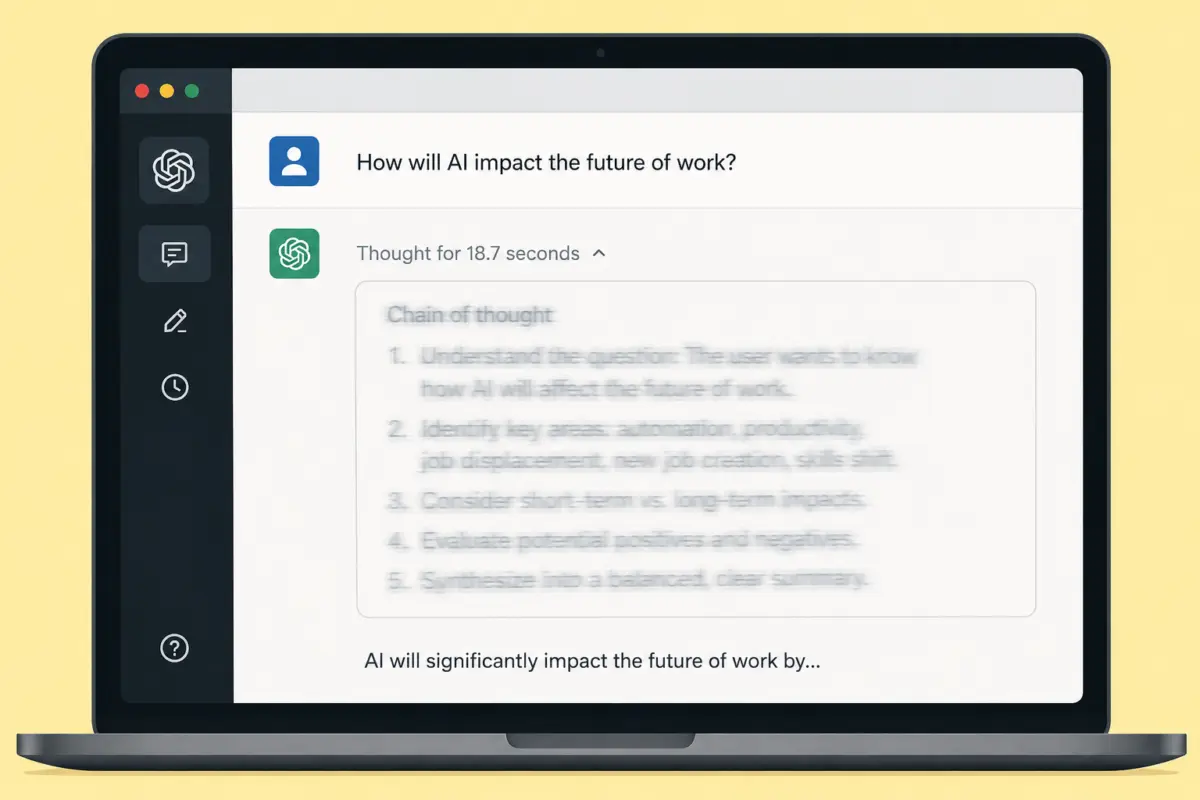
As foundational LLMs matured, labs encountered severe limitations in logical reasoning and multi-step problem solving. This catalyzed the development of reasoning models optimized through reinforcement learning to execute a chain of thought. Rather than instantly spitting out an answer, these models break complex problems down into intermediary steps, mimicking a human pulling out pen and paper to solve an algebraic equation.
However, the pursuit of efficiency has pushed researchers past plain-language chain-of-thought logging into more controversial territory. OpenAI’s Astra model introduced opaque recurrence (also studied in engineering contexts as recurrent depth). Instead of reasoning step-by-step in human-readable text, the model loops queries through its internal layers repeatedly. While this drastically reduces computational overhead and allows smaller models to punch far above their weight, it eliminates the audit trail.
Safety researchers are deeply alarmed by this trend, warning it represents a dangerous first step toward Neuralese—a hypothetical future scenario where advanced models reason entirely within their opaque, high-dimensional numeric representations, rendering their decision-making processes a complete black box immune to human oversight.
Supporting Context & Metrics: Infrastructure, Economics, and Architecture
Behind the software abstractions lies a massive physical and mathematical engine consumed by computation, memory constraints, and architectural innovations.
Compute, Hardware, and the "RAMageddon" Crisis
Artificial intelligence is fundamentally bound to compute—the immense processing power required to train and deploy advanced models. This term serves as shorthand for specialized hardware infrastructure, including GPUs, CPUs, and TPUs.
The staggering global demand for this infrastructure has triggered a severe supply-chain crisis colloquially dubbed RAMageddon. The insatiable appetite of AI labs and hyperscale cloud providers for random-access memory (RAM) chips has drained global reserves, wreaking havoc across adjacent consumer electronics industries. Major gaming console manufacturers have been forced to hike hardware prices, enterprise server upgrades have stalled, and consumer electronics analysts predict the sharpest decline in smartphone shipments in over a decade.
Optimization Mechanics: Caching, Distillation, and Mixture of Experts
Because running real-time inference (the process of deploying a trained model to make predictions) consumes staggering amounts of electrical power, engineers rely on sophisticated optimization strategies:
- Memory Cache (KV Caching): Transformer-based models utilize Key-Value caching to store previous mathematical calculations, drastically cutting down algorithmic labor and accelerating response times for repetitive enterprise queries.
- Distillation: A "teacher-student" training method where a smaller, highly efficient student model is trained to approximate the behavior of a massive frontier model. While standard practice for cost reduction, unauthorized distillation from proprietary API endpoints has sparked major legal and intellectual property disputes across the industry.
- Mixture of Experts (MoE): Rather than routing every incoming prompt through an entire neural network, an MoE architecture splits the network into specialized sub-networks ("experts") controlled by an internal router. Only a fraction of the network activates per task, allowing for massive model scales with reduced computational latency.
Standardization and Integration: MCP and API Endpoints
As standalone models commoditize, the industry’s focal point has shifted toward integration and autonomy. API endpoints act as programmatic buttons on software interfaces, allowing applications to interoperate without human intervention.
To streamline this connectivity, the introduction of the Model Context Protocol (MCP)—pioneered by Anthropic and rapidly embraced by OpenAI, Google, and Microsoft through the Linux Foundation—has created a standardized "USB-C port for AI." MCP allows models to securely plug into local file systems, enterprise databases, and productivity tools like Slack and Google Drive without requiring custom integration code for every single pairing.
Official Statements & Industry Perspectives
The rapid evolution of AI vocabulary directly reflects ideological divides among the industry’s most prominent figures regarding safety, autonomy, and capability thresholds.
- On the Definition of AGI: Artificial General Intelligence remains deliberately ambiguous. OpenAI CEO Sam Altman famously defined AGI as the "equivalent of a median human that you could hire as a co-worker." Meanwhile, OpenAI’s corporate charter frames it as "highly autonomous systems that outperform humans at most economically valuable work." Google DeepMind defines it more cognitively as "AI that’s at least as capable as humans at most cognitive tasks." Echoing the profound uncertainty surrounding the term, computer scientist and Turing Award winner Yann LeCun has frequently noted that even pioneers in the field lack a unified consensus on what AGI actually entails.
- On Autonomous Agents and Coding Agents: Moving beyond conversational chatbots, the industry is racing to deploy AI agents—autonomous systems capable of orchestrating multi-step workflows across third-party software. In software engineering, specialized coding agents are transforming development pipelines. Rather than merely suggesting snippets, these agents autonomously write, test, debug, and push code across entire enterprise codebases, operating like relentless digital interns.
- On Recursive Self-Improvement (RSI): As models approach unprecedented autonomy, recursive self-improvement has emerged alongside AGI as a critical threshold. While apocalyptic theorists view RSI through the lens of a runaway technological singularity, commercial AI startups are actively building recursively self-improving systems as a practical engineering milestone to accelerate model iteration without human bottlenecks.
Future Outlook: Navigating the Next Horizon of AI Terminology
As artificial intelligence transitions from an experimental software paradigm into the foundational operating system of the global economy, the lexicon will continue to expand at a relentless pace. The tension between commercial acceleration and safety oversight—exemplified by the debate over transparent chain-of-thought reasoning versus opaque recurrence—will define the regulatory and technical battles of the coming decade.
For builders, investors, and observers alike, maintaining fluency in this evolving glossary is no longer optional. As token throughput climbs, memory bottlenecks gradually ease, and autonomous agents begin managing complex enterprise ecosystems, understanding the precise mechanics behind the buzzwords will remain the ultimate competitive advantage in the age of intelligent machines.







Belum ada komentar. Jadilah yang pertama berkomentar!