

Executive Overview
For decades, the global consumer electronics landscape has associated LG Corporation with industry-leading household appliances, pioneering OLED display technology, and sleek, ultralight portable computing solutions like the renowned LG Gram series. However, the rapidly expanding high-performance gaming ecosystem has long remained a domain where LG primarily supplied the panels rather than the complete, end-user hardware systems. That strategic paradigm has shifted definitively with the official announcement of the LG UltraGear 17G90Q—the company’s inaugural, purpose-built gaming laptop.
Unveiled to the global tech community ahead of CES 2022, the UltraGear 17G90Q represents a calculated and aggressive expansion by LG into the fiercely competitive high-end gaming notebook market. Historically dominated by established enthusiast brands such as ASUS ROG, MSI, Razer, and Alienware, this sector demands relentless innovation, uncompromising thermal management, and top-tier computational performance. By leveraging its decades of display manufacturing mastery, industrial design expertise, and supply chain maturity, LG is attempting to carve out a commanding presence among elite gamers, content creators, and power users.
This extensive review and market analysis investigates the architectural blueprint of the LG UltraGear 17G90Q. We will dissect its industrial design philosophy, benchmark its internal processing capabilities, evaluate its proprietary software ecosystem, and contextualize its arrival within the broader trajectory of the personal computing and gaming industries.
Detailed Chronology and Product Evolution
The genesis of the UltraGear 17G90Q did not occur in a vacuum. It is the culmination of years of brand consolidation, engineering refinement, and market observation. To fully appreciate the significance of this launch, one must examine the chronological progression of LG’s computing endeavors leading up to this pivotal announcement.
The Foundation: The LG Gram Legacy
Long before entering the gaming segment, LG mastered the art of ultra-portability through its Gram lineup. Celebrated for defying conventional wisdom by packing large-screen experiences (14-, 15-, and 17-inch configurations) into featherlight magnesium-alloy chassis, the Gram series established LG’s credibility in the premium laptop space. Engineers learned invaluable lessons regarding spatial optimization, battery density management, and structural rigidity. These lessons directly influenced the mechanical blueprints of the UltraGear 17G90Q, proving that a high-performance machine does not inherently need to be an excessively bulky, unmanageable desktop replacement.
Cultivating the UltraGear Sub-Brand
Concurrent with the evolution of the Gram, LG cultivated its dedicated gaming sub-brand: UltraGear. Initially deployed across high-refresh-rate monitors and high-end visual peripherals, the UltraGear moniker quickly synonymous with uncompromising speed, color accuracy, and competitive advantage. Gamers worldwide came to associate the badge with elite visual performance. Expanding the UltraGear identifier into the laptop sector was a natural evolutionary step, providing instant brand equity and consumer trust in a market where brand loyalty is fiercely guarded.
The December 2021 Reveal and CES 2022 Buildup
In December 2021, LG officialized months of industry rumors by issuing a global press release detailing the UltraGear 17G90Q. Positioned as a direct salvo ahead of the Consumer Electronics Show (CES) in January 2022, the announcement sent ripples through the tech journalism community. The strategic choice to launch in key markets—specifically the United States and South Korea in early 2022—signaled LG’s intent to contest market share directly on the turf of entrenched North American and Asian competitors.
Architectural Breakdown: Hardware Specifications and Performance Metrics
The LG UltraGear 17G90Q is engineered to command attention on paper and deliver in execution. Below is a granular examination of the hardware components that power LG’s maiden gaming voyage.
+-----------------------------------------------------------------+
|               LG ULTRAGEAR 17G90Q SPECIFICATION MATRIX          |
+----------------------+------------------------------------------+
| Component            | Specification Details                    |
+----------------------+------------------------------------------+
| Display Panel        | 17.3-inch Full HD (1920 x 1080) IPS,     |
|                      | 300Hz Refresh Rate, Fast Response Time   |
+----------------------+------------------------------------------+
| Processor (CPU)      | 11th Generation Intel Tiger Lake H       |
|                      | Core Processor                           |
+----------------------+------------------------------------------+
| Graphics (GPU)       | NVIDIA GeForce RTX 3080 Max-Q            |
+----------------------+------------------------------------------+
| System Memory (RAM)  | 16GB or 32GB Dual-Channel DDR4           |
+----------------------+------------------------------------------+
| Internal Storage     | Up to 1TB NVMe Solid State Drive (SSD)   |
+----------------------+------------------------------------------+
| Battery Capacity     | 93Wh Massive Capacity Cell               |
+----------------------+------------------------------------------+
| Physical Dimensions  | Thickness: < 21.4mm | Weight: < 2.7kg    |
+----------------------+------------------------------------------+
| Chassis Material     | Premium Aluminum Casing                  |
+----------------------+------------------------------------------+
| Colorway             | Distinctive Purple Gray                  |
+----------------------+------------------------------------------+
Visual Engineering: The 300Hz IPS Display
Given LG’s world-renowned status in display technology, it comes as no surprise that the visual interface of the UltraGear 17G90Q is among its most compelling selling points. The notebook houses an expansive 17.3-inch IPS (In-Plane Switching) panel. While competitive gaming circles often debate the merits of Resolution versus Refresh Rate, LG has opted for a blistering 300Hz refresh rate, ensuring ultra-fluid motion rendering, minimal input latency, and a decisive competitive edge in fast-paced eSports titles such as Counter-Strike 2, Valorant, and Apex Legends.
The choice of a Full HD (1920 x 1080) resolution for a 17.3-inch panel is strategic: it ensures that the integrated graphics processing unit can consistently saturate the 300Hz refresh rate ceiling without demanding impossible computational overhead, resulting in buttery-smooth framerates.
Computational Might: Intel Tiger Lake H Meets NVIDIA RTX 30-Series
Beneath the hood, the UltraGear 17G90Q is armed for heavy combat. Processing duties are handled by an 11th Generation Intel Tiger Lake H Core processor, architected to push high clock speeds and maintain multi-threaded stability under intense workloads. Whether compiled code, rendering complex 3D scenes, or streaming high-bitrate gameplay, the CPU provides a robust computational foundation.
Graphics rendering is spearheaded by the NVIDIA GeForce RTX 3080 Max-Q GPU. Utilizing NVIDIA’s Ampere architecture, this card brings real-time ray tracing and AI-accelerated DLSS (Deep Learning Super Sampling) to the mobile form factor. The Max-Q variant ensures that power consumption and thermal dissipation are carefully balanced against the physical constraints of a slim chassis, optimizing performance-per-watt without sacrificing graphical fidelity.
To complement this horsepower, the system supports configurations of 16GB or 32GB of DDR4 RAM paired with up to 1TB of high-speed NVMe storage, guaranteeing rapid boot times, near-instant application launches, and seamless multitasking.
Physical Form Factor and Thermal Architecture
One of the most remarkable engineering feats achieved by LG with the 17G90Q is its physical footprint. Traditional 17-inch gaming laptops are notorious for being cumbersome, heavy, and difficult to transport. LG has defied this convention.
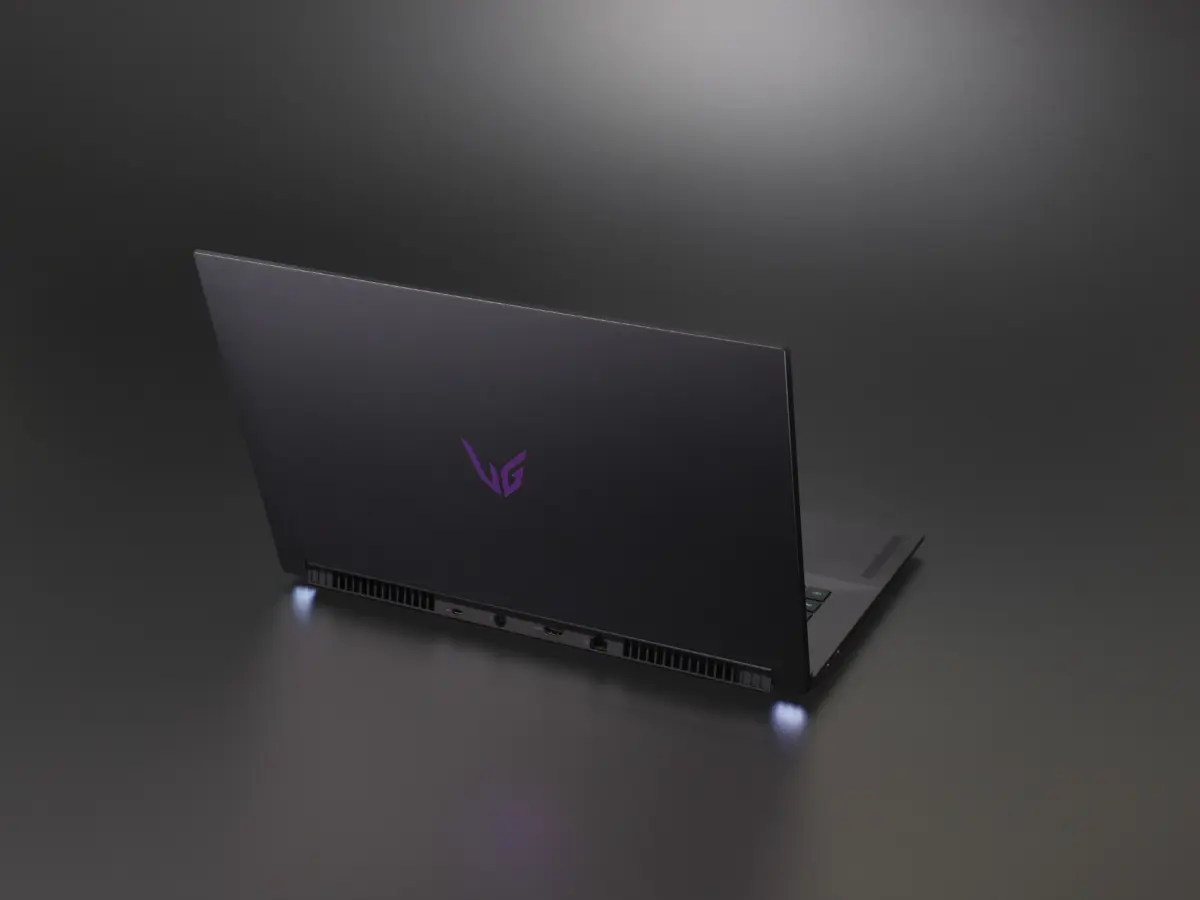
Encased in a sophisticated Purple Gray aluminum chassis, the laptop measures under 21.4mm in thickness and tips the scales at less than 2.7kg. This structural integrity is achieved through precision aluminum milling, which grants high resistance to flexing while projecting an understated, professional aesthetic that easily transitions from a high-stakes gaming battle station to a corporate boardroom.
Managing thermal output in a chassis this thin is a monumental challenge. LG has integrated a custom, highly efficient vapor chamber cooling system designed to rapidly draw heat away from both the CPU and GPU. This ensures sustained peak performance during extended gaming sessions without inducing aggressive thermal throttling or excessive acoustic noise from the cooling fans.
Software Ecosystem and Connectivity
Hardware is only as effective as the software ecosystem and physical inputs that govern it. LG has invested significantly in developing a user-centric experience that extends far beyond raw component specifications.
LG UltraGear Studio: Real-Time Telemetry and Customization
For modern enthusiasts, system monitoring and personalization are paramount. LG addresses this via LG UltraGear Studio, a proprietary software suite designed to give users granular control over their machine.
Through this centralized dashboard, users can track system telemetry in real time, including:
- CPU clock speeds and thermal load
- GPU Total Graphics Power (TGP) and active clock frequencies
- System memory allocation and bandwidth usage
Furthermore, the UltraGear Studio governs the per-key RGB backlit keyboard. Users can customize lighting profiles, animate color waves, or map functional lighting zones to match their personal aesthetic preferences or gaming setups.
Comprehensive I/O and Modern Connectivity
Despite its slim profile, the UltraGear 17G90Q refuses to compromise on peripheral connectivity. Recognizing that modern gamers and creators utilize an array of external hardware, docks, and displays, LG has loaded the machine with a robust array of ports:
- Multiple USB Type-A and USB Type-C ports (featuring modern high-speed data transfer protocols)
- Dedicated HDMI output for external display pairing
- RJ45 Ethernet port for lag-free, hardwired competitive gaming
- MicroSD/SD card reader for media creators on the go
- Combined audio jack for high-fidelity headsets
Wireless connectivity is equally future-proofed, featuring Wi-Fi 6 (802.11ax) integration for ultra-low latency wireless networking and stable packet transmission. Security and convenience are further augmented by an integrated fingerprint reader embedded directly into the power button, enabling swift biometric login via Windows Hello. Finally, a built-in 1080p webcam ensures crystal-clear visual fidelity for live streaming, video conferencing, and remote collaboration.
Powering this entire ecosystem away from the wall outlet is a formidable 93Wh battery. While high-end gaming laptops notoriously drain batteries quickly under heavy computational loads, the 93Wh capacity represents one of the largest power reserves permissible for air travel, ensuring commendable productivity runtime when untethered.
Supporting Context and Competitive Landscape
To understand the strategic gravity of the LG UltraGear 17G90Q, one must analyze the broader market dynamics of the high-end gaming notebook industry in the post-pandemic era.
The global gaming hardware market has experienced unprecedented expansion, driven by the mainstreaming of competitive eSports, the explosive growth of game streaming platforms like Twitch and YouTube Gaming, and a demographic shift where consumers increasingly view powerful laptops as all-in-one desktop replacements.
However, competition is cutthroat:
- ASUS ROG (Republic of Gamers) commands massive loyalty through relentless innovation in dual-screen setups (Zephyrus Duo) and ultra-compact form factors (ROG Flow).
- Razer has long defined the luxury gaming laptop space with its CNC-milled unibody aluminum designs, serving as the benchmark for minimalist aesthetic appeal.
- MSI and Alienware cater to uncompromised, maximum-performance enthusiasts who prioritize raw benchmark scores over absolute portability.
By positioning the UltraGear 17G90Q as a fusion of Gram-like portability and elite UltraGear performance, LG is carving out a unique middle ground. It targets the professional gamer, traveling content creator, or affluent tech enthusiast who demands desktop-class performance (RTX 3080 and 300Hz display) without the traditional 4-kilogram physical burden associated with 17-inch gaming powerhouses.
Official Statements and Industry Reception
The announcement of the UltraGear 17G90Q drew extensive commentary from industry analysts and technology executives alike.
In the official press rollout, LG emphasized its commitment to pushing boundaries beyond traditional consumer electronics. Company representatives highlighted that the venture into gaming laptops was a natural evolution of listening to consumer demand. Users who had praised LG’s display technologies and lightweight engineering wanted a unified hardware ecosystem designed specifically for high-performance entertainment.
Tech journalists and hardware reviewers praised LG for its ambition. The decision to enter the market at the absolute high-end—rather than testing the waters with a budget or mid-range offering—signaled supreme confidence in their supply chain, thermal engineering, and display integration. While critics noted that the 11th Gen Intel processor placed the initial launch at a transitional technological juncture (with 12th Gen chips looming on the horizon), the overall consensus viewed the 17G90Q as an impressive, highly polished debut that immediately put legacy PC manufacturers on notice.
Future Outlook: What the UltraGear Signifies for LG
The launch of the LG UltraGear 17G90Q is much more than the introduction of a single laptop model; it is a clear indicator of LG’s long-term strategic diversification. As profit margins on traditional household appliances face commoditization, high-value computing and gaming hardware represent lucrative avenues for sustained revenue growth.
Looking forward, industry watchers anticipate several developments stemming from this launch:
- Expansion of the UltraGear Lineup: Following the 17-inch flagship, future iterations are expected to introduce varying screen sizes (such as 15-inch and 14-inch models) to capture broader market segments.
- Adoption of Next-Gen Silicon: Subsequent models will undoubtedly integrate subsequent generations of Intel Core and AMD Ryzen processors, alongside next-generation NVIDIA and AMD mobile graphics architectures.
- Synergy with LG Display: As OLED technology continues to infiltrate the laptop market, LG’s unmatched prowess in OLED manufacturing suggests future UltraGear laptops may feature self-emissive, infinite-contrast gaming displays, setting a new gold standard for visual fidelity.
In conclusion, the LG UltraGear 17G90Q successfully bridges the gap between LG’s storied legacy in display and lightweight engineering and the demanding world of competitive PC gaming. By combining a stunning 300Hz IPS panel, robust NVIDIA RTX 3080 graphics, and a remarkably slim aluminum chassis, LG has proven that it is a formidable new contender in the gaming hardware arena. As the first units roll out in the United States and South Korea, the message to the industry is unmistakable: LG is here to play, and they are playing to win.








Belum ada komentar. Jadilah yang pertama berkomentar!