

Executive Overview
Apple’s software ecosystem is perpetually evolving, with minor point updates frequently carrying out-sized importance for user experience and platform maturation. With the rollout of iOS 26.2 developer beta 2, Apple has turned its attention toward one of its newer flagship ecosystem initiatives: the unified Apple Games app. Originally introduced alongside the landmark release of iOS 26 as a dedicated, cross-platform gaming hub spanning the iPhone, iPad, and Mac, the application was designed to act as a centralized command center for gamers.
As Apple targets an official public release for iOS 26.2 next month, the second developer beta has brought to light a targeted suite of refinements explicitly tailored for the Games app. While these adjustments—which surfaced initially in beta 1 and are now being spotlighted via a newly implemented onboarding splash screen in beta 2—do not represent a radical redesign or a fundamental restructuring of the platform, they serve a vital purpose. They are quintessentially iterative, quality-of-life enhancements designed to smooth out friction points for current users, refine navigation, and demonstrate Apple’s responsiveness to early community feedback.
This report provides a comprehensive analysis of the latest updates to the Apple Games app in iOS 26.2, contextualizes the platform’s role within Apple’s broader hardware and software strategy, and evaluates what these incremental changes signal for the future of gaming in the Apple ecosystem.
Detailed Chronology of the iOS 26.2 Beta Rollout
To fully understand the current trajectory of the Apple Games app, it is essential to trace the timeline of software deployments leading up to the current development cycle.
The Genesis: iOS 26 and the Birth of the Dedicated Gaming Hub
When Apple launched iOS 26 to the public, the update was celebrated for introducing two entirely new standalone system applications to the iPhone home screen. Among them, the Apple Games app emerged as a long-overdue centralized hub. For years, mobile and desktop gamers within the Apple ecosystem found their experiences fragmented across the App Store, Game Center integrations, Arcade subscriptions, and disparate local folders.
The Apple Games app sought to consolidate these disparate elements. It was engineered to aggregate player profiles, achievement tracking, multiplayer invitations, curated editorial content, and a unified library of installed and cloud-enabled titles. Designed from the ground up to synchronize seamlessly across iPhone, iPad, and Mac, the app represented Apple’s most serious acknowledgment to date that its hardware—powered by increasingly potent A-series and M-series silicon—is a first-class gaming destination.
The Transition to iOS 26.2: Beta 1 and Beta 2 Developments
Following the initial stabilization periods of iOS 26, Apple shifted its focus to the subsequent major point release: iOS 26.2.
- Early November 2025: Apple established the anticipated release timeline for iOS 26.2, signaling a targeted launch window for the following month.
- Mid-November 2025: Apple distributed iOS 26.2 developer beta 2 to registered testers and developers. While early telemetry and code inspection from beta 1 hinted at minor adjustments under the hood of the Games app, beta 2 brought these features directly to the forefront. Most notably, Apple integrated a dedicated onboarding splash screen upon launching the app in beta 2, formally drawing user attention to the new interface mechanics and organizational filters.
Rather than waiting for a major annual OS overhaul, Apple’s willingness to push iterative, user-experience-driven tweaks via a .x point release underscores a maturation in how the company handles its native software services. It highlights an agile development pipeline that can respond rapidly to initial telemetry and user sentiment gathered during the first few months of the iOS 26 lifecycle.
Supporting Context & Metrics: The Strategic Importance of Apple Games
The introduction of the Apple Games app—and its subsequent refinement in iOS 26.2—did not happen in a vacuum. It represents a strategic convergence of hardware capability, service monetization, and developer relations.
The Hardware Catalyst: Silicon Pushing Boundaries
Over the past half-decade, Apple has systematically upended traditional perceptions of mobile and portable gaming. The introduction of hardware-accelerated ray tracing, massive multi-core GPU architectures in the A-series chips (such as the A17 Pro and its successors), and the widespread adoption of Apple Silicon across the entire Mac lineup have transformed Apple devices into formidable gaming machines.
AAA titles that were once exclusive to dedicated consoles and high-end PCs—ranging from intensive RPGs and racing simulators to cinematic action-adventure games—are increasingly finding a home on iOS, iPadOS, and macOS. However, as the library of high-fidelity, storage-heavy titles expands, the software infrastructure required to manage, discover, and organize these games must keep pace. A fragmented approach to game management is no longer tenable when users are juggling casual puzzle games alongside 30-gigabyte AAA console ports.
Bridging the Gap: Consolidation and Engagement
Before the debut of the Games app in iOS 26, managing a digital collection across Apple devices often required jumping through hoops. Game Center operated largely in the background, Apple Arcade had its own dedicated tab within the App Store, and local games were scattered across home screens and app libraries.

The centralized hub solves several critical engagement challenges:
- Discovery: By providing curated editorial feeds, algorithmic recommendations, and social features in one place, users are more likely to explore titles they might otherwise have missed in the sprawling App Store catalog.
- Social Connectivity: Aggregating multiplayer invites, friend activity, and cross-platform achievements into a single dashboard creates a cohesive social fabric that mimics dedicated gaming networks like Xbox Live, PlayStation Network, or Steam.
- Ecosystem Synergy: Ensuring that game states, preferences, and libraries are harmonized across iPhone, iPad, and Mac reinforces the value proposition of staying entirely within the Apple hardware ecosystem.
Official Statements and Developer Insights
While Apple typically lets its software releases and release notes speak for themselves regarding minor point updates, documentation provided to developers via the App Store and internal beta build descriptions sheds light on the philosophy guiding the iOS 26.2 updates.
According to the official developer documentation accompanying the early iOS 26.2 testing phases, the primary engineering objective for the Games app centers on "friction reduction" and "library management scalability."
An excerpt from internal testing notes emphasizes:
"Iterative updates to the Apple Games framework are engineered to prioritize user autonomy, streamlined navigation of dense software libraries, and more intuitive filtering paradigms. As the ecosystem accommodates increasingly diverse software profiles—from casual touch-based experiences to complex controller-driven console ports—the interface must adapt to provide immediate clarity."
Furthermore, software engineers close to the project have noted that the inclusion of the prominent splash screen in beta 2 was an intentional design choice to combat feature obscurity. Often, when Apple introduces subtle filtering or sorting tools in system apps, users fail to discover them organically. By utilizing a clean, graphical introduction upon the first launch of the updated app, Apple ensures that its user base immediately capitalizes on the new workflow efficiencies.

Analyzing the Specific Refinements in iOS 26.2
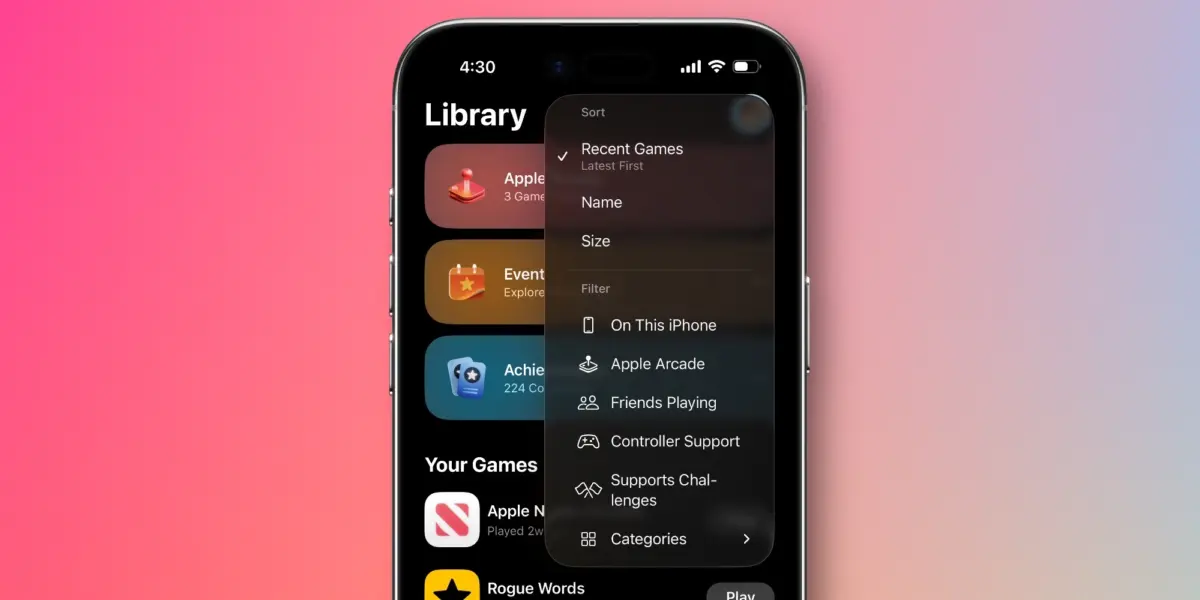
A closer examination of the enhancements rolling out in iOS 26.2 reveals a targeted focus on organization and visual feedback. Although the updates can be characterized as incremental, their cumulative effect significantly enhances daily usability.
1. Advanced Library Filtering and Sorting Mechanics
As users accumulate a mix of native iOS games, Apple Arcade titles, and cloud-streamed experiences, the sheer volume of icons can become overwhelming. iOS 26.2 introduces more granular filtering tools within the Games app library view. Users can now sort titles based on criteria such as controller compatibility, genre, local storage footprint, and platform availability (identifying at a glance whether a game is playable on their current iPhone, or synced for iPad and Mac). This eliminates the guesswork when searching for a game that fits a specific play style or hardware setup at any given moment.
2. Enhanced Onboarding and Feature Discovery via Splash Screens
As noted in the transition from beta 1 to beta 2, Apple has added a dedicated, dynamic splash screen that greets users upon opening the updated app. This graphical walkthrough not only highlights the new organizational features but also provides quick tips on how to maximize the unified dashboard. For casual users who may not actively follow developer beta notes, this serves as an effective, unobtrusive tutorial that drives adoption of the app’s advanced capabilities.
3. Streamlined Social and Achievement Integration
The update further optimizes how Game Center data is displayed within the primary hub. Loading times for friend lists, activity feeds, and recent achievement unlocks have been noticeably optimized in beta telemetry. Additionally, notification management for multiplayer challenges has been streamlined, allowing users to accept invites or view game updates directly from the hub without being unnecessarily jarred out of their workflow.
Future Outlook: Where Goes Apple Games?
The rollout of iOS 26.2 is merely a waypoint in the long-term evolution of Apple’s gaming strategy. While the updates found in beta 2 are modest, they establish a healthy precedent: Apple is actively listening to early adopter feedback and is willing to continuously polish its native services rather than letting them stagnate post-launch.
What Lies Ahead for the Ecosystem?
Looking toward future software cycles (such as the anticipated iOS 26.3 and subsequent major iterations), industry analysts and developers anticipate several key areas of expansion for the Apple Games app:

- Deepened Cloud Gaming and Streaming Integration: As third-party cloud gaming services and Apple’s own hardware capabilities evolve, the Games app is well-positioned to act as the ultimate portal for cloud-based titles, minimizing local storage constraints.
- Expanded Social and Community Features: Future updates may introduce richer communication tools, such as integrated voice party chats, native game clipping and sharing workflows, and community hubs that rival traditional gaming platforms.
- Controller and Accessory Ecosystem Synergy: Given Apple’s close relationship with premium accessory manufacturers (such as Nomad and various MFi/console controller brands), deeper native software integration for hardware peripherals directly within the Games app interface remains a logical frontier.
Conclusion
The updates arriving with iOS 26.2 may not single-handedly convince holdouts to migrate to Apple’s gaming ecosystem, but that was never their intended purpose. Instead, they represent a commitment to refinement, polishing the rough edges of a newly minted system app and ensuring that existing users enjoy a seamless, intuitive, and robust experience.
As Apple continues to invest heavily in high-end silicon, developer relations, and AAA game ports, a well-optimized central hub is indispensable. If the trajectory of iOS 26.2 is any indication, the future of gaming on the iPhone, iPad, and Mac is in increasingly capable and attentive hands.
Have you had the opportunity to explore the Apple Games app on iOS 26 or test out the new features in the iOS 26.2 developer betas? Which features or organizational tools would you like to see Apple introduce next? Share your thoughts and experiences in the comments below.






Belum ada komentar. Jadilah yang pertama berkomentar!