

Executive Overview
At its annual Roblox Developer Conference (RDC), the gaming and virtual world giant unleashed a staggering array of platform updates designed to fundamentally transform how digital worlds are built, distributed, monetized, and experienced. Moving far beyond its traditional boundaries as a walled-garden ecosystem, Roblox is aggressively positioning its underlying technology stack as a universal game engine.
The headline announcements center on the broader commercial and public rollout of generative artificial intelligence (AI) creation tools, the unprecedented capability for developers to export their creations as standalone applications across mobile, PC, and consoles, and the introduction of serious financial infrastructure—including a dedicated Roblox Wallet and a physical/digital Roblox Card. Furthermore, the company announced architectural upgrades enabling 2D game development, AI-driven non-player character (NPC) playtesters, offline game modes, and context-aware social features.
These sweeping developments signal a massive pivot in corporate strategy. Roblox is no longer just focused on keeping users inside its proprietary app. Instead, it is actively empowering its community of developers to extend their reach across the broader web and external platforms, all while streamlining development through natural language prompts and offering professional-grade financial tools. With founder and CEO David Baszucki reporting a staggering cumulative 29 billion hours of player engagement across 180 countries in just the last quarter alone, the stakes for the platform have never been higher.
Detailed Chronology & Technological Breakthroughs
Expanding "Build": Generative AI Comes to the Forefront
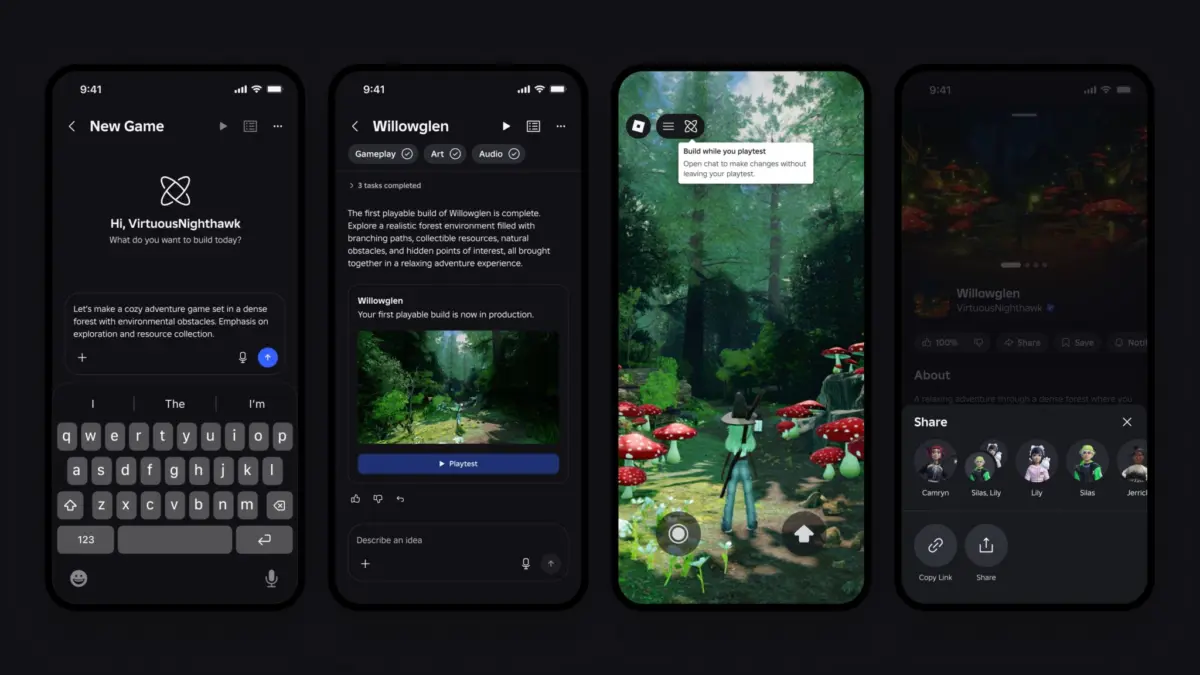
First teased earlier in the summer during its initial mobile app launch in New Zealand, Roblox’s natural-language game creation tool—aptly named "Build"—is receiving a major geographical and functional expansion. The feature, which allows users to spin up interactive environments and game mechanics simply by typing text prompts, is now expanding its testing footprint to Serbia and Singapore.
Crucially, Build is breaking out of its mobile confines. Roblox announced that the feature is gaining desktop access to accommodate big-screen creation workflows, supported by a brand-new asset library and refined iterative control mechanisms. Looking ahead to later this year, Build and the professional-grade Roblox Studio will receive an advanced prompt-based scene-generation feature. This upgrade will allow creators to generate complex, multi-layered 3D environments instantaneously through descriptive text commands.
Beyond the Walled Garden: Multiplatform Publishing and In-Browser Links
Historically, games built on Roblox lived exclusively inside the Roblox ecosystem. That paradigm is officially coming to an end.
Roblox announced that creators will soon be able to package and publish their custom games as independent, standalone applications across mobile devices, traditional personal computers, and dedicated gaming consoles. In this new architecture, Roblox acts primarily as the underlying game engine powering these titles.
Moreover, by the end of the year, friction will be reduced even further for casual players. Users will be able to join an active Roblox game directly through an in-browser link without needing to navigate through the main client launcher first. This structural shift transforms Roblox from a mere destination into a fully fledged game development engine competing with the likes of Unity and Unreal Engine for indie developers.
Engine Upgrades: 2D Games, Intelligent NPCs, and Offline Support
Roblox is also expanding the technical horizons of what can be built within its engine:
- 2D Game Development: Developers can now design classic 2D games utilizing an orthographic camera, animated image containers, and direct sprite-sheet imports for fluid animations.
- Autonomous AI NPCs: Later this year, creators will gain access to advanced NPC capabilities—most notably, non-player characters capable of autonomously playtesting a game to identify bugs, balance issues, and navigation blockers before human players ever log in.
- Offline Mode: To combat connectivity dropouts, developers will be able to implement an offline mode in their games, permitting users to maintain gameplay continuity even in areas with weak or absent network connections.
Social and Discovery Enhancements
On the consumer-facing side of the platform, user experience is receiving a massive overhaul:

- Persistent Friends Chat: A newly designed Friends chat tab will travel across different game experiences seamlessly alongside the user, featuring integrated voice-typing support for rapid communication.
- Age-Tailored Discovery Algorithms: An improved content discovery algorithm will dynamically suggest shorter-format, fast-paced games to younger users, while steering older audiences toward deeper experiences with longer playtimes.
- Frictionless Commerce in Feeds: Within the Moments short-form video gameplay clip feed, players will soon be able to tap directly on any avatar within a video clip to purchase the exact virtual items worn by that avatar.
Supporting Context & Metrics: The Creator Economy Milestone
The economic scale of the Roblox ecosystem has reached staggering proportions. According to company disclosures revealed during the conference, independent game makers and studios have collectively earned more than $5 billion on the platform since 2013. Demonstrating exponential growth, earnings for the trailing 12 months alone reached a monumental $1.7 billion.
To put these figures into perspective, Roblox is no longer just a hobbyist playground for teenagers experimenting with coding; it is a viable, multi-billion-dollar digital economy supporting professional game development studios. Recognizing this maturity, Roblox is finally deploying the financial infrastructure required to treat its creators like enterprise business partners.
The Roblox Wallet and Airwallex Partnership
Addressing long-standing developer complaints regarding payout speed and financial liquidity, Roblox is launching the Roblox Wallet.
- Daily Payouts: Creators can now get paid out in real fiat currency by the end of each business day, eliminating the traditional lengthy processing delays.
- Bank Transfers: Accumulated earnings can be effortlessly transferred from the Roblox ecosystem to external commercial bank accounts.
- Regulatory Compliance & Global Rollout: To securely execute this financial service, Roblox has partnered with fintech infrastructure provider Airwallex. The wallet service is initially rolling out to U.S.-based users aged 18 and older, with a comprehensive global expansion roadmap planned for the near future.
The Roblox Card
Complementing the digital wallet, Roblox teased the upcoming launch of the Roblox Card, slated for release next year. This card will enable creators and power-users to spend their platform earnings anywhere standard payment cards are accepted, effectively bridging the gap between virtual world revenues and physical-world purchasing power.
Official Statements & Industry Positioning
The overarching narrative of RDC 2026 is one of maturation and decentralization. During his keynote presentations, Roblox Founder and CEO David Baszucki emphasized the sheer scale of the platform’s global footprint, pointing out that in the most recent quarter alone, players spent over 29 billion hours cumulatively across 180 countries.
Industry analysts tracking the event have noted that Roblox is successfully executing a dual-track strategy:
- Lowering the Barrier to Entry: By expanding generative AI tools like Build and introducing prompt-based scene generation, Roblox is making game design accessible to millions of non-technical users.
- Elevating the Ceiling for Professionals: By offering multiplatform app publishing, advanced 2D engines, daily financial payouts via the Roblox Wallet, and enterprise-grade tools, the company is actively preventing top-tier developers from defecting to competing engines like Unity, Unreal, or Godot.
Roblox is no longer content with being an isolated digital playground. Through aggressive technological evolution, it is positioning itself as an omnipresent infrastructure layer for the future of interactive entertainment.
Future Outlook
As the technology roadmap outlined at RDC 2026 rolls out over the remainder of the year and into the next, the implications for the broader gaming industry are profound.
The convergence of natural-language generative AI and multiplatform app publishing means that the line between consumer and creator will continue to blur. A user playing a short-form video clip in the Moments feed can tap an avatar, purchase an item, jump instantly into a game via a browser link, and eventually play that game offline on a standalone mobile app—all powered by the Roblox engine.
For developers, the combination of daily real-money payouts through the Airwallex-backed Roblox Wallet and the upcoming Roblox Card provides unprecedented financial freedom. If Roblox successfully executes this ambitious transition, it will cement its status not merely as a popular online game, but as one of the most powerful, vertically integrated game development ecosystems and digital economies in modern tech history.






Belum ada komentar. Jadilah yang pertama berkomentar!