

KYOTO — The perennial tension between Japan’s ancient heritage and its relentless march toward ultramodernity rarely manifests as harmoniously as it does in Kyoto. Visitors traversing the historic capital can wander past centuries-old wooden townhouses (machiya) only to spot the familiar, emerald-eyed twin-tailed siren of a modern Starbucks emblem discreetly mounted on a heritage-grade exterior. It is an aesthetic dichotomy that defines contemporary Japan: the preservation of the sacred juxtaposed with the adoption of the hyper-new.
Embracing this duality with cutting-edge panasse is Naked, Inc., a Tokyo-based creative collective internationally renowned for merging cinematic storytelling, spatial design, and projection mapping. Over the past decade, Naked has carved out a distinct niche by turning Japan’s most hallowed historical landmarks—from Himeji Castle to the pine-studded islands of Matsushima—into glowing, breathing canvases of light and sound.
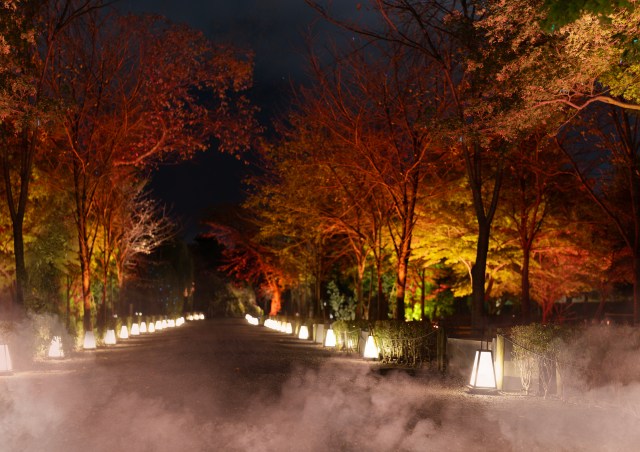
This autumn, the collective returns to one of its most prestigious stages. Running from October 23 through December 5, 2026, the flagship immersive art exhibition Naked Meets Nijo Castle 2026 transforms the sprawling, centuries-old grounds of Kyoto’s Nijo Castle into an ethereal nighttime wonderland. Blending state-of-the-art digital projections, responsive audio landscapes, and interactive installations, the event invites locals and international travelers alike to step directly into a 400-year-old historical narrative.
Executive Overview: A Landmark Anniversary of Power and Art
At first glance, Naked Meets Nijo Castle 2026 is a stunning visual spectacle—a nighttime exhibition of light-lit gardens, ambient soundscapes, and high-tech installations. However, beneath the glowing projections and participatory digital fashion lies a deeply researched historical commemoration.
The 2026 exhibition marks the 400th anniversary of the 1626 Kanei Gyoko (Imperial Visit), a monumental five-day summit that fundamentally reshaped Japan’s sociopolitical and cultural landscape. Originally constructed in 1603 by Tokugawa Ieyasu—the founder of the Tokugawa shogunate—Nijo Castle served as the Kyoto residence for the reigning shoguns whenever they visited the imperial capital. By 1626, the shogunate had unified the country under military rule, yet the legitimacy of their regime still required the tacit approval of the Imperial Court.
The Kanei Gyoko was a masterclass in political theater. For five days, Emperor Go-Mizunoo visited the Tokugawa shogun at Nijo Castle in an unprecedented display of statecraft. While the shogunate utilized the opulent event to project absolute authority and financial might over a pacified nation, the imperial family leveraged the occasion to assert their enduring cultural and spiritual relevance. Amid this high-stakes political chess match, a profound cultural synthesis occurred. The cross-pollination between courtly refinement and samurai austerity catalyzed the golden age of traditional arts, leaving an indelible mark on the Japanese tea ceremony, flower arrangement (ikebana), and textile design.
Naked, Inc.’s 2026 exhibition serves as the artistic centerpiece of the broader Kanei Gyoko 400th Anniversary Festival, bringing this pivotal era out of dusty history textbooks and projecting it onto the literal walls where it unfolded four centuries ago.
Detailed Chronology and Artistic Journey Through the Exhibition
Visitors entering Naked Meets Nijo Castle 2026 do not simply observe history; they walk through a carefully curated chronological and spatial narrative. The experience is divided into three distinct zones, each utilizing different technological mediums to interpret the legacy of the Kanei era.
Zone 1: The Threshold of Power — The Karamon Gate
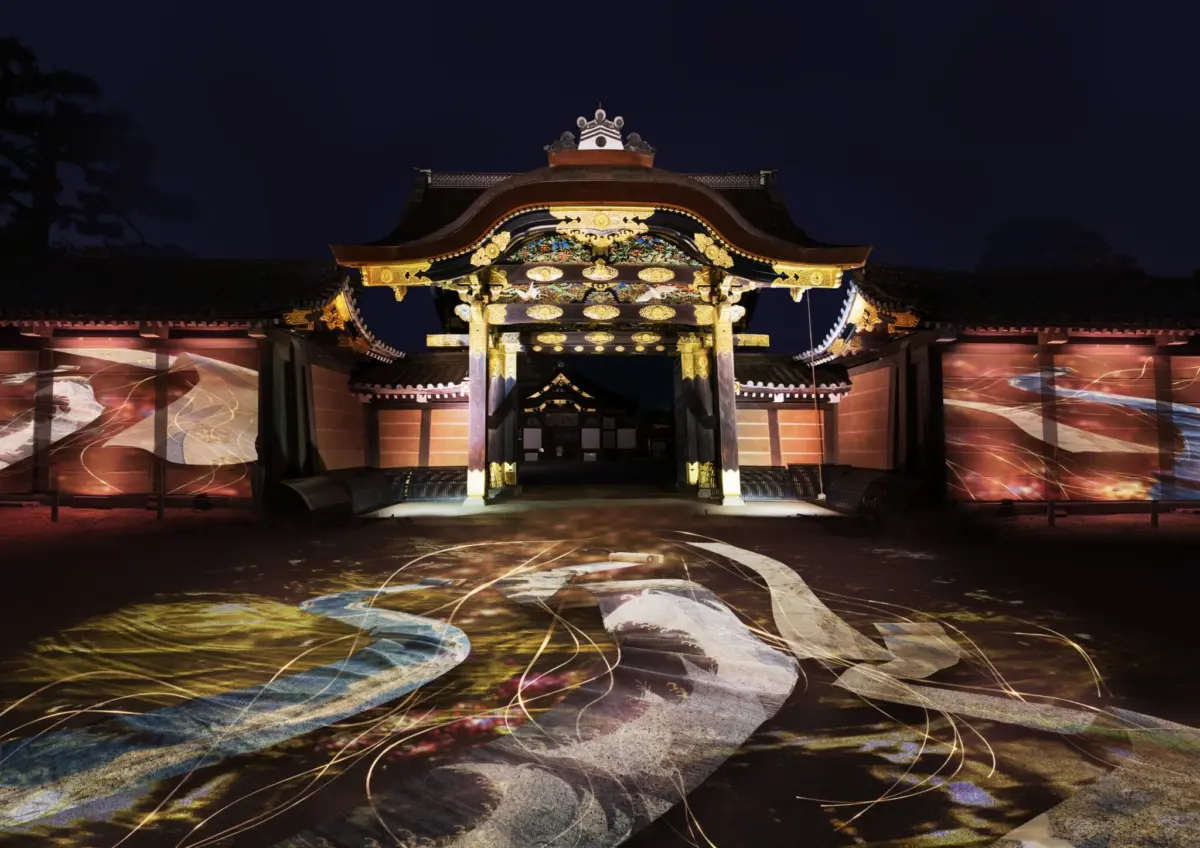
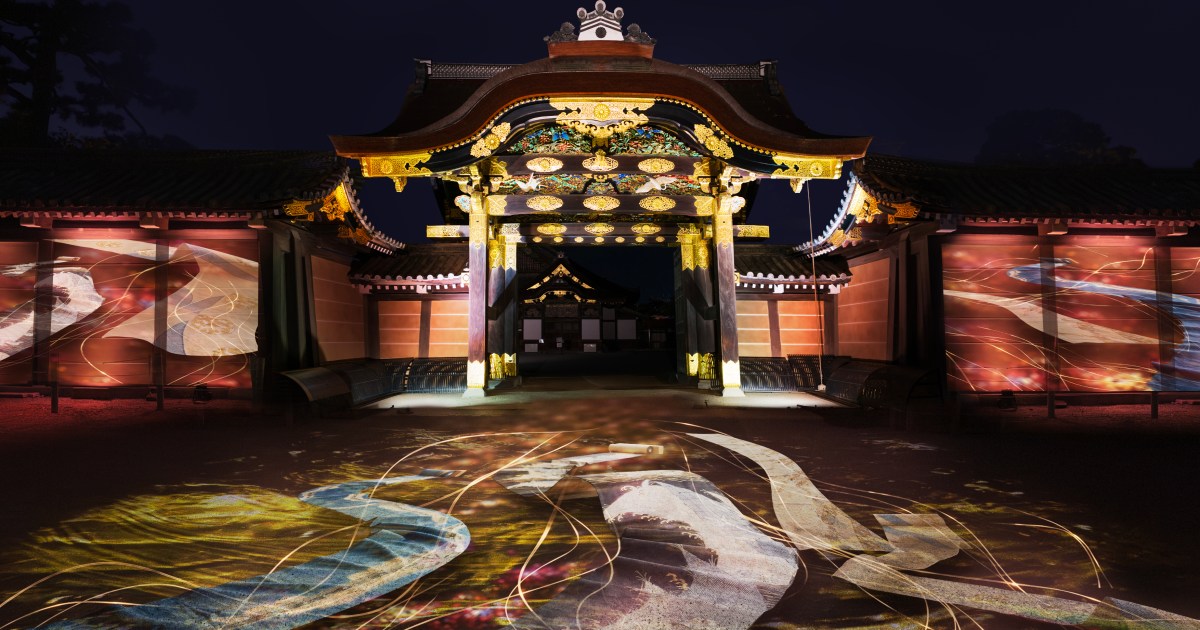
The journey begins at the majestic Karamon Gate, a designated Important Cultural Property renowned for its ornate Chinese-style architecture, intricate wood carvings of auspicious animals, and brilliant gold-leaf accents.
As dusk settles and the exhibition opens at 6:00 p.m., the gate undergoes a dramatic transformation. Eschewing harsh, static lighting, Naked, Inc. deploys high-definition projection mapping that hugs every contour of the historic woodwork. Dynamic waves of color and classic Kanei-era geometric patterns ripple across the facade, shifting in sync with a custom spatial audio composition. The installation visually represents the moment the imperial procession arrived at the gates in 1626, setting a tone of regal grandeur for the evening.
Zone 2: Courtly Elegance and the Samurai Spirit — Ninomaru Palace, Moat, and Seiryuen Garden
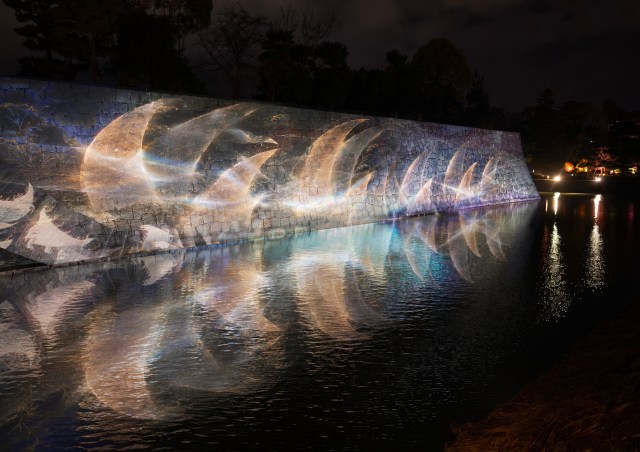
Moving past the gate, guests navigate the perimeter of the Ninomaru Palace—the only surviving palace complex of its kind from the early Edo period—before following the illuminated inner moat toward the expansive Seiryuen Garden.
In this zone, the exhibition turns its focus toward Tokugawa Masako, the daughter of the second Tokugawa shogun (Hidetada), consort to Emperor Go-Mizunoo, and mother to a reigning empress. Masako was the ultimate bridge between two opposing worlds: she carried the heavyweight political expectations of the samurai clan while cultivating the supreme refinement of the imperial court. Her legacy is deeply woven into the development of traditional Japanese aesthetics, particularly in textile arts and classical poetry.
Along the pathways of Seiryuen Garden, interactive light and sound installations draw direct inspiration from Masako’s personal life and literary works. Delicate waka poetry composed by the Empress Consort is projected onto the stone pathways and water surfaces, appearing and fading like ripples in a pond. The surrounding trees and traditional landscaping are illuminated with subtle, shifting hues that evoke gosho-zome—the highly sophisticated dyeing techniques historically reserved for the imperial court.
Zone 3: Interactive Heritage — The Kitchen Forecourt and Night Tea Party
The final leg of the journey lands guests in the castle’s historic kitchen forecourt, where passive observation gives way to active participation.
Here, Naked, Inc. introduces one of the exhibition’s most innovative features: custom digital garments. Guests stand before advanced motion-sensing projection screens where classic Kanei-era textile patterns—drawn directly from historical kimono archives—are cast directly onto a digital canvas. Visitors can watch as intricate motifs of chrysanthemums, phoenixes, and flowing water drape dynamically over a virtual kosode (the historical short-sleeved garment that served as the direct predecessor to the modern kimono). It is a playful, highly shareable homage to the fashion revolution championed by women like Masako during the Edo period.
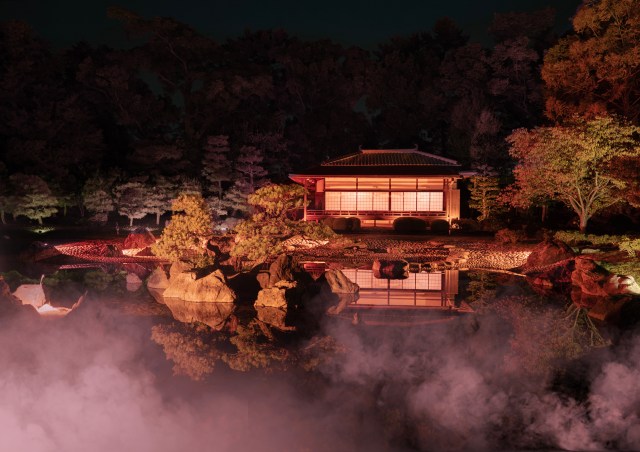
The journey culminates in Masako’s Night Tea Party, an immersive culinary and cultural experience. Guests are invited to sit within a specially designed nocturnal tea space that merges contemporary digital art with the solemn, meditative grace of traditional Japanese tea culture, bringing the hospitality of the 1626 imperial visit into the 21st century.
Supporting Context, Metrics, and Event Logistics
Staging a production of this magnitude within a UNESCO World Heritage Site requires a delicate balance between artistic ambition and rigorous preservation mandates. Nijo Castle’s fragile architectural assets—including its famous uguisubari ("nightingale floors") and priceless Kano School wall paintings—mean that all installations must be carefully engineered to leave zero physical footprint while maximizing sensory impact.
Ticketing, Pricing, and Accessibility
To manage crowd flow and ensure an intimate viewing experience, timed-entry ticketing is enforced throughout the duration of the exhibition.
- Event Dates: October 23, 2026 – December 5, 2026
- Operating Hours: 6:00 p.m. – 10:00 p.m. (Last entry strictly at 9:00 p.m.)
- Advance Ticket Pricing (Available through October 22):
- Weekdays: ¥1,600
- Weekends & Holidays: ¥2,000
- Standard Ticket Pricing (From October 23 onward):
- Monday – Thursday: ¥2,000
- Friday, Weekends & Holidays: ¥2,400
- Special Discounts: Students and registered Kyoto residents are eligible for an on-site ¥500 cashback refund upon presenting valid identification at the ticket booth.
Advance tickets can be secured digitally via major Japanese convenience store ticketing networks (Family Mart, 7-Eleven, Lawson, Eplus) as well as international travel platforms including Jalan and Rakuten Travel.
Official Statements and Industry Perspective
While Naked, Inc. has built an extensive portfolio of heritage-site activations—having previously illuminated landmarks in Tokyo, Kyoto, Nara, and beyond—the creative team views Naked Meets Nijo Castle 2026 as a distinct milestone in their institutional partnerships.
"When we approach a site as historically dense as Nijo Castle, our objective is never to overshadow the architecture with technology," notes a lead designer from Naked, Inc. "Instead, technology acts as a magnifying glass. The 1626 Kanei Gyoko was an event defined by a delicate, intentional exchange of culture between two opposing social classes. By utilizing light, sound, and interactive digital fashion inspired by figures like Tokugawa Masako, we are simply giving modern audiences the sensory tools to perceive the layers of human history that are already embedded in these stones."
Cultural preservation authorities in Kyoto have similarly praised the collaboration for its ability to drive sustainable tourism during the shoulder autumn season while educating younger generations on the nuanced political history of the early Edo period. Rather than relying on static signage, the exhibition allows visitors to absorb the geopolitical and artistic weight of the Kanei era through visceral, emotional engagement.
Future Outlook: The Evolution of Immersive Heritage Tourism
The launch of Naked Meets Nijo Castle 2026 underscores a broader, accelerating trend within Japan’s tourism and cultural preservation sectors: the shift toward experiential, tech-forward heritage engagement. As international visitor numbers continue to rebound to record highs, heritage sites face the dual challenge of accommodating mass tourism while preventing wear-and-tear on delicate structures.
By migrating major cultural programs into the evening hours through nighttime digital art exhibitions, destinations like Nijo Castle can effectively distribute visitor traffic across a 24-hour cycle. Furthermore, initiatives like Naked’s newly opened traditional craft workshop at Kyoto Station demonstrate a holistic business model—one that encourages visitors to transition from passive nighttime spectatorship into active daytime artisans.
For travelers fortunate enough to find themselves in Kyoto this autumn, Naked Meets Nijo Castle 2026 offers far more than just a picturesque evening stroll. It is a rare masterclass in historical translation, proving that when cutting-edge creativity meets four hundred years of imperial and shogunate history, the past does not merely echo—it brilliantly illuminates.








Belum ada komentar. Jadilah yang pertama berkomentar!