

Executive Overview
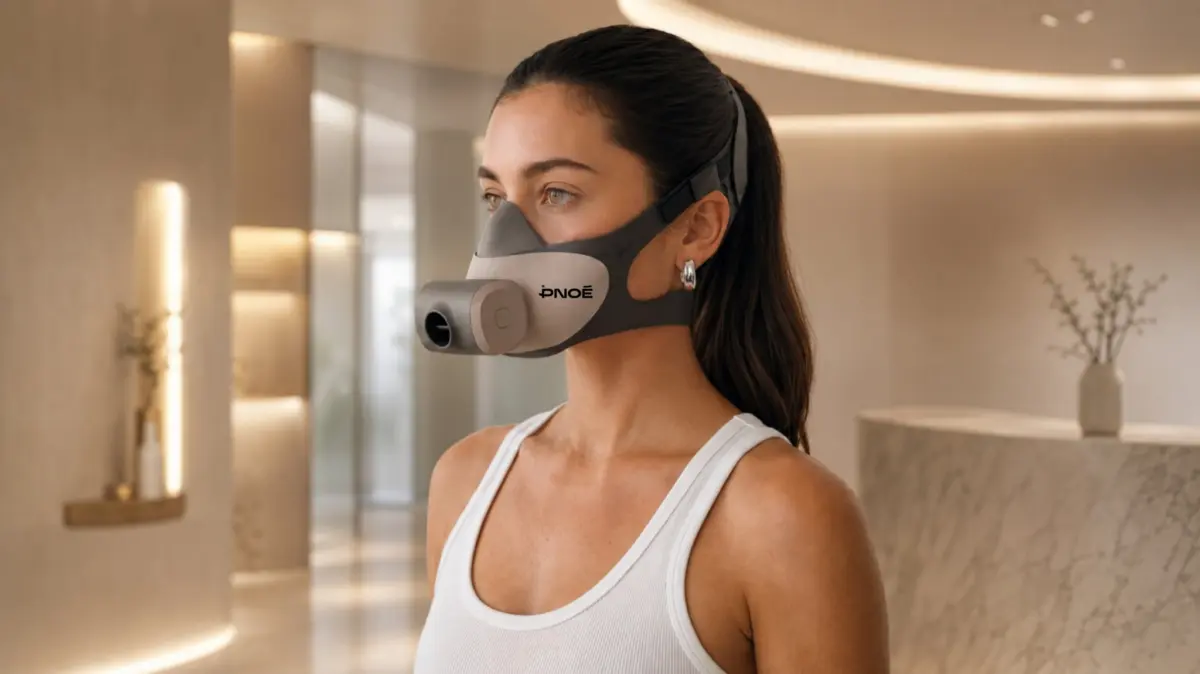
At first glance, the newest flagship device from health-tech startup PNOĒ evokes a striking piece of pop-culture iconography. The mask—designed to cover both the nose and mouth while securing tightly around the back of the head—bears an undeniable visual resemblance to the menacing facial gear worn by Bane, Batman’s hulking, venom-fueled adversary. Yet, despite its dystopian, sci-fi aesthetic, the device’s underlying purpose is entirely constructive, wellness-oriented, and surprisingly straightforward.
The apparatus is engineered to measure human respiration in real time, precisely tracking oxygen consumption and carbon dioxide exhalation. This raw respiratory data is then synthesized by companion software into actionable, highly personalized guidance on nutrition, athletic training, and—the company ultimately hopes—healthspan extension.
Founded by Cambridge PhD graduate Apostolos Atsalakis and childhood friend Panos Papadiamantis, PNOĒ is preparing for the commercial rollout of its second-generation platform, the PNOĒ 2.0, slated to launch on October 1. The defining breakthrough of this iteration is its fully self-administered testing protocol.
Unlike its predecessor, which required a certified technician to operate and monitor the session, the 2.0 model empowers everyday gym-goers to administer the test independently. A user simply walks into a partner facility, puts on the mask, pushes a start button, sits back, and breathes naturally for eight minutes.
+-----------------------------------------------------------------------------------+
|                            THE PNOĒ 2.0 TESTING PIPELINE                          |
+-----------------------------------------------------------------------------------+
|                                                                                   |
|  [1. USER ACTION]       --->   [2. RESPIRATORY CAPTURE]  --->  [3. DATA SYNTHESIS]  |
|  Put on silicone mask         Measure O2 consumed and        Process 23 distinct  |
|  & press start button         CO2 exhaled over 8 mins        biomarkers           |
|                                                                                   |
|                                                                                   |
|  [5. WELLNESS ADVICE]   <---   [4. SOFTWARE ENGINE]      <------------------------|
|  Tailored recommendations      Translate data into actionable                     |
|  for fitness & nutrition       training & caloric metrics                         |
+-----------------------------------------------------------------------------------+
This pivot from clinician-dependent hardware to a seamless, self-service model represents a fundamental shift in how advanced physiological data is gathered. By removing the labor bottleneck, PNOĒ can scale into staffed fitness studios, unstaffed boutique gyms, corporate wellness hubs, and even neighborhood pharmacies.
As the wellness industry shifts its gaze from superficial step-counting to deep metabolic health, PNOĒ is positioning itself as the bridge between bulky, hospital-grade metabolic carts and consumer-grade fitness trackers. With profitability secured, a growing global footprint, and a fresh $11 million funding injection in its coffers, the 10-year-old startup is betting that millions of consumers are ready to strap on a Bane-esque mask in pursuit of longevity.
Detailed Chronology: From Cambridge Labs to Global Scale
The genesis of PNOĒ can be traced back to the academic halls of the University of Cambridge, where co-founder Apostolos Atsalakis was immersed in doctoral research focusing on advanced sensing technologies. During this period, the consumer wearables market was experiencing its initial massive surge, popularized by wrist-worn step counters and basic optical heart-rate monitors.
However, Atsalakis became increasingly fascinated by a glaring limitation in the consumer tech landscape: while wearables were monitoring external motion and pulse, they were largely blind to the internal, chemical engine of the human body. He realized that breath—the most fundamental metabolic output—held vastly more complex and revealing data about human physiology than any wrist sensor could hope to capture.
Determined to translate academic sensing breakthroughs into practical consumer solutions, Atsalakis partnered with his childhood friend, Panos Papadiamantis. Papadiamantis, now serving as the company’s chief product officer, joined forces with Atsalakis to lay the groundwork for what would become PNOĒ.
In the winter of 2019, the fledgling startup was accepted into Y Combinator’s prestigious Winter cohort. At the time, "longevity" and healthspan optimization were nascent concepts restricted primarily to biohacking circles and academic gerontology labs, rather than the multi-billion-dollar consumer wellness category they represent today.
Following its time at Y Combinator, PNOĒ systematically built out its B2B distribution model, opting to sell directly to elite fitness chains, hotels, and healthcare institutions rather than pursuing a direct-to-consumer e-commerce strategy. This B2B2C framework allowed the company to scale its hardware deployment while leveraging the trust and operational staff of established brands.
Over its decade-long evolution, the startup has raised approximately $22 million in total capital. This funding trajectory includes a recently closed $11 million financing round backed by prominent institutional investors such as 50 Years, alongside high-profile angel investors including Google Maps co-founder Lars Rasmussen, who operates out of Athens, Greece.
Today, PNOĒ maintains a dual-headquarters operational structure, split between Malden, Massachusetts, and Athens, Greece, where its engineering and software development teams are housed. With a workforce of 110 employees, the company recently achieved profitability while maintaining a blistering year-over-year revenue growth rate exceeding 100%.
As it looks toward the immediate future, PNOĒ is preparing to initiate a Series B funding round within the next six to twelve months, aimed at fueling international expansion and accelerating the deployment of the PNOĒ 2.0 device across retail and wellness channels globally.
Supporting Context & Metrics: The Science of Biomarkers
To understand the commercial value proposition of PNOĒ, one must examine the physiological science underpinning metabolic testing. For well over a century, gas-exchange analysis has served as the undisputed clinical gold standard for quantifying human cardiorespiratory fitness.
Traditionally restricted to elite university sports laboratories, Olympic training centers, and cardiology departments, these assessments rely on heavy, expensive metabolic carts to calculate $textVO_2$ max—the maximum volume of oxygen an individual can utilize during exhaustive, incremental exercise. High $textVO_2$ max scores consistently correlate with lower all-cause mortality, making cardiorespiratory fitness one of the most robust, scientifically validated predictors of human longevity.
Despite its clinical utility, traditional metabolic testing has remained entirely inaccessible to the general public due to cost, equipment complexity, and the requirement of specialized technician supervision. PNOĒ aims to democratize this diagnostic capability.
According to company specifications, the PNOĒ testing suite captures 23 distinct metabolic biomarkers from a single breath-analysis session. These comprehensive metrics extend far beyond basic $textVO_2$ max calculations to include:
- Resting Metabolic Rate (RMR): The exact number of calories an individual’s body burns at complete rest, providing an empirical baseline for nutritional planning.
- Metabolic Flexibility: A measure of how efficiently the body transitions between oxidizing fats and burning carbohydrates for cellular energy under varying workloads.
- Cardiorespiratory Efficiency: Evaluating how effectively the heart, lungs, and vascular system deliver oxygen to working muscle tissue.
- Anaerobic Threshold: The precise point during exertion where lactic acid begins to accumulate in the bloodstream faster than it can be cleared.
+-----------------------------------------------------------------------------------+
|                        PNOĒ'S 23-BIOMARKER METABOLIC PROFILE                       |
+-----------------------------------------------------------------------------------+
|                                                                                   |
|   [CARDIORESPIRATORY]          [METABOLIC EFFICIENCY]       [CALORIC BASELINES]   |
|   • VO2 Max                    • Metabolic Flexibility      • Resting Metabolic   |
|   • Ventilatory Thresholds     • Fat vs. Carb Oxidation       Rate (RMR)          |
|   • Heart Rate Recovery          Ratios                     • Active Caloric      |
|   • Breathing Economy          • Cellular Oxygen Uptake       Expenditure         |
|                                                                                   |
+-----------------------------------------------------------------------------------+
CEO Apostolos Atsalakis emphasizes that these granular respiratory metrics answer critical physiological questions that standard blood draws simply cannot address. While a lipid panel or metabolic blood panel provides a static snapshot of chemical concentrations in the bloodstream at a specific moment in time, dynamic breath analysis reveals how the body’s cellular machinery actually functions under stress and at rest.
This functional insight enables individuals to tailor their caloric intake with precision and structure their cardiovascular and strength training zones around empirical metabolic thresholds rather than generalized heart-rate formulas.
Official Statements & Industry Positioning
The development of the PNOĒ 2.0 device required a rigorous, multi-year design process. Because no self-administered metabolic testing device of this caliber had ever been successfully commercialized, the startup collaborated closely with Milan-based industrial design powerhouse Design Group Italia.
According to Atsalakis, the partnership involved "a lot, a lot, a lot of iterations" to ensure the hardware was simultaneously rugged enough for gym environments, aesthetically approachable, and technically fail-safe.
A critical hurdle in designing shared fitness hardware—particularly in a post-pandemic consumer landscape—is hygiene and user confidence. To resolve the inevitable question of "who wore this mask last?", the PNOĒ engineering team decoupled the sensitive electronics from the physical silicone interface.
The sophisticated sensor pods and data transmitters easily detach from the medical-grade silicone mask and adjustable head straps. Consequently, commercial facilities can invest in a small number of costly electronic hardware units while allowing individual clients to purchase or retain their own personalized, affordable silicone masks.
Despite the clinical depth of its reporting, PNOĒ maintains strict regulatory boundaries regarding its market classification. The device is not cleared or approved by the U.S. Food and Drug Administration (FDA) as a medical diagnostic tool. Atsalakis is explicit about the company’s regulatory posture:
"We do not provide medical recommendations. It’s like a body composition device, like a scale. A doctor cannot prescribe medication based on our results."
Instead, PNOĒ consciously positions its ecosystem within the broader wellness and lifestyle sector, serving as an advanced bridge between casual consumer wearables and full clinical workups.
The company operates strictly on a B2B SaaS and hardware subscription model. Commercial clients—including high-end fitness institutions like Equinox (where PNOĒ is integrated across nearly all club locations), luxury hospitality brands like Four Seasons, elite athletic organizations including the NBA and Red Bull, the Mount Sinai Health System, and med-spa chains such as Restore Hyper Wellness—pay a recurring monthly subscription fee ranging from $400 to over $1,000.
This subscription package functions as a turnkey "business in a box," encompassing the physical hardware, continuous software updates, staff training programs, and comprehensive marketing collateral.
Crucially, the PNOĒ software integrates directly with the specific service offerings of the host business. If a gym or longevity spa administers a test, the platform automatically correlates the diagnostic output with the facility’s internal menu of personal training sessions, nutritional coaching, or recovery modalities, allowing businesses to upsell targeted services grounded in hard data.
Future Outlook: The Competitive Horizon and Clinical Aspirations
As PNOĒ accelerates its market penetration, it enters an increasingly crowded and competitive landscape. The middle ground of fitness diagnostics is heavily contested from multiple directions:
- Consumer Wearables: Technology giants and fitness disruptors like Apple, Garmin, and Whoop estimate $textVO_2$ max algorithmically using continuous optical heart-rate and accelerometer data, offering passive tracking with zero friction.
- Targeted Niche Devices: Consumer-focused breath analyzers like Lumen specifically target fat- and carbohydrate-burning states on a daily basis.
- Clinical Carts: Traditional, bulky metabolic carts continue to dominate hospital environments and high-end university human-performance laboratories.
PNOĒ carves out its distinct market niche by offering hospital-grade accuracy packaged into an eight-minute, self-administered routine designed specifically for commercial fitness environments. With approximately 85% of its revenue generated in the United States—which Atsalakis characterizes as "by far the most advanced market globally" for longevity and preventative wellness—the company is actively executing an international expansion strategy into Europe, Latin America, and Asia via strategic channel partners.
Looking further ahead, PNOĒ harbors long-term ambitions that extend beyond fitness and caloric optimization. Medical researchers have spent years investigating whether volatile organic compounds and metabolic signatures exhaled in human breath can serve as early diagnostic biomarkers for systemic pathologies, including various forms of cancer and metabolic diseases.
Atsalakis acknowledges that as the company’s proprietary database of human respiratory metrics expands exponentially, it could eventually serve as a powerful epidemiological tool for flagging underlying health anomalies.
However, the company remains deliberately measured in its near-term roadmap. Full clinical diagnostics and formal regulatory clearances are, in Atsalakis’s estimation, "definitely a couple of years away," with stringent regulatory hurdles likely to stretch development timelines.
For now, the immediate focus remains singular: scaling the PNOĒ 2.0 deployment, expanding its B2B footprint across premium wellness centers, and normalizing the sight of fitness enthusiasts strapping on a Bane-inspired mask in gyms worldwide in the relentless pursuit of human longevity.








Belum ada komentar. Jadilah yang pertama berkomentar!