

Executive Overview
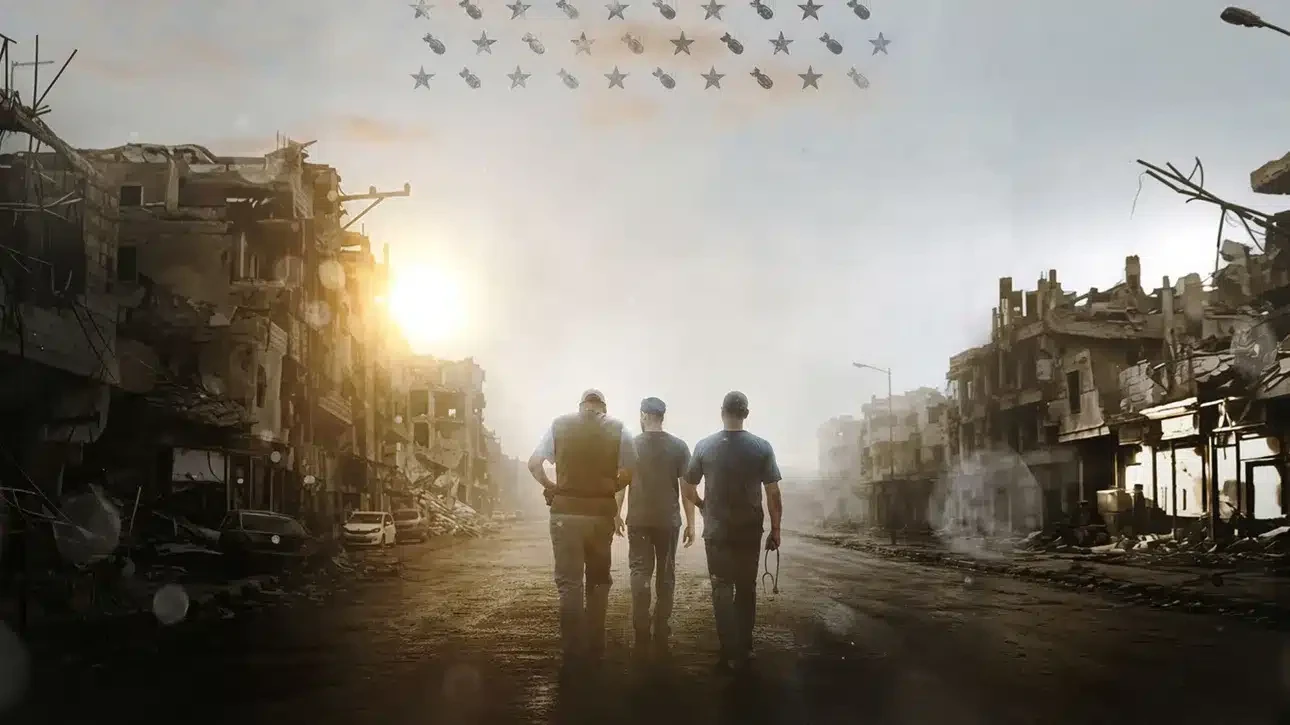
In the sprawling landscape of contemporary documentary filmmaking, few projects step quite as deliberately—and perhaps perilously—into the geopolitical crosshairs as Poh Si Teng’s American Doctor. The documentary tracks the harrowing, transformative journeys of three United States medical professionals who volunteered in the Gaza Strip immediately before, during, and after the 2025 ceasefire.
The subjects are all "birthright" American citizens, a demographic distinction that holds intense weight in the current polarizing political climate:
- Dr. Mark Perlmutter, a Jewish-American orthopedic surgeon hailing from North Carolina;
- Dr. Thaer Ahmad, a Palestinian-American emergency room physician from Illinois; and
- Dr. Feroze Sidhwa, a Parsi-American trauma surgeon based in California.
At its core, American Doctor attempts an observational, verité-style chronicle of high-stakes humanitarian work under fire. However, the film frequently stumbles at the intersection of pure documentation and necessary contextualization. Director Poh Si Teng presents a work that is visually stunning, driven by the raw, unvarnished testimonies of its physician-subjects. Yet, the documentary struggles with a profound structural tension: by refusing to actively interrogate, contextualize, or fact-check the explosive claims made on screen—opting instead for an "old-school" observational purity—the film risks reducing complex geopolitical suffering to a series of aestheticized, frictionless images.
This review-analysis explores the thematic, ethical, and political dimensions of American Doctor, weighing its raw emotional power against its analytical shortcomings, and examining how a well-crafted war documentary risks getting lost in the broader, numbing echo chamber of global political indifference.
Detailed Chronology: From the Operating Room to the Halls of Congress
Act I: The Dilemma of Representation
American Doctor wastes no time thrusting the viewer into ethical quagmires. The documentary opens with a tense, revealing editorial debate between Director Poh Si Teng and subject Dr. Mark Perlmutter over whether to include an unblurred photograph of dead children. Teng initially argues for digital blurring, invoking the principle of the “dignity of the dead” and leaning on professional documentary guidelines—such as those promoted by human rights audiovisual organizations like WITNESS. Teng’s underlying, unspoken question is crucial: Does displaying the raw photograph deepen the documentary’s analytical scope, or does it merely shock the viewer?
Perlmutter counters successfully, arguing that showing the image unblurred actually restores the dignity stripped from the children during their violent deaths, bolstered by explicit family consent. He insists that audiences must confront the unvarnished physical reality of what transpires in Gaza, rather than accepting the metaphorical and literal blurring common in sanitized Western media coverage.
When the film relents and displays the photograph, it proves remarkably tranquil, eliciting a sublime sorrow rather than cheap shock value. Yet, this opening debate sets a precedent: from this moment onward, the documentary plunges into increasingly graphic depictions of violence, testing the boundaries of viewer endurance.
Act II: Abstract Violence and the Hollywood Spectacle
As the narrative moves deeper into the conflict zones, American Doctor ventures into territory the director frames as "abstract violence." Drone footage hovers apathetically over miles of pulverized urban infrastructure, reducing multi-story apartment blocks and civic centers to flattened, dystopian grey plains. Groups of displaced civilians appear as microscopic black dots traversing cleared paths through mountains of rubble.
The aesthetic parallels are unmistakable: these frames look precisely like establishing shots from high-budget Hollywood post-apocalyptic blockbusters. A viewer could easily imagine a marquee action star—a Tom Hanks, a Denzel Washington, or a Tom Hardy—stepping into the frame as the beleaguered protagonist.
This stylistic choice triggers a chilling meta-critique: Do fictional movies look like reality, or has reality become entirely indistinguishable from the endless stream of digitally rendered violence consumed daily from the comfort of domestic safety? Teng’s camera captures the devastation with breathtaking composition, color, and lighting, courtesy of cinematographers Ibrahim Al Otla and Chris Renteria. But in making a war zone look so visually exquisite, the film runs the risk of rendering the human cost dangerously thin, transforming real-time atrocities into high-art cinematic wallpaper.
Act III: Lobbying the Capital and the Limits of Testimony
The final movement of American Doctor shifts its geographical focus from the shattered operating tents of Gaza to the cavernous, marble-columned corridors of the United States Congress and international policy panels. Here, the documentary follows the exhausted trio of doctors as they attempt to translate their trauma into legislative momentum.
The camera trails the physicians and their advocacy entourage through a grueling gauntlet of meetings with congressional staffers and elected officials. Some lawmakers listen intently, visibly moved; many more are conspicuously absent, leaving aides to issue rehearsed diplomatic platitudes or defensive pushback. The doctors participate in panel discussions, give relentless press interviews, and lobby the administration for policy shifts and unfettered humanitarian aid.
Yet, the editing in this final sequence is frantic and brief, conveying an impression of frantic, wheel-spinning activity with minimal tangible result. The underlying tragedy exposed here is not that the world refuses to listen to the doctors, but rather that the facts were never genuinely in dispute. The political apparatus is not ignorant of the destruction; it is indifferent to it.
Supporting Context & Metrics: The Global Geography of Indifference
To fully grasp the critical weight of American Doctor, one must contextualize its narrow geographic focus against the broader, grim ledger of 21st-century humanitarian crises. While Teng’s decision to focus entirely on the Gaza Strip is emotionally potent, it invites difficult questions regarding the selective allocation of Western moral outrage and cinematic attention.
| Crisis / Conflict Region | Estimated Scale / Impact (Documented Metrics) | Relevant Verifying Body |
|---|---|---|
| Gaza Strip | Tens of thousands of civilian casualties; systematic destruction of medical infrastructure. | United Nations OCHA / Local Health Ministries |
| Ukraine | Approximately 20,000 Ukrainian children subjected to forced transfers and mass abductions. | Yale Humanitarian Research Lab |
| Sudan | Systematic, widespread deployment of mass sexual assault as a weapon of war. | United Nations Human Rights Monitors |
| Myanmar / Bangladesh | Over 1 million Rohingya refugees displaced in sprawling camps fleeing what the US State Department terms genocide. | UNHCR / US State Department |
| United States Border | Routine detention of roughly 50,000 individuals daily (exceeding 500,000 annually); average daily deportations exceeding 1,000. | Department of Homeland Security (DHS) |
When placed within this grim global matrix, a critical inquiry emerges: Why focus exclusively on Gaza to the total exclusion of concurrent, systemic human rights collapses across Sudan, Myanmar, or Ukraine?
Furthermore, domestic metrics complicate the moral framing. In 2026, the United States Department of Homeland Security maintained a daily detention population hovering around 50,000 people, while international investigators continue gathering evidence regarding potential civilian casualties stemming from US military engagements abroad. By hyper-focusing on a single conflict without contextualizing it within the broader machinery of global superpower complicity, American Doctor occasionally feels insular, leaving audiences to wonder whether the documentary aims to enlighten or merely to echo existing ideological echo chambers.
Official Statements and Subject Perspectives
The documentary relies heavily on the direct, unmediated testimonies of its three primary subjects, each bringing a distinct socio-political lens to the operating table. Because Director Teng largely eschews editorial intervention, these statements stand on screen virtually unchallenged, inviting strong polarized reactions from viewers.
-
Dr. Mark Perlmutter (Orthopedic Surgeon, North Carolina):
"We are seeing injuries that no human being should ever have to treat… This is not merely a war on combatants; this is a systematic erasure. What we are witnessing meets every definition of genocide."
Perlmutter’s willingness to invoke fierce, highly charged political terminology—including explicit critiques of Zionism—stems from his unique positioning as a Jewish-American clinician. While some viewers find his moral clarity indispensable, others argue that his unvarnished rhetoric, left unexamined by the filmmaker, pushes the documentary dangerously close to partisan polemic. -
Dr. Feroze Sidhwa (Trauma Surgeon, California):
Addressing the contentious military assertions regarding hospital facilities, Sidhwa is blunt:"The claims that Hamas built command tunnels beneath medical facilities are simply untrue. I walked those halls; I operated in those rooms. The evidence presented by military authorities does not match the reality on the ground."
Though occasional figures in the background attempt to challenge Sidhwa’s assertions, the film offers no investigative follow-up, leaving the veracity of these competing claims suspended in an editorial vacuum. -
Dr. Thaer Ahmad (ER Physician, Illinois):
Reflecting on the emotional toll of his deployment, Ahmad captures the existential exhaustion of humanitarian work in active combat zones:"The last nine months have been nothing short of horrific. You try to piece children back together while the ceiling shakes above you, knowing full well that the weapons being used carry ‘Made in the USA’ stamps."
Future Outlook: The Legacy of Verité War Documentaries
As American Doctor finds its way to festival circuits, streaming platforms, and academic seminars, its ultimate legacy will likely rest not on its ability to shift foreign policy, but on its utility as a primary historical artifact.
The film operates less as an analytical essay and more as a digitized archive—a collection of field letters, audio diaries, and high-definition visual evidence that future historians will undoubtedly parse to understand the psychological toll of the Gaza conflict on Western medical volunteers. Yet, its refusal to contextualize leaves it intellectually vulnerable.
Key Takeaways for Future Filmmakers:
- The Danger of Pure Observation: When covering complex asymmetric warfare, pure observational documentary risks abdicating the filmmaker’s responsibility to provide structural context, leaving audiences prone to confirmation bias.
- Aestheticizing Atrocity: Cinematographic excellence in war documentaries can inadvertently create a numbing effect, where the horror of human suffering is swallowed up by the beauty of the composition.
- The Limits of Moral Testimony: While personal testimonies from doctors on the front lines are profoundly moving, they cannot substitute for rigorous investigative journalism and multi-angled geopolitical analysis.
Ultimately, American Doctor will elicit precisely what the viewer brings into the theater with them. Supporters of Israel’s military campaign will likely view the project as uncritical advocacy; fierce critics of the war will find their pre-existing moral outrage validated; and those caught in the exhausted middle will leave saddened, yet fundamentally unchanged. In an era saturated with high-definition digital trauma, Poh Si Teng’s film proves that capturing suffering on camera is no longer enough—the harder, more essential task is explaining why the world has chosen to watch in silence.





Belum ada komentar. Jadilah yang pertama berkomentar!