YAMANASHI PREFECTURE, JAPAN — Just a two-hour journey by car or train from the urban sprawl of Tokyo, and roughly an hour from the iconic slopes of Mount Fuji, lies a sanctuary of seasonal transformation: Hokuto City. Nestled within Yamanashi Prefecture and encircled by the towering grandeur of Japan’s southern and southern-central peaks, Hokuto City transitions into a living canvas every autumn. As the crisp alpine air sweeps down from the mountains, the region ignites in a breathtaking palette of crimson maples, golden larches, and deep emerald waterways.
For travelers seeking an escape from the city to witness the vibrant Japanese koyo (autumn foliage) season, Hokuto City offers an array of lesser-known yet astonishingly beautiful destinations. Below is an exhaustive journalistic overview of the seven must-visit autumn foliage spots in Hokuto City, complete with logistical details, historical context, and essential traveler advisories for the 2026 season.
Executive Overview: The Geography of Hokuto’s Autumn
Hokuto City’s topography is defined by its dramatic elevation changes, river-carved valleys, and proximity to legendary Japanese peaks like Mount Yatsugatake, Mount Komagatake, and Mount Kinpu. This geographical diversity creates a staggered autumn foliage season that typically rolls across the landscape from mid-October through late November.
Unlike the manicured gardens of Kyoto or the bustling parks of Tokyo, Hokuto’s autumn charm lies in its wild, untamed nature. Visitors here walk ancient samurai paths, gaze down dizzying gorges from suspended engineering marvels, and trace crystal-clear streams born from the melting snows of the Southern Japanese Alps. However, accessing these natural masterpieces requires careful planning, as seasonal road closures and ongoing infrastructure projects can impact travel itineraries.
Detailed Chronology of the Seven Wonders
1. Higashizawa Ohashi Bridge (The "Red Bridge")
Location: Kiyosato district
Best Viewing Period: Mid-October to early November
Advisory Note:Major repair work is scheduled from September 1, 2026, to August 10, 2027. During this window, half of the bridge will be covered with scaffolding sheets, which may partially obstruct the view.
Spanning 90 meters across a deep, forested gorge in Kiyosato, the Higashizawa Ohashi Bridge—affectionately nicknamed the "Red Bridge"—is one of Yamanashi’s most photographed landmarks. Painted a striking vermilion, the arch bridge cuts a dramatic line through the landscape.
During the peak of autumn, the surrounding gorge explodes into the vibrant colors of Nishiki (brocade-like autumn leaves). The bright red structure creates a stunning, high-contrast visual against the earthy tones of the gorge, framed in the background by the majestic, jagged peaks of the Yatsugatake Mountains. For photographers and sightseers, the observation deck situated on the east side of the bridge (facing Kiyosato Station) offers the most exceptional vantage point. Despite the 2026–2027 repair work, the juxtaposition of the alpine backdrop and the changing larch and maple trees remains a powerful draw.
Advisory Note:The trail beyond Chigafuchi is exceptionally narrow with severe drop-offs. Proper hiking boots and gear are mandatory. Inexperienced hikers or those lacking physical endurance should avoid the deeper trails. Additionally, the forest road beyond Sengafuchi is closed during the winter season from early December to late April.
Carved by waters originating directly from the Southern Japanese Alps, the Ojiragawa Valley holds official status as one of "Japan’s 100 Exquisite and Well-Conserved Waters." Approximately a 15-minute walk from the main parking lot brings visitors to Senga-fuchi, a mesmerizing pool where crystal-clear emerald-green water meets the fiery red and yellow foliage of native beech and maple trees.
The visual harmony between the crystalline river and the autumnal canopy is nothing short of magical. While casual visitors can easily enjoy the tranquil beauty near Sengafuchi, the valley also serves as a gateway for serious trekkers. A network of trails pushes deeper into the gorge, revealing a series of hidden waterfalls. However, municipal authorities strongly advise caution due to the rugged and hazardous nature of the terrain.
3. Yatsugatake Kogen Great Bridge (The "Yellow Bridge")
Location: Kiyosato / Yatsugatake highlands
Best Viewing Period: Late October to early November
Serving as a chromatic counterweight to the Red Bridge, the Yatsugatake Kogen Great Bridge—frequently dubbed the "Yellow Bridge"—stretching 490 meters across and soaring 100 meters above the valley floor, is an architectural marvel.
Equipped with a dedicated pedestrian walkway, the bridge provides an unobstructed, panoramic platform for landscape enthusiasts. Looking north, visitors are greeted by the formidable Yatsugatake Mountains; turning southwest reveals the expansive Minami Alps; and to the south, the solitary, snow-dusted peak of Mount Fuji pierces the horizon. In autumn, the valley below transforms into a rolling sea of gold and orange foliage. For the optimal photographic composition and easiest access, travelers are advised to utilize the observation deck parking lot located on the eastern side of the bridge, toward Kiyosato Station.
4. Mizugakiyama Nature Park
Location: Base of Mount Mizugaki
Best Viewing Period: Mid-October to early November
Advisory Note:Access forest roads are closed seasonally during the winter months, typically spanning from early December to late April.
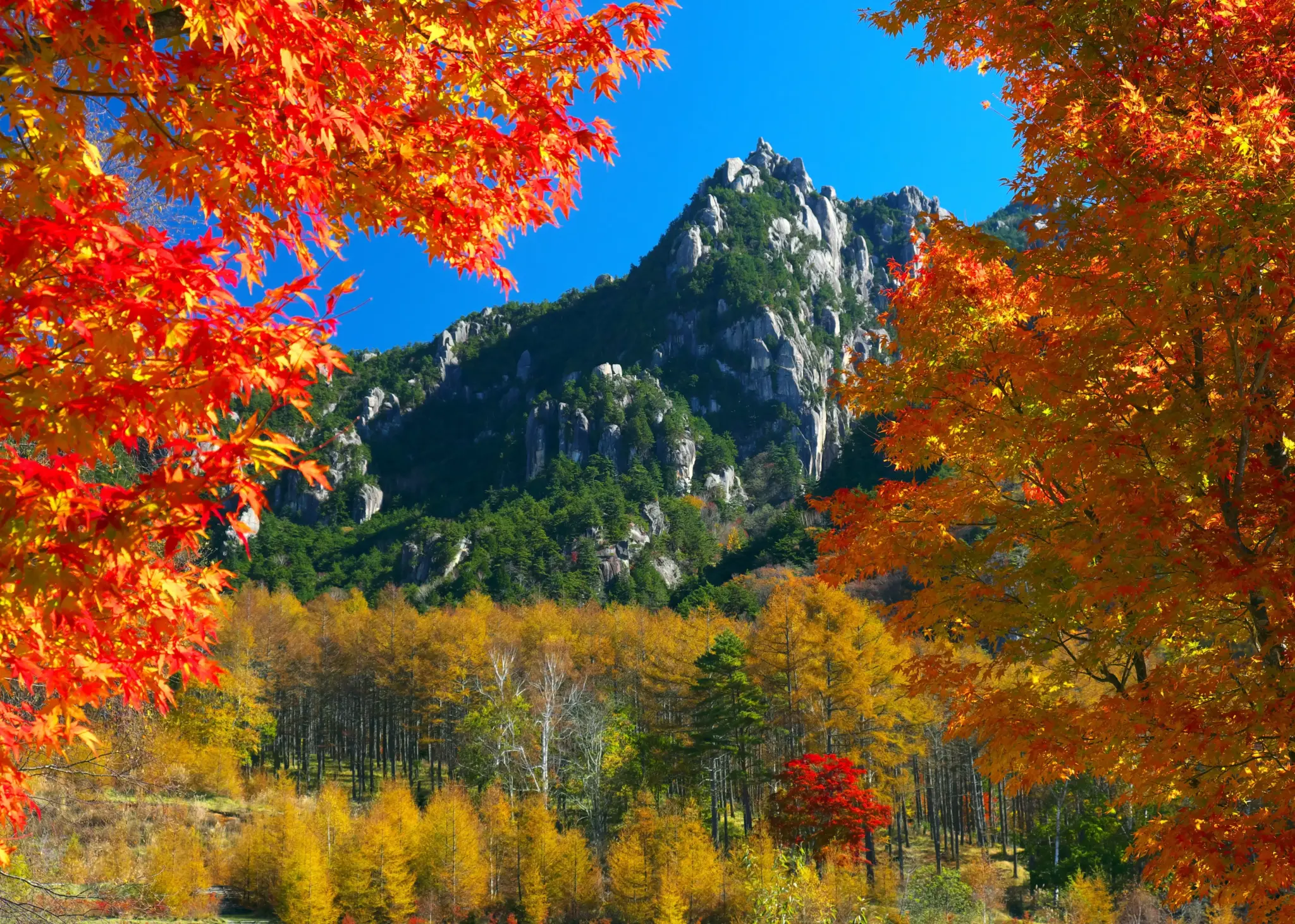
Situated at the rugged foot of Mount Mizugaki—a peak enshrined as one of "Japan’s 100 Famous Mountains"—the Mizugakiyama Nature Park is an expansive alpine sanctuary. The park’s primary geological feature is the imposing, monolithic granite spire of Mount Mizugaki itself, which thrusts aggressively into the sky.
When autumn arrives, the park undergoes a dramatic atmospheric shift. The native larch trees turn a brilliant, glowing gold, while scattered maples flare crimson against the pale, weathered rock faces of the mountain. The juxtaposition of jagged granite crags, golden needles, and crisp blue autumn skies delivers a visual experience that defines the Japanese highland autumn.
5. Hontanigawa Valley
Location: Mount Kinpu foothills
Best Viewing Period: Late October to early November
Advisory Note:Certain sections of the local forest road network are closed for the winter season from early December to late April.
Carved by the Hontanigawa River—which traces its source to the sacred slopes of Mount Kinpu—this secluded valley represents the pinnacle of pristine Japanese riverine ecology. The stream has been officially recognized as one of the "100 Best Waters of the Heisei Era."
In October and November, the valley’s native larch and maple stands turn vivid shades of amber, copper, and yellow, casting colorful reflections onto the mirror-like surface of the river. The Hontanigawa Valley offers a remarkably tranquil retreat from busier tourist corridors, providing visitors with a quiet space to absorb the meditative sights and sounds of tumbling clear water meeting vibrant autumn canopies.
6. Shingen Bomichi (Shingen’s Straight Road)
Location: Historical Yamanashi trail system
Best Viewing Period: Late October to early November
Blending natural splendor with deep historical resonance, the Shingen Bomichi is an authentic military highway constructed by the legendary Sengoku-period warlord Takeda Shingen (1521–1573). Built to facilitate troop movements across his domain, the route earned the name "Bo" (pole) road due to its characteristic, uncompromising straight-line layout.
Today, the historic corridor has been carefully preserved and developed into a nature trail, earning a designation as one of the "500 Beautiful Walking Paths in Japan." As autumn deepens, the ancient route transforms into a golden tunnel formed by rows of mature larch trees. Walking this path offers a profound sense of temporal connection: along the trail, moss-covered stone Buddhist statues—silent witnesses that have stood watch since the Edo period (1603–1868)—look out over the seasonal transformation, offering modern travelers a deeply romantic glimpse into Japan’s feudal past.
7. Fujimi-daira (Mt. Fuji View Plateau)
Location: High-altitude plateau region
Best Viewing Period: Mid-October to early November
Advisory Note:Access forest roads close for the winter season earlier than lower elevations, typically from late November through late April.
True to its descriptive name—meaning "Mt. Fuji View Plateau"—Fujimi-daira is a high-altitude vantage point engineered by geography to offer unobstructed, sweeping sightlines directly toward Mount Fuji.
During the peak of the autumn season, the plateau is encircled by stands of larch trees that transition into a brilliant golden hue. This sea of gold serves as a magnificent foreground framing the distant, snow-capped or clear-weather profile of Japan’s most revered peak. Accompanied by the crisp, invigorating alpine air, the vista from Fujimi-daira provides a sensory climax to any Hokuto City autumn itinerary.
Supporting Context & Metrics
To assist travelers, regional tourism data outlines the following strategic metrics for visiting Hokuto City during the autumn window:
Travel Accessibility: Located roughly 120 kilometers west of central Tokyo, Hokuto City is reachable via a 2-hour drive along the Chuo Expressway or an efficient 2-hour journey via the JR Chuo Main Line express trains.
Elevation Profile: Hokuto City features wide variations in elevation, ranging from 400 meters in the valley floors up to over 2,500 meters in the surrounding mountains. This vertical drop is the primary driver behind the rolling wave of autumn colors (koyo front), which descends from the peaks downward between mid-October and late November.
Water Quality Index: Three of the seven featured locations (Ojiragawa Valley, Hontanigawa Valley, and surrounding watersheds) hold national designations for water conservation and purity, making Hokuto one of Japan’s premier destinations for combining aquatic clarity with terrestrial foliage.
Official Statements and Local Tourism Perspectives
Municipal tourism authorities in Yamanashi Prefecture emphasize that Hokuto City’s appeal lies in its capacity to offer authentic, uncommercialized wilderness experiences.
"Hokuto City occupies a unique geographical sweet spot," notes a representative from the Hokuto City Tourism Association. "Within a two-hour radius of a megalopolis like Tokyo, visitors can step back centuries along Takeda Shingen’s historic military roads or gaze upon untouched alpine valleys that rival any national park in the world. Our goal for the 2026 autumn season is to welcome travelers while ensuring they respect our mountain ecology—particularly regarding trail safety in regions like the Ojiragawa Valley."
Officials also stress the importance of public awareness regarding infrastructure maintenance, specifically pointing to the structural preservation work underway at the Higashizawa Ohashi Bridge. While aesthetic modifications are present through August 2027, regional planners maintain that the surrounding vistas across the Kiyosato highlands remain fully accessible and rewarding.
Future Outlook: Sustainable Tourism in Hokuto
Looking ahead, Hokuto City is expanding its focus on sustainable alpine tourism. As seasonal weather patterns shift and international interest in regional Japanese destinations grows, municipal planners are implementing enhanced trail markers, digital multilingual advisories for road closures, and improved waste-management protocols around high-traffic viewing points like Mizugakiyama and Fujimi-daira.
For the autumn 2026 season and beyond, Hokuto City stands ready to welcome a new generation of hikers, photographers, and peace-seekers. Whether you are tracing the steps of medieval samurai along the Shingen Bomichi or marveling at the emerald waters of Senga-fuchi, Yamanashi’s hidden foliage capital offers an unforgettable journey into the heart of Japanese nature.


![[Autumn 2026] Just 2 hours from Tokyo ! 7 must-see autumn foliage spots in Hokuto City , Yamanashi Prefecture, rich in nature!](https://resources.matcha-jp.com/resize/720x2000/2025/10/22-247709.webp)
![[Autumn 2026] Just 2 hours from Tokyo ! 7 must-see autumn foliage spots in Hokuto City , Yamanashi Prefecture, rich in nature!](https://resources.matcha-jp.com/resize/720x2000/2024/09/27-199306.webp)
![[Autumn 2026] Just 2 hours from Tokyo ! 7 must-see autumn foliage spots in Hokuto City , Yamanashi Prefecture, rich in nature!](https://resources.matcha-jp.com/resize/720x2000/2024/09/27-199309.webp)
![[Autumn 2026] Just 2 hours from Tokyo ! 7 must-see autumn foliage spots in Hokuto City , Yamanashi Prefecture, rich in nature!](https://resources.matcha-jp.com/resize/720x2000/2024/09/27-199312.webp)
![[Autumn 2026] Just 2 hours from Tokyo ! 7 must-see autumn foliage spots in Hokuto City , Yamanashi Prefecture, rich in nature!](https://resources.matcha-jp.com/resize/720x2000/2025/10/21-247463.webp)
![[Autumn 2026] Just 2 hours from Tokyo ! 7 must-see autumn foliage spots in Hokuto City , Yamanashi Prefecture, rich in nature!](https://resources.matcha-jp.com/resize/720x2000/2025/10/21-247475.webp)
![[Autumn 2026] Just 2 hours from Tokyo ! 7 must-see autumn foliage spots in Hokuto City , Yamanashi Prefecture, rich in nature!](https://resources.matcha-jp.com/resize/720x2000/2025/10/21-247477.webp)
![[Autumn 2026] Just 2 hours from Tokyo ! 7 must-see autumn foliage spots in Hokuto City , Yamanashi Prefecture, rich in nature!](https://resources.matcha-jp.com/resize/720x2000/2025/10/22-247536.webp)







Belum ada komentar. Jadilah yang pertama berkomentar!