

Executive Overview
For a genre historically plagued by mischaracterizations, shifting commercial paradigms, and critical derision, emo has quietly emerged as one of the most resilient subcultural movements of the 21st century. In the mid-to-late 1990s, guitar-driven underground bands with heart-on-sleeve lyricism forged an intimate bridge between punk rock and indie melancholia. However, the genre suffered a protracted identity crisis during the late 2000s, morphing into a glammed-up, Hot Topic-driven caricature that favored image over substance and mirrored the casual misogyny of 1980s hair metal.
When major-label support dried up, commercial radio lost interest, and tastemaker publications like Pitchfork and Alternative Press turned their backs on the scene, emo was left for dead. Yet, out of these commercial ashes grew the "fourth wave"—an organic, fiercely independent resurrection spearheaded by millennials who bypassed traditional industry routes in favor of DIY house shows, basement networks, and digital word-of-mouth.
Author and journalist Andrew Sacher captures this vital chapter in music history in his new book, Emo Revival: Community, DIY, and Rebirth in Post-Hardcore and Emo (2008–2018). Chronicling the underground networks that stretched across North America, the United Kingdom, Canada, and Japan, Sacher’s work documents how a marginalized community of bands, labels, and fans reclaimed the earnest roots of second-wave emo. Far from a fleeting nostalgia trip, the fourth-wave revival established an enduring, self-sustaining ecosystem that continues to shape the contemporary alternative landscape.
Detailed Chronology: From the Second Wave to the Basement Renaissance
The Golden Era and the Lost Decade
To understand the emergence of the 2010s revival, one must look back at the foundational architecture of the 1990s. Fueled by jagged guitars and deeply confessional songwriting, bands like Sugar, Superchunk, Sebadoh, Archers of Loaf, and Built to Spill captivated fans who straddled the line between punk, hardcore, and indie rock. This second wave—bolstered by icons like Braid, The Promise Ring, Texas Is the Reason, and Jawbreaker—prioritized emotional vulnerability and unpolished musicianship.
However, as the 2000s dawned, the landscape shifted dramatically. Emo entered its third, commercially dominant wave. While bands like My Chemical Romance managed to transcend the era’s limitations with grand theatricality, the broader commercial landscape devolved. Emo became synonymous with fashion-conscious post-hardcore, neon aesthetics, and bitter, hyper-masculine "ex-boyfriend" grievances. By the late 2000s, the genre had exhausted its commercial viability. Major labels dropped their rosters, the Vans Warped Tour pivoted toward digital metalcore and neon pop-punk, and the culture at large wrote emo off as a juvenile, misogynistic fad.
The Fourth-Wave Awakening (2008–2018)
With no festivals willing to book them, no magazines willing to review them, and no major labels offering contracts, a new generation of musicians was forced into isolation. Instead of folding, these artists leaned into collective survival.
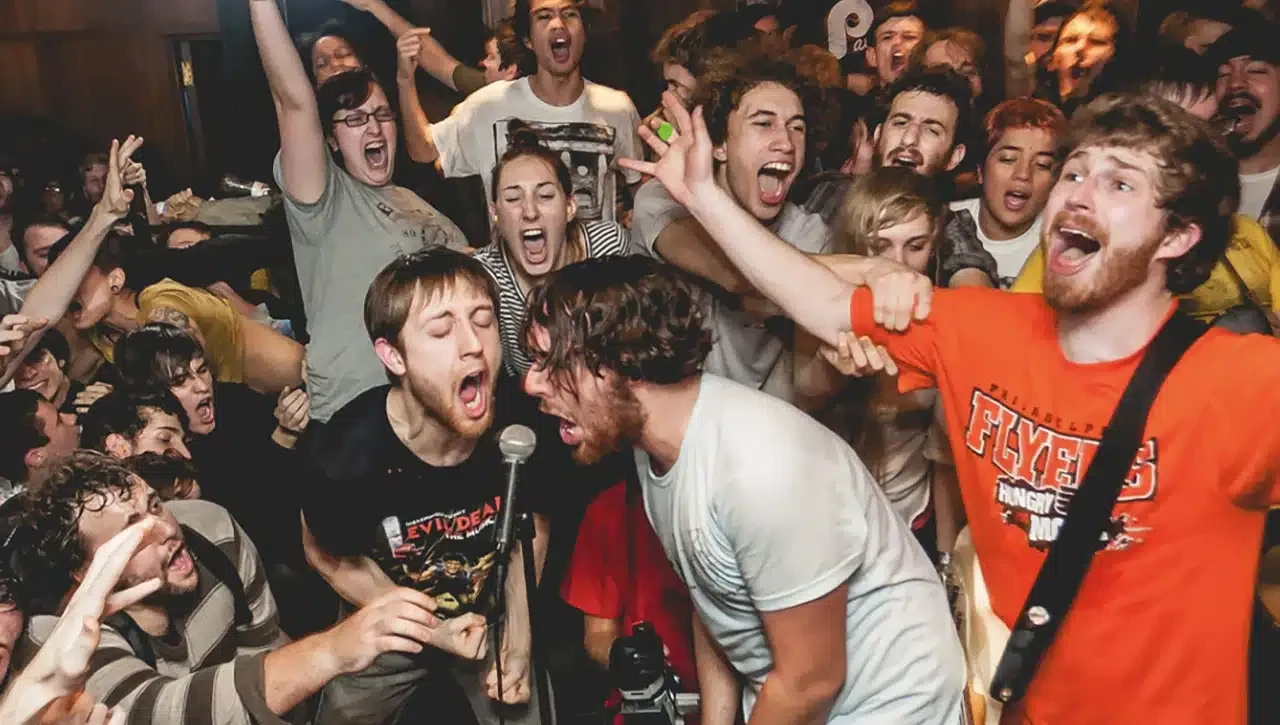
Beginning around 2008, a fourth wave quietly took shape. Bands like The Wonder Years, Modern Baseball, Tigers Jaw, Into It. Over It., Snowing, and Algernon Cadwallader began playing cramped, all-ages basements, VFW halls, and DIY spaces. Taking direct cues from 1990s touchstones like Cap’n Jazz and American Football rather than their immediate third-wave predecessors, these young artists prioritized community over commercial breakthroughs.
By 2013, the movement had outgrown its hidden-in-plain-sight status. Fueled by impassioned music blogs, independent record labels, and word-of-mouth networks, the scene exploded into an international phenomenon. Basement shows transformed into regional circuits, eventually catching the attention of music critics who were forced to acknowledge a massive, thriving infrastructure operating entirely outside the traditional industry machine.
Supporting Context & Metrics: The Mechanics of the Underground
The 2010s emo revival was not sustained by algorithmic playlists or heavy radio rotation; it was powered by a hyper-committed micro-economy of independent record labels, DIY promoters, and multi-regional venue runners.
At the heart of this ecosystem were boutique independent labels that took financial risks on unknown bands, creating physical and digital distribution networks that rivaled mid-tier commercial operations. Labels such as:
- Top Shelf Records
- Run for Cover Records
- Tiny Engines
- Count Your Lucky Stars
These entities acted as the institutional anchors of the movement. Similarly, regional DIY venues—often converted basements, living rooms, and cooperative spaces managed directly by the musicians themselves—fostered an atmosphere where the traditional barrier between artist and fan evaporated entirely.
The Shift in Critical Reception
For years, tastemaker publications treated emo with open hostility. Seminal releases from the second and third waves were routinely panned or ignored by critics who favored avant-garde indie rock or polished pop-punk. However, as the fourth wave gained undeniable momentum, a cultural course-correction occurred. Publications like Pitchfork began reevaluating canonical emo records, publishing retrospective reviews that elevated albums once dismissed as overly melodramatic to masterclasses in songwriting.

Despite this retroactive validation, the economic reality of fourth-wave emo remained distinct from its predecessor. While third-wave bands frequently achieved gold and platinum records, fourth-wave acts operated in a sustainable middle ground. Even breakout groups like Title Fight or festival staples like Hot Mulligan maintained deep ties to independent labels, proving that a band could achieve international acclaim without surrendering creative control to major conglomerates.
Official Statements: Perspectives from the Frontlines
Andrew Sacher, speaking on the organic nature of the movement, emphasizes that the fourth wave was rarely conceived as an intentional ideological rebellion against third-wave excesses. Instead, it was an aesthetic evolution driven by millennial musicians discovering underground punk through accessible mainstream entry points.
"A lot of these bands’ members are millennials. A lot of them found punk or emo or hardcore through bands like Blink-182 or Taking Back Sunday, and those were some of the biggest bands in the world at that point," Sacher explains. "Punk is very accessible because it was literally all around them, and then from there, it’s an easy path to Lifetime or Cap’n Jazz. I think what happened is these people found punk through the mainstream stuff, kind of quickly found the more underground stuff, and thought that held more appeal for them."
Crucially, these artists sought to strip away the toxic bravado and casual misogyny that marred the genre’s commercial peak.
"One of the great things about punk and hardcore is it gives people a vessel to really open up about inner emotions," Sacher notes. "I think that in the third wave emo scene, a lot of bands ended up taking that to a really sort of toxic conclusion. But fourth wave bands were like, ‘Well, I want to be open and vulnerable and use that side of punk and hardcore, but I want to do it in a more responsible and respectful way.’"
Recalling the early days of the revival, Sacher draws direct parallels to the foundational ethos of early American hardcore:
"I remember seeing many of these bands play shows back when there wasn’t attention on them. There would be a hundred people here, but everybody was just deeply in it. It felt like what I imagined it must have felt like to have seen a great hardcore show in 1981… Everyone there was so passionate, but it was still this tiny thing."
Veterans of earlier eras also experienced a cultural rehabilitation through the movement. Second-wave icons like Steve Holmes and Steve Lamos of American Football and Chris Simpson of Mineral noted how the label "emo" had historically functioned as a journalistic slur. Yet, fourth-wave bands eagerly embraced the designation, transforming a pejorative descriptor into a badge of honor and bridging generational divides within the subculture.
Future Outlook: The Enduring Legacy of Emo’s Fourth Wave
As the shockwaves of the 2010s revival settle, the landscape of alternative music bears the permanent imprint of its DIY infrastructure. While industry analysts frequently debate whether an emo band will ever again scale the arena-filling heights achieved by My Chemical Romance or Fall Out Boy in the mid-2000s, commercial ubiquity is no longer the metric by which the genre measures its success.
As Sacher points out, contemporary alternative heavyweights like Turnstile operate successfully in a mid-level commercial tier, while modern torchbearers like Hot Mulligan command massive festival crowds while remaining tethered to independent labels. Furthermore, the aesthetic and emotionalDNA of the emo revival has bled seamlessly into contemporary pop and indie spheres. Degrees of separation link the fourth-wave underground to cross-genre superstars like Phoebe Bridgers, Julien Baker, Alex G, and even Taylor Swift.
Ultimately, the most profound legacy of the 2010s emo revival is not found in charts or streaming metrics, but in its architecture. Where past generations burned out when major labels lost interest, fourth-wave musicians built a permanent institutional ladder. Bands that once cut their teeth playing to fifty people in cramped basements—such as The Wonder Years—have now stepped comfortably into the role of elder statesmen, establishing touring traditions and mentorship pipelines designed to catch and support every generation that follows. Emo is no longer a temporary phase to be outgrown; it is a permanent, self-sustaining home for the emotionally restless.

Belum ada komentar. Jadilah yang pertama berkomentar!