

Executive Overview
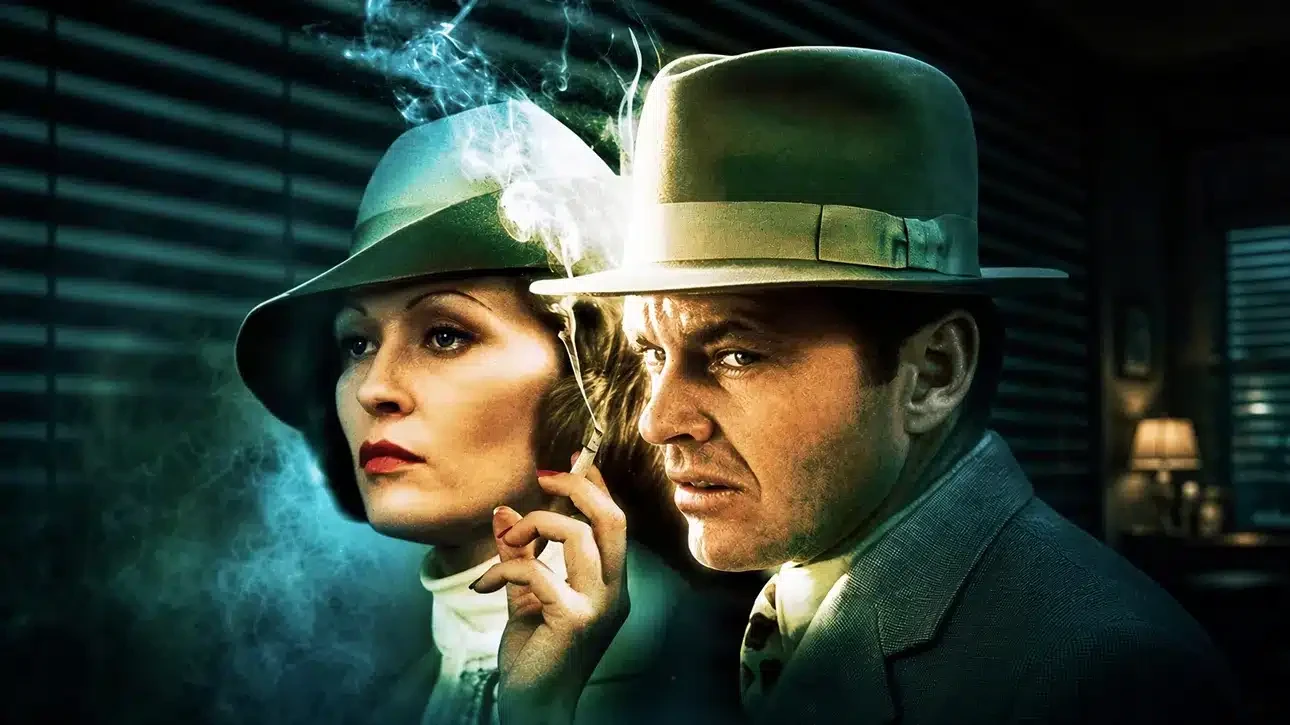
Half a century after its initial theatrical release, Roman Polanski’s 1974 masterpiece Chinatown continues to cast a long, unyielding shadow over the landscape of American cinema. While contemporary criticism often pigeonholes the film as a cynical product of post-Watergate disillusionment or a cinematic dramatization of the early-20th-century Owens Valley water scandals, such historical reductions miss the forest for the trees. Masterworks of true longevity possess thematic architectures that stretch far beyond their immediate socio-political genesis.
At its core, Chinatown is not merely a neo-noir genre exercise or a period-specific political critique; it is perhaps the greatest Hollywood movie ever made. Through the seamless synthesis of Robert Towne’s pristine, award-winning screenplay, precise framing, and deeply resonant character archetypes, the film delivers a devastating meditation on the limits of human knowledge and the crushing permanence of structural power.
This piece explores the anatomy of Chinatown, examining how its narrative machinery, thematic density, and triple-layered symbolism—grounded in reality, historical allusion, and archetypal myth—converge to create a cinematic experience that remains as intellectually urgent and emotionally devastating today as it was in 1974.
Detailed Chronology: The Unraveling of Private Investigator Jack Gittes
To understand the tragic machinery of Chinatown, one must trace the step-by-step disillusionment of its protagonist, private investigator Jake Gittes (Jack Nicholson). The narrative’s brilliance lies in its adherence to traditional noir tropes while radically subverting their underlying philosophies.
Act I: The Illusion of Discovery
The film begins within the familiar parameters of the detective genre. Gittes is hired by a woman claiming to be Evelyn Mulwray to expose her husband’s supposed infidelity. We follow Gittes as he methodically pieces together clues:
- He captures photographs of Hollis Mulwray (Chief Engineer at the L.A. Department of Water and Power) with a young woman.
- He uncovers that his initial client was an imposter financed to publicly discredit Hollis.
- He watches as Hollis is subsequently murdered—drowned in a dry riverbed amid an engineered drought.
Throughout this initial phase, the audience is tethered to Gittes’ perspective. Director Roman Polanski and cinematographer John A. Alonzo frame scenes in medium lengths, frequently placing the camera over Gittes’ shoulder. As in classic noir, we learn as he learns.
Act II: The Labyrinth of Foreknowledge
As Gittes delves deeper, he realizes that his sleuthing is not uncovering hidden truths, but merely unearthing facts that powerful entities already know.
- The city coroner is well aware that Hollis drowned in a dry basin.
- The clerk at the Hall of Records knows that massive tracts of arid land are secretly changing hands.
- Police Lieutenant Lou Escobar knows Gittes was framed from the outset.
Gittes prides himself on his street smarts and his professional acumen, but he fails to realize a fundamental truth: he is not exposing a conspiracy; he is navigating a reality that has already been meticulously organized by Noah Cross (John Huston). When Gittes confronts Cross over lunch, Cross calmly sizes up the investigator, demonstrating that institutional power does not need to outwit its opposition—it simply dictates the terms under which everyone else operates.
Act III: The Descent into Chinatown
The narrative hurtles toward its inevitable, crushing conclusion when the truth of the conspiracy is finally laid bare. The land monopoly, the manufactured drought, and the systemic corruption are all tied to Noah Cross. Worse still, Cross has subjected his own daughter, Evelyn Mulwray (Faye Dunaway), to incestuous abuse, fathering Katherine—who is simultaneously Evelyn’s daughter and sister.
In the film’s tragic climax in the labyrinthine streets of Chinatown, Gittes attempts to save Evelyn and rescue Katherine from Cross’s grasp. Instead, his intervention yields the exact opposite of his intentions. Evelyn is shot dead in the street, her eye pierced by a bullet hole—echoing the film’s pervasive motifs of vision, perception, and spectacles.
Cross calmly walks away with Katherine, retaining his money, his influence, and absolute impunity. As Gittes stands paralyzed by the futility of his efforts, a local officer utters the most devastating line in cinematic history: "Forget it, Jake. It’s Chinatown."
Supporting Context & Metrics: The Triple Structure of Artistry
What elevates Chinatown above standard cinematic fare is its rare "unity of expression"—a tripartite structural framework wherein nearly every plot point, character, and setting operates simultaneously on three distinct levels: the realistic, the allusive, and the archetypal. Film scholars frequently note that this rare cohesion is matched in Western literature only by George Orwell’s Animal Farm (1945).
1. The Realistic Level
Chinatown functions brilliantly as a gritty, ground-level narrative. Gittes is a deeply human, flawed protagonist—combining professional vanity, coarse humor, professional expertise, and a lingering sense of being haunted by his past failures in Chinatown. The mechanics of land speculation, water rights manipulation, and corporate corruption reflect the hard, unglamorous realities of municipal development in early-20th-century America.
2. The Allusive Level
Beyond its immediate surface, the film explicitly references historical anxieties. It alludes directly to the California water wars of the 1910s and 1920s, specifically William Mulholland and the Owens Valley aqueduct scandal, where public resources were diverted to enrich private land speculators. Furthermore, it alludes to the cinematic history of the 1930s noir tradition—specifically John Huston’s 1941 adaptation of The Maltese Falcon—where the pursuit of truth traditionally culminated in mastery and resolution. By casting John Huston (the director of The Maltese Falcon) as the ultimate villain, Chinatown symbolically slays the old Hollywood myth that justice always prevails for the clever investigator.
3. The Archetypal Level
At its deepest layer, Chinatown operates as a dark modern myth:
- Jake Gittes plays the archetypal Seeker of Knowledge, the classic Fool who is continually misled by his own hubris, assuming that exposure equals justice.
- Evelyn Mulwray embodies the dual archetype of the femme fatale and the trapped victim of patriarchal tyranny, ultimately standing as the tragic figure bearing a monstrous secret.
- Noah Cross transcends mere villainy to become a dark demiurge—a corporate Titan and corrupt patriarch who views boundaries, human bodies, and nature itself as mere property to be reorganized by his personal will. His incestuous violation of his daughter represents the ultimate collapse of moral boundaries, portraying a Satanic figure who remains relentlessly charming, polite, and completely untouchable.
Official Statements and Critical Reception
Upon its release by Paramount Pictures in the summer of 1974, Chinatown was met with widespread critical acclaim and commercial success, though its bleak worldview baffled some mainstream audiences.
Paramount executives initially worried about the film’s uncompromising darkness, particularly the devastating fate of Evelyn Mulwray and the unpunished triumph of Noah Cross. However, writer Robert Towne and director Roman Polanski stood firm, refusing to soften the blow of a narrative designed to subvert Hollywood happy endings.
In retrospective analyses, film historians and critics have continually lauded the picture’s structural perfection:
- The Writers Guild of America frequently ranks Robert Towne’s screenplay among the greatest scripts ever written for the screen, praising its intricate plotting, subtle foreshadowing, and masterclass economy of dialogue.
- The Academy of Motion Picture Arts and Sciences recognized the film with 11 Academy Award nominations, ultimately awarding Robert Towne the Oscar for Best Original Screenplay.
- Cultural critics frequently cite Chinatown as the defining bridge between the classic studio era and the gritty, director-driven renaissance of 1970s New Hollywood.
Future Outlook: The Enduring Relevance of Chinatown
As we look toward the future of storytelling, the thematic lessons of Chinatown remain urgently relevant. In an era dominated by hyper-connected data, algorithmic curation, and systemic institutional corruption, the film’s central thesis feels more prophetic than ever: The truth may be visible, but visibility does not guarantee liberation.
The cultural legacy of Chinatown is secured not by its nostalgic recreation of 1930s Los Angeles, but by its unflinching examination of institutional power. It reminds modern audiences and aspiring filmmakers alike that true artistic greatness does not lie in comforting resolutions or neat moral packages. Instead, it lies in the courage to stare into the abyss of human limitation and acknowledge that sometimes, despite all our striving, the systems we fight against are simply too entrenched to break.
As long as power structures organize reality for their own preservation, audiences will continue to return to the dry riverbeds and sun-scorched asphalt of Chinatown, whispering to themselves the film’s final, haunting refrain: "Forget it, Jake. It’s Chinatown."








Belum ada komentar. Jadilah yang pertama berkomentar!