

By Jon Nicholson
Freelance Esports Journalist
Last Updated: September 7, 2026
Executive Overview
The September esports calendar has erupted into action, bringing a relentless wave of high-stakes tournaments across the global competitive ecosystem. As the industry pivots toward legendary season-ending spectacles like VALORANT Champions and the League of Legends World Championship, the first full weekend of the month delivered a masterclass in dramatic storylines, unexpected roster exits, and paradigm-shifting match outcomes.
From the historic Super Bock Arena in Porto to the fierce battlegrounds of the LEC, the competitive landscape experienced massive tremors over the past 48 hours. Team Spirit continued their meteoric rise by dominating the Counter-Strike landscape at BLAST Open Porto 2026. Meanwhile, in the League of Legends European Championship, G2 Esports shattered the immaculate, flawless aura of Karmine Corp, handing the French titans their first defeat of the LEC Summer 2026 Split.
Yet, the most profound shockwave reverberated far beyond active tournament servers. In a stunning announcement that has sent ripples of anxiety across the competitive gaming economy, reigning The International 2025 champions Team Falcons officially bowed out of the Dota 2 esports scene.
This comprehensive report breaks down the weekend’s marquee events, analyzing the tactical brilliance, the statistical anomalies, and the structural implications of a weekend that has forever altered the trajectory of the 2026 competitive season.
Detailed Chronology: Weekend Highlights
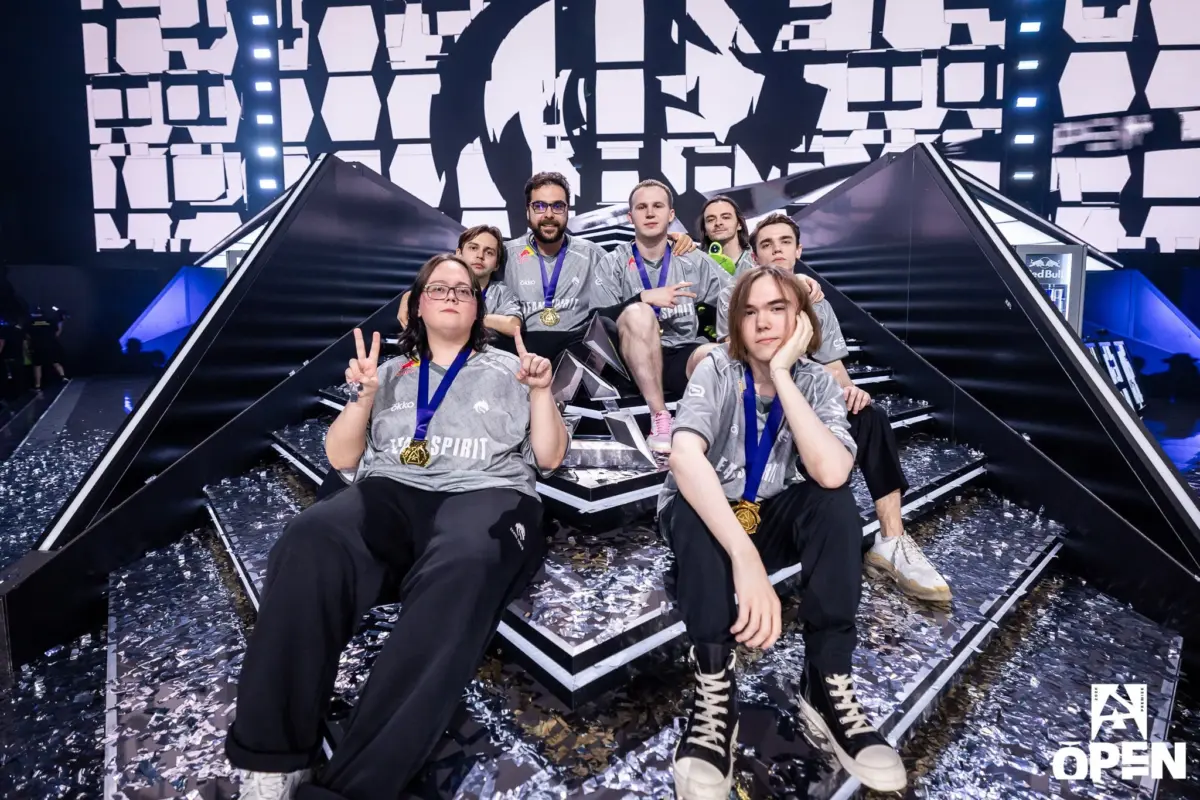
1. Counter-Strike: Team Spirit’s Masterclass at BLAST Open Porto 2026
Entering the tournament, BLAST Open Porto 2026 was widely projected by analysts and pundits alike to be the most wide-open, unpredictable Counter-Strike tier-one event of the year. With a dozen elite rosters converging on Portugal’s Super Bock Arena, parity seemed to be the order of the day. Bookmakers priced Team Spirit at 10/3 (4.33), giving them a modest 23.1% implied probability of lifting the trophy—a valuation that undervalued the sheer momentum and tactical evolution of the Esports World Cup 2026 champions.
Over the course of the tournament, Team Spirit shattered those expectations. Displaying a level of tactical discipline and mechanical mastery rarely seen in modern CS2, the squad dropped a meager one map across the entire event.
In the grand finale against MOUZ, Spirit faced early adversity. MOUZ staged a remarkable, heart-stopping comeback from an 11–4 deficit on Mirage, snatching the map away and threatening to derail the Russian powerhouse’s momentum. However, elite championship teams are forged in resilience. Spirit rebounded with ruthless efficiency, dismantling MOUZ 13–3 on Ancient before shifting the spotlight to Andrey "tN1R" Tatarinovich on Nuke.
Tatarinovich delivered a legendary map performance, anchoring defensive sites with clinical spray control and surgical precision. He closed out Nuke with a map-high 18 frags, an astonishing 1.70 individual rating, and a 96.5 ADR (Average Damage per Round), ultimately sealing the 13–6 victory and securing the series.
Unsurprisingly, Danil "donk" Kryshkovets continued his reign of terror as the preeminent rifler in Counter-Strike history. Maintaining a blistering 1.4 tournament rating, donk added yet another MVP medal to his overflowing trophy cabinet, confirming that the "Spirit Era" of CS2 is operating at peak performance.
2. League of Legends: G2 Esports Ends Karmine Corp’s Historic Streak
In the LEC Summer 2026 Playoffs, all eyes were glued to "The Blue Wall." Karmine Corp entered the post-season riding the high of a flawless, undefeated Regular Season. Their playoff journey initially continued on that trajectory with a commanding 3–1 victory over GIANTX. Top-laner Kim "Canna" Chang-dong masterminded the series, culminating in an 18/8/19 cumulative scoreline and cementing his dominance with a game-winning pentakill that sent the LEC studio into a frenzy.
Crucially, the victory over GIANTX guaranteed Karmine Corp a coveted qualification slot for the 2026 World Championship—marking the French organization’s historic debut appearance at Riot Games’ premier global event.
However, the Upper Bracket Final pitted them against their ultimate domestic rival: G2 Esports. The clash of European titans lived up to every ounce of its pre-match hype. In the opening game, Hall of Legends inductee Rasmus "Caps" Winther asserted absolute authority on Viktor, securing a devastating quadra-kill that broke open the map and handed G2 the early psychological edge.

At the height of the series, live markets reflected the razor-thin margins between the two rosters, with bookmakers briefly pricing both squads at an identical 17/20 (1.85)—a 50% fair probability split that highlighted how evenly matched the titans truly were.
Game two saw Steven "Hans Sama" Liv take center stage on Yunara. Racking up a pristine 12/1/6 KDA, Hans Sama dragged G2 to match point, placing Karmine Corp on the precipice of their very first defeat of the split.
True to their resilient moniker, the Blue Wall struck back in game three. Martin "Yike" Sundelin unleashed a masterclass on Qiyana, generating relentless side-lane pressure and orchestrating devastating skirmish combos alongside Rumble.
Game four, however, belonged once again to Caps. Returning to his signature Tristana, the legendary mid-laner pumped out 18,293 total champion damage, dictating the tempo of every early teamfight and completely denying Karmine Corp any window to stabilize. G2’s superior macro lane control ultimately closed out the series 3–1. While G2 marches directly into the Grand Final, Karmine Corp’s championship dreams are far from over; a run through the Lower Bracket Final could set the stage for an epic rematch.
3. Dota 2: The Shocking Exit of Team Falcons
While the tournament servers burned with action, the biggest development of the weekend happened in the corporate suites. Team Falcons, the reigning champions of The International 2025, stunned the global esports community by releasing an official statement announcing their immediate departure from the Dota 2 ecosystem.
Over the past three years, the Saudi Arabian-backed organization had firmly established itself as a cornerstone of Valve’s premier MOBA, capturing multiple tier-one LAN trophies alongside the ultimate prize: the Aegis of Champions. Their sudden exit marks a seismic shift for the discipline.
Supporting Context & Metrics
To fully comprehend the gravity of this past weekend, one must analyze the intersecting financial, competitive, and cultural metrics driving the ecosystem:
- Counter-Strike Tier-One Volatility: Team Spirit’s dominant run at BLAST Open Porto proves that individual mechanical brilliance—anchored by donk’s 1.4 rating and tN1R’s 1.70 map-winning impact—can withstand strategic counter-stratting, provided the team possesses deep tactical flexibility.
- LEC Viewing Metrics & Market Equilibrium: The G2 versus Karmine Corp series drew record-breaking concurrent viewership for the LEC Summer split. The 17/20 (1.85) odds equilibrium observed live by analysts underscored a rare paradigm in European League of Legends: the traditional king (G2) fighting an existential battle against an ascending dynasty (Karmine Corp).
- The Dota 2 Economic Climate: Team Falcons’ departure underscores an ongoing crisis in sustainable esports financing. Despite dominating the competitive tier (including winning TI2025), the organization cited a "strategic realignment toward ecosystems offering long-term operational sustainability"—a clear indictment of Valve’s current financial structures and tournament tiering.
Official Statements
Team Falcons on Their Dota 2 Departure
In a carefully worded joint statement released across digital channels, Team Falcons management addressed the community:
"Following a comprehensive strategic review of our global esports operations, Team Falcons has made the difficult decision to step away from the Dota 2 competitive ecosystem. Over the past three years, our journey to the summit—culminating in hoisting the Aegis at The International 2025—has been nothing short of historic. However, our organizational focus must now pivot toward titles and ecosystems that offer greater structural alignment and long-term operational sustainability for our partners and athletes. We extend our deepest gratitude to our players, coaching staff, and the incredible Dota 2 fans who supported us through every triumph."
Future Outlook
As the dust settles on an electrifying weekend, the global esports industry stands at a critical crossroads.
In Counter-Strike, Team Spirit has firmly established themselves as the team to beat heading into the final quarter of the year, though hungry contenders like MOUZ and Vitality will undoubtedly refine their playbooks. In League of Legends, G2 Esports has reminded Europe who rules the roost, but Karmine Corp’s lower-bracket redemption arc promises a thrilling conclusion to the LEC Summer Split ahead of Worlds 2026.
However, the broader narrative of the week belongs to Team Falcons’ departure from Dota 2. When an organization with deep financial resources and a recent World Championship pedigree chooses to abandon one of esports’ foundational titles, alarm bells must ring across the industry. The structural viability of publisher-led ecosystems versus open circuits remains an existential question. If the premier titles cannot retain elite-tier capital investment, tournament organizers and developers must urgently rethink their revenue-sharing models to secure the future of competitive gaming.
For now, the games go on. Eyes turn immediately to the upcoming lower-bracket battles, regional playoff finales, and the looming global championships that will define the legacy of the 2026 competitive year.



Belum ada komentar. Jadilah yang pertama berkomentar!