

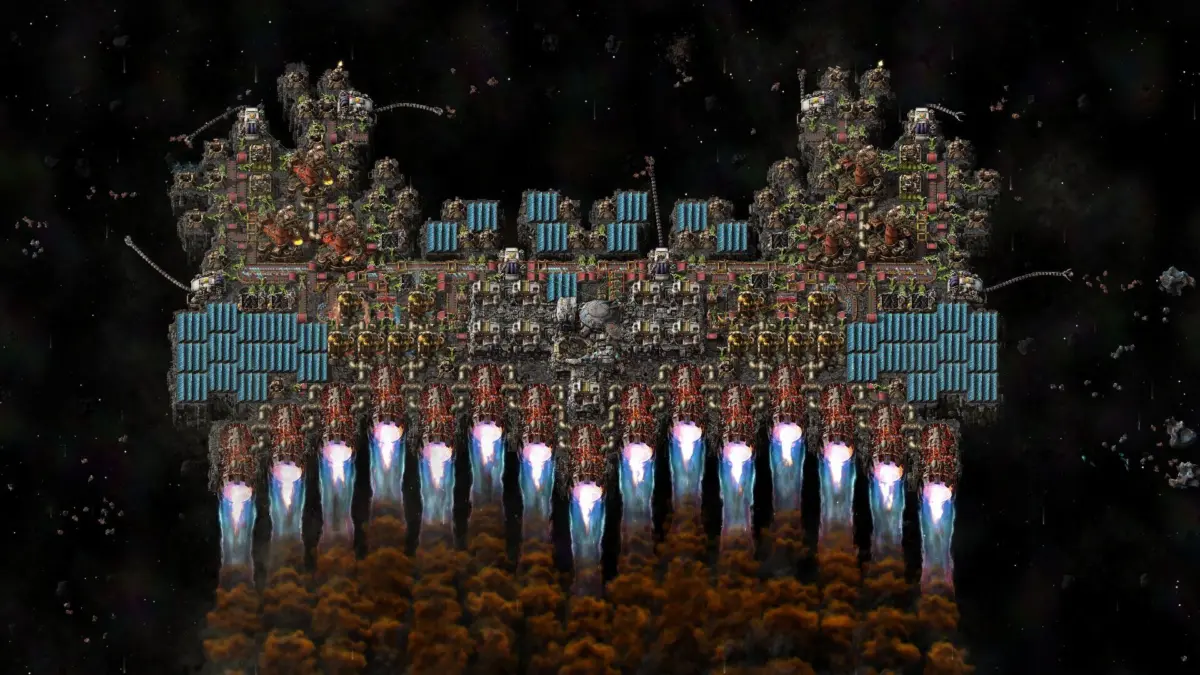
The industrial sirens have sounded their final note, the conveyor belts have ground to a halt, and the blazing blast furnaces of Factorio are quietly cooling. After an astonishing 14 years of continuous, community-driven development, Wube Software has officially confirmed that Update 2.1 will serve as the final major content patch for its genre-defining factory-building masterpiece.
First signaled by the developer back in May, the decision to wind down active development stems from a deliberate philosophical consensus within the studio: Factorio has finally reached a holistic, feature-complete state that requires no further systemic expansions. This definitive closure arrives roughly two years after the historic launch of the critically acclaimed Space Age expansion, a massive undertaking that successfully catapulted players past the stratosphere to industrialize four entirely distinct alien worlds.
Rather than chasing an elusive grand finale loaded with sprawling new research trees or alien biomes, Update 2.1 is designed as a masterclass in refinement. It represents a sweeping accumulation of quality-of-life adjustments, deeply requested utility features, and meticulous backend polishing. For a game that has fundamentally shaped the simulation and strategy landscape since its early crowdfunding days, this final patch acts as the capstone on a legendary monument of game design.
Detailed Chronology: Fourteen Years of Optimization
To truly understand the weight of Factorio concluding its development cycle, one must trace the timeline of a project that grew from a modest indie passion project into a cultural touchstone for engineering-minded gamers worldwide.
The Genesis and Early Access Years (2011–2016)
Conceived by developer Wube Software, Factorio emerged during a golden era of PC survival and crafting titles. However, it quickly carved out a unique identity by prioritizing pure industrial automation over simple survival mechanics. Players crash-landed on a hostile alien planet with nothing more than their bare hands, tasked with harvesting resources, laying down intricate networks of conveyor belts, and eventually launching a rocket.
The introduction of the game’s Public Alpha and subsequent Early Access release on Steam in 2016 allowed Wube to cultivate a uniquely close relationship with its player base. Through the legendary "Friday Facts" developer blog series, the studio maintained radical transparency, detailing optimization breakthroughs, graphical overhauls, and design philosophies week after week.
The 1.0 Milestone and Cultural Dominance (2020)
In August 2020, amidst a global landscape desperately seeking deep, immersive digital time-sinks, Factorio officially graduated to version 1.0. The full release cemented the game’s reputation for peerless optimization. While other modern titles struggled with frame rates under heavy simulation loads, Factorio could manage hundreds of thousands of active entities, trains, and biters running at a buttery-smooth 60 frames per second. It quickly became the gold standard by which all other factory-automation games were measured—giving rise to an entire sub-genre colloquially known as "Factorio-likes."

The Final Frontier: Space Age and Version 2.0 (2024–2025)
Just when players thought the formula had been perfected, Wube announced the Space Age expansion. Released to overwhelming critical acclaim, the expansion blew the roof off the core game. It allowed industrialists to construct massive orbital space platforms, manage interstellar supply lines, and colonize four wildly diverse planets—each introducing unique hazards, technologies, and automation challenges. Paired with the foundational 2.0 update, Space Age redefined the game’s scope.
Now, with Update 2.1 on the horizon, the cycle is complete. Wube is closing the book, leaving behind a codebase that is as robust as it is comprehensive.
Supporting Context & Metrics: Inside Update 2.1
While Update 2.1 consciously omits new planetary bodies or bloated tech trees, its feature set directly targets the logistical friction points that veteran players have wrestled with for years.
Space Logistics Overhaul
The centerpiece of the final update addresses the complex supply chains introduced in Space Age. Managing orbital platforms and interplanetary trade routes often required overly rigid automation setups. Update 2.1 introduces crucial changes:
- Multi-Item Rockets: Rockets are no longer restricted to carrying a single uniform item type. They can now haul mixed payloads, drastically streamlining the early-stage construction of space platforms.
- Orbital Transfers: Space platforms can now seamlessly transfer cargo between one another while in orbit, creating dynamic logistics hubs in the void.
- Automated Imports: Platforms gain the ability to intelligently pull items from all available planetary and orbital locations based on real-time deficits.
- Constructable Unloading Bays: Landing pads can now be fitted with direct unloading bays, allowing robotic inserters to pull goods straight from rockets onto conveyor belts or waiting cargo trains.
Ground-Level Refinements and Biter Evolution
Surface automation hasn’t been left behind. Update 2.1 introduces sweeping changes to the game’s native antagonists, the Biters:
- Scalable Grouping: Biter expansion now scales dynamically alongside evolution metrics, ensuring that clearing out nests remains a satisfying, tactical challenge rather than an endless chore of stamping out tiny, insignificant outposts.
- Natural Habitats: Expansion algorithms have been tweaked so that biters choose ecologically logical terrain for new bases. Furthermore, they will actively expand their territory even if players choose not to aggressively scout the fog of war early in a playthrough.
- Fluid Mechanics: The update officially reintroduces fluid mixing prevention measures, eliminating accidental pipeline contamination.
- Quality System Tweaks: Minor balancing passes have been applied to the Space Age Quality system to ensure gear tiers feel rewarding without breaking map-wide balance.
Graphical and Quality-of-Life Polish
Aesthetically, the game receives a late-stage visual glow-up. Assembling machines, oil refineries, rocket silos, and heat exchangers all boast crisp, modernized assets. Perhaps most thrilling for long-time automation architects, a brand-new rendering system makes it significantly easier for fluid pumps to snap onto and connect with rail fluid wagons—eradicating one of the community’s longest-standing mechanical frustrations.
Official Statements and Developer Philosophy
Wube Software’s steadfast commitment to quality over monetization has earned them legendary status within the gaming industry. Unlike many modern studios that chase endless live-service roadmaps, Wube recognizes the value of artistic completion.

In their comprehensive Friday Facts blog detailing the closure, the development team elaborated on why Update 2.1 focuses strictly on refinement rather than expansion:
"Version 2.1 isn’t about new planets, enemies, or research trees. Instead, it delivers a massive collection of quality-of-life adjustments, small features, polish, and the precise mechanical elements we wanted to include in 2.0 but simply didn’t have the time to finish."
Reflecting on the overarching decision to conclude active development, Wube reiterated sentiments first shared in May, noting that the simulation ecosystem has finally "reached a good place to conclude active game development." By stepping away voluntarily, Wube preserves the artistic integrity of Factorio, ensuring it remains a pristine, self-contained monument of engineering simulation rather than a bloated, endlessly patched experiment.
Future Outlook: The Next Horizon for Wube Software
As the sun sets on Factorio, the global community naturally casts its gaze toward the horizon. What lies ahead for the brilliant engineering minds at Wube Software?
Back in May, alongside the initial announcement regarding Update 2.1’s scope, studio representatives confirmed that the core team had already begun brainstorming and developing early-stage game prototypes. However, true to their meticulous, measured nature, the developers issued a firm caveat to eager fans: there will not be anything to share for a long time.
Wube operates under a philosophy that refuses to rush creative output. Just as Factorio spent years cooking in early access to emerge as a generational masterpiece, any future intellectual property from the studio will undoubtedly undergo rigorous, behind-the-scenes iteration before it ever sees the light of day.
For now, the factory floor belongs entirely to the players. With Update 2.1 providing the ultimate, friction-free toolkit for galactic industrialization, Factorio stands finished, polished, and eternal. The factory must grow—and thanks to 14 years of uncompromising dedication, it has finally reached its absolute peak.








Belum ada komentar. Jadilah yang pertama berkomentar!