

Executive Overview
The Wikimedia Foundation has officially rolled out its engaging daily history puzzle game, "Which came first?", to iOS users worldwide. Following a successful debut on the Android platform, the latest update to the official Wikipedia iOS application integrates this bite-sized trivia challenge directly into the app’s Explore feed.
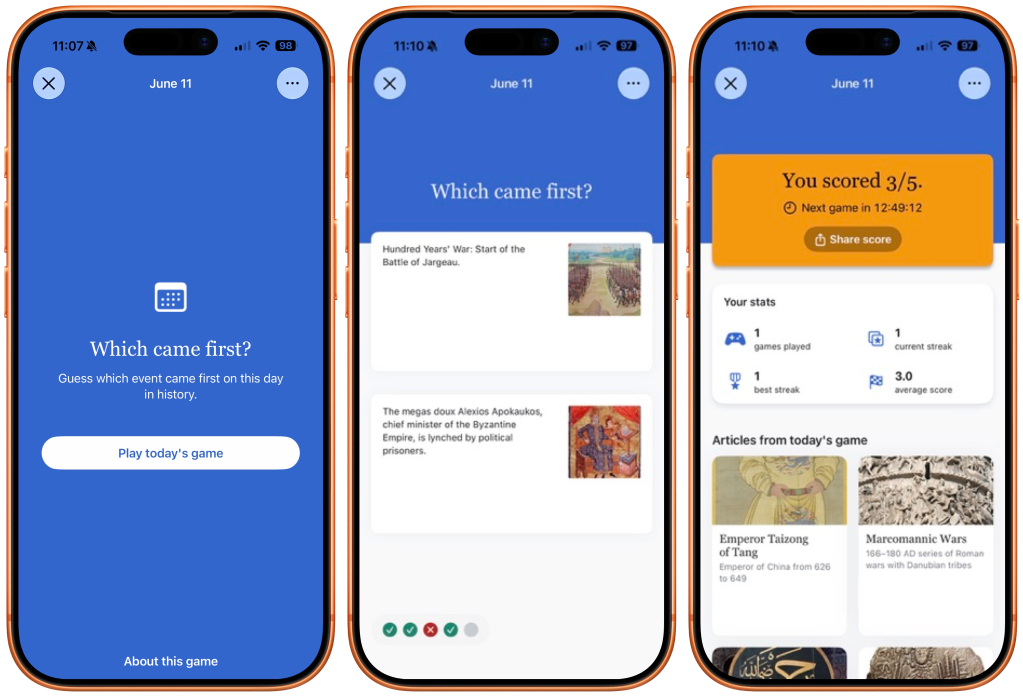
Designed to blend education with casual gaming, "Which came first?" challenges users with a series of five chronological puzzles every single day. The questions are cleverly tethered to real-world historical events that occurred precisely on the current calendar day in years past. By combining the vast informational repository of the world’s largest crowdsourced encyclopedia with modern gamification mechanics, Wikipedia is forging new pathways for user engagement.
Beyond merely testing a player’s grasp of global history, the feature includes robust statistical tracking—such as average scores and gameplay streaks—alongside a comprehensive archive that allows users to revisit past rounds. This strategic expansion reflects a broader industry trend among digital publishers and information hubs: transforming static reference material into interactive, habit-forming daily rituals. For iPhone and iPad users, the update is available immediately via the App Store.
Detailed Chronology: From Concept to iOS Integration
To understand the significance of the iOS rollout of "Which came first?", it is vital to examine the evolutionary timeline of how Wikipedia has experimented with interactive content, gamification, and mobile-first user interfaces over the past decade.
The Mobile-First Pivot and the Rise of the Explore Feed
For many years, Wikipedia’s mobile applications served as straightforward, lightweight portals to the desktop web experience. Users searched for a term, read an article, and navigated via hyperlinks. However, as mobile browsing habits shifted toward algorithmic feeds, curated content, and bite-sized media consumption, the Wikimedia Foundation recognized the need to make its applications more dynamic.
The introduction of the "Explore" feed on mobile apps was a watershed moment. Instead of requiring users to actively search for information, the Explore feed began serving up serendipitous historical facts, featured articles, trending topics, and imagery related to "On This Day" milestones. This infrastructure laid the groundwork for feature-rich, daily interactive elements.
Android Beta Testing and Initial Rollout
Before touching Apple’s ecosystem, the concept behind "Which came first?" underwent iterative development and testing. Android users were the first to experience the daily historical sorting mechanism. Developers designed the game to exploit a fundamental human cognitive quirk: while people can often recall that a major historical event happened, remembering the precise sequence of events relative to one another can be remarkably tricky.
The Android rollout provided the Wikimedia product and engineering teams with invaluable telemetry data. They monitored metrics such as user drop-off rates, average completion times, and social sharing habits. The overwhelmingly positive reception—marked by high daily active user retention and enthusiastic feedback on community forums—paved the way for the development of the iOS port.
The iOS Launch
Starting today, the latest version of the Wikipedia iOS app brings feature parity to Apple device owners. Integrated directly into the Explore hub, the game greets users with a fresh set of challenges every twenty-four hours. By synchronizing the launch across regions and leveraging native iOS design guidelines, the Wikimedia Foundation ensured that the transition from Android to iPhone felt seamless, responsive, and deeply integrated into the app’s established UI/UX patterns.
Supporting Context & Metrics: The Anatomy of "Which Came First?"
The mechanics of "Which came first?" are deceptively simple, yet they tap deep psychological drivers that make puzzle and trivia games wildly addictive.
Gameplay Mechanics and Daily Challenges
- Five Daily Questions: Every day, players are presented with five distinct chronological pairings or sequences.
- Thematic Relevance: Every historical event featured in the daily challenge shares a direct calendar connection to the current date, reinforcing the "On This Day" educational model.
- The Core Dilemma: Users must deduce whether Event A preceded Event B, turning passive historical facts into an active mental duel.
Tracking Progress and Retention
To foster long-term engagement, the game incorporates classic gamification loops:
- Gameplay Streaks: Encouraging users to return day after day to maintain an uninterrupted chain of successful sessions.
- Average Scores: Providing quantitative feedback on how well a user performs over time, allowing history buffs to measure their overall chronological intuition.
- The Archive: Recognizing that users might miss a day—or simply want more content—Wikipedia included an archive feature. This repository allows players to dive backward through previous rounds, effectively turning the game into an endless library of historical trivia rather than a rigid once-a-day obligation.
The Psychology of Micro-Learning
In an era dominated by doom-scrolling and rapid-fire short-form video content, "Which came first?" occupies a healthy middle ground. It offers cognitive stimulation without demanding significant blocks of time. Players can complete their daily five questions in under two minutes, walking away with a subtle nugget of historical context—such as realizing a technological breakthrough occurred decades earlier than they previously assumed.

Official Statements and Industry Perspective
While the Wikimedia Foundation operates as a non-profit organization primarily focused on the preservation and dissemination of free knowledge, its product decisions increasingly mirror those of consumer tech giants striving for user retention.
Industry analysts have noted that the integration of casual games into utility-driven applications is a proven strategy for boosting daily active users (DAUs). By turning an encyclopedia into a destination for morning mental gymnastics, Wikipedia encourages users to open the app outside of active search intent (e.g., looking up a movie director or a chemical compound).
Though official press releases from the Foundation emphasize the educational mission—framing the game as an innovative, lightweight tool to "engage with historical facts, test your knowledge of world history, and learn a thing or two about things that happened on this day hundreds of years ago"—the underlying technical execution speaks to a mature, highly polished mobile product strategy.
Furthermore, by utilizing open data from its own vast database, Wikipedia can generate an infinite supply of historical pairings without licensing fees or external content dependencies. This self-sustaining content engine positions the feature for long-term viability.

Future Outlook: What’s Next for Wikipedia on Mobile?
The successful cross-platform rollout of "Which came first?" raises intriguing questions about the future trajectory of Wikipedia’s mobile applications. As user expectations evolve, how might the Wikimedia Foundation continue to blend crowdsourced knowledge with interactive entertainment?
Potential Feature Expansions
- Multiplayer and Social Challenges: While the current iteration focuses on individual streaks and average scores, future updates could introduce friendly leaderboards, allowing users to challenge friends or share their daily score grids across social media platforms—much like the viral phenomenon seen with word and puzzle games in recent years.
- Thematic Mini-Games: Given the success of the chronological sorting game, the engineering team could explore other formats, such as map-based geography challenges, art-history matching, or audio-visual archives leveraging Wikimedia Commons media.
- Deep Article Integration: One of the greatest strengths of the Wikipedia app is its hyperlinked ecosystem. "Which came first?" naturally prompts curiosity. Future updates could feature smoother pathways to dive straight into the full Wikipedia biographies or event pages of the lesser-known historical figures and milestones featured in the daily questions.
Sustaining Free Knowledge Through Engagement
Ultimately, features like "Which came first?" serve a dual purpose. They enrich the user experience by injecting moments of discovery and play into an otherwise utilitarian application, and they deepen the bond between the global readership and the platform itself.
As mobile software becomes increasingly saturated with attention-grabbing algorithms, Wikipedia’s approach remains refreshingly pure: centering its interactive experiences around genuine facts, human history, and intellectual curiosity. For iPhone and iPad users looking to sharpen their historical wits while grabbing their morning coffee, the new game offers an intellectual diversion that is both satisfying and entirely free of charge.
The updated Wikipedia app, complete with the "Which came first?" game accessible via the Explore feed, is available for download now on the iOS App Store.









Belum ada komentar. Jadilah yang pertama berkomentar!