

Executive Overview
For decades, Japan’s Shinkansen bullet train network has set the global gold standard for high-speed rail, combining breathtaking punctuality, flawless safety records, and exceptional passenger comfort. As Japan prepares to roll out its much-anticipated, high-end "Supreme Class" private cabins this fall—aimed squarely at affluent travelers willing to pay a premium for ultimate luxury—a fascinating paradox has come to light. While media outlets and luxury tourists fixate on upcoming high-roller accommodations, a quiet, highly functional alternative has been hiding in plain sight aboard select bullet trains for years.
Known officially as the Business Booth, these compact, private sanctuaries offer passengers a slice of high-speed serenity at a fraction of the cost associated with luxury travel. Tucked away between carriages on specific high-speed routes, these spaces provide an enclosed, quiet environment complete with a desk, power outlets, and panoramic windows. Despite being operational since 2022, the service has largely evaded the radar of casual travelers and tourists alike.
This oversight is largely by design. Marketed strictly as a mobile workspace rather than a luxury amenity, the booths are tethered to specific corporate-focused carriages and require an onboard digital reservation system rather than advanced booking. For the savvy traveler willing to navigate the quirks of Japan’s ticketing ecosystem, however, these private pods represent one of the best-kept secrets in modern rail travel, offering unmatched privacy, productivity, and peace for just a few hundred yen.
Detailed Chronology: The Evolution of On-Board Privacy
To understand how the Business Booth came to exist—and why it remained obscure for so long—it is necessary to examine the operational shifts that transformed Japan’s high-speed rail corridors over the past decade.
2020–2021: The Pandemic Shift and the Rise of Remote Work
The conceptual genesis of the Shinkansen Business Booth lies in the global disruption caused by the COVID-19 pandemic. As remote work became the norm and business travel slowly resumed, railway operators in Japan faced a new demographic of passengers: professionals who needed to conduct confidential calls, participate in video conferences, or simply work uninterrupted while traveling at speeds exceeding 280 kilometers per hour (174 mph).
Traditional open-car travel, while remarkably quiet by international standards, posed challenges for business travelers handling sensitive documents or making phone calls—an activity traditionally discouraged in open Shinkansen passenger cars. Recognizing this evolving market, Central Japan Railway Company (JR Central) began conceptualizing dedicated workspace environments within its rolling stock.
July 2021: The Debut of the "S Work" Car
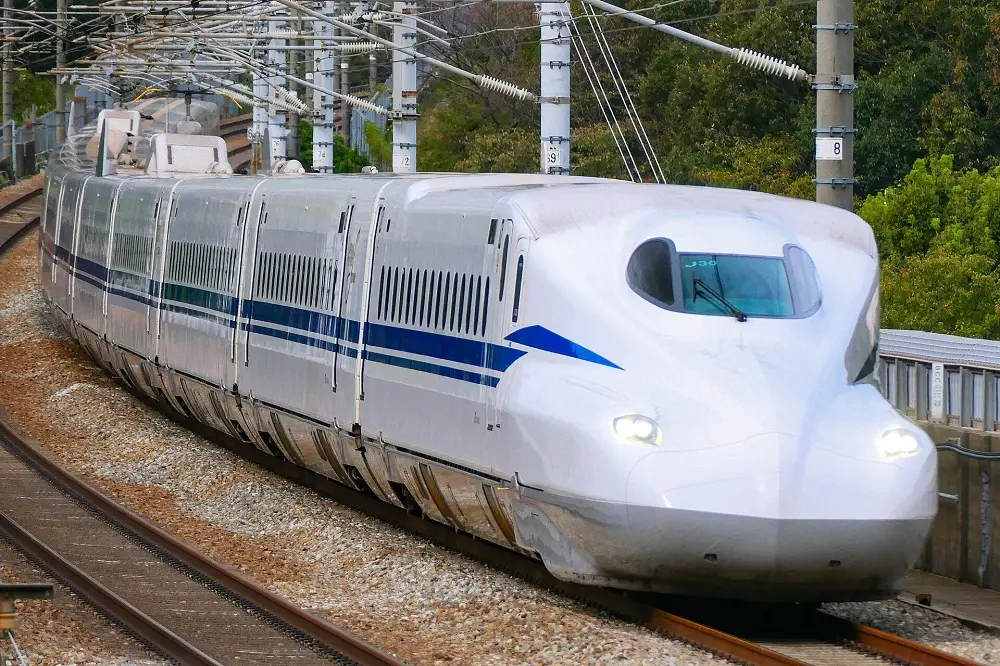
In July 2021, JR Central introduced the "S Work" car on its flagship Tokaido Shinkansen line, designating Car 7 on N700S-series Nozomi trains as a specialized zone for working professionals. In this carriage, typing loudly, using laptop computers without restraint, and holding brief phone calls at designated spaces were permitted and encouraged.
However, open-car environments still lacked true acoustic and visual privacy. Recognizing that corporate travelers often require absolute confidentiality for sensitive negotiations or video meetings, engineers looked for ways to integrate private micro-spaces within the train’s architecture without sacrificing revenue-generating passenger seating.
October 2022: The Quiet Launch of the Business Booth
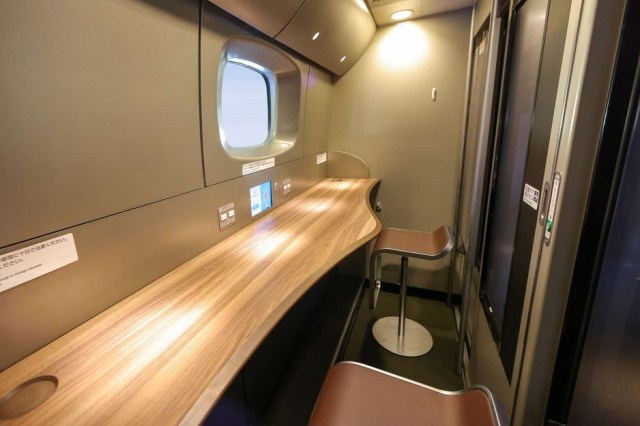
In late 2022, JR Central quietly rolled out the solution: the Business Booth. Installed in the transitional connecting space between Car 7 and Car 8 on N700S Nozomi trains, the booth was engineered as a compact, sound-dampened modular room.
Because the feature was conceived as a practical utility for business commuters rather than a flashy consumer amenity, it was introduced without major fanfare or international advertising campaigns. It was integrated directly into the day-to-day operations of the Tokaido and Sanyo lines—which connect Tokyo with major western hubs like Nagoya, Kyoto, Osaka, and Fukuoka’s Hakata Station—without changing the broader luxury narrative of the Shinkansen experience.
Supporting Context & Metrics: Accessibility, Pricing, and Logistics
The Shinkansen Business Booth is an exercise in operational efficiency. Far from being a sprawling VIP lounge, it is a masterclass in spatial optimization, designed to fit seamlessly into the interstitial architecture of high-speed train sets.
Where and How to Find Them
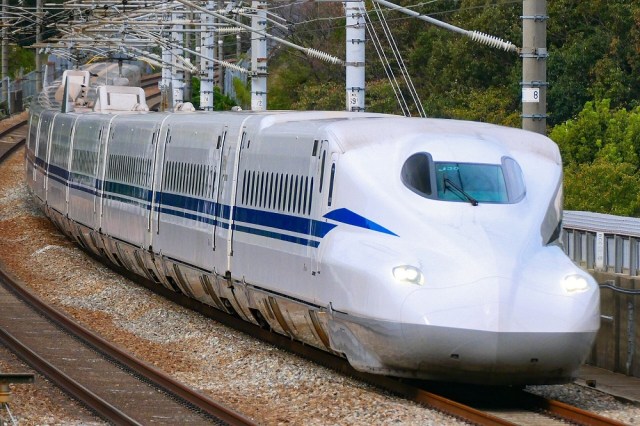
The private booths are exclusively integrated into N700S-series Nozomi Shinkansen trains, which operate along the Tokaido and Sanyo high-speed corridors.
Crucially, access is gated by strict eligibility requirements:
- Carriage Restriction: Travelers cannot simply wander off another car to book the booth. Passengers must first purchase a regular-class seat specifically in Car 7 (the designated S Work car).
- Location: The booth itself is situated in the vestibule connecting Car 7 and Car 8.
- Occupancy: The space is designed for solo travelers or pairs, accommodating a maximum of two people at any given time.
Inside the Booth: Amenities
Despite its modest footprint, the booth is surprisingly well-equipped for modern digital workflows. Amenities include:
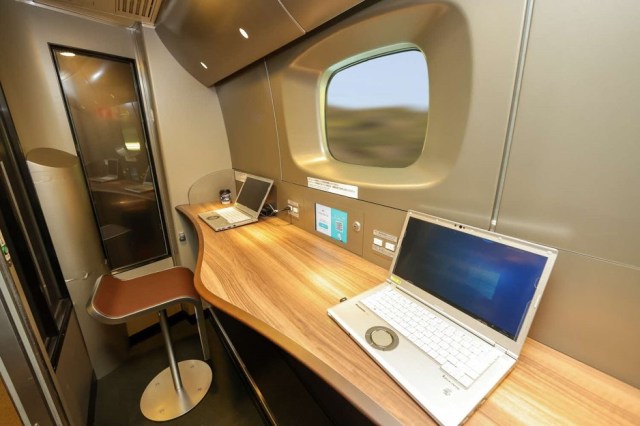
- Two ergonomic chairs facing a functional work counter.
- Standard AC electrical outlets and USB charging ports.
- A large window offering unobstructed views of the passing Japanese countryside.
- Sound-mitigating construction designed to filter out ambient train noise, facilitating clear phone calls and virtual meetings.
The Pricing Structure
Perhaps the most astonishing aspect of the Business Booth is its cost. Eschewing the exorbitant surcharges typically attached to private travel accommodations, JR Central prices the service on a sliding, time-based scale paid via credit card:
| Duration | Cost (JPY) | Approximate USD Equivalent |
|---|---|---|
| Up to 30 minutes | ¥200 per 10 mins | ~$1.25 per 10 mins |
| 30 to 60 minutes | ¥300 per 10 mins | ~$1.85 per 10 mins |
| 90 minutes | ¥2,500 total | ~$15.60 total |
| 120 minutes (Max) | ¥4,000 total | ~$25.00 total |
For a standard 30-minute working session, a traveler pays a mere 600 yen (approx. $3.75), making it one of the most cost-effective private workspace rentals available in transit infrastructure globally. For an intensive one-hour concentration block, the cost is 1,500 yen.
Onboard Reservation Mechanics
Unlike traditional Shinkansen tickets, which are booked weeks or months in advance through travel agencies or ticket machines, Business Booths cannot be reserved ahead of time.
The reservation process is entirely dynamic and managed post-boarding:
- Passengers board their designated seat in Car 7.
- Upon boarding, travelers scan a QR code displayed at the entrance of the booth or printed on informational pamphlets distributed at their seats.
- Users access an online portal to check real-time availability and claim open time blocks in increments up to a maximum of two hours.
- Payment is processed securely via credit card directly through the digital interface.
Official Statements and Operational Strategy
Railway analysts and representatives from JR Central have frequently pointed to the Business Booth as a symbol of passenger-centric engineering in an era of shifting commuting habits.
"The modern business environment is no longer tethered to a physical office, even while in transit," noted a transport logistics researcher based in Tokyo. "Rail operators worldwide are grappling with how to cater to hybrid workers. While European and North American rail networks have experimented with quiet cars, Japan has taken it a step further by introducing modular, on-demand acoustic privacy at an accessible price point."
JR Central’s official operational guidelines emphasize that while the booth was constructed with corporate utility in mind—facilitating confidential phone calls, spreadsheet reviews, and Zoom meetings—the company does not police the personal motives of those who book it. If a passenger simply wishes to escape the social pressure of an open carriage, read a book in absolute silence, or watch Mount Fuji roll by undisturbed for an hour, the space is entirely theirs once booked.
To assist passengers in planning their journeys around these specific amenities, JR Central maintains a dedicated tracking tool on its official website (railway.jr-central.co.jp/business-booth/). This tool allows travelers to verify which specific N700S-series Nozomi runs are scheduled with the business booth hardware on any given day, ensuring that tech-dependent or privacy-seeking commuters can tailor their travel schedules accordingly.
Future Outlook: The Coexistence of Utility and Luxury
The revelation of the Shinkansen Business Booth arrives at a fascinating crossroads for Japanese rail travel. With the upcoming rollout of ultra-luxury "Supreme Class" private cabins this autumn, JR Central is clearly segmenting its market into distinct tiers.
On one end of the spectrum lie the high-end private suites designed for affluent leisure tourists and executives willing to pay premium prices for bespoke luxury, expansive space, and upscale interior fittings. On the other end stands the Business Booth—a utilitarian, highly efficient micro-pod that prioritizes functional access, affordability, and digital connectivity for the everyday working professional.
This dual-track approach suggests that the future of high-speed rail is not monolithic. Rather than converting entire trains into luxury cruisers or maintaining a one-size-fits-all cabin model, operators are increasingly leveraging modular design to cater to micro-demographics.
For the international traveler or domestic commuter willing to look beyond the flashy headlines of luxury travel marketing, the Business Booth serves as a reminder of Japan’s ingenuity in public transit. It proves that high-speed serenity does not always require a massive financial investment—sometimes, it is hiding just down the aisle, waiting to be unlocked with the scan of a QR code.





Belum ada komentar. Jadilah yang pertama berkomentar!