

Executive Overview
Apple’s ongoing crusade to unify its hardware and software ecosystems around gaming reaches a new milestone this week with the rollout of iOS 26.2 Developer Beta 2. Originally introduced to the public as one of the hallmark system applications of the iOS 26 release cycle, the standalone Apple Games app serves as a centralized hub for all gaming activity across the user’s suite of devices, spanning the iPhone, iPad, and Mac.
While the initial launch of the application provided a foundational ecosystem for achievements, friend activity, and cross-platform library management, early user feedback made it clear that organizational and quality-of-life adjustments were necessary. With the upcoming public release of iOS 26.2 scheduled for next month, Apple is introducing a targeted suite of refinements aimed directly at streamlining the user interface and optimizing content discovery.
Although these updates do not represent a massive, paradigm-shifting overhaul of the platform, they highlight Apple’s sustained responsiveness to the gaming community. By polishing the user experience through thoughtful filter mechanisms and interface streamlining, Apple is signaling that its native gaming hub is not merely a forgotten default application, but a continuously evolving pillar of its software strategy. This report breaks down the architectural context of the Apple Games app, analyzes the specific features introduced in the latest developer beta, and evaluates the broader strategic implications of Apple’s deepening commitment to mobile and desktop gaming.
Detailed Chronology: The Evolution of Apple Games
To understand the significance of the iOS 26.2 updates, one must examine the rapid timeline that brought the Apple Games application to millions of devices worldwide.

The Inception: iOS 26 and the Birth of a Unified Hub
When Apple rolled out iOS 26 to the public, it introduced two brand-new system applications directly onto the home screens of compatible iPhones. Among them, the Apple Games app was designed to solve a long-standing fragmentation problem within the Apple ecosystem. For years, game management, achievements via Game Center, arcade subscriptions, and title discovery were scattered across the App Store, separate settings menus, and various auxiliary apps.
The Apple Games app consolidated these elements into a single command center. Whether a user was picking up a fast-paced title on an iPhone during a commute, diving into a graphically intensive title on an iPad, or enjoying macOS integration via universal linking, the Games app acted as a centralized directory. However, as the user base expanded rapidly, early adopters quickly encountered interface friction, particularly when navigating large libraries of installed and cloud-enabled titles.
The Developer Beta Cycle: From Beta 1 to Beta 2
The journey toward iOS 26.2 began in early November, with developers catching the first glimpse of upcoming software changes. While Beta 1 quietly embedded several functional tweaks under the hood, it was the arrival of Developer Beta 2 that brought these changes to the forefront of the user experience.
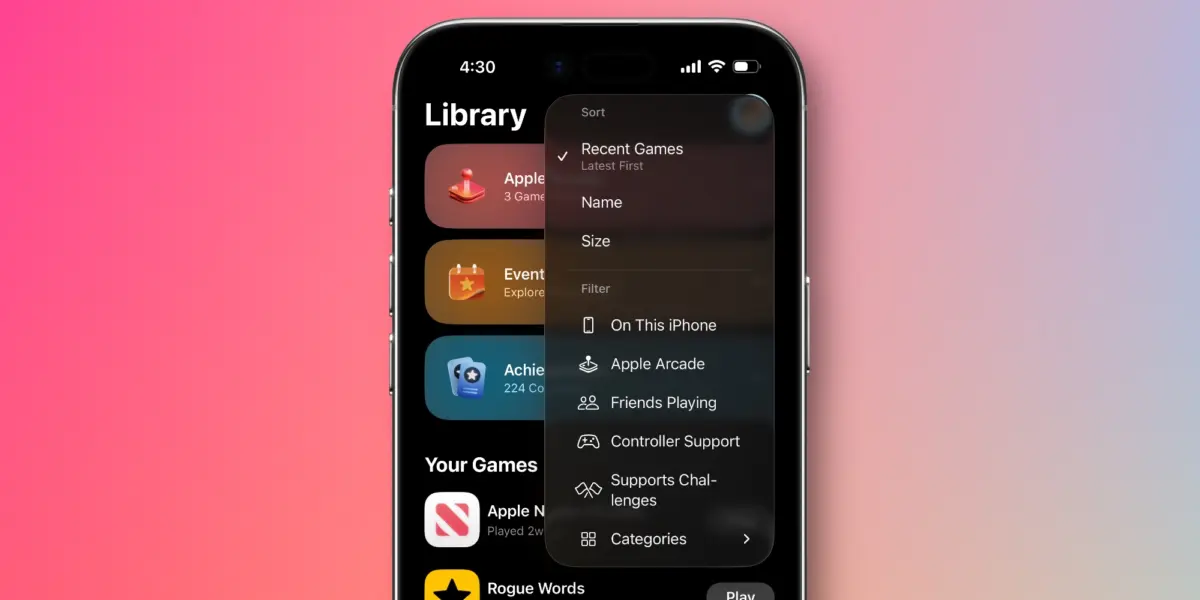
Highlighted by a brand-new, dedicated splash screen upon updating, Beta 2 officially introduces refined filtering options and organizational metrics that directly target user friction points. By addressing these minor operational hurdles ahead of the public release—slated for next month—Apple is ensuring that the software update meets a higher standard of polish. This rapid iteration cycle demonstrates an agile approach by Apple’s software engineering teams, who are utilizing developer and early-adopter feedback to fine-tune the platform before it hits millions of consumer devices.
Supporting Context & Metrics: Analyzing the iOS 26.2 Additions
The updates landing in iOS 26.2 are best categorized as "quality-of-life" enhancements. While they lack the headline-grabbing nature of new hardware announcements or major graphics API overhauls like Metal 4, these software touches are critical for day-to-day usability.
1. Advanced Filtering and Library Management
One of the primary pain points noted by power users in the initial iOS 26 release was the lack of granular filtering tools within the main library view. As users accumulate titles from the App Store, Apple Arcade, and cross-platform purchases, scrolling through an unfiltered list becomes cumbersome.
The iOS 26.2 update addresses this by introducing dynamic filtering mechanisms. Users can now sort their libraries based on specific parameters such as installation status, controller compatibility, genre, and subscription origin (e.g., separating standard App Store purchases from Apple Arcade titles). This reduces the cognitive load of finding a specific game and encourages users to explore dormant titles within their digital library.
2. Streamlined Social and Achievement Tracking
Social integration has always been a cornerstone of Apple’s gaming strategy, largely anchored by the legacy of Game Center. In iOS 26.2, the Games app refines how friend activity and global leaderboards are presented. Rather than forcing users to dive deep into nested menus to view mutual achievements or current multiplayer sessions, the updated splash screen and interface adjustments bring social feeds closer to the primary dashboard. This creates a more vibrant, community-oriented ecosystem that rivals dedicated gaming clients on other platforms.

3. Interface Responsiveness and Visual Polish
Beyond raw functionality, Beta 2 places a heavy emphasis on visual consistency and reduced latency when transitioning between different sections of the app. Animations have been tightened, and the splash screen introduced in this build ensures that users are immediately cognizant of the new tools at their disposal. These micro-interactions contribute significantly to the perceived performance of the application, making the Games app feel like a first-class citizen alongside deeply entrenched staples like Photos, Messages, and Music.
Strategic Implications: Why Apple Cares About Gaming
Apple’s aggressive push into native gaming software is not happening in a vacuum. Over the past several years, the company has systematically dismantled the perception that the iPhone, iPad, and Mac are casual-only gaming devices.
Bridging Mobile and Desktop Hardware
With the introduction of increasingly powerful silicon—ranging from the A-series chips in iPhones to the robust M-series processors in iPads and Macs—Apple hardware possesses immense graphical and computational horsepower. However, hardware capability means little without a unified software wrapper to showcase it.
The Apple Games app serves as the software glue holding this hardware ecosystem together. By providing a consistent storefront, library, and social layer across different form factors, Apple is encouraging developers to build universal experiences. A developer can optimize a title for Apple Silicon, and the user can seamlessly track, launch, and manage that experience whether they are sitting at a desktop Mac or holding an iPhone on a flight.

Cultivating Ecosystem Retention
In a mature smartphone market where hardware upgrade cycles are lengthening, software and services represent Apple’s most vital growth sectors. Apple Arcade has already established a foothold by offering curated, ad-free gaming experiences without microtransactions. By housing Apple Arcade alongside the broader catalog of traditional App Store titles within the dedicated Games app, Apple increases user engagement and cross-pollinates its subscription services. Every time a user opens the Games app to check a filter or view an achievement, they are re-engaging with Apple’s digital economy.
Future Outlook
As we look past the imminent release of iOS 26.2 next month, the trajectory of the Apple Games app points toward deeper ecosystem integration. While the current updates are iterative, they lay the groundwork for more ambitious features down the line.
Industry analysts and developer communities will be watching closely to see if Apple expands the Games app to incorporate cloud-streaming diagnostics, deeper hardware telemetry (such as real-time thermal and frame-rate monitoring for gamers), or enhanced social broadcasting tools. Furthermore, as spatial computing continues to mature with visionOS, the potential for a unified gaming hub to extend into augmented and virtual reality remains a tantalizing prospect.
For now, the focus remains firmly on the present. The refinements arriving in iOS 26.2 prove that Apple is listening to its user base, smoothing out the rough edges of its newly minted gaming hub, and steadily building an infrastructure capable of supporting the future of digital entertainment across all Apple devices.

What are your thoughts on the evolution of the Apple Games app? Have you integrated the dedicated hub into your daily gaming routine, and do any of the iOS 26.2 updates excite you? Join the conversation and let us know in the comments below.







Belum ada komentar. Jadilah yang pertama berkomentar!