

Executive Overview
In the ever-evolving, highly volatile landscape of competitive trading card games, few archetypal reveals capture the collective imagination and strategic anxiety of the community quite like those tied to literary and esoteric motifs. The unveiling of DBGV-JP040, officially designated as Ikai Fukuin [Trirealm Rift Gospel], represents a watershed moment for the Trirealm Rift archetype. First teased through cryptic narrative imagery invoking H.P. Lovecraft’s timeless themes of lost keys and twilight portals—“When Randolph Carter was thirty, he lost the key of the gate of dreams…”—this Continuous Spell card is far more than a stylistic nod to cosmic horror. It is a mechanically dense, resource-manipulating engine designed to reshape how duelists manage advantage, zone economy, and recursive Special Summoning.
At its core, Trirealm Rift Gospel introduces a demanding activation cost: banishing five cards face-down from the Graveyard and/or the top of the Deck. In return, it grants duelists a persistent, invaluable resource multiplier: an additional Normal Summon for "Trirealm Rift" monsters each turn. Furthermore, it establishes a dynamic transformation loop within the archetype’s ranks, allowing players to banish a low-level "Trirealm Rift" monster they control face-down to resurrect a higher-level counterpart from among their face-down banished cards.
This investigative report provides an exhaustive breakdown of the card’s mechanics, evaluates its immediate and long-term implications for the competitive metagame, explores the underlying resource mathematics, and outlines the future trajectory of the Trirealm Rift archetype in light of this monumental release.
Detailed Chronology: From Lore Teaser to Meta-Shifting Reveal
The Literary Premise: Opening the Gate
The rollout of Trirealm Rift Gospel began not with raw text statistics or rulebook clarifications, but with atmospheric storytelling. Official promotional channels released imagery and cryptic flavor text referencing the existential dread and architectural liminality of the "gate of dreams." For veteran players, this immediately signaled a deep dive into high-concept archetypal design—one that treats the act of banishing cards face-down not merely as a cost, but as an exploration into an inaccessible, otherworldly dimension.
In the lore of the archetype, the "Trirealm" represents the fragile barrier dividing reality from the abyssal unknown. The "Gospel" functions as the esoteric liturgy required to breach that divide. The requirement to banish five cards face-down from the Graveyard or the top of the Deck symbolizes the steep, perilous toll exacted upon a duelist’s conscious resources just to catch a glimpse of what lies beyond.
The Official Unveiling via Social Channels
On August 20, 2026, the official Yu-Gi-Oh! OCG information channels (@YuGiOh_OCG_INFO) shattered the anticipation by publishing the complete card text for DBGV-JP040. The reveal immediately electrified online strategy forums, deck-building communities, and competitive syndicates. Analysts immediately recognized that the card bypassed standard resource constraints by creating a bridge between hidden zones—the face-down banished pile—and the active field state.
Unlike traditional Continuous Spells that merely search or passively boost statistics, Trirealm Rift Gospel actively alters game rules for its user. By granting an extra Normal Summon specifically tailored to the archetype, it accelerates setup speeds, turning sluggish hands into explosive opening boards. The community response was swift: within hours of the announcement, content creators and high-tier competitors began theory-crafting optimal ratios, burial engines, and synergy pieces designed to maximize the card’s heavy activation price.
Mechanics, Metrics, and Mathematical Breakdown
To fully understand the competitive viability of Trirealm Rift Gospel, one must dissect its mechanics with clinical precision. The card operates on two distinct functional pillars, supported by a severe initial investment.
[Trirealm Rift Gospel] (Continuous Spell)
        │
        ├──► Activation Cost: Banish 5 cards face-down (GY and/or Top of Deck)
        │
        ├──► Effect (1): Additional Normal Summon of a "Trirealm Rift" monster per turn
        │
        └──► Effect (2): Banish 1 face-down Level ≤4 "Trirealm Rift" monster
                 │
                 └──► Special Summon 1 face-down banished Level ≥5 "Trirealm Rift" monster
The Cost: Deconstructing the Face-Down Banishment of Five
Activation: “Activate this card by banishing (face-down) 5 cards from your GY and/or the top of your Deck.”
This is the most critical hurdle of the card. Face-down banishment is traditionally the most secure, untouchable zone in the game; cards banished in this manner are virtually impossible to interact with, retrieve, or manipulate through standard means. By demanding a sacrifice of five cards from the Graveyard, the top of the Deck, or a combination of both, Trirealm Rift Gospel levies a heavy upfront tax.
- Graveyard Vulnerability vs. Deck Depletion: Utilizing Graveyard resources lightens the blow if the player has already established a healthy graveyard. However, eating into the top five cards of the Deck introduces a permanent element of risk—key combo pieces, vital one-of tech cards, or essential engine starters could be permanently locked away in the face-down abyss before the duel even hits its stride.
- Mitigation Strategies: Competitive duelists are already looking at self-milling engines, card-dumping staples, and searchers that precede the activation of Trirealm Rift Gospel. Ensuring the Graveyard is sufficiently stocked prior to activation minimizes the hazardous guesswork of banishing blindly from the top of the deck.
Effect (1): The Tempo Engine
(1) You can Normal Summon 1 “Trirealm Rift” monster during your Main Phase each turn, in addition to your Normal Summon/Set (you can only gain this effect once per turn).
In modern card games, economy of actions is everything. Extra Normal Summons are among the most coveted effects in the game, routinely restricted, heavily guarded, or tied to restrictive clauses. By granting a continuous, per-turn bonus Normal Summon dedicated exclusively to "Trirealm Rift" monsters, the card fundamentally alters the archetype’s pacing.
- It allows players to deploy primary starters that require normal deployment while still executing standard engine extensions.
- It bypasses the traditional bottleneck of single-summon restrictions, enabling multi-layered board building without burning through vital field-swarming Spells prematurely.
Effect (2): The Inter-Dimensional Transmutation Loop
(2) During your Main Phase: You can banish (face-down) 1 “Trirealm Rift” monster you control whose original Level is 4 or lower, and if you do, Special Summon 1 of your face-down banished Level 5 or higher “Trirealm Rift” monsters.
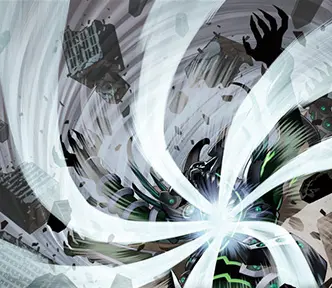
![YGOrganization | Spread The Good Word With “Trirealm Rift Gospel” [DBGV]](https://cdn.ygorganization.com/2026/08/MysteriesOfABlindlyImpersonalCosmos.png)
This effect forms the narrative and mechanical heart of the card. It establishes a closed-loop economy between the field and the face-down banished zone:
- The Sacrifice: Take a low-level (Level 4 or lower) "Trirealm Rift" monster currently sitting on your field. Banish it face-down.
- The Reward: Pull a high-level (Level 5 or higher) "Trirealm Rift" monster from your face-down banished pile and Special Summon it directly to the field.
Because Trirealm Rift Gospel itself sends cards to the face-down banished zone upon activation, this second effect gives those lost cards an immediate, highly lucrative purpose. It transforms initial setup sacrifices into heavy-hitting boss monsters, creating an upward trajectory of power as the duel progresses. Furthermore, because the low-level monster is banished face-down as a cost rather than sent to the graveyard, it evades graveyard-hate staples while feeding future recursive loops if other card effects interact with the banished zone.
Official Statements and Community Expert Analysis
Industry analysts, tournament judges, and professional players have weighed in heavily on the ramifications of DBGV-JP040. While the consensus acknowledges the immense ceiling of the card, opinions remain divided on whether its steep cost makes it a high-risk liability or an indispensable cornerstone.
Tournament Tacticians Speak
"When you look at a card that requires five cards to be banished face-down just to hit the table, your first instinct is caution," notes prominent OCG meta-analyst Kenji Sato. "However, ‘Trirealm Rift Gospel’ is a prime example of a card where the reward vastly outweighs the upfront expenditure. The ability to cycle a redundant Level 4 normal summon into a high-level powerhouse, combined with the extra Normal Summon, means this single Continuous Spell acts as both a starter and an extender. It changes math angles for opponents trying to disrupt your plays."
Another seasoned competitor, speaking under condition of anonymity pending upcoming regional tournaments, highlighted the psychological aspect of the card:
"Your opponent knows that every card sitting in your face-down banished zone is a loaded gun. They don’t know if you’ve locked away your game-winning boss monster or just fodder. That uncertainty forces misplays. More importantly, it turns the face-down banished zone—traditionally a graveyard graveyard—into an active deckbuilding resource."
Rules and Interaction Nuances
Rules arbiters have also pointed out several critical technicalities regarding the activation and resolution of Trirealm Rift Gospel:
- Chain Resolution: Because banishing the 5 cards is a cost for activation, if the activation of Trirealm Rift Gospel is negated (e.g., by Ash Blossom & Joyous Spring or similar negation effects), the 5 cards remain banished face-down, and the spell goes to the graveyard. This makes timing and baiting opponent interruptions vital before laying down the card.
- Original Level Verification: Effect (2) specifies "whose original Level is 4 or lower." This prevents shenanigans involving level manipulation effects, ensuring that players cannot use modified levels to bypass the intended design parameters of the archetype.
Comparative Matrix: Trirealm Rift Gospel vs. Traditional Archetypal Engines
To appreciate the design philosophy behind DBGV-JP040, it is helpful to compare its mechanical framework against classic archetype-accelerating Continuous Spells from recent competitive history.
| Feature / Metric | Trirealm Rift Gospel (DBGV-JP040) | Standard Searcher Spells (e.g., Branded, Runick) | Traditional Field Spells (e.g., Kashtira, Perlereino) |
|---|---|---|---|
| Initial Cost / Risk | High (Banish 5 cards face-down) | Variable (Discard, Life Points, or Free) | Low to None |
| Action Economy | Grants Extra Normal Summon | Grants search or direct summon | Boosts stats or triggers on-field effects |
| Resource Interaction | Utilizes & Manipulates Face-Down Banished Zone | Interacts with GY, Deck, or Hand | Interacts with Deck or Field |
| Recursion Potential | High (Converts Level ≤4 to Level ≥5) | Moderate to Low | Low to Moderate |
| Interruption Vulnerability | High (Cost paid upfront regardless of negation) | Moderate (Dependent on resolution) | Moderate (Dependent on field presence) |
As illustrated above, Trirealm Rift Gospel occupies a unique space: it is far riskier to activate than standard search spells, but its ceiling for explosive, multi-stage plays dwarfs traditional field spells that rely solely on passive advantages.
Future Outlook: The Meta Horizon for Trirealm Rift
As the competitive scene prepares for the integration of DBGV into broader tournament formats, the future of the Trirealm Rift archetype hinges entirely on how effectively players can mitigate the initial resource drain of Trirealm Rift Gospel.
Deck-Building Adaptations
- Engine Dilution vs. Specialization: Builders must decide whether to run a pure build that burns through its own deck to feed the face-down zone or a hybrid build utilizing generic self-mill packages (such as Ishizu-adjacent or rogue graveyard-dumping engines) to ensure the activation cost never touches vital combo pieces.
- Side-Deck Countermeasures: Because the card relies heavily on the face-down banished zone, opponents are likely to look for niche disruption tools that punish heavy banishment strategies or capitalize on exhausted resource pools. However, because face-down banished cards remain almost entirely immune to direct interaction, finding effective counters will prove challenging for mainstream side-decks.
Long-Term Viability
Archetypes that possess built-in cheat mechanics—such as swapping low-level bodies for high-level boss monsters without paying standard tribute costs—historically enjoy prolonged competitive shelf lives. Trirealm Rift Gospel provides precisely this kind of structural advantage.
Whether the archetype ascends to Tier 1 dominance or settles comfortably as a high-potential rogue contender will depend heavily on the remaining wave support in the Deck-Build Pack: Grand Voyage (DBGV) set. Yet, one thing is abundantly clear: the gate of dreams has been unlocked, and the competitive landscape will never be quite the same.
Stay tuned to our ongoing competitive coverage as further card reveals from DBGV unfold in the coming weeks.

![[Chronicles] Sinful Spoils ep 3 Teaser](https://youganba.com/wp-content/uploads/2026/10/chronicles-sinful-spoils-ep-3-teaser-420x260.webp)







Belum ada komentar. Jadilah yang pertama berkomentar!