

Executive Overview
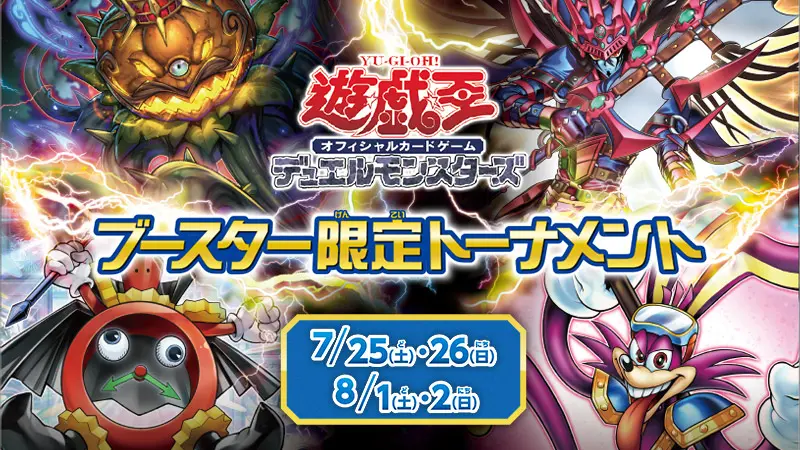
Competitive Yu-Gi-Oh! card game strategies are undergoing a radical recalibration across Official Tournament Stores (OTS) in Japan. Moving away from the hyper-optimized, open-pool meta-environments that traditionally dominate competitive play, Konami’s newly announced specialized booster tournament circuit introduces a localized, highly restrictive deck-building paradigm. Scheduled across two high-stakes summer weekends—July 25th–26th and August 1st–2nd, 2026—these store-level events enforce strict limitation parameters: duelists must construct their main and extra decks exclusively from a curated, isolated pool of recent product releases, while completely omitting generic meta-defining "staple" cards.
Operating under a fast-paced Swiss-style format featuring best-of-one (Bo1) matches capped tightly at 25 minutes, the tournaments force players to abandon comfortable optimization loops. Instead, competitors must innovate within closed ecosystems defined by sets such as Chaos Origins, Revolution Booster (-Toon/Witchcrafter/Unchained-), World Premiere Pack 2026, and Beyond the Brave.
This journalistic deep dive examines the tournament parameters, deconstructs the official sample deck lists released by Konami’s database, analyzes the intricate structural mechanics of this new format, and evaluates the long-term strategic implications for the global Yu-Gi-Oh! competitive community.
Detailed Chronology & Event Parameters
The operational blueprint for the Summer 2026 OTS Booster Tournaments has been meticulously designed to maximize logistical efficiency while testing the absolute limits of player adaptability under time constraints.
Operational Schedule and Timeline
- Weekend 1: July 25th (Saturday) and July 26th (Sunday), 2026.
- Weekend 2: August 1st (Saturday) and August 2nd (Sunday), 2026.
- Venue Parameters: Hosted exclusively at participating Yu-Gi-Oh! Official Tournament Stores (OTS) throughout Japan.
Tournament Structure and Match Regimen
- Participant Capacity: Intimate pods of 8 to 16 players per tournament block, ensuring localized competition and heightened regional rivalries.
- Format: Swiss-style pairings, guaranteeing that competitors play multiple rounds regardless of early losses, culminating in a definitive bracket or record standing.
- Match Design: Best-of-1 (Bo1) matches. In a format devoid of side decks, main-deck composition becomes an immediate gamble between addressing primary archetypal threats and maintaining internal consistency.
- Time Constraints: 25-minute match clocks. This aggressive timer completely alters resource management. Complex loops, extensive calculation states, and defensive stalling are heavily penalized by time expiration rules, forcing aggressive win conditions and rapid decision-making.
The Core Restriction: Isolated Product Pools
The definitive hallmark of these 2026 tournaments is the complete prohibition of universal staple cards (such as standard hand traps, generic board breakers, and universal search engines). Deck construction is legally bound only to cards printed within the following four distinct product lines and their corresponding expansions:
- CHAOS ORIGINS & CHAOS ORIGINS +1 EXPANSION PACK
- REVOLUTION BOOSTER -Toon / Witchcrafter / Unchained –
- WORLD PREMIERE PACK 2026
- BEYOND THE BRAVE & BEYOND THE BRAVE +1 EXPANSION PACK
By systematically severing access to decades of legacy card pools, Konami has engineered an artificial format where synergy outclasses raw individual card power.
Supporting Context & Metrics: Deconstructing the Official Sample Deck Recipes
To aid duelists in navigating this restrictive environment, Konami has published twelve official sample deck recipes via the official Card Database. A comprehensive analysis of these lists reveals a landscape dominated by specialized hybrid strategies, high-risk ritual builds, and tightly managed resource loops.
1. "Light and Darkness Ritual" Deck
- Core Focus: Leveraging high-level Chaos architecture alongside ritual mechanics.
- Key Inclusions: Magician of Dark Chaos – Black Chaos, Black Luster Soldier – Soldier of Light and Darkness, Light and Darkness Ritual, and Black Chaos.
- Extra Deck Support: Features extensive Unchained integration (Unchained Abomination, Unchained Soul of Rage, Unchained Soul Lord of Yama) alongside explosive board presences like Red-Eyes Black Dragon Exceed and Azure Ocean Dragon Lord – Neo-Daedalus Rage.
- Strategic Evaluation: This build bridges classic dark magic iconography with modern recursion engines, relying on ritual spells to trigger high-impact disruptions while maintaining backup extraction via spatial manipulation cards like Spatial Trunade.
2. "Sacred Beasts" Deck
- Core Focus: Summoning and protecting the towering elemental lords of the Phantasmal realm.
- Key Inclusions: Inferno of the Sacred Beasts – Uria, Lord of Searing Flames, Calamity of the Sacred Beasts – Hamon, Lord of Striking Thunder, and Infinity of the Sacred Beasts – Raviel, Lord of Phantasms.
- Support Spells/Traps: Sacred Beasts Released, Fallen Paradise of the Sacred Beasts, and Sacred Beasts Thunderclap.
- Strategic Evaluation: Built to rapidly dump continuous spells and traps into the graveyard or field to fulfill summoning requirements, this deck relies heavily on protective field spells to shield its hyper-offensive bosses from targeted removal.
3. "Blitzclique" Deck
- Core Focus: Hyper-aggressive, fast-paced archetype synergy designed to overwhelm opponents before the 25-minute clock expires.
- Key Inclusions: Whisker Blitzclique, Surge Blitzclique, Crackle Blitzclique, Grain Blitzclique, and Thunder King Rai-Oh.
- Strategic Evaluation: Operating as a traditional "beatdown" style swarm deck, the Blitzclique build utilizes multi-attack enablers like Blitzclique – Over Voltage to pressure life point totals instantly in the fast Best-of-1 environment.
4. "Invoked" Deck
- Core Focus: Fusion-centric tactical adaptation utilizing the elemental prowess of Aleister.
- Key Inclusions: Aleister the Invoker, Aleister the Reminiscent, Aiwass, Divine Spirit of the Law, and multiple variants of Invocation.
- Extra Deck Composition: Hyperinvoked Aeon, Invoked Oceanus, Invoked Baybarron, Invoked Sorath, and Artemis, the Magistus Moon Maiden.
- Strategic Evaluation: By recycling Invocation through various elemental dimensions introduced in the new product waves, this deck maintains constant fusion pressure without draining its main deck resources.
5. "Toon" Deck
- Core Focus: Direct-attack lethality bypassing opponent monsters, backed by iconic cartoon variants.
- Key Inclusions: Blue-Eyes Toon Dragon, Toon Black Luster Soldier, Toon Dark Magician, Comic Cat, and Toon World the Perfect World.
- Strategic Evaluation: Toon strategies trade defensive longevity for explosive, unblockable life-point damage, utilizing Toon Table of Contents and Toon Bookmark for rapid deck-thinning.
6. "Witchcrafter" Deck
- Core Focus: Spell-driven recursion, control, and disruption via magical artisan masters.
- Key Inclusions: Witchcrafter Madame Verre, Witchcrafter Haine, Witchcrafter Marka, and Verre Magic – Lacrima of Light.
- Strategic Evaluation: A control-oriented list that rewards precise management of spell cards in the hand, allowing players to disrupt opponent plays during either turn while recycling resources during the end phase.
7. "Unchained" Deck
- Core Focus: Self-destruction mechanics that turn removal attempts into field advantage.
- Key Inclusions: Abominable Unchained Soul, Unchained Soul of Sharvara, Unchained Twins – Aruha, and Abomination’s Prison.
- Strategic Evaluation: Because opponents attempting to destroy cards will inadvertently trigger the Unchained engine, this deck acts as a reactive powerhouse that punishes aggressive opening boards.
8. "Call of the Haunted" Deck
- Core Focus: Graveyard resurrection mechanics paired with ghost-type disruptors.
- Key Inclusions: Pumpking the King of Grave Ghosts, Stare of the Snake Hair, Hublot the Dark Directory of Death, and multiple copies of Call of the Haunted.
- Strategic Evaluation: A slower, methodical trap-heavy strategy that slowly bleeds the opponent of resources by constantly bringing fallen combatants back to the active field.
9. "R.B." Deck
- Core Focus: Heavy machinery and tactical deployment mechanics.
- Key Inclusions: R.B. Ga10 Pile Bunker, R.B. Lambda Blade, R.B. Stage Landing, and R.B. VALCan Booster.
- Strategic Evaluation: Focused on lining up high-attack mechanical entities while utilizing specialized field staging to control battle phases.
10. "GMX" Deck
- Core Focus: Experimental laboratory synergies and chemical/technological combos.
- Key Inclusions: GMX Partner Selandea, GMX Chairman Kimridge, GMX Applied Experiment #55, and GMX – COMPREX.
- Strategic Evaluation: A complex archetype relying on staged experiment counters to unlock high-tier extra deck monsters and clear opponent boards.
11. "Dark Time Wizard" & "Ashtra" Decks
- Core Focus: Temporal disruption, coin-flip/probability mechanics, and mystical deity summoning.
- Key Inclusions: Dark Time Wizard, Akasuna the Battle Ashtra, Mikumari the Sealing Deity Ashtra, and Ashtrashen – Gateway to the Worlds Beyond.
- Strategic Evaluation: Designed around high-variance effects that can drastically alter game states when successful, making them high-risk, high-reward choices for tournament players.
12. "Atlantis, City of the Sea Dragon" & "Umbral Horror" Decks
- Core Focus: Aquatic environment manipulation and ranked Xyz dark-swarm corruption.
- Key Inclusions: Levia-Dragon of Atlantis – Daedalus, General of Atlantis, Shining Umbral Horror, and Number C104: Umbral Horror Masquerade Victory.
- Strategic Evaluation: These decks capitalize on field-spell environmental boosts or heavy Xyz overlay techniques to secure rapid game-ending attacks before the 25-minute timer sounds.
Official Statements & Design Philosophy
While Konami’s localized tournament announcements serve primarily as competitive frameworks, industry insiders and regional tournament organizers have noted a distinct shift in corporate design philosophy.
According to regional event liaisons, the primary objective of the Summer 2026 OTS Booster Tournaments is to "decentralize the meta-monopoly." For years, competitive Yu-Gi-Oh! has faced criticism from casual and mid-tier players regarding the high financial barrier to entry and the narrow scope of viable tournament archetypes. By enforcing a closed product pool where generic hand traps and expensive universal staples are illegal on paper, Konami is testing a format where tactical understanding of newly released mid-tier archetypes outweighs pure monetary investment.
Furthermore, the strict 25-minute match timer in a Best-of-1 setting is an intentional stress-test. Konami’s design team aims to evaluate how players manage time pressure without the safety net of Game 2 and Game 3 side-decking, potentially paving the way for faster, more digestible tournament formats in future global championships.
Future Outlook: What This Means for the Global Meta
The implementation of the Japanese OTS Booster Tournament circuit serves as a fascinating bellwether for the future of the Yu-Gi-Oh! Trading Card Game. If the data collected from the July and August 2026 events indicates positive player retention, balanced win-rates across the twelve sample archetypes, and enthusiastic store participation, several long-term shifts can be anticipated:
- Expansion of Sealed and Restricted Formats: Konami may look toward permanent localized "Restricted Pool" queues, giving older or niche archetypes a dedicated competitive home outside the master-duel or advanced-format metas.
- Shift in Product Design: Designers may place greater emphasis on self-contained archetypal synergy during initial set development (Chaos Origins, Beyond the Brave, etc.), knowing that players relish environments where cards must stand on their own merits rather than leaning on historical staples.
- Global Adoption: Western tournament organizers (such as those managing regional qualifiers in North America and Europe) frequently look to Japanese experimental formats for inspiration. Specialty side-events at premier YCS (Yu-Gi-Oh! Championship Series) tournaments could soon adopt similar restricted-pool rulesets.
Conclusion
As the clock ticks down to July 25th, 2026, duelists across Japan are meticulously analyzing deck recipes ranging from the mystical Light and Darkness Ritual to the mechanical onslaught of the R.B. and GMX archetypes. By stripping away the safety blanket of universal staples and forcing intense, 25-minute tactical showdowns, Konami has breathed fresh life into the store-level competitive scene. Whether these experimental formats will permanently alter the global Yu-Gi-Oh! landscape remains to be seen, but one thing is certain: the summer of 2026 will test the adaptability of even the most seasoned duelists.




Belum ada komentar. Jadilah yang pertama berkomentar!