

Vacations exist outside the strict boundaries of conventional time. They represent a suspended pocket of existence—a temporary exile from our natural environments before we inevitably return to the monotonous routines of daily life. In most instances, the events that transpire during a holiday seem weightless, failing to "count" in the grand ledger of personal achievement. Yet, these moments are frequently recalled with startling clarity, casting long shadows over the blurred weeks of supposed productivity that surround them.
Because "nothing is happening" in the traditional sense, this brief respite strips away the armor of professional obligations, bringing modern humanity into direct, often uncomfortable contact with genuine thoughts and underlying character traits. This psychological premise forms the bedrock of the holiday film—a remarkably malleable genre that can easily escalate into broad comedy, psychological horror, or, in its most thoughtful incarnations, evolve into a profound, quiet study of human nature.
Chief among these masterful explorations is Satyajit Ray’s 1970 cinematic triumph, Days and Nights in the Forest (Aranyer Din Ratri). Newly restored through a decade-long initiative by The Film Foundation and brought to physical media via a definitive Criterion Collection release on Blu-ray, DVD, and UHD, the film remains a towering achievement in world cinema. Boasting champion supporters ranging from contemporary cinephile-auteurs like Wes Anderson to esteemed film historians, this newly minted restoration offers both veteran admirers and first-time viewers a chance to reexamine a deceptively simple narrative that pulses with profound social, political, and psychological undercurrents.
Detailed Chronology: The Journey into Palamu
Departure and Pretense: The Urban Escapees
The opening moments of Days and Nights in the Forest establish a distinct visual rhythm. The film begins with a traveling shot of passing countryside accompanied by evocative voiceover narration. While one might initially mistake the perspective for that of a train window, Satyajit Ray—ever the formalist—saves his signature passing-train motif for later. For now, the audience is confined to the interior of a car carrying four young, ambitious men escaping the stifling, bureaucratic boredom of their professional lives in Calcutta (now Kolkata). Squeezed together in uncomfortably close quarters, they wear their urban fatigue like a second skin.
The man reading aloud is Sanjoy (Subhendu Chatterjee), a bookish, bespectacled intellectual engrossed in a 19th-century colonial guide detailing the wooded tribal region of Palamu. The text titillates the group with exoticized colonial descriptions of local tribal women, prompting knowing leers and insecure banter regarding their respective love lives. Only the loud, short, clownish Shekhar (Rabi Ghosh) loudly declares himself above such "bourgeois" topics, aggressively policing the conversation and berating his companions for their hypocrisy.
Chief among Shekhar’s targets is the sleepy, moody Hari (Samit Bhanja), a professional cricketer nursing a fresh heartbreak. Hari suffers a brief, illuminating flashback to the bitter end of his relationship. His ex-girlfriend is played by Aparna Sen—a celebrated film star who would later transition into a prominent filmmaker in her own right. As she sits before a mirror, primping and complaining about her inability to truly connect with him, Hari accidentally yanks off her voluminous wig.
This abrupt, violent mechanical halt reveals his profound shock, as though he had been entirely blind to this facet of her identity. In a jarring cut back to the present, she slaps him across the face, jolting him out of his reverie. Perhaps, despite her claims of baring her soul, she was deeply humiliated by the exposure of her artificiality. Her fury is less about his clumsiness and more about being unmasked. This emblematic vignette concisely encapsulates their relationship, framing modern urban existence as a brittle construct built entirely on physical and intellectual pretense.
Privilege, Corruption, and Class Structures
The car’s owner and driver is Ashim, the most dapper and socially polished of the group, functioning as the romantic lead of the narrative. Played by Soumitra Chatterjee—who famously debuted as the lead in Ray’s monumental The World of Apu (1959)—Ashim anchors the film with effortless cinematic authority. Although unrelated to co-star Subhendu Chatterjee, Soumitra collaborated with Ray across decades, culminating in his riveting, morally complex performance as a beleaguered doctor in Ganashatru (1990), an adaptation of Henrik Ibsen’s An Enemy of the People.
During the drive, Ashim and Sanjoy reminisce about their university days running a literary magazine. "You must admit," Sanjoy remarks proudly, "we never published any bad writing." Those salad days are long gone, replaced by soul-crushing middle-class jobs that neither man dares to discuss on vacation.
Upon arriving in Palamu, the four friends immediately exercise their class privilege. They intend to stay at a local guest bungalow designated for travelers, though a prominent warning sign stipulates that visitors must secure prior authorization from an official reservation clerk. The elderly caretaker, burdened by an ailing wife and terrified of losing his livelihood, informs the young men of the rule. Undeterred, the friends deploy charm, social engineering, and a discreet exchange of cash. Shekhar chuckles, declaring in English, "Thank God for corruption." Later, a local woman accurately summarizes Ashim’s paradox: he is a successful man who claims not to take bribes, yet readily dispenses them to secure his own comfort.
Over the ensuing days, this question of official administrative permission hangs over the group like a Damocles sword, occasionally flaring into an active crisis as higher-ranking bureaucrats pay unannounced visits. The sudden, frictionless resolution of the permit issue through personal "connections" and social engineering lays bare the mechanics of privilege in post-independence India. It exposes how status, class, gender, and regional identity dictate daily survival. The episode demonstrates that while these urbanites are willing to subvert the corrupt administrative structures that sustain them, they lack the revolutionary conviction to tear them down—preferring instead to retreat to their cabins and drink themselves into a stupor.
Supporting Context & Metrics: History, Politics, and the Shadow of Naxalbari
The Burning Newspaper: A Subversive Symbol
A seemingly minor scene involving a discarded newspaper carries immense historical and political weight. Shekhar, seeking to demonstrate their temporary liberation from city cares, dramatically burns a newspaper. To contemporary or Western viewers, this gesture might register as an eccentric, melodramatic flourish. To Indian audiences in 1970, however, it was a fraught, highly volatile symbol.
The newspaper headline details a border clash between China and the Soviet Union—geopolitical tremors directly tied to the armed Naxalbari (or Naxalite) Uprising of 1967. Launched by marginalized tribal communities in rural Bengal and fueled by radical university students, the uprising ultimately catalyzed the formation of the Communist Party of India (Marxist-Leninist) in 1969.
As Film Comment co-editor Devika Girish elucidates in her essential liner notes for the Criterion release, this socio-political backdrop is so delicately woven into the fabric of the film that it easily eludes non-Indian or contemporary viewers. Yet, it imbues Ray’s narrative with a profound, resonant tension. The vacationers are men who have safely entrenched themselves in secure, salaried urban careers (with the exception of the unemployed Shekhar). They have actively turned their backs on the radical student politics shaking Calcutta to its core. When Sanjoy participates in a parlor memory game and instinctively blurts out the names of Karl Marx and Mao Zedong, it betrays a deep psychological fracture: his mind and political sympathies are completely alienated from the bourgeois comforts of his daily lifestyle.
Romantic Encounters and Human Fragility
The core narrative engine of the vacation unfolds through three distinct romantic—or pseudo-romantic—subplots:
- Ashim and Aparna: Ashim encounters the stylish, intellectual Aparna (Sharmila Tagore), the daughter of a patrician elderly gentleman, Tripathi (Pahari Sanyal), who is visiting a nearby country estate. When Ashim impulsively inserts himself into Aparna’s private quarters, he breaches social etiquette with the frictionless entitlement of the urban elite. While she stands poised at the window like a defendant in a witness box, Ashim inspects her bookshelf, discovering an eclectic mix of Penguin paperbacks featuring new American plays, metaphysical poetry, Agatha Christie mysteries, and Alan Isaacs’ The Survival of God in the Scientific Age. Her vinyl collection is similarly diverse, spanning traditional Indian classical music, Joan Baez, Andrés Segovia, Mozart, The Beatles’ Rubber Soul (notable for George Harrison’s pioneering sitar work), and the sophisticated Indo-Jazz Suite by Indian composer John Mayer and Jamaican saxophonist Joe Harriott. "I really can’t figure you out," Ashim confesses. "Is that necessary?" she fires back, a masterclass in defensive, seductive flirtation.
- Sanjoy and Jaya: Sanjoy finds himself drawn to Jaya (Kaberi Bose), Aparna’s widowed sister-in-law, who is traveling with her young son. Their interactions unfold with agonizingly subtle psychological restraint until Jaya enacts a quiet act of emotional bravery, confronting Sanjoy with their mutual desires.
- Hari and Duli: In stark contrast to the intellectual fencing of Ashim and Aparna, the athletic, emotionally bruised Hari seeks transactional solace. Rebounding from his devastating breakup, Hari casually pursues Duli (Simi Garewal), an ebony-skinned tribal woman. Duli is fiercely independent, shaped by a harsh life history casually referenced in dialogue and driven by the necessity of serving wealthy tourists who can pay for manual labor.
This transactional dynamic is mirrored in the group’s treatment of a local peasant. Drafted into service through a toss of cash, the man hovers around the rich city folk like an eager, domesticated lackey. Kept on a short leash, he is eventually subjected to verbal accusations and physical violence by an intoxicated Hari. While Ashim and his peers force Hari to apologize to the upper-class women for perceived slights to his wallet, no such apology is offered to the tribal peasant—leaving the local man burning with a quiet, smoldering resentment that mirrors the broader class warfare brewing across the countryside.
Aesthetic Mastery: Movement and the Moving Camera
True to the traditions of "nothing happens" cinema, Days and Nights in the Forest is rich in casual incidents and sidelong psychological revelations. It functions as a distinctly Indian Chekhovian study of character frustration, bearing clear spiritual kinship to humanist masterpieces like Jean Renoir’s A Partie de campagne (A Day in the Country, 1946). The film deepens exponentially the further one wanders into its bucolic details, revealing that the rural backwoods are far from the serene, picturesque sanctuary the urbanites initially imagined.
Aside from Satyajit Ray’s own delicate musical score, the film’s defining aesthetic choice is established in its opening moments: cinematographer Soumendu Roy’s camera is almost perpetually in motion. Eschewing flashy, dramatic crane shots, the camera utilizes continuous, subtle pans and tracking dollies to spatialise the human figures, constantly recalibrating their relationships to one another and their natural environment.
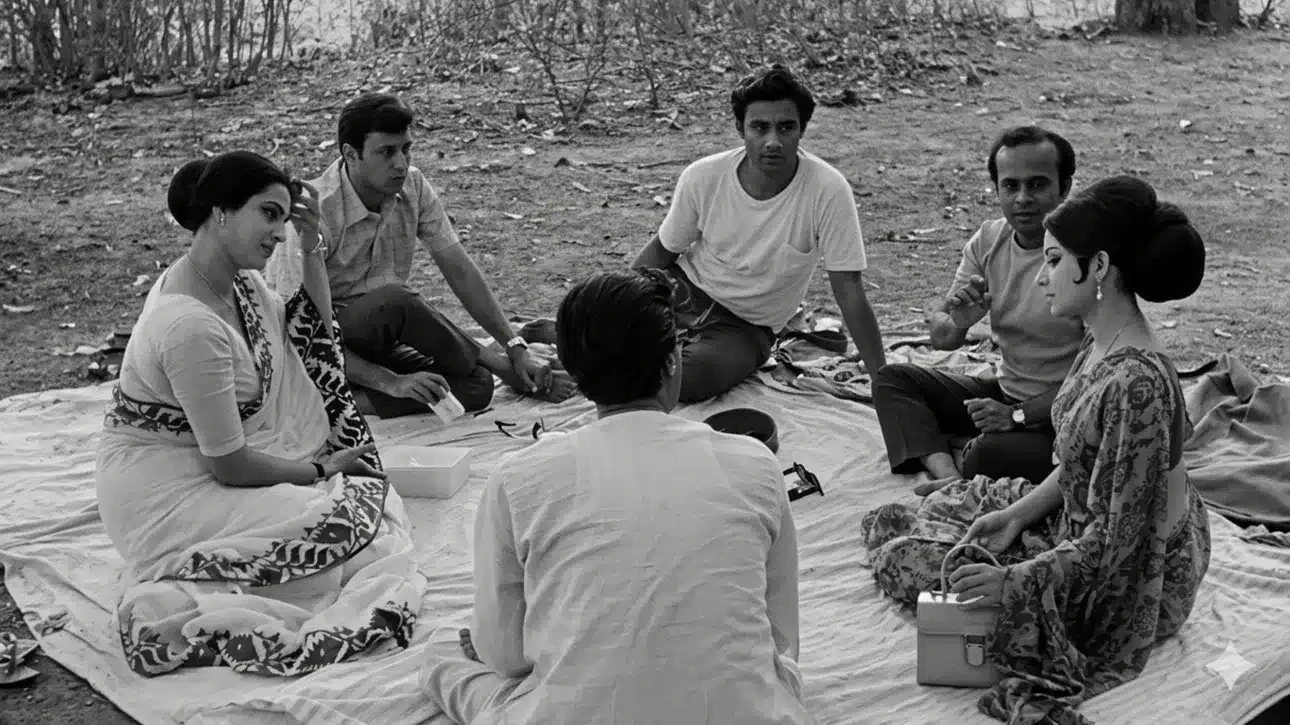
This fluid visual style reaches its zenith during a village fair sequence, captured with weightless, dizzying kinetic energy aboard a hand-cranked Ferris wheel—a staple motif of Indian cinematic grammar. Similarly, the famous scene wherein the characters sit on the forest floor playing a competitive memory game becomes a masterclass in cinematic rhythm, sweeping and cutting dynamically among the players. This restless camera movement serves a thematic purpose: it asserts that even quiet, seemingly stagnant rural retreats are alive with complex psychological friction, mirroring the relentless, hyperactive activity of the human mind.
Official Statements and Archival Restoration
The journey to bring Days and Nights in the Forest back to pristine theatrical and home video standards represents a landmark achievement in film preservation. Speaking in an exclusive bonus introduction included on the Criterion Collection release, acclaimed filmmaker Wes Anderson details his decade-long involvement alongside Martin Scorsese’s The Film Foundation to rescue the film from fading archival elements.
"Working alongside The Film Foundation to locate, secure, and restore the surviving camera negatives of Satyajit Ray’s masterwork has been an arduous, deeply rewarding labor of love," Anderson notes in his video essay. "Like so many of Ray’s cinematic treasures, finding a clean, watchable print had become increasingly difficult over the decades. To see it preserved and presented in UHD and Blu-ray is nothing short of a miracle for cinephiles worldwide."
Anderson’s reverence for Ray’s formal precision is well-documented; he openly admits to adapting the legendary "memory game" scene from Days and Nights in the Forest as a direct structural homage for his 2023 feature Asteroid City.
The physical release is further bolstered by comprehensive bonus features, including rare archival interviews with Satyajit Ray, contemporary reflections from actress Sharmila Tagore, cinematographer Soumendu Roy, and actor Rabi Ghosh, alongside insights from Film Heritage Foundation director Shivendra Singh Dungarpur. These supplementary materials contextualize the film not merely as an isolated artistic triumph, but as a crucial cultural artifact that documents a rapidly modernizing India wrestling with the ghosts of its colonial past and the turbulent birth of its political future.
Future Outlook
As physical media publishers like The Criterion Collection continue to partner with global preservation archives, the cinematic legacy of Satyajit Ray enters a secure second life for 21st-century audiences. Days and Nights in the Forest stands as a vital touchstone in this archival renaissance.
For modern viewers accustomed to fast-paced, high-concept storytelling, Ray’s patient, observational masterpiece offers a necessary antidote—an invitation to slow down, observe human fragility, and reflect on the invisible class structures that govern our daily lives. Whether viewed as an acute psychological character study, a subtle political critique of post-colonial India, or a sublime meditation on the bittersweet nature of leisure, Days and Nights in the Forest remains an indispensable cinematic escape. It proves once again that Satyajit Ray’s cinema is a sacred territory we are perpetually privileged to inhabit—if only for a few transcendent hours, or better yet, for whole days and nights.








Belum ada komentar. Jadilah yang pertama berkomentar!