

Executive Overview
In the modern landscape of the music industry, virality often overrides traditional artist development, weaponizing algorithms and internet culture to propel debut acts into the limelight. No recent phenomenon highlights this paradigm shift quite like the rise of "indie poo"—a pejorative internet micro-genre that inadvertently catalyzed the breakout success of Leeds-based outfit Garage Flower.
Officially announced on July 17, Garage Flower’s eponymous debut single was poised to be a quiet introduction for a young band rebranding from their former moniker, The Liabilities. Instead, just two weeks later, the British music ecosystem was upended by TikTok creator Angus.Official. Coining the term "indie poo" as a sardonic retort to the viral "UK poo" drill music meme, the content creator targeted a naive slew of emerging indie-rock acts, including Park Drive, Bilk, Andy Goodwin, and ultimately, Garage Flower.
Rather than burying the band, the ensuing wave of online derision acted as a powerful accelerant. Accused of rampant derivativeness, Garage Flower found themselves thrust to the forefront of an unexpected cultural firestorm. The controversy turned out to be the ultimate marketing engine, surging their debut single to number two on the UK physical sales chart before physical copies had even hit store shelves. This unfolding saga serves as a stark reminder of a modern musical truth: in the social media age, manufactured or organic backlash can function as the ultimate fuel for commercial triumph.
Detailed Chronology: From The Liabilities to Chart Contenders
To understand the meteoric and controversial rise of Garage Flower, one must look at the trajectory of its members, who are no strangers to the independent circuit. Until July 2025, the group operated under the name The Liabilities. Under that banner, they cut their teeth on the local Yorkshire circuit, releasing three independent singles and the 2024 EP Looking Back is Formidable.
The transition to Garage Flower was intended to mark a mature creative pivot—a sharpening of their sonic identity. The band officially announced their debut single under the new name on July 17, setting into motion a standard release campaign. However, the timeline accelerated rapidly due to external cultural forces:
- Mid-July 2025: Garage Flower announces their debut single, drawing inspiration from the late-80s and mid-90s Manchester baggy and Britpop scenes.
- Late July 2025: TikToker Angus.Official coins the term "indie poo" in response to the "UK poo" meme, sweeping across social media to mock a perceived homogenous wave of new indie guitar acts.
- Early August 2025: Garage Flower becomes the poster child for the "indie poo" movement. Online critics flood their socials with allegations of plagiarism and lack of originality.
- Pre-Release Surge: Capitalizing on the sudden influx of attention—both positive and deeply critical—fans and curious onlookers flood physical retail pre-orders.
- Chart Impact: The single debuts at number two on the UK physical sales chart, a staggering feat for a newly rebranded underground act.
Musical Architecture: Sonic Influences and Hybrid Aesthetics
Musically, Garage Flower’s debut single is a deliberate pastiche of mid-90s Madchester nostalgia married to modern indie-hardcore sensibilities. Vocalist Nathan Whitehead leans heavily into a Liam Gallagher-esque nasal drawl, backed by a rhythmic swagger unmistakably reminiscent of The Stone Roses. Structurally, the track follows the blueprint laid down by Oasis: a driving rhythm guitar anchors the foundation while the lead guitar weaves jangling melodies and subtle blues licks throughout the verses.
Yet, to write the track off as mere karaoke-Britpop is to ignore its undercurrent of speed and aggression. The track’s velocity feels distinctly foreign to traditional 90s indie, bearing a closer resemblance to the early hardcore leanings of bands like Title Fight. In particular, the muting pattern of the primary riff draws an immediate parallel to Title Fight’s track "Symmetry." This cross-pollination is indicative of a broader 2020s trend where contemporary hardcore acts (such as High Vis, Turnstile, and Militarie Gun) frequently borrow from indie sensibilities, making it entirely natural for indie acts to return the favor with heavier, punchier rhythmic deliveries.
Furthermore, the standout performance on the track belongs to bassist Joshua Ndombasi. Navigating the fretboard with agile precision, Ndombasi drops ghost-note-filled grooves that act as primary melodic hooks. The production even drops the rhythm guitar out entirely during the second verse, purposefully spotlighting the bassline and elevating it from a background instrument to the focal point of the arrangement.
Lyrical Tropes and Northern Realism
Lyrically, the "indie poo" label attempts to skewer a specific aesthetic: the bucket-hat-wearing, Strongbow Dark Fruits-drinking stereotype of Northern youth culture, filtered through a lens reminiscent of early Alex Turner or Libertines-era poeticism. In the context of the genre, however, these elements are often accused of being co-opted as flat aesthetic tropes and virality fodder rather than functioning as genuine, tongue-in-cheek cultural critiques.
Garage Flower’s debut opens with the lines:
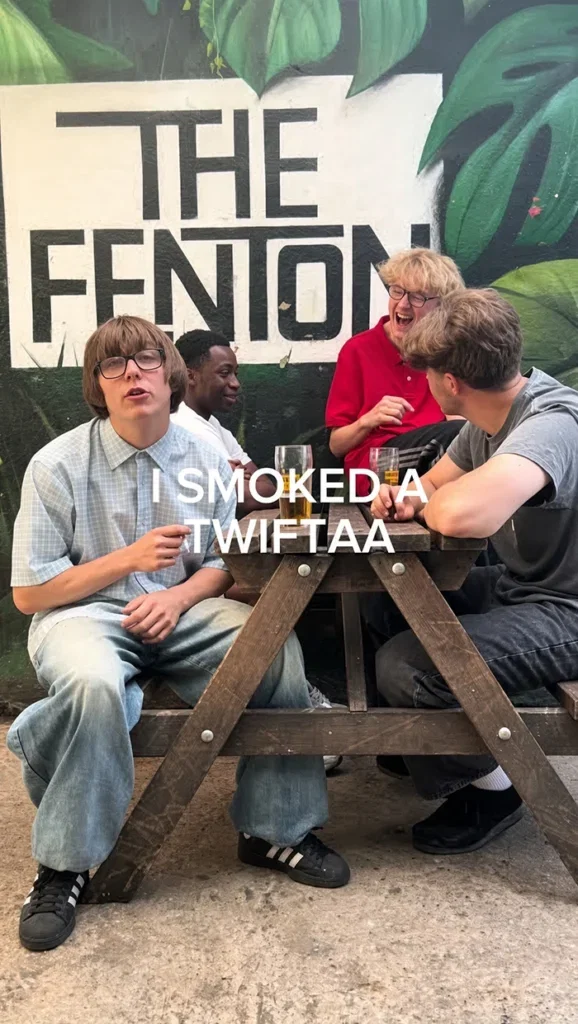
"I smoked a twifta this morning / And Quarry Hill is where I’m going."
The term "twifta" is a relatively uncommon regional colloquialism for a marijuana cigarette, even within Leeds. "Quarry Hill" refers to a campus of Leeds City College, situated directly beside Playhouse Gardens—a notorious local hotspot for skaters and cannabis enthusiasts.
While these cryptic local allusions align them with contemporaries—such as Andy Goodwin singing "She turned up in her three stripes and a Fred Perry" or Ten Hands High noting that "Baggy tees are as common as petty crime"—they serve a specific purpose. Whitehead nods directly to his forebears with lines like "Now it’s a very happy Monday" (invoking Happy Mondays) and "I’m in the garage with my flowers" (referencing The Stone Roses’ 1996 archival compilation Garage Flower, from which the band took their new name).

Despite crafting a backdrop dripping with Leeds indie-kid signifiers, the track is fundamentally a straightforward relationship song. The lyrics may flirt with vapidity, but within the ecosystem of British youth culture, straightforward guitar-driven rock functions precisely as pop music. The resistance to this—the insistence that indie lyrics must possess high literary merit—often stems from a lingering "rockist" bias that demands guitar music hold a position of supposed intellectual superiority over conventional pop.
Supporting Context & Metrics: The Evolution of "Landfill Indie"
To analyze "indie poo" merely as a snarky internet label for "bad indie music" is to miss a quarter-century of British radio history. The genre is part of a long lineage of guitar-driven rock that has dominated the UK airwaves since the garage rock revival of the early 2000s. As that initial wave proliferated and hardened into a predictable corporate formula, critics coined the term "landfill indie."
For generations of young Britons, their first exposure to the electric guitar came through these exact conduits—chiefly Arctic Monkeys, alongside 2010s mainstays like Foals, The Vaccines, and Catfish and the Bottlemen, who continually populated festival lineups from Reading to Leeds.
Leeds itself has always served as a fertile breeding ground for this lineage. Recent years have seen local acts like Indigo Project, The Sheratons, and Don’t Wake the Bear pull healthy crowds, while bands like L’objectif flirted with the mainstream between 2021 and 2022. Garage Flower now sits alongside kindred spirits like The North, representing a continuous regional pipeline of guitar-driven youth culture.
The Second Landfilling: A Cultural Zeitgeist
What makes "indie poo" unique is that it represents the second landfilling of indie music—a digital-age reinterpretation informed by a specific convergence of cultural events. This includes:
- The highly publicized Oasis reunion.
- The passing of foundational Stone Roses bassist Gary Mounfield.
- A renewed critical and commercial focus on original Britpop and baggy precursors.
- The unexpected underground resurgence of emo-hardcore acts like Title Fight.
The backlash facing Garage Flower and their peers is less about genuine plagiarism and more a symptom of cultural overexposure. When compared to contemporaries like Bayboards, The Guest List, and Strata, Garage Flower’s sonic identity remains distinct and clearly attributable.
Official Statements and Industry Reactions
As the debate surrounding "indie poo" expanded from TikTok comment sections into music publications, industry observers have weighed in on what this micro-genre signifies for the future of guitar music.
While management teams and independent PR representatives have largely remained quiet, capitalising on the free press generated by the discourse, independent commentators and creators have fiercely debated the boundaries of authenticity. Speaking anonymously, one UK-based indie promoter noted:
"The internet wants everything to either be a profound artistic revelation or a total joke. Bands like Garage Flower are just young lads making energetic guitar music because it’s what they love and what their peers listen to. The fact that the internet branded it ‘poo’ and tried to cancel them before their first single dropped actually worked in their favor. Kids bought the physicals out of spite or curiosity. The haters accidentally funded their chart position."
Future Outlook: Where Do "Indie Poo" Bands Go From Here?
The critical question facing Garage Flower—and the broader wave of bands swept up in the "indie poo" phenomenon—is sustainability. Virality born from internet mockery is a volatile asset. It can launch a physical single to number two on the charts overnight, but it risks boxing a band into a novelty category where they are viewed as memes rather than enduring artists.
However, history suggests that commercial momentum, regardless of its origin, opens doors. The "landfill indie" bands of the 2000s faced relentless critical battering from the music press, only to go on to headline festivals and define an entire generation’s youth. If Garage Flower can successfully navigate the transition from viral controversy to consistent songwriting craftsmanship, their debut single will be remembered not as a punchline on TikTok, but as the chaotic, brilliantly timed catalyst of a long and prosperous career.
Is Garage Flower "indie poo"? Sure, whatever that means. But looking at the charts, it is undeniably effective.









Belum ada komentar. Jadilah yang pertama berkomentar!