


Executive Overview
The landscape of personal computing is experiencing a structural realignment, particularly within the high-performance gaming sector. Historically, macOS has occupied a secondary—if not entirely bypassed—position in the strategic calculus of major AAA game publishers. Porting cycles have routinely suffered from frustrating multi-month or multi-year delays, and in many instances, critically acclaimed titles failed to cross the platform threshold entirely.
However, the upcoming release of Crimson Desert, developed by South Korean powerhouse Pearl Abyss, marks a watershed moment for Apple silicon. Slated for a simultaneous global launch on March 19, Crimson Desert will arrive on macOS on day one, sitting shoulder-to-shoulder with versions for Windows PC, PlayStation 5, and Xbox Series X|S.
This simultaneous multi-platform debut is not merely an isolated commercial release; it is the culmination of Apple’s multi-year, methodical push to position the Mac as a viable, high-end gaming destination. Bolstered by architectural leaps in Apple silicon—ranging from the M3 generation to the anticipated M5 Pro and M5 Max chips—and advanced graphics pipelines like MetalFX Upscaling and hardware-accelerated ray tracing, macOS is shedding its reputation as a productivity-only environment. As Apple prepares to unveil a wave of new MacBooks, the arrival of Crimson Desert offers concrete proof that the hardware, the software development kits (SDKs), and the publisher confidence are finally aligning to bridge the historical chasm between macOS and the broader gaming industry.
Detailed Chronology: The Road to macOS Day-One Parity
To appreciate the gravity of Crimson Desert launching day-and-date on the Mac, it is necessary to examine the timeline of how Apple and Pearl Abyss cultivated this partnership, transforming a traditionally Windows-centric blockbuster into a cross-platform showcase for Apple silicon.
[June 2023] ──> [Summer 2025] ──> [February 2026] ──> [March 19, 2026]
  Gameplay       Apple Announces     Pre-Orders Open     Global Day-One
  Reveal at      macOS Lineup;       & System Specs      Launch across
  Gamescom       Highlights M-Series   Released via Steam   macOS, PC, PS5,
                 Ray Tracing                              & Xbox Series X|S
The Genesis of a Technological Alliance
Pearl Abyss initially captured the attention of the global gaming community with sweeping gameplay trailers for Crimson Desert at events like Gamescom. Originally conceptualized within the universe of the studio’s massively multiplayer online role-playing game (MMORPG) Black Desert, the project evolved into an expansive, single-player open-world action-adventure game defined by breathtaking visual fidelity, complex physics-based combat, and a gritty medieval fantasy setting.

Apple’s Strategic Pivot at WWDC and Beyond
For years, Apple’s attempts to capture the gaming market were hampered by fragmented graphics APIs (such as the deprecation of OpenGL in favor of the proprietary Metal framework) and performance bottlenecks on Intel architecture. The introduction of Apple silicon fundamentally altered this dynamic.
By the summer of 2025, Apple formally signaled its aggressive intent to court AAA developers. During a major software and hardware ecosystem showcase, Apple announced that Crimson Desert would be part of a curated elite wave of nine major titles coming to macOS. Apple specifically spotlighted Pearl Abyss’s willingness to optimize the title for the unified memory architecture and advanced GPU capabilities of the M3 and M4 chip families.
Pre-Orders and System Specifications Unveiled
Fast forward to February 2026, and the anticipation has reached a fever pitch. Pearl Abyss officially opened pre-orders for Crimson Desert on Steam, pricing the Standard Edition at $69.99 and the Deluxe Edition at $79.99. Alongside the pre-order rollout, the studio published official system requirements. These disclosures provided developers and hardware analysts with their first detailed look at how the game’s heavy computational demands—spanning dense crowd simulations, dynamic weather systems, and massive open-world streaming—are handled by Apple’s Metal 3 API.
With the launch now mere weeks away, the industry stands on the precipice of a definitive test: Can a massive, bleeding-edge open-world RPG run natively and fluidly on Apple laptops and desktops without requiring a localized cloud-streaming workaround?
Supporting Context & Metrics: The Technical Architecture of Mac Gaming
The technical hurdles of bringing a modern AAA game to macOS are formidable. Developers must translate DirectX-heavy or Vulkan-based rendering pipelines into Apple’s proprietary Metal architecture while accounting for disparate thermal profiles across passive-cooled MacBook Airs and active-cooled MacBook Pros, iMacs, and Mac Studios.

MetalFX Upscaling and Ray Tracing
Apple’s secret weapon in achieving performance parity is MetalFX Upscaling. Similar to NVIDIA’s DLSS (Deep Learning Super Sampling) or AMD’s FSR (FidelityFX Super Resolution), MetalFX allows games to render at a lower internal resolution before intelligently upscaling the image to 4K or native display resolutions with minimal loss in visual fidelity.
In the case of Crimson Desert, Apple has emphasized that the game heavily leverages:
- Hardware-Accelerated Ray Tracing: Introduced widely with the M3 generation and refined in the M4 family, dedicated ray tracing cores handle complex light bounces, realistic shadows, and reflections across the rugged landscapes of Pywel, the game’s fictional continent.
- Unified Memory Architecture (UMA): Unlike traditional PC setups that must shuttle data back and forth between system RAM and dedicated graphics VRAM over a PCI Express bus, Apple silicon utilizes a high-bandwidth unified memory pool. This allows the GPU and CPU to access the same asset data instantaneously, significantly reducing load times and stutter during high-speed open-world traversal.
The Pricing and Hardware Ecosystem Matrix
| Feature / Metric | Standard Edition | Deluxe Edition | macOS Target Hardware | ||
|---|---|---|---|---|---|
| Price Point | $69.99 USD | $79.99 USD | Apple Silicon (M3, M4, M5 Families) | ||
| Primary Platform | Steam / Day-One Release | Steam / Day-One Release | macOS (via Steam client) | ||
| Core Technologies | Open-World Action-Adventure | Open-World Action-Adventure | Metal 3, MetalFX, Ray Tracing | ||
| Accompanying Launch | PC, PS5, Xbox Series X | S | PC, PS5, Xbox Series X | S | N/A |
Economic and Market Implications
The $69.99 price tag for the Standard Edition positions Crimson Desert firmly in the upper echelon of modern console and PC pricing. For Mac users, paying parity pricing for a day-one release signals that Pearl Abyss views the macOS installed base not as an afterthought or a secondary porting target subsidized by a publisher grant, but as a legitimate, paying consumer market.
Furthermore, industry insiders anticipate that Apple will showcase Crimson Desert prominently during the forthcoming hardware cycle—specifically tied to the rollout of new M5 Pro and M5 Max MacBook Pros. Demonstrating a sprawling, visually demanding open-world epic running smoothly on next-generation Apple silicon provides Cupertino with an invaluable marketing narrative for both creative professionals and digital entertainment enthusiasts.
Official Statements and Industry Perspective
While Pearl Abyss has driven the development of the game’s core engine and gameplay mechanics, Apple’s evangelism of the project has been relentless.
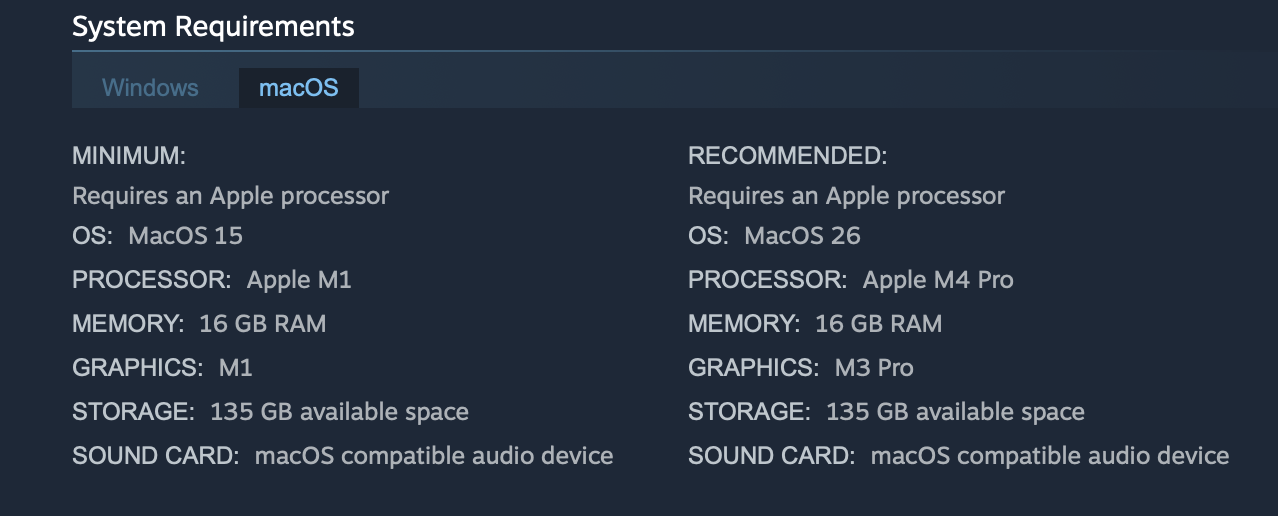
During previous developer sessions and keynote presentations, Apple representatives articulated a clear vision for what the M-series architecture brings to immersive entertainment:
"Apple silicon is engineered to scale across demanding workflows, and modern gaming is one of the ultimate tests of compute performance, graphics efficiency, and memory bandwidth. By leveraging powerful software technologies like MetalFX Upscaling to accelerate performance, and taking advantage of the M3 and M4 family of chips with hardware-accelerated ray tracing, developers like Pearl Abyss are delivering breathtaking experiences that simply were not possible on previous generations of Mac hardware."
Independent game engine developers and technical analysts have echoed this sentiment, noting that while the transition from Windows DirectX to Metal requires specialized engineering talent, Apple’s continuous refinement of developer tools—such as the Game Porting Toolkit—has dramatically shortened porting pipelines.
However, cautionary notes remain within the broader development community. Critics point out that while high-end Mac Studio and M-Max/M-Ultra configurations possess staggering compute potential, the vast majority of consumer Macs feature base-tier chips with integrated graphics and strict thermal limitations. Ensuring that Crimson Desert scales effectively across both a maxed-out MacBook Pro and a baseline machine will serve as the ultimate stress test for Pearl Abyss’s optimization team.
Future Outlook: What Crimson Desert Means for the Future of macOS
The launch of Crimson Desert on March 19 transcends the success or failure of a single video game. It represents a critical stress test for the viability of the Mac as a mainstream AAA gaming platform.

A Turning Point for Publisher Confidence
Historically, game publishers have operated under a self-fulfilling prophecy regarding macOS: Mac users do not buy AAA games; therefore, we will not port games to the Mac; therefore, Mac users do not buy games.
By breaking this cycle with a simultaneous, day-one global release for a multi-million-dollar blockbuster, Pearl Abyss and Apple are attempting to reset industry baselines. If Crimson Desert achieves strong commercial sales on macOS, it sends an unambiguous signal to other major studios—such as Capcom, Electronic Arts, Ubisoft, and Epic Games—that investing in native Metal ports is financially viable.
The Hardware Synergy
The timing of next week’s anticipated hardware launches—bringing new MacBook configurations powered by the M5 generation of chips—creates a compounding marketing effect. Consumers shopping for a high-end creative workstation will increasingly view that machine as a dual-purpose powerhouse capable of handling heavy video editing, 3D rendering, and top-tier interactive entertainment without compromise.
Challenges Ahead
Despite the optimism, significant hurdles remain before macOS can claim true parity with the Windows PC ecosystem:
- Anti-Cheat and Multiplayer Infrastructure: Many of the world’s most lucrative multiplayer games rely on kernel-level anti-cheat software that is fundamentally incompatible with macOS security architecture. While Crimson Desert is primarily a single-player experience—sidestepping this specific minefield—future multiplayer titles will require collaborative security solutions between Apple and anti-cheat vendors.
- Library Depth: A single AAA release, no matter how visually stunning or critically acclaimed, does not constitute a comprehensive gaming library. Sustained momentum requires a continuous pipeline of multi-platform releases year after year.
Conclusion
As the countdown to March 19 ticks away, all eyes in the tech and gaming sectors will be fixed on Cupertino and Pearl Abyss. Crimson Desert is poised to deliver a ferocious, visually dazzling open-world adventure to a platform that has hungered for day-one parity for decades. Whether this milestone becomes a solitary high-water mark or the foundational cornerstone of a thriving Mac gaming renaissance will depend entirely on how the market responds when the dust settles across the digital deserts of Pywel.









Belum ada komentar. Jadilah yang pertama berkomentar!