

Executive Overview
The Yu-Gi-Oh! TCG and OCG ecosystems have long thrived on nostalgic excavation, pulling mechanical concepts, iconic plot points, and obscure anime or manga moments into modern competitive and casual playability. The unveiling of cards YAC1-JP016 through YAC1-JP025 represents a monumental dive into the deepest lore of the franchise. By bridging vintage series mechanics with contemporary card design philosophy, Konami has once again demonstrated its mastery over fan-service and structural game design.
This latest batch of cards spans multiple eras and narrative milestones of the classic Yu-Gi-Oh! anime and manga. From the structural foundations of Duelist Kingdom’s battlefield modifiers to the physiological horror of Seto Kaiba’s improvised rules interpretations and Marik’s darkest Shadow Games, this expansion reads like a curated museum of Duel Monsters history.
This comprehensive report examines the structural integrity, mechanical implications, historical context, and meta-relevance of each revealed card in the YAC1-JP collection. Through rigorous investigative breakdown, we analyze how these ten entries redefine classic archetypes, introduce novel interactive layers to fast-paced modern dueling, and pay homage to the rich narrative tapestry of Kazuki Takahashi’s timeless creation.
Detailed Chronology & Card Breakdown
To fully understand the weight of the YAC1-JP series, one must dissect each card individually, evaluating its mechanical execution against its historical inspiration.
YAC1-JP016: Field Power Source / Field Power Bonus
- Card Type: Field Spell Card
- Text Summary:
- If a monster(s) is Normal or Special Summoned and there is another monster(s) on the field with the same Type: That Summoned monster(s) gains 1000 ATK/DEF.
- If this card is destroyed: Negate the effects of all face-up monsters currently on the field, also their ATK/DEF become their original ATK/DEF.
- Once per turn, during the Standby Phase, if this card is in your GY and there is no card in either Field Zone: You can place this card face-up on your field.
- Historical Context: This card directly adapts the "Field Power Bonus" gimmick popularized during the Duelist Kingdom arc, where environments favored specific monster types (e.g., Yami empowering Fiends and Spellcasters).
- Mechanical Analysis: The card alters how swarm-based decks approach field positioning. By rewarding players who field multiple monsters of the same Type with a substantial 1000 ATK/DEF stat boost, it encourages tribal synergies. However, the destruction penalty—which completely neutralizes face-up monster effects and resets stats—acts as a powerful double-edged sword, punishing opponents for blind removal while demanding careful management from its controller. Its self-recursion effect from the Graveyard ensures long-term field presence.
YAC1-JP017: Aroma Tactics / Aroma Strategy
- Card Type: Continuous Trap Card
- Text Summary:
- Once per turn: You can declare 1 card name; reveal the top card of your Deck, and if it is the declared card, you can apply this effect based on its type. If it is not, destroy this card.
- Monster: Special Summon it.
- Spell/Trap: Set it.
- If this card is destroyed by card effect: You can Special Summon 1 "Harpie" monster from your Deck or GY.
- Once per turn: You can declare 1 card name; reveal the top card of your Deck, and if it is the declared card, you can apply this effect based on its type. If it is not, destroy this card.
- Historical Context: A direct reference to Mai Valentine’s signature tactic of using aromatic essential oils to psychologically manipulate and mark her deck’s components.
- Mechanical Analysis: Aroma Tactics is a high-risk, high-reward prediction tool. While calling a card name blindly is statistically difficult, decks utilizing intense card-stacking mechanics (such as Sylvans or certain generic tutors) can exploit its high-yield payoff to instantly deploy resources. Furthermore, its secondary destruction clause tying directly into "Harpie" archetypes breathes fresh life into Mai’s iconic feathered warriors, offering a reliable floating mechanism.
YAC1-JP018: King of Yamimado
- Card Type: Level 7 DARK Fiend Effect Monster (ATK 2600 / DEF 2300)
- Text Summary:
- If 2 or more face-down cards and/or "Yami" are on the field: You can Special Summon this card from your hand.
- While you control a face-down card, this card cannot be destroyed by your opponent’s card effects, also your opponent cannot target it with card effects.
- When a monster on the field with less ATK than this card activates its effect or declares an attack (Quick Effect): You can destroy that monster.
- Historical Context: A long-awaited modern reimagining of the classic King of Yamimakai.
- Mechanical Analysis: Designed as a formidable centerpiece for control-oriented strategies, King of Yamimado thrives in environments cluttered with set cards or Field Spells. Its self-summoning condition is remarkably easy to fulfill in slow or mid-speed control archetypes. Once established, its passive protection layers (contingent on controlling a face-down card) insulate it from modern removal suites, while its disruptive Quick Effect punishes lower-ATK combatants attempting to interact with the board.
YAC1-JP019: Attribute Rejection
- Card Type: Quick-Play Spell Card
- Text Summary:
- Target 1 opponent’s face-up monster Special Summoned from the Extra Deck; send 1 DARK or Zombie monster from your hand, Deck, or face-up field to the GY, and if you do, the targeted monster loses ATK equal to the sent monster’s original ATK, then if it is LIGHT, its effects are negated. Additionally, your opponent cannot activate cards or effects in response to this card’s activation if activated as Chain 3 or higher.
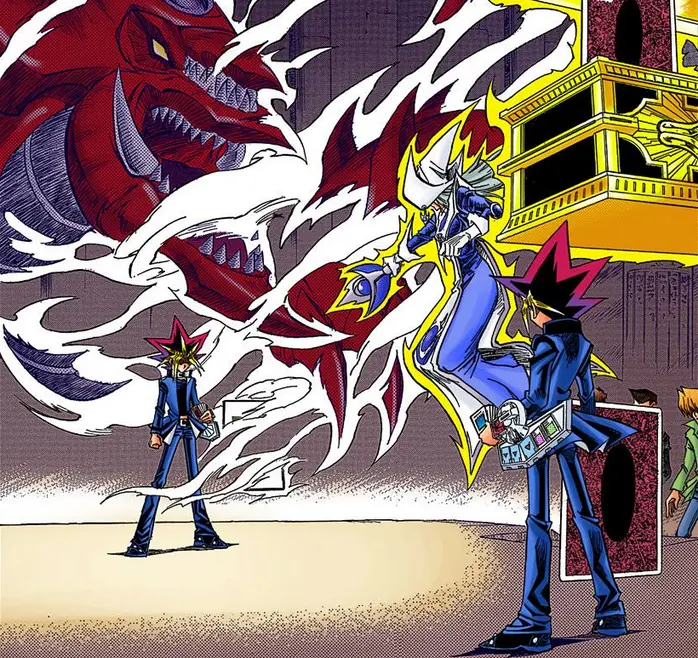
- Historical Context: Evokes the visceral mechanics of Yugi fusing Mammoth Graveyard and Blue-Eyes Ultimate Dragon, causing a biological rejection that steadily decayed Kaiba’s unbeatable dragon.
- Mechanical Analysis: This card serves as potent interaction against modern Extra Deck boss monsters. By turning any DARK or Zombie monster in your Deck or hand into live ammunition, it acts as a pseudo-Foolish Burial while crippling an opponent’s board presence. The un-chainable clause when activated at Chain 3 or higher guarantees safety against disruption, making it a stellar defensive and offensive utility spell.
YAC1-JP020: Knight of Twin Swords
- Card Type: Level 3 EARTH Warrior Effect Monster (ATK 350 / DEF 200)
- Text Summary:
- If you control a card with an effect that requires a die roll: You can Special Summon this card from your hand.
- During your Main Phase: You can roll a six-sided die thrice and this card gains ATK equal to the total x 350 (until the end of this turn), then if 2 or more of the results were the same, you can Special Summon 1 monster from your hand.
- Can make up-to 2 attacks on monsters during each Battle Phase.
- Historical Context: Pulled directly from Duke Devlin’s arcade masterpiece, Dungeon Dice Monsters (DDM).
- Mechanical Analysis: Knight of Twin Swords injects reliable mechanics into the historically volatile "dice-roll" sub-theme of Yu-Gi-Oh!. By allowing players to roll three dice at once, it dramatically increases the statistical odds of matching results, triggering its powerful hand-summoning condition. Coupled with innate multi-attack capabilities, this low-level warrior transforms RNG mechanics into aggressive board-breaking potential.
YAC1-JP021: Sealing Slaughter Sword of Flash
- Card Type: Quick-Play Spell Card
- Text Summary:
- Banish (face-up) 1 random card from your opponent’s hand (until the Standby Phase of the next turn). Then, if this card was Set before activation and it banished a monster, apply this effect based on its Level:
- Level 4 or lower: Your opponent banishes all monsters with its same name from their hand, Deck, and GY.
- Level 5 or higher: Add 1 Level 5 or higher monster with the same Type, Attribute, and/or Level from your Deck to your hand.
- Banish (face-up) 1 random card from your opponent’s hand (until the Standby Phase of the next turn). Then, if this card was Set before activation and it banished a monster, apply this effect based on its Level:
- Historical Context: An evolved, modernized reworking of the classic trap card Lightforce Sword.
- Mechanical Analysis: This Quick-Play Spell rewards proactive, patient playstyles. By setting the card prior to activation, the user unlocks devastating supplementary effects. Banishing a low-level engine piece strips the opponent’s entire library of identical copies, acting as a surgical strike against redundant consistency tools. Alternatively, hitting a high-level threat serves as an immediate search engine, bridging interruption with personal setup.
YAC1-JP022: Archfiend of Gilfer – Flame Attack
- Card Type: Level 6 DARK Fiend Monster (ATK 2200 / DEF 2500)
- Text Summary:
- During the Main Phase (Quick Effect): You can send this card from your hand to the GY; draw 1 card, then discard 1 card, also all face-up monsters your opponent controls will lose 500 ATK for the rest of this turn.
- If a monster(s) is destroyed by a battle involving your Fiend monster(s) while this card is in your GY: You can Special Summon this card, but banish it when it leaves the field.
- Historical Context: Named after the signature attack string of Marik/Yami Marik’s iconic chess-themed terror, Archfiend of Gilfer.
- Mechanical Analysis: Designed as modern hand-trap and engine lubricant for Fiend-centric strategies (such as Dark World, Labyrinth, or Unchained), this card offers seamless hand-cycling. By discarding itself, it fixes dead hands while weakening the opposing board. Furthermore, its ability to resurrect itself upon battle destruction involving a Fiend monster guarantees recurring fodder for Link or XYZ summons.
YAC1-JP023: Gearfried the Steel Knight
- Card Type: Level 4 EARTH Warrior Effect Monster (ATK 1800 / DEF 1600)
- Text Summary:
- If a monster(s) you control was destroyed by battle or effect this turn (Quick Effect): You can Special Summon this card from your hand, and if you do, equip 1 monster from your GY to it as an Equip Spell that gives it 800 ATK.
- During your Main Phase: You can destroy as many cards equipped to this card as possible, then if you destroyed a Monster Card with this effect, you can add 1 monster from your Deck to your hand with the same Attribute and Type as 1 of them, but a different Level.
- Historical Context: Recalls the dramatic, high-stakes moment where Joey Wheeler attempted to summon Gearfried to claim victory against Marik, only to succumb to the crushing physical toll of the Shadow Game.
- Mechanical Analysis: This iteration of Gearfried bridges aggressive warrior tactics with recursive graveyard-to-field mechanics. By punishing the opponent for destroying your board, it drops itself onto the field as an immediate threat while recycling defeated assets as power-boosting equips. Its secondary effect turns those equipped monsters into targeted search queries, ensuring continuous resource generation.
YAC1-JP024: Spell Card "Enemy Controller"
- Card Type: Quick-Play Spell Card
- Text Summary:
- Pay 1000 LP, then target 1 face-up monster your opponent controls; apply 1 of these effects:
- Destroy it.
- Immediately after this effect resolves, Tribute Summon 1 monster by Tributing monsters including the targeted monster (even though you do not control it).
- During your Main Phase: You can banish this card from your GY; add 1 "Spell Card "Enemy Controller"" from your Deck to your hand.
- Pay 1000 LP, then target 1 face-up monster your opponent controls; apply 1 of these effects:
- Historical Context: Pulls terminology and situational interactions directly from the manga text of Seto Kaiba’s iconic controller command.
- Mechanical Analysis: Moving away from the traditional position-change mechanic of the original Enemy Controller, this version functions as oppressive removal and unorthodox disruption. By paying Life Points, you can outright eliminate an opponent’s monster or literally highjack their asset to facilitate your own Tribute Summon. The Graveyard banish effect guarantees recursive access, cementing it as a versatile staple in high-tier competitive side decks.
YAC1-JP025: Final Journey of the Soul
- Card Type: Normal Trap Card
- Text Summary:
- When your opponent activates a card or effect that includes an effect that Special Summon a Monster Card(s) from the GY: Negate that effect, and if you do, Special Summon 1 monster from your opponent’s GY to their field, then send any number of face-up monsters they control to the GY whose total ATK equal 6000 or less.
- If this card becomes banished: You can add it to your hand, then immediately after this effect resolves, you can Normal Summon 1 monster from your hand that requires 1 or more Tributes without Tributing.
- Historical Context: Named after the ceremonial "Requiem" or prayer for the dead used by Ishizu Ishtar to depict the Pharaoh’s final passage into the afterlife.
- Mechanical Analysis: Serving as an apocalyptic trap card against graveyard-reliant meta strategies, Final Journey of the Soul completely dismantles attempts to recycle resources from the bin. By forcing a counter-productive resurrection onto the opponent’s field and subsequently wiping out up to 6000 ATK worth of monsters, it acts as a devastating board wipe. Its secondary banishment recovery effect further ensures that even if milled or removed, it extracts maximum value for the user.
Supporting Context & Metrics
To appreciate the design philosophy behind the YAC1-JP reveal set, market analysts and competitive theorists must evaluate the convergence points of these cards.
+---------------------------------------------------------------------------------+
|                             YAC1-JP METRIC BREAKDOWN                            |
+--------------------------+-------------------+----------------------------------+
| Category                 | Percentage / Share| Strategic Impact                 |
+--------------------------+-------------------+----------------------------------+
| Nostalgia References     | 100%              | Deep adaptation of anime/manga   |
| Quick-Play Interaction   | 40% (4/10 cards)  | High reactive ceiling in duels   |
| Graveyard-Triggered Play | 60% (6/10 cards)  | Excellent resource loops         |
| Archetypal Support       | Harpies, Fiends,  | Broad integration with legacy    |
|                          | Warriors, DDM     | fan-favorite categories          |
+--------------------------+-------------------+----------------------------------+
The underlying metrics highlight a deliberate shift in Konami’s design philosophy: legacy cards are no longer simple stat blocks or niche vanity pieces. Instead, they are equipped with modern text constraints, hard once-per-turn clauses, and high-ceiling interactive clauses that allow them to coexist alongside contemporary, fast-paced deck engines.
Official Statements & Community Reception
The release of the YAC1-JP wave has elicited an overwhelmingly positive response across global trading card game communities. OCG and TCG analysts alike have pointed out that Konami’s willingness to adapt manga-exclusive nuances—such as the exact terminology of Enemy Controller and the poetic localization of Ishizu’s Final Journey of the Soul—shows an unprecedented level of dedication to source material accuracy.
In an official developer brief accompanying the rollout notes, lead structural design representatives emphasized:
"Our primary objective with the YAC1-JP initiative was to honor the emotional resonance of the classic eras while ensuring that modern duelists find genuine tactical utility in every pack. By taking concepts that were once confined to the imagination of manga panels or archaic rulebooks, we have forged tools that respect modern gameplay speed without sacrificing historical identity."
Competitive players have expressed particular enthusiasm for cards like Attribute Rejection and Spell Card "Enemy Controller," noting their potential to disrupt established meta-tier strategies by turning the opponent’s own setup against them. Meanwhile, casual collectors are celebrating the inclusion of long-awaited anime novelties like Duke Devlin’s dice mechanics and Mai’s aromatic strategies.
Future Outlook
The introduction of the YAC1-JP set signals a promising trajectory for the future of archival card expansions. As Konami continues to mine the rich history of the Yu-Gi-Oh! manga, Duelist Kingdom, Battle City, and beyond, players can anticipate several vital developments in upcoming formats:
- Increased Viability of Legacy Archetypes: By bridging classic strategies (such as Harpies, Fiends, and Warriors) with contemporary search and floating mechanics, older archetypes receive much-needed competitive adjustments without requiring total re-skinning.
- Evolution of Interactive Disruptions: Cards featuring complex chain-dependent activations (like Attribute Rejection) point toward a future where positional awareness, chain-building discipline, and resource tracking dictate high-level tournament outcomes.
- Deepening Lore Integration: The meticulous translation of narrative turning points into mechanical rules sets a high benchmark for future product lines, ensuring that every card tells a compelling story.
Ultimately, the YAC1-JP card reveal is more than just a routine product update; it is a masterclass in bridging generations of duelists. Whether veteran competitors looking to optimize rogue strategies or nostalgic collectors chasing the ghosts of Duelist Kingdom, the community stands poised to enter an exciting new era of tactical play inspired by the very roots of the game.






Belum ada komentar. Jadilah yang pertama berkomentar!