

Executive Overview
If any filmmaker possesses the frantic, high-octane visual vocabulary required to properly detonate the story of how insatiable corporate greed plunged global society into our current post-truth reality, it is Danny Boyle. The acclaimed English director has long commanded global attention through the sheer, crackling vitality of his motion pictures. No matter how dense, morally compromised, or historically heavy the subject matter may be, Boyle imbues every frame with a volatile energy—making each shot feel alive and sizzling like a short fuse. This breathless cinematic intensity, of course, is maintained through a knife-edge balance against the constant threat of a complete descent into neurosis. Under Boyle’s direction, audiences are left perpetually uncertain of when he might loosen his grip and let the nitroglycerin drop.
This signature approach of calculated volatility and high-stakes danger proves ideal for the screen adaptation of Ink. Based on the acclaimed 2017 theatrical play by celebrated British dramatist James Graham, the film chronicles the meteoric, ruthless rise of a young Rupert Murdoch alongside ambitious news editor Larry Lamb as they weaponized journalism to transform The Sun into the most-read English-language daily newspaper in the world. Adapted for the screen by Graham himself, Ink features a supremely commanding Jack O’Connell as Lamb and a comfortably, chillingly playful Guy Pierce as Murdoch.
Beyond its cinematic merits, the film arrives as a timely cultural artifact. By examining the late-20th-century origins of populist tabloid journalism, Ink holds up an uncomfortable mirror to the 21st-century digital information ecosystem. It illustrates how the monetization of outrage, the erosion of factual nuance, and the prioritization of engagement over truth were not accidental byproducts of the internet age, but meticulously engineered business strategies born decades earlier on the ink-stained floors of London’s Fleet Street.
Detailed Chronology: The Anatomy of a Media Takeover
The Cold Courtship of 1969
The narrative unfurls against the backdrop of a characteristically bleak, rainy London night in the fall of 1969. Rupert Murdoch (Guy Pierce), an ambitious and largely unheralded Australian businessman, crosses paths with Larry Lamb (Jack O’Connell), a frustrated sub-editor at The Mirror. Lamb, a product of the working class, nurses a bitter, acute awareness that he will never find true acceptance among the patrician elite who traditionally gatekeep British media and society.
To the entrenched publishing establishment of Fleet Street, Murdoch is dismissed condescendingly as the "antipodean"—an outsider whose pedigree is as dubious as his financial backing. Yet Murdoch radiates the seductive, disruptive energy of a prophet promising a brave new world. He demonstrates a total disregard for traditional titles, established methods, and—most importantly—objective truth. His singular focus is corporate expansion, market disruption, and perpetual growth, regardless of the human or societal collateral damage. For Lamb, the mandate is simple: deliver a globally dominant, bestselling newspaper by any means necessary. The ethical path to that goal is deemed entirely irrelevant.
Storming the Bastions of Fleet Street
Lured by the intoxicating promise of power and influence he could never otherwise attain, Lamb reluctantly accepts the editorship of The Sun. At the time, the publication was widely regarded as a commercial laughingstock languishing on the legendary newspaper-publishing avenue of Fleet Street.
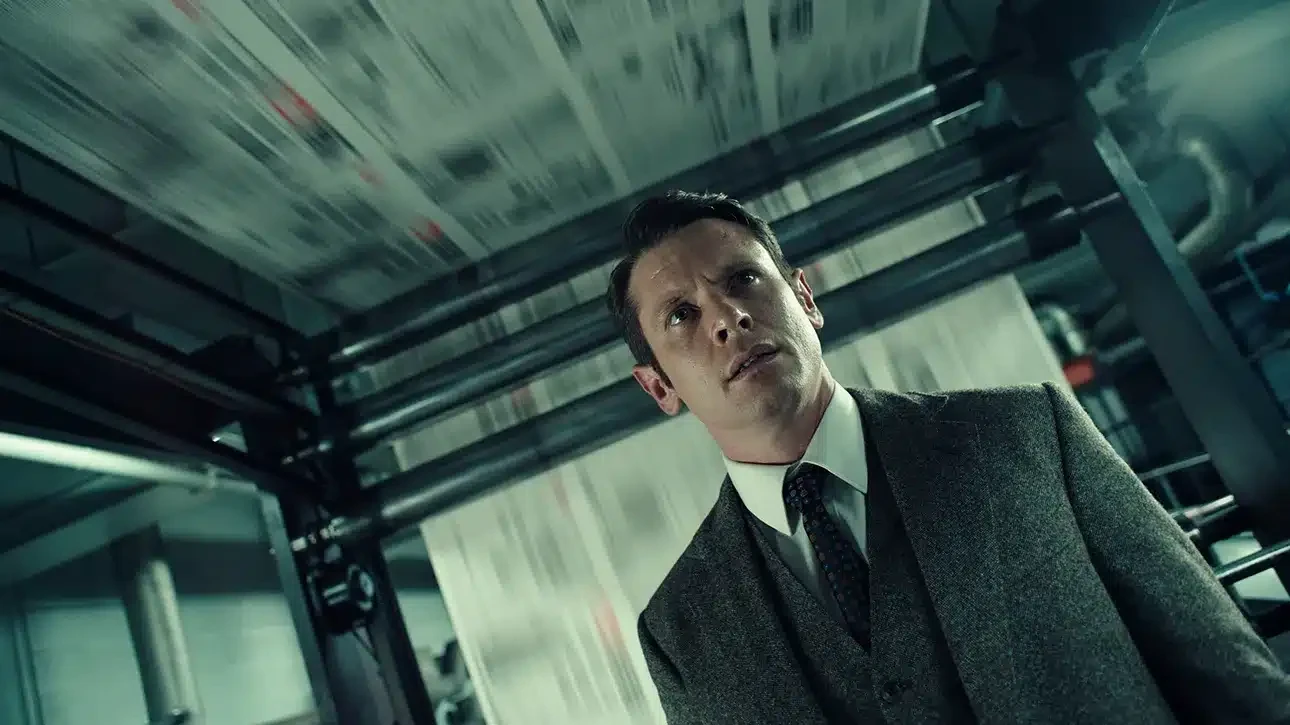
The gravity of the enterprise crystallizes in an early, symbolic sequence where Lamb takes Murdoch to kneel in the middle of Fleet Street, pressing their hands against the asphalt to feel the physical ground tremble from the subterranean power of the roaring printing presses. It is a potent realization: the ideological pulse—and the political destiny—of an entire nation is being hammered out nightly on those pages.
Moving with signature Boylean rapid-fire montage, Lamb hastily assembles his editorial "Avengers"—a ragtag collective largely comprised of industry rejects, professional castoffs, and degenerate gamblers. Amidst this bullpen of misfits, however, one brilliant figure shines through: Jules Davies, a fictionalized character brought to life with searing intensity by Claire Foy. Davies is a fiercely talented reporter whose career has been systematically stunted by institutional misogyny and systemic shunning. Lured by the prospect of finally steering the narrative, Davies throws herself into the revitalization of The Sun, driven by a dangerous mix of professional integrity and personal entanglement as Lamb’s long-term mistress and confidant.
The Pivot to Sensationalism
With the team assembled, Murdoch and Lamb discard the traditional rules of journalism. To outpace entrenched competitors, they redefine the public interest not through deep investigative reporting or measured political analysis, but through a calculated diet of gossip, scandal, sex, and high-impact violence. Even the daily weather forecast is given prominent, pop-culture-infused placement, entirely crowding out tedious reporting on civic governance or international affairs.
Embracing a literal "move fast and break things" corporate ethos decades before Silicon Valley popularized the phrase, Boyle turns his camera loose. Propulsive tracking shots, faux-scattershot angles, and staccato editing mimic the manic pulse of a newsroom racing against a printing deadline. As Murdoch strokes Lamb’s relentless ambition, structural guardrails vanish. The lines separating hard-hitting news from low-brow entertainment blur into obsolescence. Scandals are manufactured, complex societal phenomena are reduced to punchy headlines, and sprawling spreads of scantily clad young women are deployed to hook a working-class demographic. Lamb pushes relentlessly forward until The Sun claims the crown as the undisputed #1 newspaper in circulation.
Supporting Context & Metrics: The Cost of the Tabloid Revolution
To fully contextualize the historical weight of Ink, one must examine the macroeconomic and cultural shifts sweeping the British media landscape during the late 1960s and 1970s. Fleet Street, long considered the inviolable bastion of British journalism, operated under a gentleman’s agreement among legacy broadsheets that prized establishment stability over aggressive market penetration.
Murdoch’s disruption of this ecosystem was fundamentally mathematical. By introducing aggressive cost-cutting, union-busting labor strategies, and an unyielding focus on demographics, The Sun redefined publishing metrics:
- Circulation Explosion: Under Lamb’s editorial direction, The Sun transformed from a failing broadsheet into a cultural juggernaut, skyrocketing from a few hundred thousand daily readers to over 3 million by the mid-1970s.
- The Attention Economy: The publication pioneered the commodification of human curiosity, proving that visceral emotional triggers—fear, lust, outrage, and schadenfreude—generate significantly higher daily retention rates than civic education.
- The Labour Wars: The rise of The Sun directly catalyzed a brutal ideological war with powerful print unions, most notably culminating in the historic Wapping dispute of the 1980s, which permanently dismantled the traditional power of British labor in the media sector.
Boyle’s film captures this transition not merely as a business success story, but as an ideological infection. When traditional workers’ unions and establishment figures push back against the descent into sensationalism, Murdoch and Lamb remain unfazed. Even when personal and public tragedy strikes, the editorial mandate remains unchanged: the show must go on, and the public’s addiction to shock and suspense must be continually fed.
Official Statements and Critical Reception
Industry insiders, early screening attendees, and cultural critics have been swift to praise Ink for its unflinching dual indictment of both the out-of-touch establishment and the predatory, profit-driven disruptors who replaced them.
Described by early reviewers as absolute "cracker" of a film, Ink has drawn significant acclaim for its lead performances. Critics have universally lauded Guy Pierce’s portrayal of Murdoch as a masterclass in understated menace—a figure whose charm is infinitely more terrifying than overt aggression. Conversely, Jack O’Connell’s portrayal of Larry Lamb has been hailed as a triumph of anti-hero characterization.
James Graham, reflecting on the adaptation of his acclaimed stage play for the silver screen, noted in recent press statements:
"The story of how we consume news, and who profits from our collective anxieties, is more urgent today than it was in 1969, or even when the play debuted in 2017. Working with Danny Boyle allowed us to translate the visceral energy of the printing press into a cinematic language that feels entirely contemporary."
Furthermore, Danny Boyle himself has addressed the thematic resonance of the project, drawing a direct line between the print revolution of the 20th century and the algorithmic chaos of the 21st:
"We wanted to explore how the appetite for easy answers and sensational distraction corrupts everyone involved. Whether it’s ink on newsprint or code on a server screen, the fundamental mechanism of exploitation remains identical."
Future Outlook: The Ongoing Legacy of Media Disruption
As Ink prepares for its broader release, its ultimate cultural impact lies in its refusal to offer comforting moral binaries. The film’s greatest triumph—and its most unsettling takeaway—is its insistence that neither side of the media war possesses clean hands.
The traditional caste system, wherein a privileged few quietly dictated the fates of the many behind closed doors, was undeniably elitist and exclusionary. However, the neoliberal alternative championed by Murdoch and Lamb—where anything is permissible so long as it generates profit and drives engagement—unleashed a far more pervasive and destructive social decay. By treating news as an aesthetic and ideological battlefield, Ink demonstrates that the aesthetic choices of media titans inevitably shape the moral fabric of society.
In a characteristically bold meta-touch, Danny Boyle bridges the historical divide between the 20th-century print revolution and our current digital nightmare by utilizing controversial generative AI tools to animate several background sequences within the film. This self-referential creative choice underscores the film’s overarching thesis: humanity is perpetually trapped in a cycle where new paradigms, new victors, and new disruptive technologies emerge, always at the expense of objective truth.
Ultimately, Ink serves as an essential, high-voltage cautionary tale. It strips away the romanticism often associated with the history of journalism, laying bare the mechanics of modern outrage. It reminds contemporary audiences that whether power is wielded by aristocratic elites or populist tabloid emperors, unchecked authority always demands the same sacrifice: the truth.






Belum ada komentar. Jadilah yang pertama berkomentar!