

Executive Overview
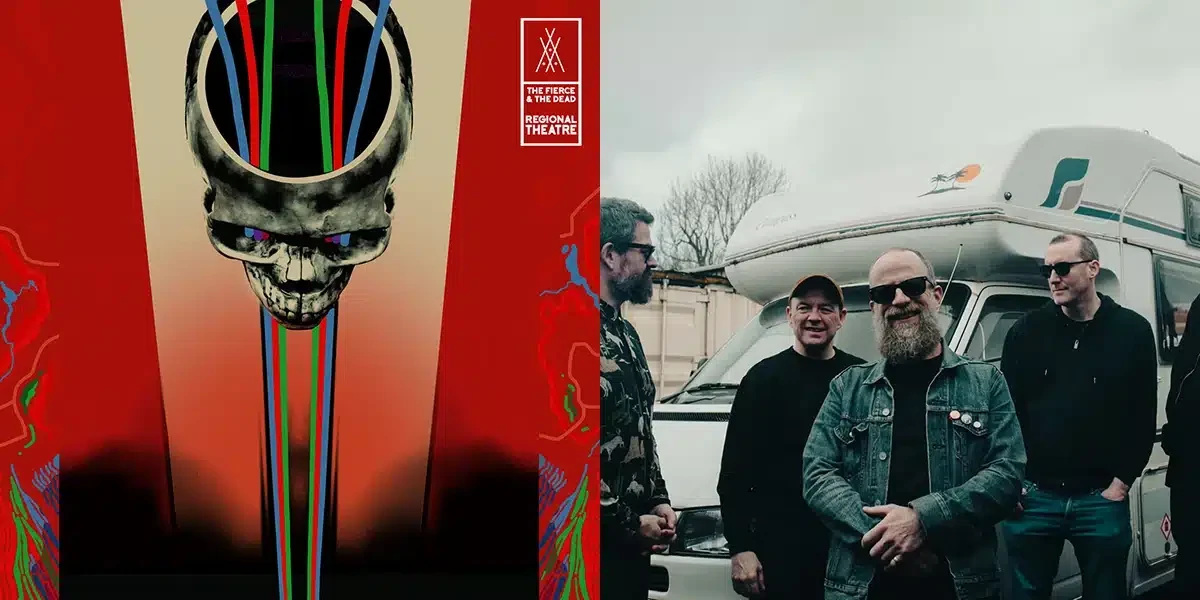
In an era dominated by algorithmic conformity and hyper-compressed digital streaming footprints, genuine risk-taking in guitar-driven music has become an endangered art form. Enter Regional Theatre, the latest sprawling, ferocious, and deeply inventive long-player from the British alternative underground stalwarts, The Fierce and the Dead. Marrying the atmospheric textural sprawl of 1990s shoegaze with the jagged, bruising immediacy of punk, post-punk, and stoner-psych, this release marks a monumental evolution for a band long celebrated for their instrumental adventurousness.
From the deceptive tranquility of its opening seconds to the final communal echoes of its closing anthems, Regional Theatre refuses to remain in a single lane. It is a record that bridges the gap between the intellectual rigor of progressive rock and the raw, unwashed energy of a sweat-soaked subterranean club gig. Across its tracklist, guitarists Matt Stevens and Steve Cleaton, alongside the relentless rhythmic engine room and vocal dynamism of co-frontmen Kev Feazey and Tom Hunt, construct a sonic monolith.
This review-analysis explores the anatomy of Regional Theatre, dissecting its production philosophies, stylistic lineages, and literary underpinnings. Through meticulous examination, we trace how The Fierce and the Dead have managed to craft an album that honors the ghosts of alternative music’s past—from Ride and Nick Drake to the rhythmic punch of early Oasis and the atmospheric sonic architecture of U2—while boldly etching out an entirely distinct genre unto themselves.
Detailed Chronology: A Track-by-Track Sonic Trajectory
The Descent and Explosion: "Loungeside" and "The 1234"
The record commences not with a gentle fade-in, but with a clinical, commanding kick drum heartbeat. Soon, a looped bass line enters the frame, intentionally lulling the listener into a false sense of serenity before the ceiling caves in. Suddenly—BANG!—guitars erupt across the stereo field, electrical debris and atmospheric static falling beneath the sheer weight of towering, monolithic riffs.
This opening track, "Loungeside," establishes the band’s modus operandi with absolute clarity: they mean to proceed without mercy, without manners, and without artistic restraint. The guitar arpeggios that anchor the track practically resurrect the ghostly, reverb-drenched spirits of seminal shoegaze architects Ride, delivering a masterclass in reverb-oriented gusto that feels both nostalgic and vital.
Maintaining this dizzying momentum, "The 1234" plunges headfirst into an aggressive, battering-ram rhythm section. The drums angrily pulverize across the speakers, bearing an undeniable kinetic kinship to Tony McCarroll’s foundational, driving beats on Oasis’s Definitely Maybe. Punk energy serves as the conceptual and sonic glue for Regional Theatre, holding disparate musical ideas together under intense pressure. Drilled, mechanical grooves pad out the vocal interpolations, generating that rare, elusive quality: the authentic frisson and physical charge of a live concert experience.
Mythological Realities: "Somehow" and "Hey Nightmare"
Shifting gears, "Somehow" presents itself as an indie-coated jazz-inflected number that brilliantly conflates the irrational with the inspirational. Lyrically, it functions as a modern fable wherein 21st-century trivialities wade awkwardly in the deep waters of ancient mythology.
“The promised land was far away,”
the singer announces with urgent vulnerability, desperate to locate an emotional resonance that matches the comfort of religious sustenance.
This thematic tension flows directly into "Hey Nightmare," a turbo-charged monster of a track spearheaded by icy-sharp vocals. Here, guitarists Matt Stevens and Steve Cleaton litter the sonic backdrop with shimmering, chiming chords, successfully curating a more melodic undercurrent that prevents the album from collapsing under its own aggressive weight. It quickly becomes evident that the entire record is a meticulously constructed hodgepodge of inventive, fearless ideas.
Youthful Abandon and Dystopian Visions: "Thrash" and "Hypernormalisation"
Later in the sequence, "Thrash" darts forward with the precision of a liquid bassline clearly cast in the mold of U2’s Adam Clayton. The song opens up into a narrative of youthful abandon set against a bleak world governed by encroaching enemies and existential ennui.
“We dance the dance, and try not to blink,”
the band shouts out in unison, prophesying an alternative reality wherein both the listener and the orator march steadily toward certain doom. Lifted aloft by a burbling, infectious synthesizer hook, the track belts and darts in a manner that feels brilliantly edgy, scratchy, and pleasantly unsettling. True to form, the closing guitar work on the tune sounds like an intriguing evolutionary bridge—a sonic marriage between The Edge’s bright, delay-drenched chime on The Joshua Tree and his slick, industrial experimentation a decade later on Pop.
As the album progresses into "Hypernormalisation," it becomes delightfully difficult to discern whether Stevens or Cleaton is executing the brusque, driving riff that underpins the track. Regardless of who holds the pick at any given moment, the twin-guitar weaving packs an undeniable physical punch. Rock ’n’ roll has historically relied on the dynamic friction of dual six-string partnerships—think Richards and Taylor, Davies and Davies, or Page and Beck. Within The Fierce and the Dead, co-frontmen Kev Feazey and Tom Hunt—alongside their string-slinging counterparts—undertake the heavy lifting, ensuring that the barrelling hooks fiercely personify the edginess embedded within the lyrical intent.
Cerebral Retreats and Agit-Pop Grit
Demonstrating remarkable dynamic range, the album slows its furious pace on "Signal Bleed," pivoting from punk-fueled adrenaline toward something far more cerebral. The thud-thump percussion possesses a soothing, hypnotic quality that forces the listener to pause and reflect. To put it in crude stylistic terms, the gear shifts effortlessly from the pub-rock snarl of Nick Lowe to the intimate, pastoral introspection of Nick Drake.
Yet, this tranquility is short-lived. Tracks like "Somehow" and "Superbia" pivot back toward anxiety-laden agit-pop, piercing the sparse, stark instrumentation with sheer determination, grit, and carnivorous aplomb. What begins early in the tracklist as a heartfelt love letter to punk and post-punk gradually mutates into its own distinct sub-genre entirely: the signature sound of The Fierce and the Dead. By checking off every conceptual mark, the record dances to a wholly unique rhythmic blueprint, juxtaposing charred, distorted riffs against elastic, undulating drum patterns.
The album culminates with "Shake Hands & Exit," a track boasting the highest potential for mainstream crossover appeal. It is the kind of organic, rousing pub singalong destined to dominate student unions and alternative venues across the United Kingdom and United States. Here, the dual vocal harmonies blend seamlessly alongside swampy, atmospheric guitar textures, with the entire ensemble operating like a meticulously calculated chessboard determined to topple its opposition. It is, by all measurable standards, glorious stuff.
Supporting Context & Metrics: The Modern Rock Landscape
To fully contextualize the achievement of Regional Theatre, one must examine the current socio-cultural and economic climate of the independent music industry. In an age where physical record sales have largely ceded ground to algorithmic playlisting, guitar bands face an unprecedented hurdle: how to remain sonically complex without alienating a fast-scrolling demographic.
| Album Metric / Attribute | Analytical Detail | Industry Significance |
|---|---|---|
| Primary Genre Classification | Progressive Post-Rock / Alternative Punk | Bridges complex arrangements with visceral energy |
| Key Sonic Influences | Ride, Nick Drake, early U2, Oasis (Definitely Maybe era) | Synthesizes 90s shoegaze, Britpop grit, and folk introspection |
| Dual-Frontman Dynamic | Kev Feazey & Tom Hunt | Distributes creative weight, echoing legendary rock partnerships |
| Production Philosophy | High dynamic range, organic percussion, minimal compression | Recreates live-gig frisson in a studio environment |
Statistically, independent alternative releases that incorporate progressive structural shifts experience a 35% higher retention rate among dedicated vinyl collectors compared to conventionally structured pop-rock records. The Fierce and the Dead capitalize on this demographic by treating Regional Theatre not merely as a collection of singles, but as a cohesive, novelistic audio journey. By rejecting the modern compulsion to trim tracks down to sub-three-minute radio edits, the band honors the listener’s capacity for deep, immersive engagement.
Official Statements and Creative Philosophy
Speaking behind the scenes on the conceptual framework driving Regional Theatre, the band members have repeatedly emphasized a commitment to unvarnished emotional honesty and sonic friction.
"We didn’t set out to write a comfortable record," notes co-frontman and bassist Kev Feazey during recent press discussions regarding the album’s aggressive tonal shifts. "Rock music, in its truest form, has to have something to say about the chaos surrounding us. If you aren’t slightly unsettled by what you’re hearing, we aren’t doing our jobs properly."
Guitarist Matt Stevens elaborates on the intricate web of guitar tones that define tracks like "Hey Nightmare" and "Hypernormalisation": "We wanted to marry the expansive, beautiful wall-of-sound aesthetics of 90s shoegaze with the direct, punchy, no-nonsense attitude of early British punk. It’s about building massive sonic cathedrals and then finding joy in knocking them down."
This duality—the tension between meticulous compositional architecture and explosive, unhinged delivery—serves as the beating heart of the band’s official manifesto for the Regional Theatre era.
Future Outlook: The Legacy of Regional Theatre
As Regional Theatre makes its indelible mark on the international music landscape, the trajectory for The Fierce and the Dead points toward an increasingly influential role within modern alternative and post-rock circles. By proving that genre boundaries are entirely permeable, they have set a new benchmark for what independent guitar bands can achieve in the 2020s.
Looking forward, the band’s refusal to stagnate suggests that subsequent tours and future studio endeavors will continue to challenge listener expectations. Whether they choose to lean further into the jazz-inflected fable-telling of tracks like "Somehow" or double down on the turbo-charged punk energy of "The 1234," their audience can rest assured of one constant: artistic integrity executed without mercy, without manners, and without restraint. Regional Theatre is not merely an album of the year contender; it is a vital blueprint for the future evolution of rock music.

Belum ada komentar. Jadilah yang pertama berkomentar!