

Executive Overview
The intersection of art, science, and technology has long been a volatile frontier. For every creative collective that successfully blurs the lines between human perception and digital engineering, dozens stumble, producing little more than hollow spectacles of flashing lights and fleeting novelty. Yet, defying the odds of contemporary art commerce, the Japanese digital art collective TeamLab has transcended these experimental boundaries to become a cultural titan of the twenty-first century.
Founded in 2001 by a group of interdisciplinary professionals—including programmers, engineers, CG animators, mathematicians, and architects—TeamLab initially operated on the fringes of the global contemporary art world. Fast-forward a quarter-century, and the collective has achieved unprecedented cultural and commercial dominance. Their immersive, boundary-pushing installations—where digital projections react dynamically to human presence, light bleeds seamlessly across rooms, and boundaries between observer and artwork dissolve—have drawn millions of awestruck visitors from every corner of the globe. Their flagship spaces in Tokyo have routinely outpaced traditional institutions, famously eclipsing global attendance figures for historic masters like Vincent van Gogh.
Now, capitalizing on an unyielding global demand and a steadily expanding diaspora of devoted fans, TeamLab has officially announced its next monumental chapter. The collective is set to construct TeamLab Tokyo, a breathtaking, purpose-built mega-museum slated for the Ariake district along Tokyo Bay. Spanning a staggering 33,000 square meters (approximately 322,917 square feet), this upcoming facility will not only dwarf every previous venue created by the collective but will also establish a new paradigm for digital art architecture worldwide.
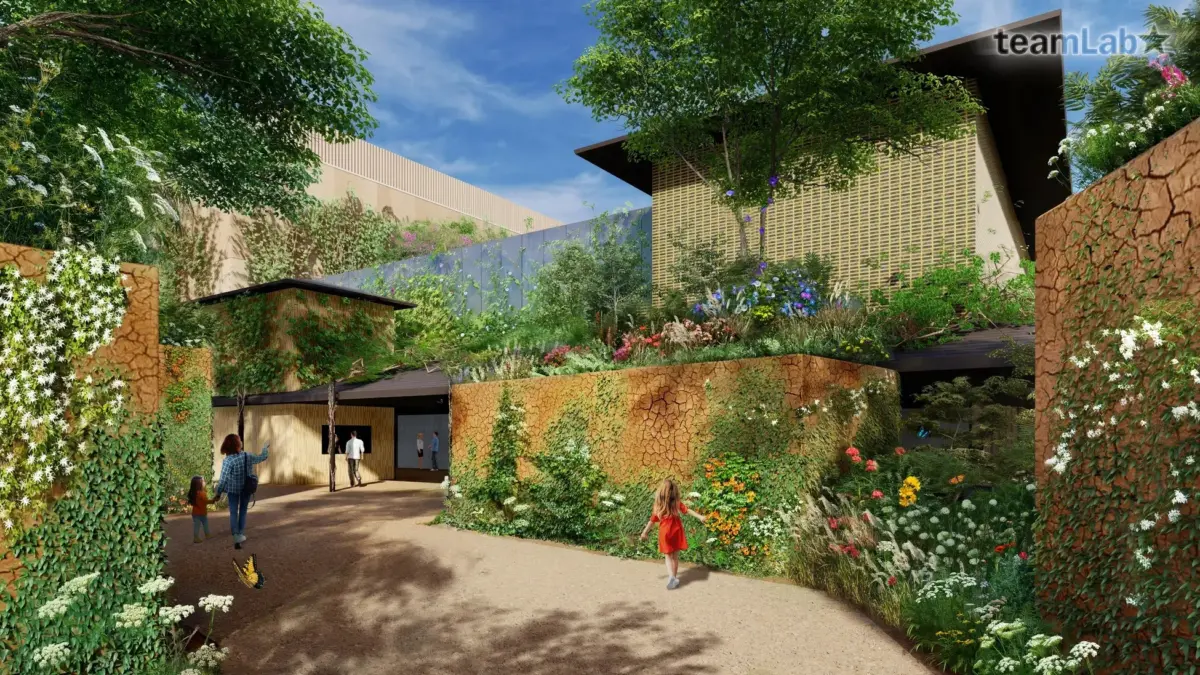
Complete with lush green open spaces, an expansive public plaza, and artisanal cafes integrated directly into the artistic ecosystem, TeamLab Tokyo is projected to open its doors to the public in 2032. As urban planners, art historians, and global travelers look toward the horizon, this ambitious project signals a bold declaration: digital art is no longer a temporary trend occupying the margins of cultural discourse, but a permanent, monumental cornerstone of the future metropolis.
Detailed Chronology: From Humble Beginnings to Global Dominance
The Formative Years (2001–2010s)
When TeamLab burst onto the scene in 2001, the contemporary art landscape was ill-equipped to categorize them. Traditional museums housed paintings in static frames or sculptures on rigid pedestals; galleries were built to preserve physical artifacts under carefully controlled environmental conditions. TeamLab, by contrast, offered a radically different proposition. They argued that digital technology could liberate art from the physical object, allowing it to transform dynamically, interact with viewers, and exist as a living, breathing ecosystem.
For the first decade and a half of their existence, the collective operated largely behind the scenes, experimenting with ultra-large-scale digital projections, interactive software, and spatial design. Their early exhibitions were often transient, appearing as temporary pop-ups or installations within science museums and tech-centric conventions. Critics frequently questioned whether these dazzling light shows constituted "real" art or mere commercial entertainment. However, TeamLab pressed forward, refusing to be pigeonholed by traditional definitions. They established their core philosophy: "Ultrasubjective Space," an artistic framework that sought to reconstruct how humans perceive spatial awareness, drawing inspiration from pre-modern Japanese spatial logic.
The Breakthrough and the Odaiba Phenomenon (2018–2022)
The turning point for TeamLab arrived in the summer of 2018 with the grand opening of TeamLab Borderless in Tokyo’s Odaiba waterfront district, developed in partnership with Mori Building. Designed as an enormous, mapless labyrinth where artworks moved freely out of their rooms, communicated with other pieces, and even spilled into corridors, Borderless was an instant cultural phenomenon.
Visitors did not simply view the art; they waded through it, touched it, and became part of its algorithmic lifecycle. Queues wrapped around the building for hours, and tickets sold out weeks in advance. Within its first year of operation, TeamLab Borderless welcomed millions of visitors from over 160 countries, briefly claiming the Guinness World Record for the most-visited single-artist museum in the world. Concurrently, they launched TeamLab Planets in Toyosu—a sensory, barefoot experience where visitors waded through knee-deep water teeming with digital koi fish that transformed into blooming flowers upon contact.

Even as the COVID-19 pandemic temporarily disrupted global tourism, TeamLab’s digital ethos proved remarkably resilient. Upon the reopening of international borders, international travelers flooded back to Tokyo, making a pilgrimage to TeamLab installations an absolute mandatory inclusion on every Japanese travel itinerary.
Relocation and Reinvention (2023–2024)
In late 2022, urban redevelopment plans forced the closure of the iconic Odaiba Palette Town complex, leading to the heartbreaking temporary shuttering of the original TeamLab Borderless. However, the collective viewed this not as an end, but as a catalyst for evolution.
In early 2024, TeamLab resurrected Borderless within the ultra-modern Azabudai Hills development in central Tokyo. Though physically more compact than its Odaiba predecessor, the Azabudai Hills iteration introduced cutting-edge computational artwork, refined sensory feedback loops, and intricate new spatial choreography. Despite its reduced footprint, it has successfully drawn over four million visitors since its opening, proving that TeamLab’s creative momentum was accelerating rather than plateauing.
Supporting Context & Metrics: Anatomy of a Mega-Museum
The announcement of TeamLab Tokyo in the Ariake district represents an exponential leap forward in scale, ambition, and urban integration. To fully grasp the magnitude of the 2032 project, it is essential to examine the spatial and conceptual metrics that define TeamLab’s physical footprint in Tokyo.
Comparative Spatial Metrics of Tokyo’s TeamLab Facilities
| Facility Name | Neighborhood | Opening Year | Approximate Scale / Status | Key Architectural & Conceptual Features |
|---|---|---|---|---|
| TeamLab Borderless (Original) | Odaiba | 2018 (Closed 2022) | Massive (Odaiba complex) | The pioneer "mapless" concept; artworks flowed freely across boundaries without defined rooms. |
| TeamLab Planets | Toyosu | 2018 | Large-scale, permanent footprint | Immersive, barefoot experience featuring water installations, mirrored infinite rooms, and tactile feedback. |
| TeamLab Borderless (Current) | Azabudai Hills | 2024 | Compact-scale urban iteration | Integrated into high-end real estate development; houses over 4 million visitors to date with refined programming. |
| TeamLab Tokyo (Upcoming) | Ariake | 2032 (Projected) | 33,000 sq. meters (~322,917 sq. ft.) | Largest facility ever built by TeamLab; features integrated green plazas, open-air public spaces, and dedicated cultural cafes. |
The Significance of Ariake
By positioning TeamLab Tokyo in the Ariake district, the collective is returning to the expansive waterfront energy of Tokyo Bay that originally defined the Odaiba era, while pushing further into a modern, highly accessible urban zone. Ariake—known for its sprawling exhibition centers, modern residential complexes, and sweeping bay views—provides the vast canvas required for a facility of 33,000 square meters.
Unlike traditional art museums that function as hermetically sealed, inward-facing white cubes, TeamLab Tokyo is designed as a hybrid ecosystem. Concept art released by the collective reveals a sweeping architectural masterclass that harmonizes indoor digital wonderlands with organic exterior landscaping. Visitors will emerge from mind-bending algorithms of light and shadow directly into open-air green plazas, blurring the boundary between the artificial and the natural—a central tenet of TeamLab’s ecological philosophy.
Official Statements and Curatorial Vision
While detailed specifics regarding the exact internal artworks of TeamLab Tokyo remain heavily guarded, statements released via official channels through PR Times and architectural partners shed light on the conceptual core driving the 2032 project.
Representatives for the collective emphasize that TeamLab Tokyo is not merely intended to be a larger exhibition space, but a fundamental reimagining of how urban public spaces and art can coexist.

"As our understanding of digital interconnectivity evolves, so too must the vessels through which we experience collective consciousness," shared a senior representative of the collective in a recent architectural brief. "For years, our installations have sought to dissolve the barrier between the self and the artwork. With TeamLab Tokyo in Ariake, we are expanding that philosophy to the urban scale. This will not just be a museum you visit for a few hours; it will be an expansive cultural environment where technology, nature, and humanity breathe together in real time."
Art critics and urban planners have been quick to praise the initiative. Dr. Kenjiro Tanaka, a Tokyo-based contemporary art historian, notes that the project marks a maturation of the digital art economy.
"For a long time, digital art was treated as a spectacle meant for temporary consumption," Tanaka explains. "By committing to a permanent, purpose-built facility spanning over 30,000 square meters with a 2032 timeline, TeamLab is asserting that digital creations require architectural monuments just as grand as those erected for oil paintings and classical sculptures. Ariake is about to become the global epicentre of twenty-first-century visual culture."
Future Outlook: The Road to 2032 and Beyond
As the global arts community processes the sheer scale of the TeamLab Tokyo announcement, several strategic questions remain. Chief among them is the operational status of the collective’s existing Tokyo venues. As of the current announcements, TeamLab has confirmed no plans to shutter either TeamLab Planets in Toyosu or TeamLab Borderless in Azabudai Hills prior to the grand opening of the Ariake mega-museum. Both current locations continue to operate at maximum capacity, pulling in hundreds of thousands of international tourists and domestic art lovers each month.
However, industry insiders speculate that the decade-long runway leading up to 2032 will allow TeamLab to test, iterate, and refine the computational engines, projection mapping technology, and sensor networks that will power the Ariake facility. Technology moves at a breakneck speed; what cutting-edge in 2024 may seem archaic by the time the doors of TeamLab Tokyo swing open in the early 2030s. Consequently, the upcoming facility is expected to feature next-generation artificial intelligence, responsive bio-digital algorithms, and hardware that has yet to be commercialized.
Furthermore, the economic implications for Tokyo are profound. As the city continues to position itself as the undisputed global capital of experiential tourism, TeamLab Tokyo will serve as an anchor investment for the Tokyo Bay regeneration zone, driving hospitality, dining, and infrastructure development for decades to come.
For travelers and art enthusiasts worldwide, the countdown has officially begun. While 2032 may feel a distant horizon, the promise of stepping into the largest, most technologically advanced digital art sanctuary ever conceived ensures that anticipation will only mount. TeamLab has spent the last twenty-five years teaching humanity how to walk through waterfalls of light, touch blooming digital flora, and lose themselves in endless mazes of color. With TeamLab Tokyo, they are preparing to build an entire world.







Belum ada komentar. Jadilah yang pertama berkomentar!