

Executive Overview
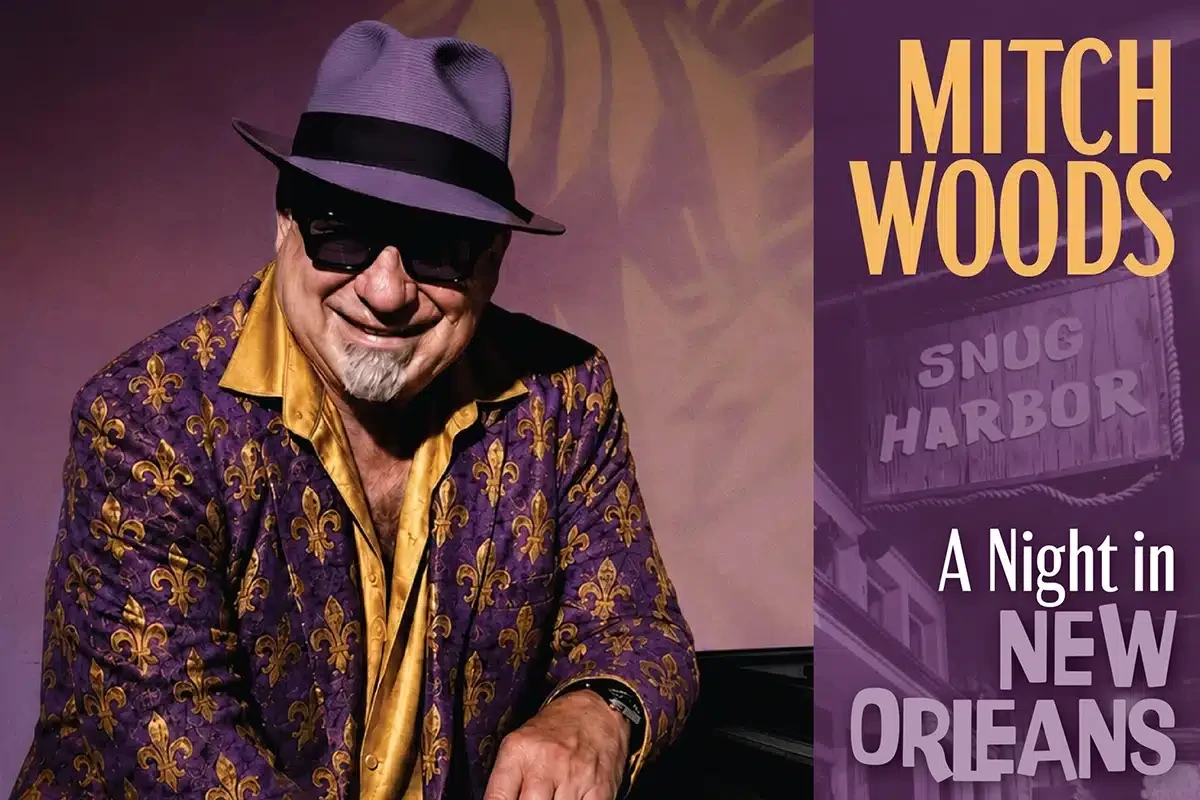
On September 4, 2026, veteran jump blues and boogie-woogie pianist Mitch Woods released his latest live album, A Night in New Orleans (MoMojo Records). Recorded live at the renowned Snug Harbor Jazz Bistro during the height of the 2026 New Orleans Jazz & Heritage Festival, the album is a triumphant, one-man sonic expedition into the heart of Louisiana’s musical lore. Stripped of a backing band, Woods single-handedly carries the weight of a rhythm section, a vocal ensemble, and a stellar piano outfit, relying entirely on his 88-key dexterity, infectious stage banter, and the palpable energy of a captivated festival crowd.
The record serves as both an homage to the foundational architects of New Orleans piano and a high-octane celebration of American roots music. Blending timeless regional standards with deeply personal original compositions, Woods crafts a dense, flavorful musical gumbo that bridges the historical gap between post-war rhythm and blues, early rock and roll, and contemporary boogie-woogie. As a five-time Blues Music Award nominee, Woods uses this stripped-down format to demonstrate the timeless viability of solo piano performance, proving that when the culture of the Big Easy is channeled with authenticity, a single piano and a roaring crowd are all it takes to raise the roof.
Detailed Chronology: The Genesis and Capture of A Night in New Orleans
Setting the Stage: Snug Harbor During Jazz Fest 2026
The New Orleans Jazz & Heritage Festival is universally recognized as one of the preeminent cultural gatherings in the world, drawing hundreds of thousands of music aficionados to a city already overflowing with sonic history. Amidst the sprawling outdoor stages and bustling French Quarter thoroughfares, the intimate confines of Snug Harbor Jazz Bistro on Frenchmen Street provided a starkly different, deeply personal atmosphere for Mitch Woods’ performance.
Unlike the massive festival grounds, Snug Harbor offers an up-close, listening-room environment where every nuance of a performance is magnified. For Woods, a lifelong devotee of the Louisiana piano tradition, playing this venue during Jazz Fest carried profound symbolic and artistic weight. Strip away the amplifiers of a full band, eliminate the safety net of a backing rhythm section, and an artist is left completely exposed to the elements of the room. Woods stepped onto the stage alone, armed only with his piano, a microphone, and an encyclopedic knowledge of American roots music.
The Performance Unfolds: Interaction and Improvisation
From the opening notes, A Night in New Orleans establishes a conversational dynamic between the performer and the audience. Woods acts as pianist, vocalist, and master of ceremonies, weaving storytelling seamlessly into rapid-fire boogie-woogie patterns.
As captured on the recording, the live audience immediately responds to Woods’ heavy left-hand driving rhythms. Rather than serving as a passive backdrop, the crowd functions as an active participant in the performance. During a blistering, stripped-down rendition of Louis Jordan’s timeless classic "Choo Choo Ch’Boogie," Woods humorously acknowledges his solo status, noting to the crowd that in the absence of a live drummer, they must supply the collective rhythm. The audience eagerly obliges, clapping, cheering, and driving Woods to push the tempo higher and play harder.
Throughout the set, Woods frequently drops out vocally, allowing the piano to take center stage. His right-hand trills and jaunty, syncopated accents speak volumes, projecting an ethos that celebrates joy, resilience, and the unyielding belief that a good party is the ultimate antidote to life’s hardships.
Supporting Context & Metrics: Navigating the NOLA Canon
Tracing the Lineage: The Greats Who Shaped the Sound
A Night in New Orleans is not merely a collection of covers; it is a living, breathing musicology lesson. Woods’ repertoire and playing style pay explicit tribute to the pantheon of Louisiana piano legends who shaped the American musical landscape:
- Professor Longhair (Henry Roeland Byrd): The architect of the "rhumba-boogie" piano style, whose syncopated, Caribbean-inflected rhythms heavily influence Woods’ rhythmic approach.
- James Booker: Known for his flamboyant virtuosity and unique blend of classical technique, rhythm and blues, and jazz harmony.
- Dr. John (Malcolm John Rebennack Jr.): The embodiment of swamp-funk and voodoo-infused blues mythology.
- Allen Toussaint: The quintessential songwriter, arranger, and pianist whose sophisticated arrangements defined the modern New Orleans sound.
Reinterpreting the Classics
Woods weaves a complex tapestry of regional anthems and crossover hits, effortlessly shifting eras and moods:

- Fats Domino’s "Blue Monday": Delivered with a rolling, infectious groove that honors Domino’s understated elegance.
- Hank Williams’ "Jambalaya": Infused with a distinctly urban, barrelhouse piano bounce that bridges country music and jump blues.
- Huey Smith’s "Rockin’ Pneumonia and the Boogie Woogie Flu": A high-energy romp that showcases Woods’ mastery of classic New Orleans rock and roll piano.
- Champion Jack Dupree’s "Nasty Boogie": A gritty, low-down blues workout that highlights the darker, more sensual side of the genre.
In addition to these regional touchstones, Woods reaches across musical borders to include high-octane interpretations of Jackie Brenston’s "Rocket 88" (widely cited as a strong contender for the first rock and roll record) and Big Joe Turner / Bill Haley’s rock standard "Shake, Rattle & Roll."
The Original Compositions: "Amber Lee" and Beyond
While the covers anchor the album in collective nostalgia, Woods’ original compositions provide its emotional core. As a five-time Blues Music Award nominee, Woods infuses his original songwriting with personal narrative. A prime example on the album is "Amber Lee," a swinging, heartfelt tune that channels the imagery of a truck stop waitress while doubling as a poignant nod to his daughter. By blending his own personal stories with time-honored blues structures, Woods demonstrates that the tradition of storytelling in New Orleans music remains active and evolving.
Official Statements and Critical Perspectives
The Aural Postcard from "The City That Care Forgot"
Industry critics have universally praised A Night in New Orleans as an "aural postcard" from New Orleans—a city frequently referred to historically as "The City That Care Forgot." Woods infuses his performance with a palpable "wish you were here" sentiment, capturing the sensory experience of walking down a humid French Quarter street laden with the smells of Creole cooking, filtered through the unmistakable strains of a honky-tonk piano.
Cultural Preservation and the American Sound
Musicologists have long argued that New Orleans is the true crucible of modern American music, where European harmonic structures, African rhythmic concepts, and Caribbean syncopations collided to form jazz, rhythm and blues, and rock and roll.
Reviewers note that listening to Woods play evokes a sensation that is simultaneously "sexy and sleazy"—a hallmark of authentic blues and early rock. Much like the complex, fiery blend of spices in a well-made Creole sauce, the brilliance of New Orleans culture lies in its hybridization. Just as the city’s culinary arts rely on the seamless integration of French, Spanish, African, and Indigenous influences, its musical output defies rigid categorization. It is precisely this rich, borderless blending of styles that defines American music at its highest level.
Future Outlook: Sustaining the Hunger for Authenticity
Post-Katrina Cultural Memory and the Tourism Economy
In the two decades following the devastating impact of Hurricane Katrina and the subsequent levee failures in 2005, the global community rallied around New Orleans with an unprecedented outpouring of affection and charitable support. However, in the intervening years, mainstream cultural discourse has occasionally allowed the city’s ongoing, daily contributions to American culture to slip into the background of public consciousness.
Mitch Woods’ live recording at Snug Harbor directly challenges this cultural amnesia. Performing before an audience largely composed of festival-goers and cultural tourists, Woods taps into a deep, lingering global hunger for authentic roots music. The enthusiastic reception of A Night in New Orleans proves that the appetite for unadulterated NOLA culture remains voracious.
The Road Ahead for Mitch Woods and MoMojo Records
With the release of A Night in New Orleans via MoMojo Records, Mitch Woods cements his status as a premier ambassador of jump blues and boogie-woogie. As the music industry continues to grapple with shifting digital consumption models, highly specialized, organic live recordings like this one demonstrate the enduring commercial and artistic value of raw, unedited musical documentation.
Looking forward, Woods’ uncompromising commitment to live performance ensures that the lineage of Professor Longhair, Fats Domino, and the unsung piano heroes of Bourbon Street will continue to inspire new generations of listeners. By taking the listener straight to the piano bench at Snug Harbor, Woods has ensured that the spirit of the Crescent City beats on—loud, proud, and unapologetically rhythmic.





Belum ada komentar. Jadilah yang pertama berkomentar!