

Executive Overview
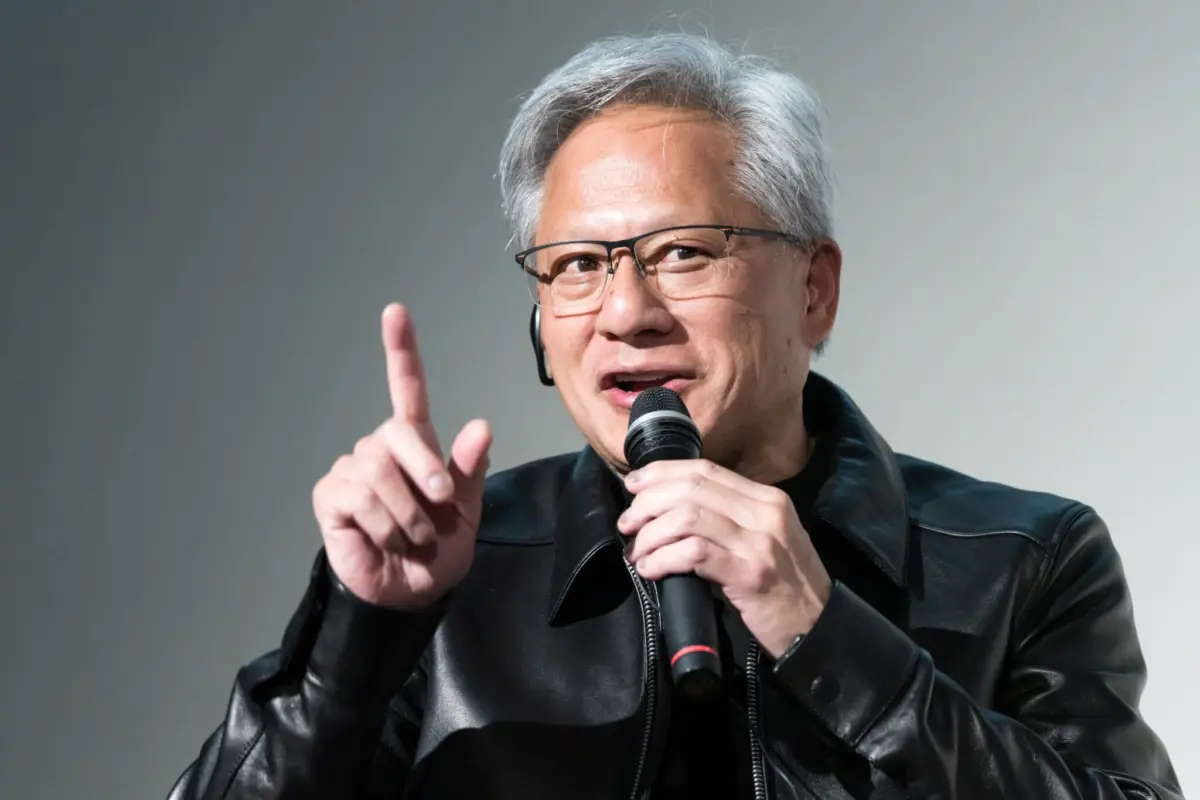
The intersection of artificial intelligence, high-stakes geopolitics, and corporate survival collided in dramatic fashion at the All-In Summit in Los Angeles. Nvidia CEO Jensen Huang, recognized globally as the chief architect of the generative AI boom, took center stage in his trademark leather jacket, only to receive a live phone call from former U.S. President Donald Trump. The public phone call, broadcasted to thousands of tech industry elites, investors, and media personnel, rapidly shifted from a casual tech-conference gimmick into a revealing policy-shaping dialogue.
The conversation zeroed in on the escalating global debate surrounding artificial intelligence safety, regulatory slowdowns, and international competition—most notably with China. Dismissing mounting existential concerns regarding frontier AI safety protocols as a "hoax," Trump argued that deliberately slowing down technological innovation would inadvertently hand the geopolitical crown to foreign adversaries. Huang, whose trillion-dollar semiconductor empire relies entirely on the relentless, unhindered expansion of AI research and infrastructure, enthusiastically validated the sentiment, amplifying the live crowd’s applause back through the receiver.
However, the event also served up a secondary, highly scrutinized hardware moment that rippled through the consumer technology landscape: initial media reports mistakenly identified the smartphone handed to Huang to take the call as an unreleased Apple device, before corrections confirmed it to be a Samsung Galaxy Fold 8. This logistical mix-up underscored the intense, hyper-attentive scrutiny under which tech executives operate. Beneath the spectacle of a live presidential call and gadget mix-ups lies a sobering reality: the multi-trillion-dollar semiconductor industry is inextricably bound to political winds, and the financial incentives of chipmakers dictate that the wheels of AI development must keep spinning at all costs.
Detailed Chronology: The All-In Summit Live Call
The atmosphere inside the Los Angeles venue for the All-In Summit was already electric. As one of the premier gatherings for venture capitalists, tech founders, and macroeconomic commentators, the conference frequently serves as a barometer for Silicon Valley sentiment. On September 14, 2026, that barometer swung violently into the political arena.
Jensen Huang took the stage to discuss the unprecedented demand for advanced graphics processing units (GPUs), the scaling laws of large language models, and the physical transformation of global data centers. Midway through the conversation, logistics coordinators backstage moved swiftly to hand Huang a mobile device. The audience quickly realized the incoming call was from none other than Donald Trump.
Placing the call on speakerphone for the auditorium to hear, Huang bridged the gap between Washington politics and the Silicon Valley elite. Trump wasted no time pivoting to the existential anxieties currently gripping regulatory bodies in Washington, Brussels, and London.
"They want to slow it down," Trump remarked over the speakerphone, characterizing the growing chorus of researchers, ethicists, and safety advocates demanding pause buttons on frontier AI models as proponents of a "hoax."
According to Trump, the primary beneficiaries of AI safety panic are not the citizens of Western democracies, but rather foreign competitors—specifically China—alongside opportunistic domestic political actors. The former president emphasized that artificial intelligence represents a technological shift "bigger than the internet," asserting that halting its progression out of fear would be a catastrophic strategic blunder.
As the thousands-strong crowd erupted into spontaneous applause, Huang leaned into the microphone to relay the room’s energy directly to the former president. "Did you hear that? Thousands of people are clapping," Huang told Trump, effectively cementing a public alignment between the tech sector’s most valuable hardware supplier and a prominent voice of political deregulation.
Supporting Context & Metrics: The Economics of Acceleration
To understand why Jensen Huang was so receptive to dismissing AI safety brakes on a live microphone, one must look at the foundational economics of Nvidia and the broader semiconductor market.
Nvidia’s unprecedented market valuation—which has routinely floated near the historic multi-trillion-dollar threshold—is entirely predicated on a singular thesis: that the world’s largest technology conglomerates, sovereign states, and AI research labs will continue buying chips at an exponential rate. In the fiscal quarters leading up to the 2026 All-In Summit, Nvidia’s share price had sustained an impressive 33% year-over-year climb, driven by insatiable demand for its Blackwell and subsequent architecture generations.
Yet, market dynamics are delicate. On the day of the live call, Nvidia’s stock experienced a modest pullback, shedding a few percentage points amid broader macroeconomic jitters and regulatory crosscurrents. For a company valued in the trillions, even minor market fluctuations represent billions of dollars in equity value.
+-------------------------------------------------------------------------+
|                  NVIDIA MARKET DYNAMICS & STAKEHOLDERS                  |
+-------------------------------------------------------------------------+
| Primary Driver    | Unabated enterprise & sovereign AI infrastructure   |
| Core Risk         | Regulatory pauses, safety moratoriums, export limits|
| Financial Metric  | +33% 12-month trailing share price growth           |
| Geopolitical Axis | U.S. vs. China semiconductor dominance              |
+-------------------------------------------------------------------------+
The existential risk debate—championed by prominent researchers and safety advocates who warn that unaligned artificial intelligence could pose catastrophic threats to humanity—directly challenges Nvidia’s core business model. If governments were to institute mandatory slowdowns, moratoriums on training runs exceeding specific compute thresholds, or heavy compliance burdens, the velocity of chip consumption would plummet.

Consequently, downplaying existential risk is not merely an ideological preference for hardware manufacturers; it is an economic necessity. If Huang were to validate the claims of AI doomers on stage, he would be signaling to Wall Street that his own addressable market faces artificial, government-imposed ceilings. By cheering on Trump’s dismissal of safety concerns as a "hoax," Huang aligned himself with the narrative of unbridled technological manifest destiny.
The Hardware Misdirection: From Apple to Samsung
Adding a layer of consumer tech intrigue to the geopolitical spectacle was the hardware itself. In the immediate aftermath of the event, tech blogs and social media feeds lit up with commentary regarding the phone handed to Huang.
Initial reports—fueled by the recent buzz surrounding Apple’s long-awaited entry into the foldable market—erroneously claimed that the device Huang used to field Trump’s call was the newly announced Apple iPhone Duo. The narrative suggested a brilliant, albeit accidental, cross-promotional coup for Apple, right on the heels of unveiling its first foldable device just days prior on September 9, 2026.
However, forensic analysis of the stage footage and subsequent clarifications from tech journalists corrected the record: the device in question was not an Apple product at all, but rather a Samsung Galaxy Fold 8.
This correction necessitated immediate retractions across major tech publications, scrubbing references to the hypothetical marketing implications for Cupertino. The mix-up highlights the intense public interest in foldable form factors as they finally achieve mainstream enterprise saturation. For Samsung, retaining the spotlight—even momentarily via a proxy call involving the world’s most famous semiconductor CEO and a former U.S. president—serves as a potent reminder of its hardware dominance in the foldable category, while Apple’s nascent foldable ecosystem continues to navigate its introductory product cycle.
Official Statements and Industry Fallout
The repercussions of the Huang-Trump phone call reverberated far beyond the walls of the Los Angeles auditorium, drawing swift commentary from policy analysts, ethics boards, and competing industry executives.
-
The Safety Advocacy Response:
Frontier AI safety research organizations released statements condemning the framing of existential risk research as a "hoax." Prominent researchers noted that treating safety protocols as political leverage ignores the genuine technical challenges of alignment, control, and systemic vulnerabilities inherent in scaling frontier models without adequate guardrails. -
Wall Street Reactions:
Financial analysts interpreted the live exchange as a bullish indicator for near-term semiconductor capital expenditures. By reinforcing the narrative that the U.S. must outpace foreign rivals at all costs, the dialogue subtly discourages domestic regulatory bodies from enacting severe compute caps, ensuring that enterprise clients can continue scaling data center investments without legal impediments. -
Geopolitical Stakeholders:
International observers, particularly in European regulatory capitals and Asian manufacturing hubs, viewed the exchange as further evidence of the widening ideological chasm between tech-accelerationist policies in the United States and precautionary regulatory frameworks abroad.
Future Outlook: Navigating the Intersection of Silicon and Statecraft
As the artificial intelligence industry races toward increasingly complex architectural milestones, the events at the All-In Summit offer a clear window into the future of tech governance. The boundary between corporate boardrooms and executive political offices has effectively dissolved.
For Nvidia and Jensen Huang, the mandate moving forward is clear: navigate the treacherous waters of international export controls, satisfy Wall Street’s insatiable demand for growth, and aggressively push back against any policy frameworks that seek to artificially throttle the pace of innovation.
Yet, the tension between acceleration and safety is unlikely to dissipate. As frontier models scale toward artificial general intelligence (AGI), the societal questions raised by safety advocates will only grow louder, putting them on an inevitable collision course with political figures and corporate leaders committed to unmitigated expansion.
Whether foldable phones from Samsung or Apple continue to ring on live stages amidst political theater, one certainty remains: the hardware that powers the future of AI will be forged in the crucible where global politics, multi-billion-dollar market valuations, and relentless technological ambition meet.





Belum ada komentar. Jadilah yang pertama berkomentar!