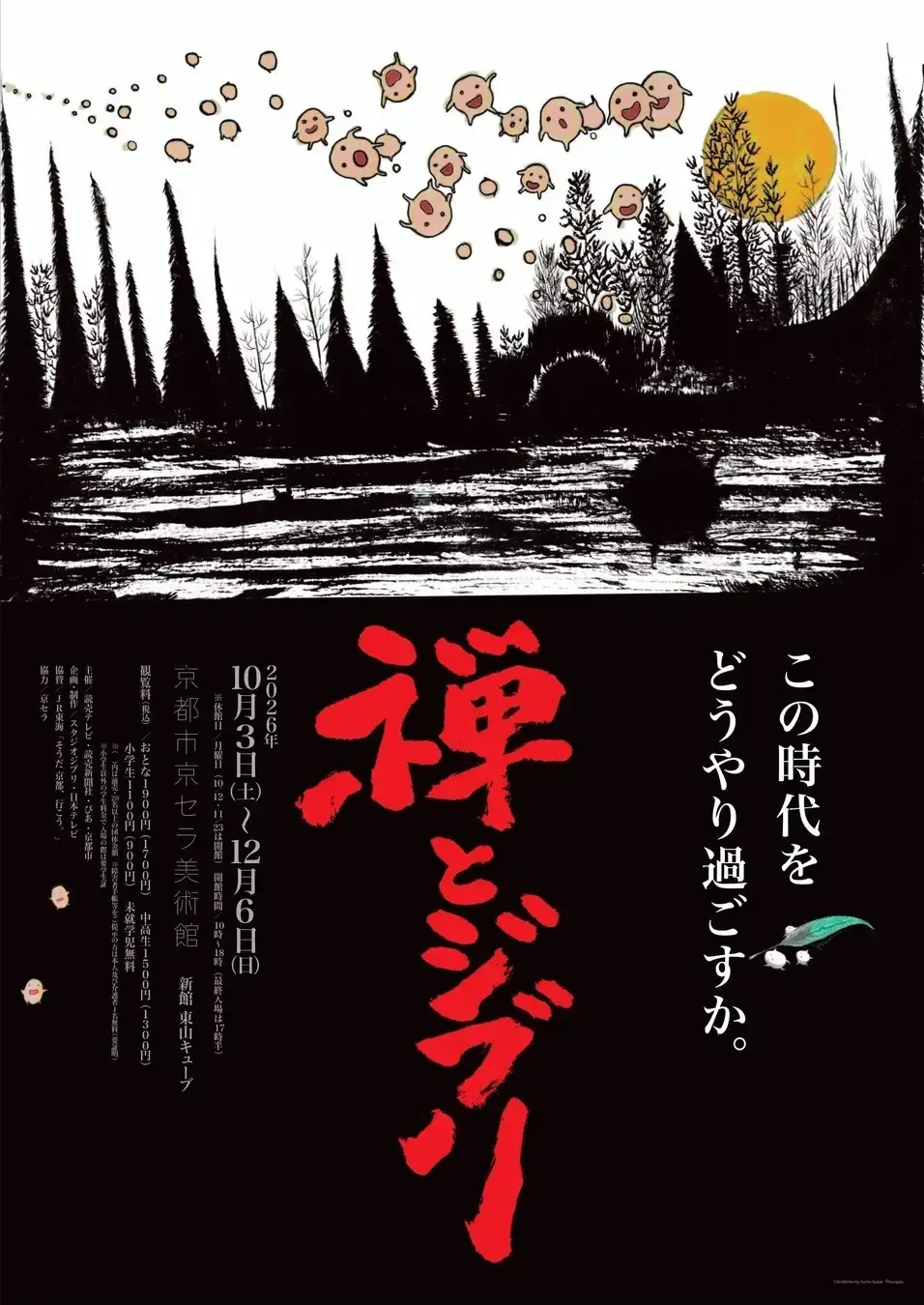
Japan’s cultural landscape is shaped by two powerful aesthetic traditions: the timeless, tranquil architecture of its ancient spiritual sanctuaries, and the whimsical, deeply philosophical storytelling of its world-renowned animation houses. This autumn, these two distinct worlds converge in an unprecedented cultural event. The Kyoto City Kyocera Museum of Art is preparing to launch "Zen and Ghibli," a groundbreaking immersive exhibition that explores the foundational philosophies of Zen Buddhism through the artistic lens of Studio Ghibli.
Marketed by organizers as a "Ghibli for grown-ups," the exhibition draws direct inspiration from a published work of the same name by veteran Studio Ghibli producer Toshio Suzuki. Rather than treating animation as mere children’s entertainment, the exhibition unpacks the complex philosophical underpinnings of legendary films, centering heavily on Hayao Miyazaki’s Academy Award-winning The Boy and the Heron. The project posits that the ambiguous, non-didactic moral landscapes of Ghibli’s cinematic masterpieces mirror the core tenets of Zen: non-duality, a refusal to rush to definitive judgments, and the radical acceptance of things as they are.
To expand this cultural exploration beyond the gallery walls, JR Central has partnered with the museum to offer exclusive travel packages. These offerings connect the exhibition to three of Kyoto’s most revered Zen institutions—Shokokuji, Nanzenji, and Myoshinji. By combining admission with limited-edition, Ghibli-themed goshuin (temple stamp certificates) and bespoke stamp books featuring beloved characters like Totoro, Porco Rosso, and San, the initiative bridges the gap between contemporary pop culture and centuries-old spiritual pilgrimage. Running from October 3 to December 6, this collaboration promises to redefine how travelers and fans alike experience both modern animation and traditional Japanese heritage.
Detailed Chronology: From Producer’s Page to Museum Gallery
The conceptual genesis of the "Zen and Ghibli" exhibition traces back to the thoughtful reflections of Toshio Suzuki, one of the driving creative forces behind Studio Ghibli. Over decades of producing films that defy Western tropes of absolute good versus absolute evil, Suzuki and his directorial colleagues—most notably Hayao Miyazaki and the late Isao Takahata—cultivated a style of storytelling that deliberately leaves space for ambiguity. Instead of wrapping up narratives with tidy morals, Ghibli works often invite audiences to sit with uncertainty.
Recognizing this profound alignment, Suzuki penned a book exploring the intersection of Zen philosophy and the studio’s creative ethos. This literary exploration caught the attention of cultural curators, leading to the conceptualization of the Kyoto City Kyocera Museum of Art’s upcoming exhibition. The project was officially scheduled for a fall run, set to open its doors on October 3 and run through December 6.
Realizing an exhibition of this magnitude required strategic logistical support, particularly in managing the influx of cultural tourists heading to Kyoto during the peak autumn foliage season. JR Central stepped in as a primary collaborator, integrating the exhibition into its EX ticketing and travel service ecosystem. Early-bird ticketing tiers were established, incentivizing visitors to secure their entry ahead of an October 2 cutoff date.
Simultaneously, negotiations with Kyoto’s historic clerical authorities bore fruit, resulting in a three-way partnership with Shokokuji, Nanzenji, and Myoshinji temples. These institutions agreed to participate by accepting specially designed, Ghibli-illustrated goshuin papers and offering official temple seals. By late summer, promotional campaigns rolled out across Japanese media via PR Times, unveiling the striking visual assets—such as the floating warara from The Boy and the Heron on the main exhibition poster—and setting the stage for what is expected to be one of the season’s most sought-after cultural tickets.
Supporting Context & Metrics: Decoding the Philosophy and Collectibles
The Intersection of Zen and Animation
To truly appreciate the "Zen and Ghibli" exhibition, one must examine the philosophical bridge connecting the two subjects. Traditional Zen Buddhism emphasizes concepts such as fufun (not dividing), fusa (not judging), and arunomama (seeing things as they are). Practitioners are taught to transcend binary modes of thinking—such as success versus failure, or pure virtue versus utter wickedness—and instead inhabit the present moment with radical acceptance.
Studio Ghibli films have long operated under this exact emotional and philosophical framework. Antagonists are rarely pure villains; characters like Lady Eboshi in Princess Mononoke possess noble goals executed through destructive means, while nature spirits demand respect rather than offering moral instruction. By anchoring the exhibition primarily around The Boy and the Heron—a film defined by its surreal dreamscapes, grief, and labyrinthine moral choices—the curators provide visitors with a framework to view Ghibli not just as art, but as a meditative exercise.
Ticketing Infrastructure and Financial Metrics
The financial mechanics of the exhibition are designed to reward early planning while catering to distinct tiers of fandom:
At-the-Door Admission: 1,900 yen (approx. $12 USD).
JR Central EX Ticketing (Early Bird, booked by Oct 2):
Exhibition Ticket + Goshuin Book Bundle: 3,300 yen.
JR Central EX Ticketing (Standard, booked after Oct 2): Prices for the respective packages increase by 200 yen, though advance booking still provides a savings compared to standard door rates.
The Art of the Goshuin
A standout feature of the collaborative packages is the integration of goshuin—hand-stamped calligraphic certificates traditionally gathered by pilgrims visiting Buddhist temples and Shinto shrines. Typically inscribed on plain white paper or bound books, these items serve as sacred talismans and artistic commemorations of a journey.
The JR Central collaboration elevates this tradition by pairing specific Ghibli characters with historic temples, blending pop culture iconography with high-art heritage:
Shokokuji Temple: Paired with a goshuin paper depicting Totoro soaring gracefully above the temple’s historic main hall.
Nanzenji Temple: Features Porco Rosso protagonist Porco, capturing a sense of solitary introspection that mirrors Nanzenji’s contemplative Zen gardens.
Myoshinji Temple: Showcases a striking visual of Howl’s Moving Castle protagonist Howl in his avian-simian hybrid form. Curatorial notes suggest this design serves as a subtle, brilliant nod to Withered Trees and Monkeys, a masterpiece by 16th/17th-century painter Hasegawa Tohaku housed within Myoshinji’s permanent art collection.
For hardcore collectors, an alternative package offers a dedicated goshuin book. The front cover is adorned with the endearing warara creatures from The Boy and the Heron, while the back cover features the fierce visage of San from Princess Mononoke. Notably, while exhibition entry is bounded by the December 6 closing date, the goshuin papers and books can be brought to the respective temples and stamped long after the gallery doors have closed.
Official Statements and Curatorial Vision
In press releases issued via PR Times, representatives for the Kyoto City Kyocera Museum of Art elaborated on the intellectual framework guiding the exhibition.
"Ghibli films often embody a worldview that does not divide good and evil, leaves space instead of rushing to answers, and embraces the attitude of ‘accepting without fully understanding,’" the museum stated. "This resonates deeply with the Zen principles of ‘not dividing,’ ‘not judging,’ and ‘seeing things as they are.’"
Organizers emphasize that the exhibition is intentionally tailored for an adult audience—hence the "Ghibli for grown-ups" tagline. In a society increasingly driven by instantaneous conclusions, polarized digital discourse, and rapid-fire media consumption, the exhibition asks viewers to slow down. By framing animation through a monastic lens, the museum encourages patrons to treat viewing a film not as passive consumption, but as a form of active, mindful contemplation.
JR Central representatives echoed these sentiments, highlighting the travel initiative as an invitation to experience Kyoto through a slower, more deliberate pace of travel. By encouraging visitors to journey from the gallery spaces in Okazaki to the quiet courtyards of Shokokuji, Nanzenji, and Myoshinji, the railway provider hopes to foster a deeper connection between modern artistic appreciation and traditional pilgrimage culture.
Future Outlook: A New Paradigm for Cultural Tourism
As Kyoto continues to navigate the complexities of global tourism, initiatives like the "Zen and Ghibli" exhibition point toward a sophisticated future for regional cultural promotion. By moving away from standard merchandise-heavy pop-up shops and instead anchoring a commercial animation studio within the intellectual and spiritual history of Rinzai and Soto Zen temples, the organizers have created a template for high-value cultural tourism.
The exhibition demonstrates that contemporary popular culture does not need to dilute historic heritage to find a shared audience; rather, when curated thoughtfully, pop culture and high tradition can illuminate one another. Fans gain a deeper, intellectually rigorous appreciation for the films that shaped their childhoods and adulthoods alike, while historic temples find innovative ways to engage younger generations with centuries-old philosophies.
Running through the crisp autumn months until December 6, 2026, "Zen and Ghibli" stands as a rare cultural moment where the transcendent quiet of a Kyoto zen garden meets the whimsical breeze of a Catbus or the soaring flight of a magical heron. For travelers fortunate enough to secure their packages early, this autumn promises a journey not just across the geographic expanse of Kyoto, but inward through the quiet corridors of the mind.


![Ghibli/Kyoto crossover artwork decorates goshuin papers for Zen and Ghibli art exhibition [Pics]](https://soranews24.com/wp-content/uploads/sites/3/2026/09/3_e680a5.jpg?w=1000&h=525&crop=1)
![Ghibli/Kyoto crossover artwork decorates goshuin papers for Zen and Ghibli art exhibition [Pics]](https://soranews24.com/wp-content/uploads/sites/3/2026/09/0_229f9a.jpg?w=640)
![Ghibli/Kyoto crossover artwork decorates goshuin papers for Zen and Ghibli art exhibition [Pics]](https://soranews24.com/wp-content/uploads/sites/3/2026/09/2_2aac04.jpg?w=640)
![Ghibli/Kyoto crossover artwork decorates goshuin papers for Zen and Ghibli art exhibition [Pics]](https://soranews24.com/wp-content/uploads/sites/3/2026/09/4_298341.jpg?w=640)
![Ghibli/Kyoto crossover artwork decorates goshuin papers for Zen and Ghibli art exhibition [Pics]](https://soranews24.com/wp-content/uploads/sites/3/2026/09/5_17c3fb.jpg?w=640)
![Ghibli/Kyoto crossover artwork decorates goshuin papers for Zen and Ghibli art exhibition [Pics]](https://soranews24.com/wp-content/uploads/sites/3/2026/09/6_2e60a0.jpg?w=640)





Belum ada komentar. Jadilah yang pertama berkomentar!