

Executive Overview
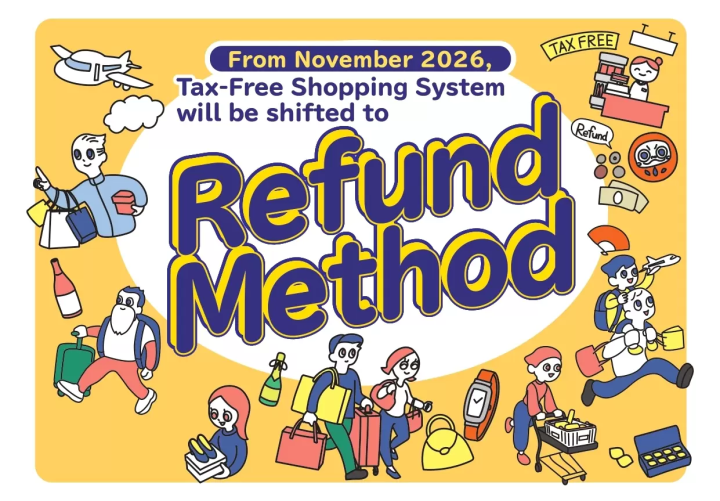
Starting November 1, 2026, Japan will fundamentally dismantle its long-standing, point-of-sale tax-free shopping framework for international visitors, replacing it with a centralized, customs-verified "Refund Method." For decades, tourists have enjoyed immediate savings at the register by presenting their passports and purchasing eligible merchandise with the 10% consumption tax instantly deducted. Under the upcoming structural reform spearheaded by the Japan Tourism Agency (JTA), this instantaneous discount will cease to exist.
Instead, international travelers must pay the full tax-inclusive price at the point of purchase, register their preferred electronic or physical refund mechanism, and subsequently claim their tax-equivalent reimbursement at designated airport or seaport terminals upon departure.
The policy shift is designed to curb rampant tax evasion, black-market reselling rings, and compliance loopholes that have plagued the legacy system. While the immediate checkout experience remains largely frictionless—requiring only passport verification—the operational burden shifts entirely to departure day.
Travelers must now navigate self-service Customs Tax Refund Kiosks or online clearance workflows via Visit Japan Web prior to checking their luggage. Failure to present physical goods, matching every item on a receipt, or leaving the country without completing customs validation will permanently forfeit the consumption tax refund.
This comprehensive guide breaks down the structural differences between the legacy system and the 2026 framework, outlines the mandatory three-step departure process, highlights critical operational risks that could result in lost refunds, and addresses frequently asked questions concerning international cruises, shipping, and cash reimbursements.
Detailed Chronology & Structural Evolution
The Demise of Point-of-Sale Discounts
The transition to the Refund Method represents the most radical overhaul of Japan’s inbound tourism economy in decades. Until October 31, 2026, the procedural mechanics of duty-free shopping were handled entirely at the retail counter. Tourists simply exhibited their short-term visitor landing permission status, signed a covenant pledge promising to export the goods, and walked out of boutiques, electronics superstores, and convenience shops with immediate tax savings.
However, this decentralized model created systemic enforcement challenges. Japanese customs authorities repeatedly flagged instances where bad-faith buyers acquired bulk quantities of luxury goods or electronics at tax-free prices, only to flip them domestically on the black market before leaving the country, pocketing the uncollected 10% consumption tax margin.
Furthermore, the physical inspection of goods upon departure—the primary safeguard against tax leakage—was rarely enforced for the millions of tourists exiting annually, leaving the system heavily reliant on honor-system declarations.
The November 1, 2026 Pivot: Pay Now, Refund Later
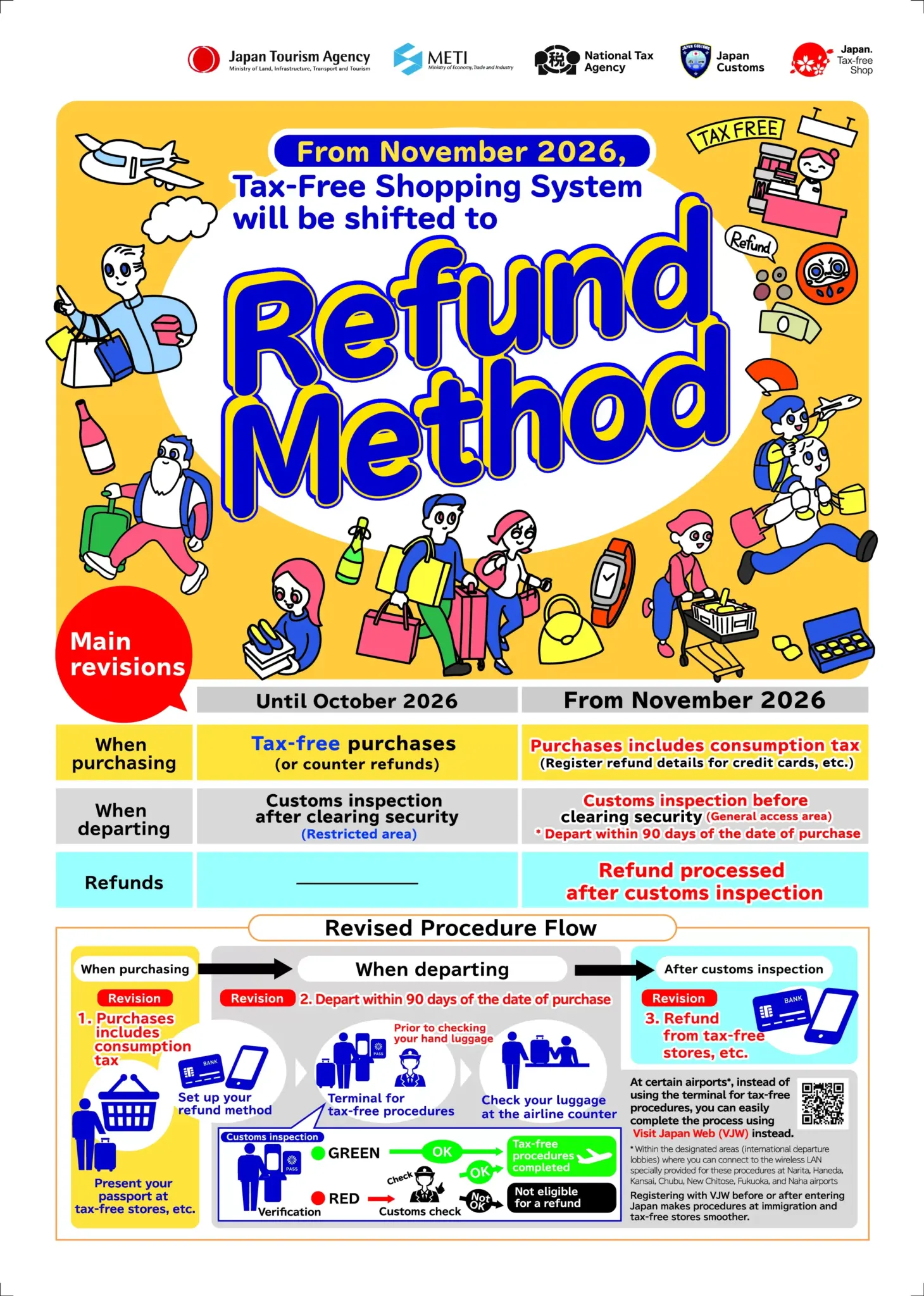
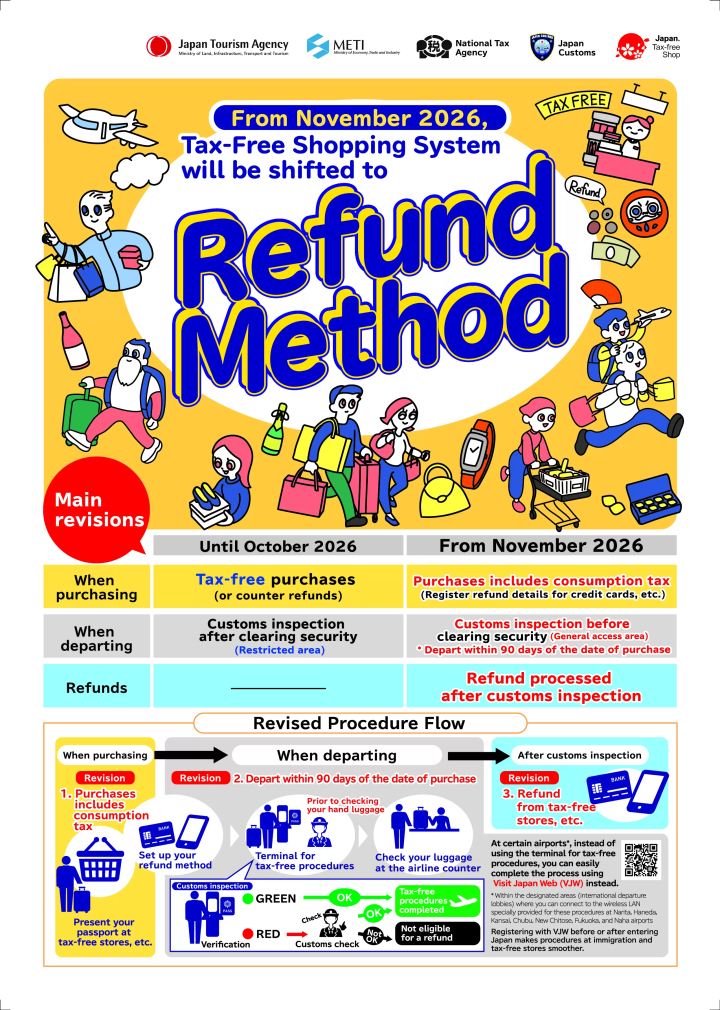
Beginning November 1, 2026, the paradigm shifts to a strict "Pay Now, Refund Later" architecture. The following matrix illustrates the operational differences between the outgoing legacy procedures and the new mandatory workflow:
| Procedure Flow | Tax-Free Shopping System Before the Change (Until October 31, 2026) | Tax-Free Shopping System After the Change (Starting November 1, 2026) |
|---|---|---|
| 1. Purchase at the Store | Present passport; purchase items immediately at tax-free prices (consumption tax deducted). | Present passport; purchase items at tax-inclusive prices. Register your refund method during the same transaction. |
| 2. Customs Inspection | Not required at departure (assumed completed at the retail level at the time of purchase). | Mandatory. Undergo customs inspection at the airport or seaport when exporting eligible items. |
| 3. Tax Reimbursement | None necessary (tax was already deducted at purchase). | Issued via your registered payment method after clearing customs inspection and verifying purchase records. |
Crucially, while the old system forced retailers to pack consumables (such as cosmetics, pharmaceuticals, and foodstuffs) into tamper-evident, sealed plastic bags—prohibiting their use within Japan—the Refund Method formally discontinues the mandatory special packaging requirement.
While this eliminates the annoying bulk of sealed plastic bags in travelers’ luggage, the underlying legal restriction remains ironclad: consumers are strictly prohibited from opening, consuming, or utilizing any tax-free eligible merchandise within Japanese territory prior to export. Unsealing an item early compromises its export status, rendering it legally ineligible for a consumption tax refund.
The Three-Step Refund Method: A Walkthrough
Navigating the new system successfully requires adherence to a strict, sequential three-step itinerary. Missing or misordering any phase can result in financial loss.
Step 1: Purchasing and Registering at the Retailer
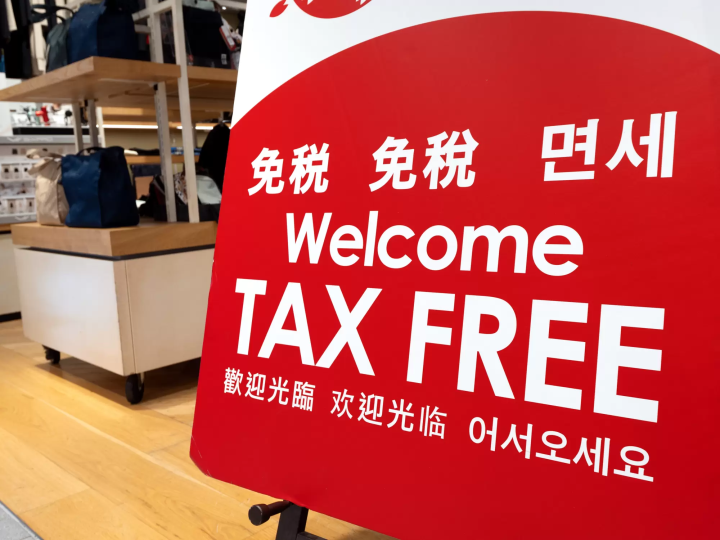
When shopping at any establishment displaying the authorized "Tax Free" signage, international visitors will present their passports to verify short-term visitor status. At the register, the point-of-sale software will calculate the total, including the standard consumption tax.
Concurrently, the buyer will register their desired refund route—such as a designated credit card, authorized digital wallet, or (where supported) cash disbursement channels. Retailers will issue a standardized transaction receipt linked directly to the buyer’s digital passport profile.
Step 2: Clearing Customs Prior to Luggage Drop
This step represents the single greatest operational bottleneck and point of failure for travelers. Customs inspection must be completed before checking baggage into the hold.

International departure lobbies across major aviation hubs—including Narita, Haneda, Kansai, Chubu, Fukuoka, New Chitose, and Naha—will feature dedicated Customs Tax Refund Kiosks (electronic scanning terminals). Alternatively, tech-savvy travelers can utilize the Visit Japan Web portal via dedicated Wi-Fi zones established within the landside international departure lobbies prior to security checkpoints.
By scanning their passport at a kiosk or via the web portal, the automated customs database cross-references the purchase history and issues one of two distinct statuses:
- GREEN Indicator: Tax-free export procedures are fully satisfied. The traveler is cleared to proceed to airline bag-drop counters and outbound security.
- RED Indicator: Physical verification required. The traveler must present all tax-free eligible merchandise corresponding to the flagged receipt to a human customs officer at an inspection counter.
Note on Timing: Japanese tax law stipulates that customs clearance must be executed within 90 days of the original purchase date; otherwise, the transaction permanently expires from eligibility. Furthermore, if a traveler checks their luggage before visiting a customs kiosk and subsequently receives a RED inspection prompt, recovering checked bags depends entirely on individual airline policies. Many carriers cannot or will not retrieve checked hold luggage on demand, leaving the passenger unable to present the goods and forfeiting the refund entirely.
Step 3: Automated or Cashless Reimbursement
Once the digital or physical customs clearance protocol registers a successful export confirmation, the system triggers the financial reimbursement. Funds are routed directly back through the pre-registered mechanism—typically credited to the tourist’s credit card or digital wallet over the subsequent days, depending on financial clearinghouse processing times.
Supporting Context, Metrics, and Risk Factors
To prevent common pitfalls, travelers must understand the strict compliance boundaries enforced by the Japan Tourism Agency and Japan Customs. The system treats the tax refund and the physical exportation of the goods as an inseparable legal package.

The "All-or-Nothing" Receipt Rule
Customs audits and kiosk verifications operate strictly on a per-receipt basis. If a traveler purchased five distinct items on a single receipt, but one of those items is lost, gifted away domestically, discarded, or consumed within Japan, the entire receipt is disqualified. The refund is denied not just for the missing item, but for every single piece of merchandise tied to that specific transaction document.
The Consumable Paradox
While the bureaucratic headache of bulky, sealed tamper-evident bags is gone, the statutory prohibition against consuming goods on Japanese soil remains absolute. Consuming a single green tea KitKat, applying a duty-free facial serum, or taking a headache tablet purchased tax-free prior to clearing outbound customs invalidates the tax status of that specific purchase.
Airport Time Management and Liability
Because airport kiosks require physical interaction—and potential redirection to human customs agents via a RED status—departing passengers must dramatically expand their airport arrival buffers.
Official advisories emphasize that neither Japanese Customs nor commercial airlines will provide financial compensation, rebooking waivers, or liability coverage for passengers who miss their international flights because they were caught in long queues for tax-free customs verification. Travelers are strongly urged to arrive at airports significantly earlier than standard international departure windows dictate.
Frequently Asked Questions (FAQ)
Can I ship tax-free eligible items from Japan to my home country?
No. Ahead of the launch of the Refund Method, Japan officially discontinued the legacy "Separate Delivery System" on March 31, 2025. Consequently, all tax-free eligible items must either be carried out of the country physically by the traveler in their personal baggage, or dispatched via international commercial shipping arrangements managed directly through the retailer at the time of sale. The availability of direct international retail shipping varies heavily by merchant and must be confirmed counter-side.
How long does the airport customs inspection take?
Under normal conditions utilizing an automated Customs Tax Refund Kiosk, scanning a passport takes mere seconds. However, if a transaction triggers a RED status requiring manual inspection, or if airport queues during peak holiday travel seasons are congested, processing times can expand unpredictably. This underscores the necessity of early airport arrival.
How do international cruise passengers complete tax-free procedures?
Travelers embarking on or departing via international cruise ships must present their tax-free eligible items and passports at the seaport’s designated customs inspection counter or kiosk prior to boarding. The underlying compliance workflow mirrors the airport process. For itineraries involving domestic Japanese flights following a domestic cruise segment, customs clearance generally occurs at the final seaport or airport from which the traveler physically exits Japanese territory.
Can I receive my consumption tax refund in cash?
The primary refund infrastructure is digital, relying on pre-registered credit cards or electronic payment methods linked at the retail register. While certain retailers or designated refund operators may offer cash disbursement options, availability varies widely by merchant. Travelers should never assume cash is available and should confirm cash-out capabilities at the time of purchase.
Future Outlook & Strategic Advice for Travelers
The implementation of the Refund Method on November 1, 2026, marks a watershed moment for Japanese tourism commerce. By shifting enforcement from the point of sale to the point of departure, Japan aligns its fiscal policy with major international travel hubs while closing billions of yen in tax leakage vulnerabilities.
For the international visitor, the operational takeaway is straightforward: purchasing goods becomes slightly easier due to the elimination of sealed packaging, but exiting the country requires meticulous logistical discipline.

To guarantee a seamless journey, travelers visiting Japan post-November 2026 should adhere to three core operational rules:
- Never check baggage before completing customs tax clearance at a terminal kiosk or via Visit Japan Web.
- Keep receipts intact and match every physical item against its corresponding purchase document to avoid total disqualification under the all-or-nothing receipt rule.
- Allocate an extra 60 to 90 minutes to your pre-flight airport schedule to absorb potential customs queues and verification delays.
By adopting these practices, tourists can continue to enjoy Japan’s vibrant retail landscape while navigating the post-2026 tax-free system with absolute confidence and peace of mind.
(Sponsored by the Japan Tourism Agency)









Belum ada komentar. Jadilah yang pertama berkomentar!