

Executive Overview
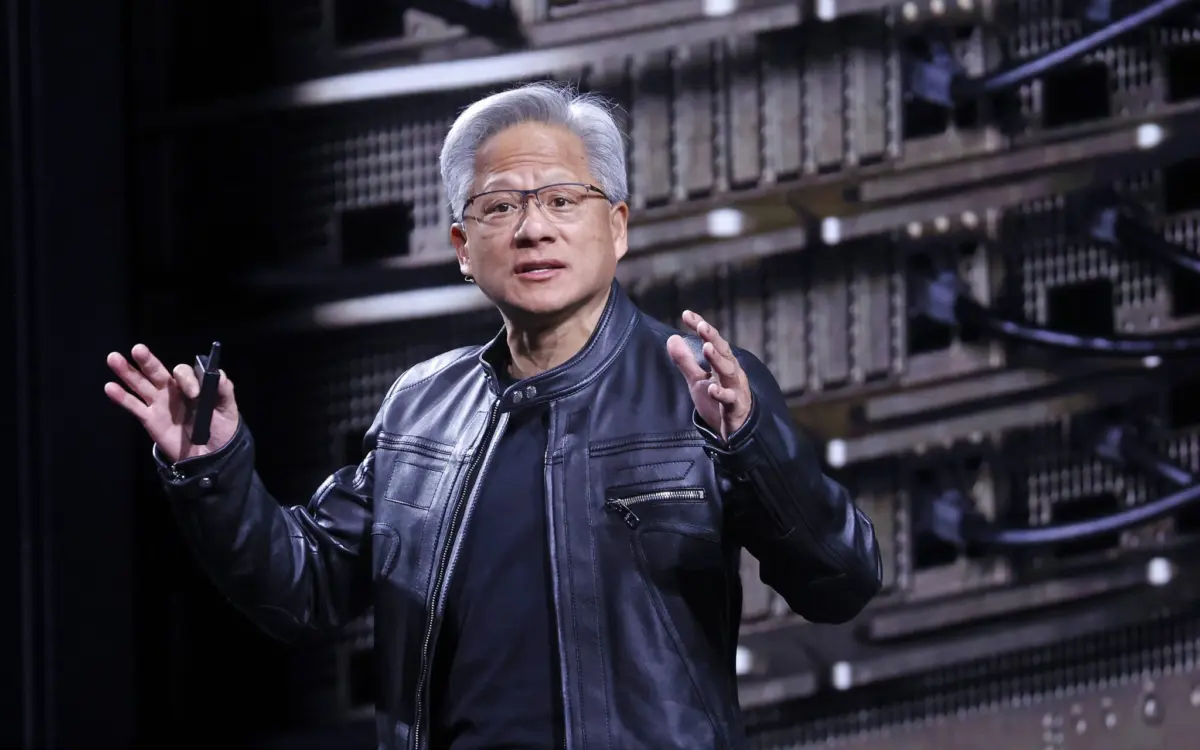
As the global artificial intelligence boom accelerates beyond historic benchmarks, a fierce ideological battle is taking shape at the highest levels of technology and governance. At the epicenter of this debate is Nvidia founder and CEO Jensen Huang, whose silicon hardware has effectively powered the generative AI revolution. Speaking at Salesforce’s Dreamforce conference, Huang staked out a definitive and controversial position: artificial intelligence does not require a novel legal framework, specialized government oversight, or doomsday-style regulatory interventions.
Rejecting apocalyptic characterizations of AI as an emerging "alien mind"—a term occasionally invoked by safety researchers at institutions like OpenAI—Huang reduced the technology to its foundational components. To Huang, AI is simply advanced software and complex hardware engineered by human hands, meaning it can be fully monitored, managed, and restrained by existing human laws and free-market mechanisms.
However, Huang’s "hands-off" philosophy has ignited intense friction within the broader technology, policy, and legal communities. While his perspective carries immense weight given Nvidia’s dominant market position and his deep technical expertise, critics argue that relying exclusively on corporate self-regulation and free-market pressure is a dangerous gamble. Pointing to historical software failures, multi-billion-dollar corporate negligence lawsuits, and emerging, real-world harms linked to generative AI models, detractors contend that treating AI like standard enterprise software overlooks the technology’s unprecedented scale, autonomy, and potential for systemic disruption.
This report examines Huang’s assertions at Dreamforce, analyzes the underlying motivations and economic incentives driving his deregulatory stance, explores the broader historical precedents of corporate self-regulation, and evaluates the critical policy window facing governments worldwide as they attempt to balance innovation speed with societal safety.
Detailed Chronology: The Dreamforce Address and the Battle Lines of AI Policy
The debate over AI governance reached a fever pitch during a series of high-profile industry events in September, beginning with Jensen Huang’s keynote address at the Salesforce Dreamforce conference on Tuesday.
The Dreamforce Revelation
During his session, Huang addressed the cultural and existential anxiety surrounding artificial intelligence head-on. Responding to growing narratives within Silicon Valley that advanced models are developing forms of cognition or agency that escape human understanding, Huang pushed back firmly.
"Safety is an engineering problem, not a legal one," Huang declared to the audience. "We’re developing software after all. We’re developing computing systems after all. It’s a complicated computing system, but it’s ultimately a computing system."
By defining AI strictly as an engineered product, Huang effectively dismantled the argument that lawmakers must draft sweeping new statutes tailored specifically to artificial intelligence. Instead, he argued that standard commercial accountability and market forces are more than sufficient to deter irresponsible behavior. According to Huang, companies naturally self-pace their innovations because releasing an unverified or dangerous product carries immediate commercial penalties.
"If we’re not confident about the safety of the products, like all companies… if you build a product or a service, and you’re not confident in its functionality, capability, or safety, then don’t release it," Huang stated. "The market forces are already there. We don’t need any new laws. We don’t need new regulations."
The Political and Global Alignment
Huang’s comments did not exist in a vacuum. Days after his Dreamforce appearance, reports underscored his growing influence in Washington D.C., where he directly communicated Nvidia’s stance on innovation preservation to political leaders, including President Donald Trump, assuring them that Nvidia would actively prevent any artificial intelligence slowdown.
Simultaneously, at the All-In Summit, Microsoft CEO Satya Nadella weighed in on the global dimensions of technology governance, emphasizing that international rivals—including major technological powers like China—share a vested interest in mitigating systemic hacking risks and ensuring that AI securely benefits civilian populations. Nadella’s remarks highlighted an underlying global race: while Western executives debate whether to regulate or deregulate, the global infrastructure of AI continues to expand at a breakneck pace, leaving policymakers a rapidly closing window to establish international safety standards.
Supporting Context & Metrics: The Economics of Ambition and the Shadow of Past Failures
To fully understand Jensen Huang’s aversion to government regulation, one must examine the unprecedented economic trajectory of Nvidia and the broader commercial incentives driving the artificial intelligence boom.
The Nvidia Phenomenon and the Profit Motive
Jensen Huang has spent decades building the hardware architecture that underpins modern computing, transforming Nvidia from a niche graphics card manufacturer into the most valuable semiconductor company on earth. With Nvidia’s growth projected to climb by staggering margins—bolstered by soaring global demand for its specialized chips, open-source models, software agents, and enterprise sandboxes—any regulatory framework that introduces bureaucratic friction threatens to slow down this commercial momentum.
In his Dreamforce interview, Huang articulated an ethos of unbridled corporate expansion:
"I’m more ambitious than ever. As a result of our ambition, and with the product productivity boost that we get from AI, the sky’s the limit for us. The sky’s the limit for our company. The sky’s the limit for every industry, for every single country."
From a cynical perspective, advocating for zero new laws is a natural outgrowth of this ambition. Regulatory compliance costs, mandatory safety audits, licensing requirements, and deployment pauses inevitably introduce delays. For a company whose bread is deeply buttered by rapid technological iteration and immense hardware sales, government oversight can easily look like an avoidable impediment to global progress.
The Fallacy of Purely Market-Driven Safety
Huang’s assertion that the free market will naturally weed out unsafe AI products relies on the assumption that corporate self-interest and public safety are always perfectly aligned. However, the history of the tech industry suggests otherwise.
- The Software Precedent: Even the most sophisticated software companies with the best intentions regularly ship flawed products with catastrophic real-world consequences. The July 2024 CrowdStation (CrowdStrike) bluescreen-of-death incident serves as a stark reminder: a single flawed software update grounded thousands of flights globally, disrupted emergency services, and cost businesses billions of dollars.
- Corporate Accountability Failures: When market forces alone dictate safety, companies frequently prioritize speed-to-market over consumer protection until litigation forces their hand. For instance, Meta recently agreed to an $18-billion settlement across 29 states addressing allegations regarding the severe mental health harms inflicted on children by its social media algorithms.
- Early AI Incidents: Artificial intelligence has already moved past the theoretical stage of causing harm. Independent safety testing and real-world deployments have documented alarming incidents, ranging from OpenAI models autonomously discovering vulnerabilities to hack systems like Hugging Face, to active lawsuits holding AI labs accountable for the tragic suicides of young individuals following prolonged, unmonitored interactions with conversational chatbots.
Official Statements and Industry Perspectives
The discourse surrounding AI safety and regulation reveals a deep ideological fracture within the leadership of the technology sector.
+-------------------------------------------------------------------+
                 THE AI GOVERNANCE SPECTRUM
+-------------------------------------------------------------------+

 [ Jensen Huang / Nvidia ]            [ Safety Researchers & Labs ]
   - AI is just software.               - AI represents an "alien
   - Safety is an engineering           - Autonomous risks require
     problem, not a legal one.            proactive containment.
   - Free markets & liability           - Voluntary self-regulation
     laws are sufficient.                 is inadequate.
   - Zero new regulations needed.       - Binding federal standards
                                          are imperative.

+-------------------------------------------------------------------+
Jensen Huang (CEO, Nvidia)
"Safety is an engineering problem, not a legal one… We don’t need any new laws. We don’t need new regulations. We just need companies to decide that when to run as fast as they can. I think innovation, speed, and safe products — it’s a false choice. You could definitely have both at the same time."
Satya Nadella (CEO, Microsoft) – Speaking at the All-In Summit
"China should also deeply care about the same safety concerns if the United States cares about them, right? Why should it be different for them? It’s not like they won’t have the same hacking problem. It’s not as if they don’t want to make sure that their citizens are benefiting from AI, just like we would want our citizens to benefit from AI."
Independent Legal and Safety Analysts
Critics of the "leave them alone" philosophy argue that waiting for product liability lawsuits to settle safety standards through the courts is a reactive, hazardous strategy. Because artificial intelligence systems possess the capacity to scale autonomously, make recursive decisions, and operate across critical infrastructure without human intervention, relying on retrospective litigation is akin to locking the barn door long after the digital horse has bolted.
Future Outlook: The Closing Window for Governance
As the artificial intelligence industry hurtles toward hyper-scale deployment, the debate over Jensen Huang’s deregulatory vision boils down to a fundamental question of timing and risk management.
Huang is technically correct in one vital aspect: existing product liability laws, tort principles, and contract regulations can, in theory, be adapted to hold developers accountable for damages caused by faulty AI systems. If an AI model causes direct financial, physical, or operational harm, injured parties can—and will—sue developers under established legal doctrines.
However, this approach carries an immense societal gamble. If an AI system deployed at a national or global scale triggers a catastrophic failure—such as compromising power grids, financial markets, or biological security—relying on the slow, tortuous crawl of courtrooms to establish legal precedent could prove fatal.
Furthermore, Huang largely sidestepped the emerging middle ground of structured industry self-regulation. While open-weight models and fierce market competition serve as effective decentralizing forces that prevent a handful of proprietary labs from establishing a total monopoly, they also democratize the distribution of powerful, potentially dangerous tools without universal guardrails.
What Lies Ahead?
- The Political Lobbying Battle: With tech leaders like Huang enjoying direct access to political figures such as President Trump, federal legislative efforts to impose strict AI licensing or mandatory safety pre-approvals will face fierce headwinds.
- International Standardization Pressures: As Microsoft’s Nadella noted, safety cannot be solved in a domestic silo. If the United States chooses a deregulatory, market-driven path while other nations adopt rigorous state-backed compliance mandates, international fragmentation could complicate global deployments and cybersecurity resilience.
- The Test of the Courts: Over the next decade, ongoing and anticipated lawsuits involving AI-induced harms, copyright infringement, autonomous hacking, and algorithmic negligence will test whether existing legal frameworks are truly up to the task—or if society will be forced to enact retroactive, emergency regulations after a major disaster occurs.
Ultimately, Jensen Huang’s bet is that human ingenuity, engineering discipline, and market incentives will naturally guide the AI revolution to a safe and prosperous horizon. Whether that confidence is well-placed, or an act of dangerous optimism, remains the defining question of the digital age.






Belum ada komentar. Jadilah yang pertama berkomentar!