

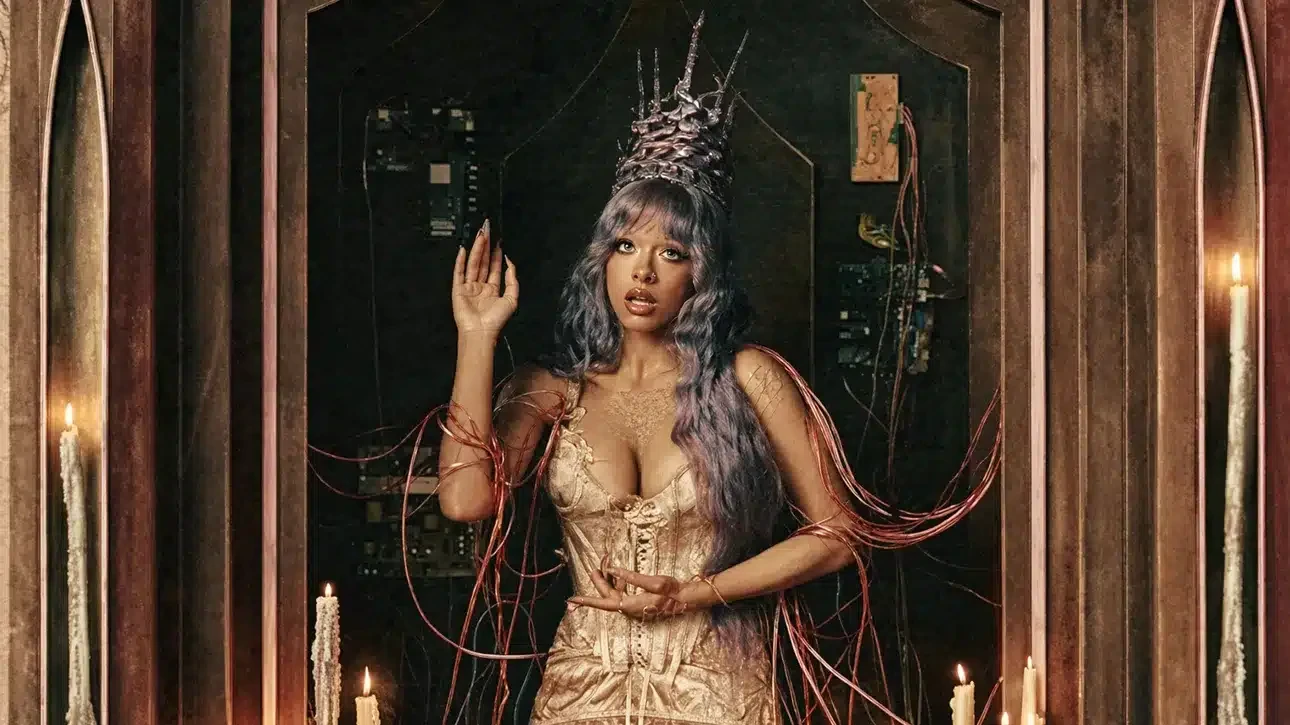
Executive Overview
Pop music has a long, contentious history of dragging institutional religion into the mud, but few recent releases have weaponized the intersection of sacred iconography and secular vice quite as aggressively as Melanie Martinez’s "THE VATICAN." Featured on her 2026 full-length album HADES, the track immediately commands attention through its brazenly modern targets—tackling Catholic imagery, sexual repression, queer shame, American partisan politics, and institutional hypocrisy with a total lack of diplomatic restraint. Sonically, the track bridges the ethereal and the explicit, opening with solemn, haunting, church-like vocal arrangements before rapidly giving way to pulse-pounding, synth-driven electronic pop where the language of holy devotion is systematically remapped onto the language of physical desire.
Yet, despite its 21st-century production and contemporary political framing—born, as Martinez has noted, out of the social tensions surrounding the 2024 Republican National Convention—"THE VATICAN" taps into a tradition of subversion that is centuries old. When institutions present themselves as infallible, transcendent, and entirely divorced from the messiness of human biology, one of the most durable and effective forms of pushback is to drag their lofty language straight back into the physical body.
While critics and fans alike have debated the cultural efficacy, lyrical risks, and moral boundaries of Martinez’s shock-pop strategy, placing "THE VATICAN" in dialogue with medieval tavern masses, Geoffrey Chaucer’s anticlerical satire, and modern cultural critique reveals a profound truth: the song is not merely an isolated provocation. It is the latest iteration of a timeless comedic and political machinery that recognizes that the quickest way to puncture holy authority is to remind the preacher that they, too, are made of flesh.
Detailed Chronology and Artistic Genesis
The development of HADES and the conceptual rollout of "THE VATICAN" reflect a calculated escalation in Martinez’s artistic evolution. To understand the cultural footprint of the track, it is essential to trace its trajectory from conceptualization to critical reception.
Phase 1: The Political and Personal Crucible (2024–2025)
According to interviews surrounding the release of HADES, the thematic architecture of the album was forged during a period of intense sociopolitical upheaval in the United States. Martinez has explicitly pointed to the political climate surrounding the 2024 Republican National Convention as a primary catalyst for the biting skepticism embedded in the record. Witnessing the intersection of conservative religious rhetoric, nationalist politics, and the systematic marginalization of vulnerable groups pushed Martinez to interrogate the weaponization of faith.
Crucially, Martinez has maintained a nuanced stance regarding spirituality itself. In a 2026 conversation with Billboard’s Hannah Daly, the artist clarified that she grew up Christian and retains a deep respect for personal faith, spiritual communities, and the genuine comfort religion brings to individuals. Her profound objection is not to belief, but to the mechanics of organized religion—specifically instances where institutions utilize spiritual authority to enforce control, spread shame among LGBTQ+ youth, and mask systemic abuses of power.
Phase 2: The Release of HADES and "THE VATICAN" (Early 2026)
Upon the arrival of HADES in early 2026, "THE VATICAN" immediately established itself as a lightning rod for critical discourse. Reviewers noted the track’s striking structural duality. Publications like RIFF Magazine highlighted how the track opens with a stark, haunting choral atmosphere that mimics a traditional Latin hymn, lulling the listener into a state of solemn reverence before abruptly shattering the illusion with a heavy, synth-driven electronic beat.
As the music shifts, the lyrics systematically dismantle traditional Catholic vocabulary. Confession, holy water, celibacy, the Trinity, and kneeling are stripped of their ecclesiastical sanctity and reframed through an erotic, highly physical lens. This calculated juxtaposition quickly polarized listeners and critics, setting off a fierce debate over the boundaries of pop provocation.
Phase 3: The Critical Backlash and Public Discourse (Spring 2026)
As the album permeated the cultural mainstream, the song’s lyrical framing drew intense scrutiny. Writing for Slant Magazine, critic Michael Savio argued in his review ("Melanie Martinez ‘Hades’ Review: Insubstantial Dark Pop") that the track’s attempts to critique religious hypocrisy occasionally stumble into problematic territory, particularly when the lyricism risks caricaturing marginalized groups alongside the conservative institutions it seeks to condemn. This tension highlighted a central risk of contemporary pop satire: when navigating delicate subjects like clerical abuse, closeted sexuality, and institutional corruption, provocative shock value can occasionally outpace nuance, leaving the overarching political message muddled.
Supporting Context & Metrics: A History of Sacrilegious Subversion
To fully grasp what Martinez is attempting in "THE VATICAN," one must look beyond modern pop criticism and examine the deep historical lineage of religious parody. For centuries, artists, writers, and even clergy members have used bodily humor, linguistic subversion, and sacrilege to check the unchecked power of religious institutions.
The Medieval Tradition of the Drinkers’ Mass
Religious parody is hardly a modern invention born of MTV or internet subcultures. In her seminal 2022 essay, "For Mine Is the Bitter, the Ale and the Lager: Parodic Prayer and the Spirituality of Humour" (published in Acta Theologica), religious studies and theology professor Anita Houck traces a vibrant tradition of parodic prayer spanning from the 11th through the 16th centuries.
During this era, European writers—many of whom scholars believe were young, lower-level clerics with an insider’s mastery of Latin liturgy—regularly rewrote prayers and complete masses around base human appetites: drinking, gambling, and unbridled sexuality. A prime example is the Drinkers’ Mass, a popular medieval trope where sacred Latin formulas were twisted into tavern anthems. In one famous piece of wordplay, the sacred liturgical command oremus ("let us pray") was deftly altered to potemus ("let us drink").
As Houck notes, these texts were not necessarily written by hardened enemies of Christianity. Instead, they operated as insider humor. A sacred formula derives its power from solemnity, repetition, and universal recognition. By changing a single word, the entire atmospheric architecture collapses: worship is reduced to appetite, and the smell of incense is instantly replaced by the stench of wine, sweat, and crowded rooms.
Chaucerian Anticlericalism and the Politics of the Body
Centuries later, Geoffrey Chaucer mastered this exact dynamic in The Canterbury Tales. Chaucer was deeply invested in exposing the moral rot of corrupted clergy, yet he maintained a clear distinction between corrupt individuals and true faith (as evidenced by his respectful portrayal of the Parson).
In modern literary analysis, scholars emphasize that Chaucer’s satire functions as a tool for institutional reform. In her 2024 study "Laughing at Church Abuse in Chaucer’s The Canterbury Tales: Satire as a Tool for Reform" (published in Modern Studies in English Language and Literature), theologian Jin Sunwoo argues that Chaucer’s humor centers precisely on the gaping chasm between what religious leaders preach and how they actually behave.
When Chaucer wanted to skewer false piety, he did not rely on polite theological debate; he relied on vulgarity. In "The Summoner’s Tale," a manipulative friar aggressively presses a sick man for a financial donation, only to receive a flatulent blast instead of holy coin. As literary historians note, the joke goes far beyond simple toilet humor: it functions as a visceral parody of Pentecost, replacing the sacred breath of the Holy Spirit with the lowest, most embarrassing product of the human digestive tract.
The underlying principle remains unchanged across the centuries: the higher an institution’s claim to absolute moral purity, the stronger the temptation to remind its representatives that they are trapped inside fragile, desiring, corruptible bodies.
Official Statements & Industry Perspectives
The cultural friction generated by "THE VATICAN" has elicited a wide range of commentary from artists, musicologists, and cultural critics, highlighting the deep divide over how pop music should engage with religious institutions.
-
Melanie Martinez (Reflecting on HADES and Spiritual Power):
"I grew up Christian, and I have a lot of respect for people who find genuine community and peace in their faith. My problem is never with belief; it’s with the weaponization of spirituality. It’s when organizations use God as a shield to abuse power, protect abusers, and make LGBTQ kids feel ashamed of who they are. If my music makes people uncomfortable, it’s because the reality of what those institutions do behind closed doors is far more uncomfortable." (In conversation with Hannah Daly, Billboard, 2026)
-
Anita Houck (On the Function of Sacred Parody):
"Knowing what a joke attacks is rarely straightforward. A parody can appear to mock the sacred text itself, while actually utilizing the undeniable authority of that text to criticize something much darker—like hypocrisy, greed, or the abuse of authority. The sacred meaning isn’t erased by the joke; the joke entirely depends on it for its power." (Acta Theologica, 2022)
-
Michael Savio (Critiquing the Lyrical Execution):
"While Martinez’s desire to dismantle religious conservatism is clear, songs like ‘THE VATICAN’ occasionally stumble into lazy tropes, blurring the lines between institutional corruption, closeted identity, and systemic harm in a way that feels more like sensationalist dark pop than nuanced social critique." (Slant Magazine, 2026)
Future Outlook: The Enduring Utility of the Sacred Subversion
As the discourse surrounding HADES continues to evolve, "THE VATICAN" stands as a potent case study in the complex relationship between popular art, institutional power, and public morality.
Looking ahead, the track’s polarized reception signals a broader cultural fatigue with diplomatic artistic expression. In an era marked by intense political polarization and culture-war flashpoints, polite discourse frequently fails to capture the visceral anger felt by marginalized communities targeted by religious and political dogmatism. By dragging the immaculate, unyielding imagery of the Vatican down into the sweaty, pulsing world of electronic dance-pop and sexualized confession, Martinez has tapped into a primal artistic instinct.
Whether the song is celebrated as a liberating act of defiance or criticized as heavy-handed shock value, its very existence proves that the ancient machinery of satire remains fully operational. When cultural authorities demand absolute deference, art will always find a way to remind them of the body beneath the robes. As long as institutions preach purity while practicing hypocrisy, the sacred and the vulgar will continue to collide on the pop charts—proving that the shortest distance between a pious sermon and a disruptive truth is a well-placed, unapologetic shock to the system.




Belum ada komentar. Jadilah yang pertama berkomentar!