

Executive Overview
The landscape of mobile gaming is shifting beneath our fingers. For years, mobile esports athletes and dedicated handheld gamers have faced a silent hardware compromise: phones offered ergonomic grips and ultra-wide aspect ratios optimized for competitive shooters and MOBAs (Multiplayer Online Battle Arenas), but their screens were simply too cramped for extended tactical clarity. Conversely, tablets delivered sprawling, immersive displays—ideal for media consumption and sprawling RPGs—yet suffered from a rigid 16:10 aspect ratio. In fast-paced multiplayer titles like League of Legends: Wild Rift or Honor of Kings, this traditional tablet format inadvertently restricted peripheral vision, placing tablet users at a distinct spatial disadvantage against smartphone players.
Enter Lenovo’s aggressive push into the dedicated gaming ecosystem. Alongside its upcoming high-performance gaming smartphones, the technology giant is preparing to launch the Lenovo Legion Y700—a purpose-built, compact gaming tablet engineered from the ground up to solve these exact ergonomic and visual dilemmas.
Recent leaks and official teasers shared by Lenovo executive Lin Lin on Weibo have pulled back the curtain on what makes the Legion Y700 a watershed device for mobile gaming enthusiasts. Driven by Qualcomm’s battle-tested Snapdragon 870 System-on-Chip (SoC), a pristine 8.8-inch high-refresh-rate display, and a revolutionary software-driven aspect ratio adjustment tool, the Legion Y700 aims to bridge the gap between portable handhelds and traditional slate computing. This report provides an exhaustive, in-depth breakdown of the Lenovo Legion Y700’s technical architecture, software innovations, market implications, and what the future holds for the burgeoning mobile gaming tablet segment.
Detailed Chronology: The Evolution of the Legion Y700 Leak Pipeline
Understanding how the Legion Y700 entered the public consciousness requires tracing a steady, calculated drip of information managed by Lenovo’s internal leadership and leaks from major tech communities.
Phase One: The Initial Hardware Teasers
Rumors surrounding Lenovo’s intentions to expand the Legion sub-brand beyond laptops and smartphones began circulating in late 2021. While Lenovo had established a strong foothold in the PC gaming space with its Legion desktops and laptops, translating that pedigree to a sub-10-inch Android tablet was uncharted territory.
The first official validation came through promotional posters released on Lenovo’s official channels and Chinese microblogging platform Weibo. These initial marketing materials confirmed that Lenovo was not building a generic media consumption device; instead, they were targeting mobile gamers who preferred a more compact form factor than traditional 10-inch or 11-inch slates. The promotional collateral showcased an 8.8-inch form factor—a sweet spot for gamers seeking a balance between screen estate and physical manageability.
Phase Two: Executive Disclosures and Processor Confirmation
As anticipation mounted in early January 2022, Lenovo executive Lin Lin stepped forward to offer deeper technical clarity. Through a series of social media posts, Lin Lin confirmed the processing engine powering the Legion Y700: Qualcomm’s Snapdragon 870 SoC.
While flagship devices of the era were transitioning toward the Snapdragon 888 and Snapdragon 8 Gen 1 chips, Lenovo’s choice of the Snapdragon 870 was widely praised by hardware analysts. Renowned for its exceptional thermal efficiency, rock-solid stability during long gaming sessions, and more than adequate graphical horsepower, the Snapdragon 870 ensured that the Legion Y700 could sustain high frame rates without succumbing to the severe thermal throttling that plagued some first-generation 5nm flagship processors.
Phase Three: Unveiling the "Ultra-Wide Viewing Mode"
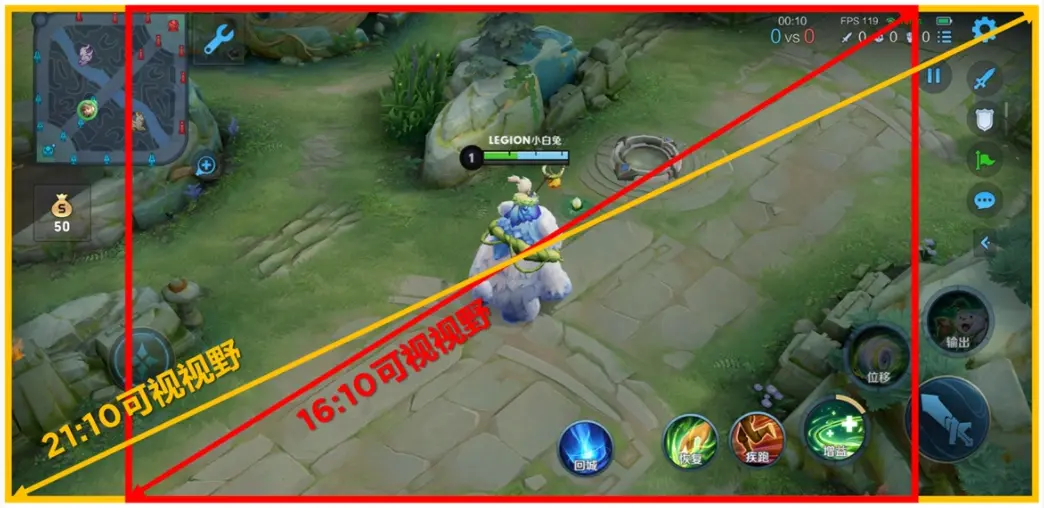
The most critical turning point in the Legion Y700 narrative arrived when Lin Lin demonstrated a proprietary software feature designed to eliminate the inherent competitive drawbacks of tablet gaming. Through operational screenshots and video demonstrations shared on Weibo, Lenovo revealed the tablet’s ability to dynamically alter its native aspect ratio.
By introducing the Ultra-Wide Viewing Mode, Lenovo directly addressed the community feedback regarding MOBA visibility. Rather than forcing users to play within the confines of a traditional 16:10 box, the Legion Y700 software suite empowers users to stretch and customize their viewing parameters to a wider 21:10 aspect ratio, complete with positional alignment controls. This move transformed the Legion Y700 from a standard hardware release into a thoughtfully engineered solution for competitive mobile esports.
Supporting Context & Metrics: Under the Hood of the Legion Y700
To fully appreciate the engineering achievement behind Lenovo’s new device, one must examine the raw specifications and underlying metrics detailed in official promotional materials and executive briefings.
Display Architecture and Visual Fidelity
At the heart of the Legion Y700 is an 8.8-inch IPS LCD panel that punches well above its weight class. Key display specifications include:
- Resolution: 2560 × 1600 pixels, yielding a sharp pixel density that ensures crisp text and immaculate in-game asset rendering.
- Refresh Rate: A fluid 120Hz refresh rate, ensuring buttery-smooth motion transitions, vital for tracking fast-moving targets in competitive shooters and high-speed racing games.
- Touch Sampling Rate: A responsive 240Hz touch sampling rate, dramatically reducing input latency between a user’s finger taps and the corresponding on-screen action.
- Color Gamut: Full support for 100% of the DCI-P3 color gamut, delivering vibrant, true-to-life color reproduction that enhances cinematic immersion in modern role-playing games.
Processing Power: The Snapdragon 870 Advantage
While raw benchmark chasing dominates modern smartphone marketing, practical gaming performance relies heavily on sustained efficiency. The Qualcomm Snapdragon 870 SoC features an octa-core Kryo 585 CPU clocked up to a brisk 3.2 GHz, paired with an Adreno 650 GPU.
In real-world testing scenarios across similar hardware configurations, the Snapdragon 870 consistently delivers:
- Sustained Thermal Performance: Unlike its hotter successors, the Snapdragon 870 maintains higher percentage yields of peak performance over extended 60-to-90-minute gaming marathons.
- App Compatibility: Universal optimization across virtually all mainstream Android titles, ensuring minimal stuttering, texture pop-in, or compatibility crashes.
- Power Efficiency: Optimized battery drain management, allowing players to enjoy extended gaming sessions without requiring an immediate tether to a wall charger.
Solving the Aspect Ratio Dilemma: The Core Innovation
The standout technical feature of the Legion Y700 is its approach to screen real estate utilization. Standard tablets utilize a 16:10 aspect ratio. While excellent for watching movies or multitasking with split-screen productivity apps, this format acts as a bottleneck in modern competitive mobile games.
The MOBA Disadvantage Explained
In games like League of Legends: Wild Rift, Honor of Kings, and Mobile Legends: Bang Bang, tactical awareness depends heavily on horizontal field-of-view (FOV). Players utilizing modern smartphones with ultra-wide aspect ratios (such as 20:9 or 21:9) can see enemies approaching from the left or right flanks significantly earlier than players using a traditional 16:10 tablet display.
Lenovo’s Software Countermeasure
To level the playing field, Lenovo’s Ultra-Wide Viewing Mode introduces a software-level aspect ratio adjustment, shifting the display geometry to a wider 21:10 ratio. Furthermore, Lenovo understands that stretching a screen vertically on an 8.8-inch tablet can make top-mounted interface elements difficult to reach with thumbs. To mitigate this, the interface includes customization options allowing users to align the active game window either in the center or shifted toward the bottom of the display. This ensures optimal thumb ergonomics while preserving the critical wider field of view required for competitive play.
Official Statements and Industry Insights
The unveiling of the Legion Y700 has sparked significant discussion across global tech journalism and enthusiast forums. Industry insiders have noted that Lenovo’s strategy represents a calculated pivot toward specialized, niche hardware categories that major manufacturers often overlook.
Insights from Lin Lin and Lenovo’s Design Philosophy
Statements released by Lenovo executive Lin Lin emphasize a user-centric design philosophy. By actively engaging with the community on social media platforms and responding directly to gamer grievances regarding tablet aspect ratios, Lenovo has positioned the Legion Y700 as a device built by gamers for gamers.
Lin Lin’s disclosures highlight that hardware specifications alone are no longer enough to win over discerning mobile gamers. In an era where multiple manufacturers can source identical Snapdragon processors and high-refresh-rate panels, software optimization and hardware-software integration are the ultimate differentiators. The inclusion of granular aspect ratio controls demonstrates that Lenovo’s engineering teams are looking past spec sheets and examining the actual micro-interactions of competitive gameplay.
Market Reception and Analyst Perspectives
Market analysts monitoring the mobile accessories and gaming hardware sectors have pointed out several key takeaways regarding the Legion Y700:
- Revitalizing the Small Tablet Market: The market for premium, high-performance tablets under 9 inches has been largely neglected, with most manufacturers focusing on productivity-oriented 11-inch to 12.9-inch devices. By targeting the compact gaming demographic, Lenovo has carved out a unique monopoly space.
- Ecosystem Synergy: The Legion Y700 is not arriving in a vacuum; it is part of a broader synchronized push that includes Lenovo’s gaming smartphone initiatives. This allows Lenovo to market a cohesive ecosystem of high-performance mobile gaming hardware.
Future Outlook: What Lies Ahead for Mobile Gaming Tablets
As we look toward the official commercial rollout and global availability of the Lenovo Legion Y700, several critical questions remain for consumers and industry observers alike.
Availability and Pricing Speculation
While Lenovo has officially teased the hardware specifications, display metrics, and software features, a definitive global release date and pricing structure have yet to be formally announced at the time of writing. Given Lenovo’s typical go-to-market strategy, the device is expected to debut initially in the Chinese domestic market before seeing a broader international rollout under the Legion banner. Tech enthusiasts across North America, Europe, and Southeast Asia are closely watching for confirmation of global SKU availability.
The Broader Impact on Android Gaming Hardware
The success of the Legion Y700 could serve as a bellwether for the entire Android tablet market. If Lenovo proves that a high-performance, compact gaming tablet equipped with specialized software features like Ultra-Wide Viewing Mode can capture significant market share, competing original equipment manufacturers (OEMs) may be forced to rethink their own tablet design paradigms. We could soon witness a new wave of gaming-centric slates featuring advanced cooling solutions, physical shoulder triggers, and customizable aspect ratio engines.
Conclusion
The Lenovo Legion Y700 represents a refreshing evolution in mobile gaming hardware. By identifying a glaring structural disadvantage in tablet-based competitive gaming and addressing it with innovative software engineering—all while packing a robust Snapdragon 870 chipset, a vibrant 120Hz display, and an ergonomic 8.8-inch form factor—Lenovo has crafted a compelling proposition for mobile esports enthusiasts.
As we await further announcements regarding pricing and official launch dates, one thing is abundantly clear: the rules of engagement for mobile gaming are changing, and the Legion Y700 is leading the charge. Stay tuned as we continue to monitor developments surrounding Lenovo’s exciting new gaming tablet.








Belum ada komentar. Jadilah yang pertama berkomentar!