

Executive Overview
The mobile gaming landscape has long been dominated by smartphones, largely due to ergonomics, optimization, and hardware tailored for competitive play. However, traditional tablets—while offering sprawling, immersive displays—have frequently suffered from a critical competitive bottleneck: inflexible aspect ratios. When playing fast-paced multiplayer titles like League of Legends: Wild Rift or Honor of Kings on a standard 16:10 tablet, users often find themselves at a distinct disadvantage compared to smartphone players, whose wider field of view allows them to spot opponents and map changes much earlier.
Entering the fray to disrupt this status quo is Lenovo. Expanding far beyond its upcoming Legion Y90 gaming smartphone, the tech giant is setting its sights on the dedicated mobile gaming slate market with the Lenovo Legion Y700.
Leaked and officially teased details—curated largely through insights shared by Lenovo executive Lin Lin on Weibo—reveal a device meticulously engineered to bridge the gap between tablet immersion and smartphone competitive agility. Powered by Qualcomm’s tried-and-true Snapdragon 870 system-on-chip (SoC) and headlined by an innovative Ultra-Wide Viewing Mode capable of shifting aspect ratios on the fly, the Legion Y700 is shaping up to be one of the most anticipated mobile gaming accessories of the year.
This comprehensive report examines the technical specifications, structural design choices, competitive advantages, and broader industry implications of Lenovo’s upcoming gaming slate.
Detailed Chronology of Leaks and Announcements
The journey of the Lenovo Legion Y700 from a whispered concept to a tangible, highly anticipated piece of hardware highlights Lenovo’s calculated marketing strategy of drip-feeding information through executive social media channels.
The Initial Teasers: Unveiling the 8.8-Inch Form Factor
The narrative surrounding Lenovo’s next-generation gaming hardware began in earnest with promotional posters distributed across Chinese tech forums and Weibo. Unlike massive media-consumption tablets that measure 11 inches or larger, Lenovo made a deliberate choice to target a more compact, highly maneuverable form factor.
The initial teasers confirmed that the Legion Y700 would feature an 8.8-inch LCD display. For mobile gamers, this size represents a sweet spot: it is substantially larger than any smartphone screen—allowing for more intricate controls and expansive visual clarity—yet compact and lightweight enough to be held comfortably for hours during intense competitive matches without inducing severe hand fatigue.
Hardware Validation and the Snapdragon 870 Reveal
As speculation grew regarding what would power this compact powerhouse, Lenovo executive Lin Lin stepped forward to confirm key internal specifications. Rather than opting for the power-hungry and thermally volatile Snapdragon 888 or Snapdragon 8 Gen 1 chips—which have occasionally faced criticism in smaller form factors due to heat dissipation challenges—Lenovo opted for the Qualcomm Snapdragon 870 SoC.
This decision was met with widespread approval from the tech community. The Snapdragon 870 is renowned for its exceptional thermal efficiency, rock-solid stability during sustained gaming sessions, and more than adequate processing muscle to handle graphically demanding titles at maximum frame rates.
Solving the Field of View Problem: The Aspect Ratio Breakthrough
The most recent wave of disclosures, again championed by Lin Lin, addressed the elephant in the room regarding tablet gaming: the inherent field-of-view (FOV) disadvantage imposed by standard 16:10 displays.
Through a series of detailed interface previews, Lenovo showcased a proprietary feature built into the Legion Y700’s software ecosystem. Dubbed Ultra-Wide Viewing Mode, this software-level innovation allows users to override or adapt standard game scaling, effectively adjusting the display aspect ratio to a wider format. This chronological progression—from hardware sizing to chipset selection, and finally to software-driven competitive balancing—paints a clear picture of a device built by engineers who genuinely understand the pain points of mobile gamers.
Supporting Context & Metrics: The Engineering Behind the Legion Y700
To truly understand why the Legion Y700 is generating such high-profile interest, one must examine the raw metrics and display technologies underpinning the device. Lenovo has spared little expense in ensuring that every hardware component serves a distinct purpose in competitive gaming.
Display Specifications and Visual Fidelity
At the heart of the Legion Y700 lies an 8.8-inch high-resolution LCD panel. Key display metrics include:
- Resolution: 2560 × 1600 pixels, ensuring crystal-clear text, sharp UI elements, and high-definition environment textures.
- Refresh Rate: A fluid 120Hz refresh rate, delivering butter-smooth animations and reducing motion blur during rapid camera pans in first-person shooters or fast-paced action RPGs.
- Touch Sampling Rate: A responsive 240Hz touch sampling rate, minimizing input latency to ensure that every tap, swipe, and gesture is registered instantaneously by the game engine.
- Color Gamut: Full 100% support for the DCI-P3 color space, guaranteeing vibrant, accurate color reproduction that brings game worlds to life.
The Ultra-Wide Viewing Mode: Mechanics and Utility
The standout feature of the Legion Y700 is its aspect ratio adjustment capability, which directly combats the traditional limitations of tablet gaming.
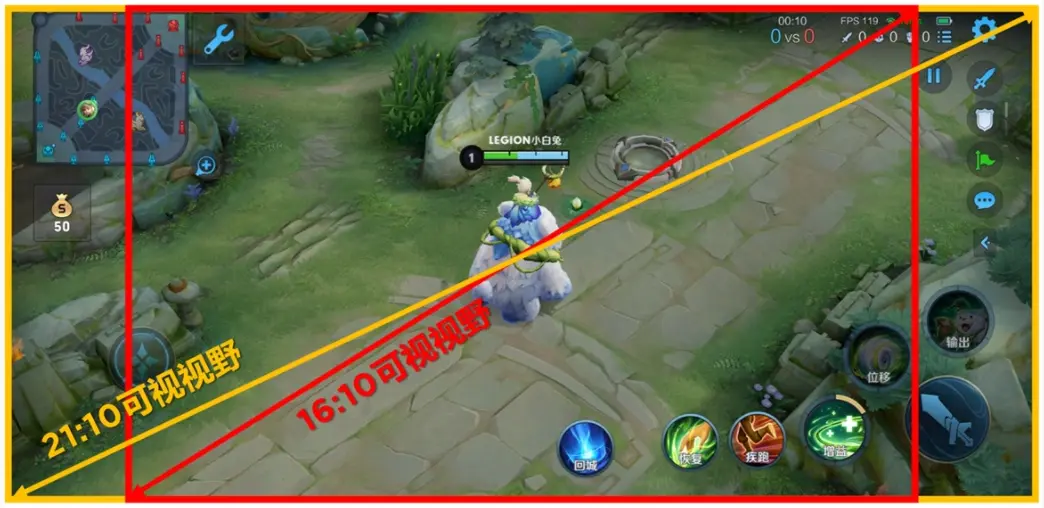
On standard 16:10 tablets, multiplayer online battle arena (MOBA) games such as League of Legends: Wild Rift or Honor of Kings crop the horizontal field of view to fit the vertical boundaries of the screen. Consequently, smartphone users playing at 20:9 or 21:9 aspect ratios can see enemies approaching from the flanks before tablet users even realize they are in danger.
Lenovo’s Ultra-Wide Viewing Mode solves this by allowing users to switch the active game display area to a 21:10 aspect ratio. Furthermore, the software provides granular positioning controls:
- Centered Display: Retains balanced black bars or dead space while centering the expanded view.
- Bottom-Aligned Display: Shifts the active game content toward the bottom or edge of the screen, making thumb reaches significantly more ergonomic for users holding the tablet horizontally with both hands.
Processing Power: Why the Snapdragon 870 Shines
While flagship silicon gets all the marketing glory, the Qualcomm Snapdragon 870 remains a favorite among performance-minded enthusiasts. Built on a mature 7nm process node, the Snapdragon 870 features an octa-core Kryo 585 CPU clocked up to an impressive 3.2 GHz, paired with an Adreno 650 GPU.
In a compact 8.8-inch tablet chassis, thermal management is a monumental challenge. High-end modern chips often throttle aggressively under heavy loads, leading to stuttering frame rates mid-match. The Snapdragon 870 strikes an optimal balance, delivering sustained peak performance without generating unmanageable heat levels. This ensures that competitive players experience stable, high frame rates over hours of continuous gameplay.
Official Statements and Industry Insights
The rollout of information regarding the Legion Y700 has been characterized by direct, transparent communication from Lenovo’s leadership team, specifically through executive disclosures on Weibo.
Lin Lin’s statements have consistently emphasized user-centric design choices. By openly acknowledging that tablets are traditionally poorly optimized for competitive MOBA and tactical shooters, Lenovo has positioned the Legion Y700 not merely as a scaled-up phone or a media consumption device, but as a specialized tool tailored for esports enthusiasts.
Industry analysts have noted that the dedicated gaming tablet market is largely untapped. While companies like ASUS (with the ROG Phone series) and Black Shark have dominated the gaming smartphone space, the tablet category has historically been left to general-purpose media devices like the iPad Pro or Samsung Galaxy Tab S series. By introducing targeted software features like aspect ratio adjustment alongside enthusiast-grade hardware, Lenovo is carving out a brand-new niche.
Experts suggest that if the Legion Y700 proves successful, it could force competing manufacturers to rethink how tablet operating systems handle mobile game scaling, ultimately setting a new industry standard for portable gaming hardware.
Future Outlook and What Lies Ahead
As anticipation builds, several critical questions remain regarding the global commercial rollout of the Lenovo Legion Y700.
Pricing, Availability, and Global Launch
While Lenovo has extensively detailed the technical specifications and software innovations of the Legion Y700 in regional teasers (primarily targeting the Chinese market), a definitive global launch date and international pricing structure have yet to be officially confirmed. Historically, many of Lenovo’s dedicated Legion mobile products eventually find their way to international markets—either directly or via rebranded iterations—meaning global consumers are watching regional developments closely.
The Evolution of Gaming Tablets
The introduction of the Legion Y700 signals a potential turning point for portable gaming. As mobile titles become increasingly complex, demanding higher graphical fidelity and more expansive control schemes, the demand for intermediate form factors—devices larger than smartphones but far more agile than traditional 11-inch or 12.9-inch tablets—is expected to surge.
If Lenovo’s Ultra-Wide Viewing Mode and ergonomic positioning options are well-received by consumers and esports players alike, we can expect rival original equipment manufacturers (OEMs) to develop competing software solutions. Furthermore, future iterations of gaming tablets will likely incorporate advanced cooling systems, specialized triggers, and dedicated accessory ecosystems (such as clip-on controllers and active cooling docks) modeled after the success of the Legion lineup.
Conclusion
The Lenovo Legion Y700 represents a refreshing and much-needed evolution in the mobile hardware space. By intelligently pairing the thermally efficient Qualcomm Snapdragon 870 chipset with a vibrant 120Hz 8.8-inch display and solving the long-standing MOBA aspect ratio disadvantage through its Ultra-Wide Viewing Mode, Lenovo has crafted a device that respects the needs of competitive gamers.
As we await the official release date and final pricing announcements, one thing is abundantly clear: Lenovo is not just participating in the mobile gaming market—it is actively shaping its future. Stay tuned to our coverage as we continue to track developments on the Lenovo Legion Y700 and its companion gaming smartphone, the Legion Y90.









Belum ada komentar. Jadilah yang pertama berkomentar!