

Executive Overview
For video game historians, preservationists, and old-school desktop veterans, the late 1990s represent a wild, lawless frontier—an era when persistent virtual spaces were forged not in the sterile, heavily optimized server farms of modern tech giants, but out of raw dial-up grit, ambitious design philosophy, and sheer technological audacity. Chief among the monuments of this foundational period stands Ultima Online (UO), a title that effectively birthed the modern Massive Multiplayer Online Role-Playing Game (MMORPG) genre.
Now, more than two decades after its commercial debut, the turbulent and culturally seismic history of Richard Garriott’s seminal creation has been meticulously documented in a staggering new format. YouTube essayist Majuular has returned with what is purportedly the penultimate installment of his multi-year, critically acclaimed Ultima video series: a monumental, four-and-a-half-hour deep dive into the creation, launch, cultural evolution, and everlasting legacy of Ultima Online.
Six months in production, this latest video is more than a mere retrospective; it is a masterclass in video-essay journalism. Tracing the trajectory from the game’s unlikely conceptualization under the stewardship of Richard Garriott and Starr Long to its rigorous structural refinement by Raph Koster and a dedicated cohort of Multi-User Dungeon (MUD) enthusiasts, Majuular unpacks how Ultima Online changed the course of interactive entertainment forever. This comprehensive feature examines the scope of Majuular’s latest documentary effort, explores the chaotic and brilliant history of Ultima Online, and contextualizes the broader phenomenon of a dedicated creator whose obsession with gaming history captured the imagination of over 200,000 subscribers.
Detailed Chronology: From Concept to Digital Chaos
To fully appreciate the narrative weight of Majuular’s four-and-a-half-hour documentary, one must understand the tumultuous historical arc of Ultima Online. The game’s genesis was characterized by wild technical ambitions that routinely clashed with the hard realities of late-20th-century computing and networking infrastructure.
The Visionaries and the Blueprint (Mid-1990s)
The story begins within Origin Systems, where legendary game designer Richard Garriott—famous for the single-player Ultima franchise—envisioned a persistent online world where players could inhabit a living, breathing fantasy ecosystem. Alongside Starr Long, Garriott sought to transcend the limitations of text-based MUDs by introducing graphical representation, dynamic player interaction, and a simulated economy.
However, transforming this high-fantasy vision into a functional commercial product required bringing in external talent steeped in the intricacies of text-based shared environments. Enter Raph Koster and his team of MUD aficionados. Koster injected deep systemic integrity into the project, championing concepts like a fully simulated ecology where flora and fauna interacted, players could build houses anywhere in the world, and systemic player-versus-player (PvP) freedom reigned supreme.
The Launch and the Crucible (1997)
When Ultima Online officially launched in September 1997, it was an immediate cultural watershed, yet an operational disaster. Servers buckled under unprecedented user demand, pathfinding lagged, and duping exploits ran rampant. Yet, despite the technical hurdles, players were captivated. Britannia became a chaotic crucible.
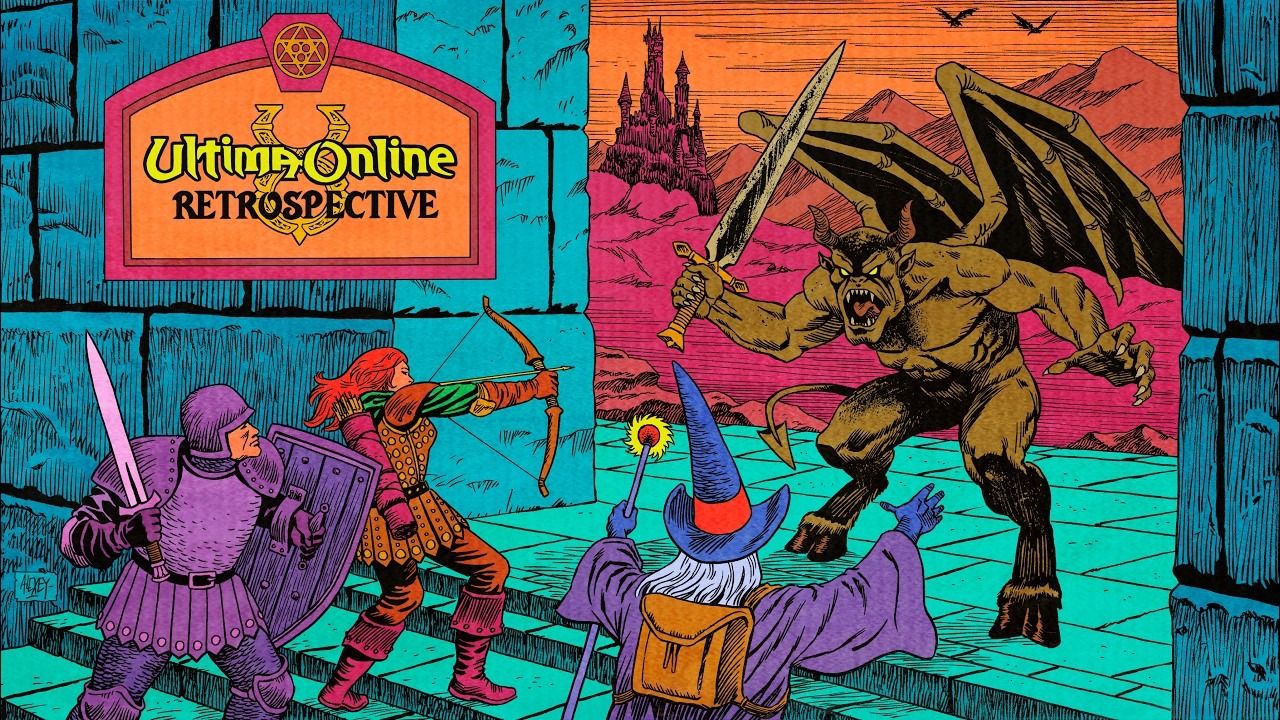
Majuular’s documentary brilliantly captures this lawless era—a time when the lack of safe zones and the implementation of full-loot mechanics meant that stepping outside a town gate could mean instant death at the hands of seasoned highwaymen. It was a social experiment as much as a game, forcing communities to self-organize, form guilds, and establish towns, trade routes, and laws entirely organically.
Identity Crises and Industry Competition
As the years progressed, Ultima Online was forced to evolve. The arrival of formidable competitors like Verant Interactive’s EverQuest in 1999 shifted consumer expectations toward structured, theme-park style progression and PvE-centric endgame loops. UO weathered numerous expansions—such as The Second Age, Renaissance, and Lord Blackthorn’s Revenge—which attempted to reconcile the desires of hardcore PvP players with a growing demographic that preferred a safer, more cooperative virtual life. These shifts in identity, policy pivots, and community fractures form the emotional core of Majuular’s narrative exploration.
Supporting Context & Metrics: The Scale of Majuular’s Magnum Opus
To contextualize the release of this latest four-and-a-half-hour epic, one must look at the unprecedented scale of Majuular’s overarching project. What began as a passionate hobby evolved into a multi-year, life-altering creative campaign that has amassed over 20 hours of meticulously researched documentary footage.
| Metric / Milestone | Detail |
|---|---|
| Total Project Duration | Over 2 years of continuous research, writing, and editing. |
| Cumulative Runtime | Exceeds 20 hours across the entire Ultima retrospective series. |
| Latest Chapter Runtime | 4 hours and 30 minutes (Ultima Online retrospective). |
| Channel Growth | Propelled the creator past 200,000 devoted YouTube subscribers. |
| Production Fuel | Fueled by "infinite drive, meticulous note-taking, and lots of Diet Pepsi." |
| Preservation Impact | Revitalized interest in classic emulation and historic server projects like In Mani Ylem. |
The rigorous nature of Majuular’s work sets a gold standard for digital archiving. Unlike traditional media outlets that skim over historical milestones with brief retrospectives, Majuular engages in the "dirty work" of actually playing through the source material, cross-referencing archival design documents, interviewing key developers, and analyzing lore on its own terms.
Furthermore, the documentary serves a practical preservationist function. For viewers inspired by the documentary to experience the game firsthand, Majuular highlights active communities keeping the original spirit alive. Notably, he spotlighted In Mani Ylem, a dedicated fan-run server designed to faithfully recapture the specific balance, mechanics, and community ethos of Ultima Online as it existed in the late 1990s. Alongside official avenues, these passion projects ensure that Britannia remains open for exploration.
Official Statements & Community Reception
The release of the Ultima Online retrospective has sent ripples through the classic PC gaming community, drawing praise from veteran developers, digital historians, and modern content creators alike.
In the comments section of the YouTube release, Majuular reflected on the immense production hurdle of the project: "This one was a doozy. Six months in the making, trying to condense the chaotic history of the world’s most influential MMORPG into a digestible narrative while doing justice to the developers and the players who lived through it."
Industry observers have similarly lauded the series’ unique ability to bridge generations. Younger gamers, accustomed to streamlined modern MMOs like World of Warcraft or Final Fantasy XIV, have expressed astonishment at the sheer systemic audacity of early UO design—where players could manipulate the world’s economy, steal items right out of other players’ backpacks, and influence real estate markets by claiming plots of wilderness.
Veteran developers who worked on the original game have also voiced appreciation. While official statements from legacy corporate entities like Electronic Arts remain muted, former Origin Systems staff members have frequently taken to social media to validate Majuular’s historical accuracy, noting that the documentaries capture not just the mechanics, but the genuine emotional anxiety and triumph of shipping a genre-defining product under impossible deadlines.
Future Outlook: The End of an Era and Lasting Legacy
As Majuular’s grand Ultima retrospective nears its final chapter, the cultural footprint of the project is secure. It stands as proof that long-form, deeply researched video essays can achieve both critical acclaim and sustainable commercial viability on modern streaming platforms.
For Ultima Online, the game continues to occupy a unique space in digital history. Though its peak concurrent player counts are long gone, its DNA persists in virtually every sandbox MMO, survival crafting game, and persistent-world RPG released in the 21st century. Concepts like player-driven economies, housing plots integrated into a shared overworld, open-world conflict, and emergent storytelling all trace their lineage directly back to the servers that Origin Systems brought online in the autumn of 1997.
Whether you choose to dedicate a weekend afternoon to watching Majuular’s four-and-a-half-hour masterpiece, dive into the complete series playlist, or log into a retro-shard like In Mani Ylem to experience the dial-up era of gaming firsthand, one thing is certain: the legacy of Ultima Online refuses to fade into digital obscurity. Through passionate preservationists and meticulous historians, Britannia will live on forever.








Belum ada komentar. Jadilah yang pertama berkomentar!