


Executive Overview
The landscape of personal computing is experiencing a tectonic shift, and nowhere is this more palpable than in the realm of high-performance desktop gaming. Historically, the macOS ecosystem has played second fiddle to Windows-based PCs and dedicated consoles. While Apple hardware boasts exceptional silicon efficiency, thermal architecture, and raw compute capabilities, the software pipeline has frequently suffered from delayed console-to-Mac ports, a lack of day-one parity, and a historical perception that the Mac is strictly a tool for enterprise, audio engineering, and creative design rather than immersive, high-end entertainment.
That narrative is rapidly changing.
Next week promises to be a watershed moment for Apple hardware enthusiasts, with several new MacBook configurations slated to launch. Yet, overshadowing even the hardware refresh is a milestone that signals a fundamental evolution in Apple’s gaming strategy: Pearl Abyss’s Crimson Desert, one of the most heavily anticipated AAA open-world action-adventure games of the decade, is launching on March 19 with full, day-one macOS support.
By releasing simultaneously alongside versions for PC, PlayStation 5, and Xbox Series X|S, Crimson Desert breaks years of precedent. It proves that major third-party developers are finally willing to treat macOS as a first-class citizen at launch, rather than an afterthought. Leveraging Apple’s advanced graphics APIs, hardware-accelerated ray tracing, and MetalFX Upscaling, the title promises to showcase the graphical muscle of Apple Silicon—specifically the M3, M4, and the upcoming M5-generation chips.
Priced at $69.99 for the Standard Edition and $79.99 for the Deluxe Edition, and currently available for pre-order on Steam, Crimson Desert represents a litmus test for the future of Mac gaming. If it succeeds, it could open the floodgates for more AAA developers to embrace macOS on day one.

Detailed Chronology: From Apple’s Silicon Transition to Day-One AAA Parity
To fully grasp the significance of Crimson Desert arriving on the Mac this March, it is essential to trace the historical lineage of Apple’s gaming initiatives and how the industry arrived at this juncture.
The Intel Era and the Fragmentation of Mac Gaming
For decades, Macintosh users endured a frustrating ecosystem. During the PowerPC era, games were rare and frequently suffered from optimization issues. When Apple transitioned to Intel processors in the mid-2000s, hopes ran high that PC titles could easily be ported using Boot Camp or native wrappers. While casual titles, strategy games (such as those from Paradox Interactive or Blizzard Entertainment), and indie hits found a home on the Mac, major AAA blockbusters largely ignored the platform.
The primary culprits were fragmented graphics architectures, a historical reliance on the aging OpenGL standard while Windows aggressively adopted DirectX, and a relatively small dedicated gaming market share. Even as Apple eventually deprecated OpenGL in favor of its proprietary Metal API in 2014, developers remained hesitant to rewrite their graphics pipelines for a distinct ecosystem that lacked a standardized gaming storefront or dedicated high-end GPU configurations in most standard consumer machines.
The Apple Silicon Revolution (2020–2024)
The paradigm shifted permanently in November 2020 when Apple introduced the M1 chip, kickstarting its transition away from Intel. By integrating CPU, GPU, and Unified Memory Architecture (UMA) onto a single system-on-a-chip (SoC), Apple created hardware capable of incredible power efficiency and sustained performance.
Recognizing that hardware alone was insufficient, Apple rolled out a multi-pronged strategy to court developers:

- The Game Porting Toolkit (2023): Introduced at WWDC 2023, this developer tool allowed studios to quickly evaluate how existing Windows games would run on Apple Silicon by translating DirectX 12 code to Metal on the fly. It dramatically lowered the barrier to entry for porting Windows titles.
- Metal 3 and MetalFX Upscaling: Apple introduced advanced rendering features, including hardware-accelerated ray tracing (beginning with the M3 generation) and spatial/temporal upscaling akin to NVIDIA’s DLSS or AMD’s FSR, allowing high-resolution rendering without sacrificing frame rates.
- Strategic Partnerships: Apple began working directly with AAA publishers—such as Capcom (Resident Evil series), Kojima Productions (Death Stranding Director’s Cut), and Larian Studios (Baldur’s Gate 3)—to ensure high-profile titles made their way to macOS, albeit typically months or years after their initial PC and console debuts.
The Turning Point: Summer 2025 and the Nine-Game Showcase
The momentum reached a fever pitch in July 2025. During a major platform showcase, Apple announced a massive push for entertainment, detailing a curated lineup of nine major new games slated to arrive on macOS. Among them was Crimson Desert, a sprawling epic developed by South Korean powerhouse Pearl Abyss.
Unlike previous high-profile ports that arrived as "Director’s Cuts" or "Complete Editions" long after their console debuts, Crimson Desert was positioned differently. Pearl Abyss and Apple committed to a simultaneous global rollout, setting the stage for the upcoming March 19, 2026 release date.
Supporting Context & Metrics: Technical Specifications and Market Impact
Bringing a next-generation open-world game to macOS requires robust underlying technology. Crimson Desert is built on Pearl Abyss’s proprietary BlackSpace Engine, a cutting-edge piece of software designed to render breathtaking vistas, hyper-detailed character models, dynamic weather systems, and massive, physics-driven combat encounters.
System Requirements and Hardware Synergy
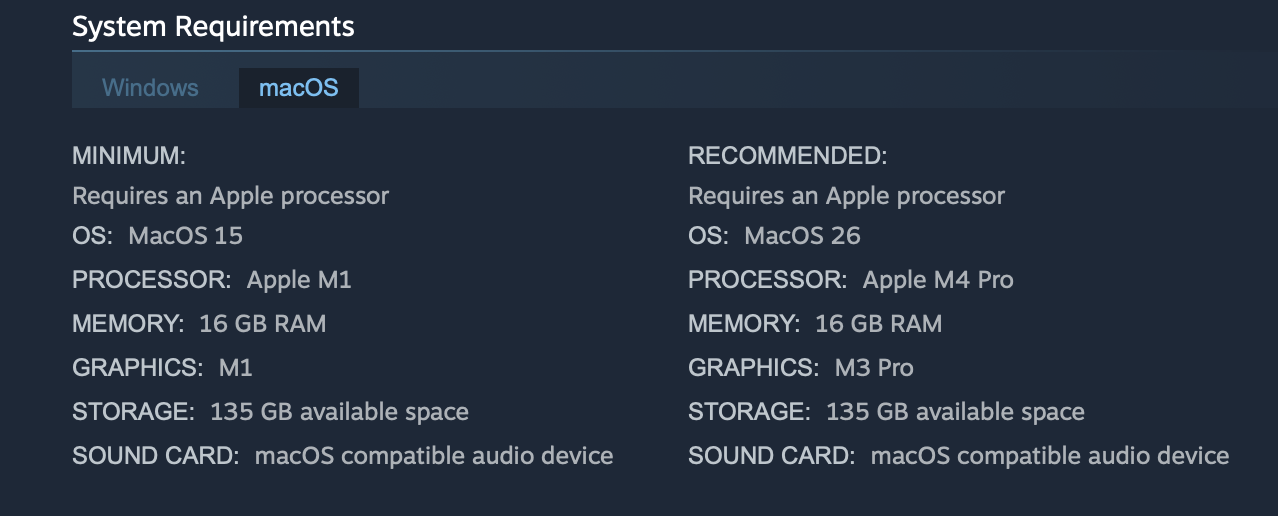
Analyzing the system requirements for running Crimson Desert on macOS highlights the vital role played by Apple Silicon’s advanced architecture.
- Processor & Memory: The game demands the processing prowess of Apple’s advanced M-series processors, specifically targeting the M3 and M4 families of chips, with expectations that upcoming M5 Pro and M5 Max configurations will extract even higher fidelity and frame stability.
- Ray Tracing Support: Thanks to the hardware-accelerated ray tracing blocks introduced in the M3 generation, Crimson Desert on Mac will feature realistic lighting, shadows, and reflections that match or closely parallel the console and high-end PC experiences.
- MetalFX Upscaling: Because open-world rendering is notoriously demanding on system resources, the integration of MetalFX Upscaling ensures that players can enjoy crisp visual fidelity at high resolutions without inducing thermal throttling or severe battery drain on portable MacBooks.
Pricing, Editions, and Pre-Orders
Market reception for the game has been robust. Currently available for pre-order via Steam, Crimson Desert is positioned as a full-price AAA release:
- Standard Edition: $69.99
- Deluxe Edition: $79.99 (including various in-game cosmetic packs, early-access bonuses, and digital art assets)
The decision to launch simultaneously on Steam for macOS further simplifies the consumer experience, bypassing cumbersome proprietary launchers and integrating neatly into the growing library of native Mac-compatible titles available on Valve’s platform.
Official Statements and Industry Perspectives
The convergence of Pearl Abyss and Apple represents a notable alignment of corporate messaging regarding the future of interactive entertainment on desktop operating systems.
During last summer’s hardware and software previews, Apple executives emphasized the deep collaboration between Cupertino engineers and third-party studios. Apple specifically highlighted how Crimson Desert would “leverage powerful software technologies like MetalFX Upscaling to accelerate performance and deliver high-quality visuals, as well as take advantage of the M3 and M4 family of chips with ray tracing for a breathtaking experience.”
Industry analysts have similarly weighed in on the strategic importance of the release. For Pearl Abyss, tapping into the burgeoning, high-income demographic of Mac users—particularly creative professionals and power users who also enjoy gaming—opens an entirely new revenue stream without requiring an entirely separate porting studio down the line.
Furthermore, insiders speculate that Apple’s upcoming hardware events—particularly the anticipated unveiling of new M5 Pro and M5 Max MacBook configurations—will feature Crimson Desert prominently as a benchmark of desktop-class capability running natively on portable form factors.

Future Outlook: What Crimson Desert Means for the Future of Mac Gaming
As the gaming industry looks past the March 19 launch of Crimson Desert, the broader implications for macOS as a viable gaming platform cannot be overstated.
1. The Death of the "Late Port" Paradigm
For years, the greatest deterrent for gamers considering a Mac was the "wait factor." Knowing that a game would arrive six months to two years late—if at all—discouraged enthusiasts from investing in Mac hardware for gaming. Day-one multiplatform parity completely alters consumer psychology. If players know they can purchase a MacBook Pro and play the year’s biggest releases alongside their PC-owning peers on launch day, the Mac becomes a far more attractive all-in-one machine.
2. Validation of Apple Silicon for Hardcore Gamers
While casual and indie games have thrived on macOS via Steam and Apple Arcade, hardcore AAA titles require sustained thermal efficiency, massive memory bandwidth, and robust graphics toolsets. If Crimson Desert runs fluidly on M-series silicon utilizing native Metal and ray-tracing pipelines, it will serve as concrete proof that Apple’s hardware roadmap is fully capable of handling the most demanding workloads the industry can produce.
3. Encouragement for Other Publishers
Success breeds success. If Pearl Abyss reaps financial and critical rewards from its day-one macOS gamble, other major publishers—such as Electronic Arts, Ubisoft, and Square Enix—will take notice. The friction of porting games to Metal has steadily decreased thanks to Apple’s continuous refinement of developer kits and developer support programs.
Conclusion
The release of Crimson Desert on March 19 is more than just the debut of another video game; it is a stress test for the future of desktop computing ecosystems. By bridging the gap between console, PC, and Mac development on day one, Pearl Abyss and Apple are signaling that the era of the Mac as a gaming wasteland is drawing to a close.

Whether you are eyeing the upcoming MacBook refreshes or preparing your current Apple Silicon setup for the trials of Pywel, Crimson Desert stands ready to redefine what is possible in a portable form factor.
Are you planning to dive into Crimson Desert on your Mac, or will you be sticking to traditional gaming hardware? Share your thoughts in the comments below.









Belum ada komentar. Jadilah yang pertama berkomentar!