

Executive Overview
For over a decade, Truecaller has been synonymous with caller identification. Boasting more than 500 million monthly active users globally—with over 350 million residing in India alone—the Swedish tech company built its reputation on screening incoming voice calls and blocking persistent spammers. However, the modern cybercrime landscape has evolved dramatically. Scammers have pivoted from traditional phone calls to an intricate web of messaging apps, fraudulent text messages (SMS), malicious web links, and deceptive social engineering tactics.
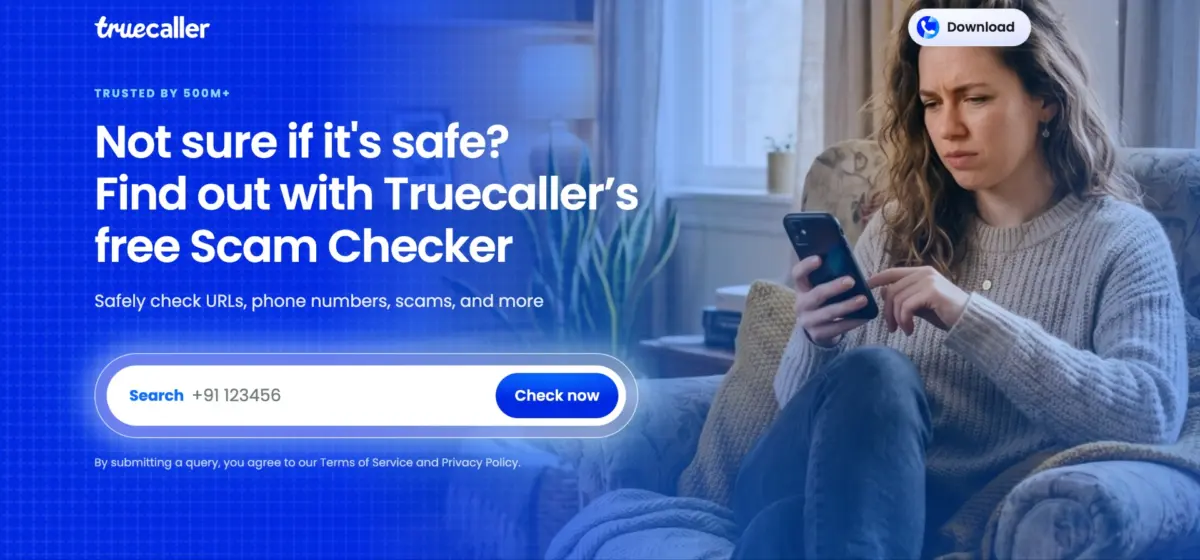
Recognizing that modern scams no longer respect the boundaries of a traditional phone app, Truecaller is taking its vast threat intelligence engine to the open web. The company officially launched Scam Checker, a brand-new, friction-free web and Android tool that allows users to paste suspicious phone numbers, links, or messages to instantly determine if they are fraudulent—requiring no app download, installation, or user sign-in.
Debuting initially in India—Truecaller’s largest and most fiercely contested market—the free-to-access tool is scheduled for rapid global expansion into Latin America, the Middle East and Africa, and Southeast Asia.
This strategic launch arrives at a critical juncture for Truecaller. The company’s core caller ID business is facing mounting pressures from mature markets, tightening regulatory frameworks, new domestic carrier-backed services like India’s Calling Name Presentation (CNP), and native spam-protection features baked directly into iOS and Android by Apple and Google. By transitioning from a reactive caller-ID utility to a proactive, multi-channel fraud intelligence platform, Truecaller is reshaping its business model to follow fraudsters wherever they strike.
Detailed Chronology & Mechanics: How Scam Checker Works
The conceptualization of Scam Checker was not born out of a vacuum; it was driven by observable user behavior. Internal data and traffic analysis at Truecaller revealed that individuals make approximately 14 million web searches every month simply to manually check suspicious phone numbers, shortened URLs, or fraudulent text messages.
Truecaller CEO Rishit Jhunjhunwala highlighted this exact consumer dilemma during launch discussions:
“When you need it, you’re usually somewhere else. The link shows up on WhatsApp. Your mum gets a message about a traffic fine. A friend forwards you a screenshot and asks, ‘Is this real?’ What people do in that moment is search.”
The Technical Workflow
To combat this fragmented user journey, Truecaller engineered Scam Checker to operate with maximum accessibility and zero onboarding friction. The service functions through a streamlined, multi-step technological pipeline:
- Input Ingestion: Users navigate to the web tool or use the Android service to paste a suspicious string—which can be a standalone phone number, a URL, or an entire text message block.
- Smart Parsing: If a user pastes an unstructured text message (such as a phishing SMS or a WhatsApp forward), the system’s backend automatically extracts embedded phone numbers or web links.
- URL Traversal and Expansion: For web links, Scam Checker safely expands shortened URLs (e.g., bit.ly or custom redirects) and follows the redirect chain all the way to its ultimate destination server, protecting the user from prematurely triggering drive-by downloads or credential-harvesting sites.
- Database & Risk Signal Cross-Referencing: The destination URL, IP signatures, or phone numbers are aggressively checked against Truecaller’s proprietary risk database and real-time fraud signals.
- Community-Driven Context: The tool cross-references submissions with ScamFeed, Truecaller’s crowdsourced community feed where users post, verify, and discuss active local scams.
Despite its powerful diagnostic capabilities, Truecaller has maintained strict privacy boundaries. While the tool surfaces community-reported scam trends, more granular and sensitive data—such as the specific legal name or identity associated with a private phone number—remains safely restricted behind Truecaller’s traditional sign-in app infrastructure to prevent doxxing or data abuse.
Supporting Context & Metrics: The Scale of Multi-Channel Fraud
Truecaller’s pivot is heavily underpinned by hard data illustrating how consumer fraud has migrated away from traditional voice channels.
The Shift in Attack Vectors
A landmark 2025 GSMA survey of Indian adults exposed a clear shift in how modern scammers target victims:

- 46% of respondents who reported falling victim to scams were approached via messaging apps (such as WhatsApp, Telegram, and Signal).
- 37% were targeted via SMS text messages.
- Only 32% were targeted via traditional voice calls.
This multi-channel proliferation has turned scam syndicates into industrialized operations. Truecaller’s internal telemetry underscores the sheer volume of global fraud attempts. Between September 14 and 20, the company’s automated global security apparatus evaluated 12.9 billion messages worldwide, out of which an astounding 20.3 million messages were definitively flagged as fraudulent.
In India alone, Truecaller’s localized crowdsourced ecosystem has become a critical shield. The company reports that there are currently 20,000 active, verified scam reports live on ScamFeed in India, with approximately 1,300 fresh reports pouring in from vigilant users every single week.
Looking ahead, Truecaller has outlined ambitious roadmap updates for Scam Checker. In the near future, the company plans to expand the engine’s cognitive capabilities to detect emerging forms of synthetic fraud, alongside introducing screenshot upload functionality, allowing users to snap pictures of suspicious app interfaces or fraudulent invoices for instant AI-driven threat analysis.
Official Statements & Business Strategy
While Scam Checker is engineered primarily as a free, consumer-facing public utility, its underlying mechanics offer substantial strategic advantages for Truecaller’s enterprise ecosystem.
Consumer Utility Meets Enterprise Intelligence
As users feed new URLs, messages, and phone numbers into the open-web Scam Checker, Truecaller gains an invaluable, real-time macro view of the fraud vectors circulating globally. This crowdsourced early-warning system significantly sharpens the threat intelligence models that Truecaller sells to corporate clients via its Truecaller for Business suite—helping banks, fintech firms, and enterprise call centers shield their customers from impersonation scams.
However, CEO Rishit Jhunjhunwala is quick to emphasize that Scam Checker is, at its core, a public-good consumer product designed to expand the company’s upper-funnel reach:
“Caller ID was the first problem we solved, and it’s still how most people find us. But scams moved to a more multi-channel approach with links and messages, and increasingly to voice and video. Our protection has to follow the scammer.”
By removing app-installation barriers on the open web, Truecaller is effectively deploying Scam Checker as a high-volume lead-generation funnel, gently encouraging users who require deeper identity verification to eventually download the core application and sign in.
Future Outlook & Market Pressures
Truecaller’s diversification away from basic caller ID is not merely opportunistic—it is existential. The company’s flagship market, India, where it commands over 350 million users, is undergoing massive regulatory and technological shifts that threaten its traditional business model.
Regulatory and Competitive Headwinds
- Government-Backed Telco Solutions: Indian telecom operators are actively rolling out the federal government-backed Calling Name Presentation (CNP) service, which natively displays verified subscriber names on mobile screens at the network level, potentially reducing reliance on third-party apps.
- Native OS-Level Competition: Tech giants Apple and Google continue to deepen their native operating system integrations, baking robust caller identification, spam-blocking, and message-filtering mechanisms directly into iOS and Android.
- Regulatory Mandates: In a controversial move, India’s telecom regulator recently ordered third-party caller-ID applications to automatically share user-submitted spam intelligence directly with telecom operators. Truecaller openly criticized the mandate, labeling it an unfair “one-way exchange” of proprietary community data.
The Road Ahead
These converging pressures mean Truecaller can no longer rely on being a simple directory of phone numbers. The modern threat landscape demands a holistic security architecture that transcends voice calls, enveloping URLs, instant messaging apps, emails, and deepfake-driven voice or video vectors.
By launching Scam Checker, Truecaller is signaling a bold transformation. It is shedding its identity as a mere smartphone utility and positioning itself as an agile, cross-platform cyber-intelligence guardian. As fraudsters continue to adapt their tactics across the digital ecosystem, Truecaller’s survival strategy is clear: wherever the scam travels, its detection net must follow.









Belum ada komentar. Jadilah yang pertama berkomentar!