

Executive Overview
There is a disarming, radical sincerity in titling a record I Love My Computer. For those born on the precipice of the Y2K panic or in the immediate wake of the new millennium, the desktop monitor was not merely a peripheral tool; it was a hearth. It was a digital portal that hummed in the dark bedrooms of adolescence, casting a pale, cinematic glow over formative years.
With her latest masterwork, I Love My Computer, Australian producer and electronic artist Ninajirachi has crafted more than a nostalgia-soaked dance record. She has delivered a definitive cultural artifact of the 2020s—a high-definition sonic diary for a generation whose identities were forged through the connective tissue of chat rooms, Limewire downloads, fractured iPod Touch screens, and the relentless evolution of cyberspace.
Rather than serving up a cheap, vaporwave-tinted exercise in millennial or Gen-Z tokenism, I Love My Computer operates as a sophisticated work of digital-native storytelling. It traces the trajectory of the internet from the chaotic wild west of dial-up and early YouTube to the hyper-curated, algorithmic landscapes of modern social media. The album avoids lazy pastiche, instead weaving classic dubstep, Y2K club rhythms, and contemporary hyperpop into a seamless continuum. In doing so, Ninajirachi poses a profound question: What happens to the human psyche when your first confidant, your primary record store, and your community square all live inside a glowing box?
Detailed Chronology: From Limewire to the 2020s Club Floor
To understand the weight of I Love My Computer, one must retrace the technological evolution that birthed it. The history of electronic dance music (EDM) is inextricably bound to the march of technology. From Kraftwerk’s pioneering analog-digital soundscapes in the 1970s and Daft Punk’s maximalist, robotic house odysseys on 2001’s Discovery, to Justice bridging the gap between rock and rave in 2007, the genre has always evolved alongside its tools.
Yet, Ninajirachi’s lineage diverges from these foundational eras. She did not discover electronic music in a physical record store or a secluded European warehouse; she encountered it through the peer-to-peer sharing networks and early community forums of the nascent web.
The Dial-Up and Desktop Era
The album’s opening movements and texture choices evoke the tactile memory of early computing. Tracks like “CSIRAC” mimic the bleeps and bloops of primitive Flash games, while lyrics on songs like “iPod Touch” explicitly anchor the listener to a specific epoch:
"Sounds like iPod Touch, yellow Pikachu case / FL Studio free download in my search history / Hidden underneath my pillow ’cause I should be asleep."
This is the sound of the mid-2000s and early 2010s digital adolescence—an era defined by the thrill of discovering new artists through compressed MP3s, curating a MySpace "Top 8," and debating complex Lost fan theories on message boards.
The Transition to Modern Hyperconnectivity
As the album progresses, Ninajirachi seamlessly bridges historical digital memory with modern sonic fluency. Tracks like “It’s You” wouldn’t feel out of place in a cutting-edge Porter Robinson or Madeon DJ set, while “Battery Death” reinvents classic dubstep tropes with breezy, modern melodies. Meanwhile, “London Song” catches the exact wave of the 2020s hyperpop renaissance—sharing DNA with the brazen, sweat-soaked ethos of modern British club culture popularized by acts like Charli XCX.
The emotional centerpiece of the record, however, balances high-energy club mechanics with raw, deeply personal vulnerability. On “Delete,” Ninajirachi confronts the digital age’s unique brand of social anxiety: the deliberate, calculated vulnerability of posting a story solely so an ex-lover will view it. It is a moment that captures the paradoxical nature of modern life—being hyper-connected yet profoundly isolated.
Supporting Context & Metrics: The Shift in Music Discovery and Digital Culture
The release of I Love My Computer arrives at a fascinating cultural juncture. As physical formats like vinyl experience a commercial renaissance, the actual mechanics of how humans discover, categorize, and consume music have undergone a permanent, irreversible digital migration.
The Demise of the Local Record Store
For decades, the record store served as the primary nexus for subcultural identity. However, the launch of Napster in 1999 initiated a seismic shift, transferring the burden of music curation from physical storefronts to digital hard drives. Today, even legendary vinyl champions like Third Man Records maintain massive digital footprints, utilizing platforms like Instagram and TikTok as their primary town squares.
[Traditional Era]       [P2P Revolution]        [Algorithmic Age]
Local Record Stores  -> Limewire / Torrents  -> TikTok / Discord / Reddit
(Physical Curation)     (Peer-to-Peer Sharing)  (Ecosystem Communities)
The Evolution of the Online Community
Message boards never truly vanished; they merely mutated. The DNA of early internet forums lives on in the sprawling architecture of Reddit, Discord servers, Twitch streams, and Patreon communities. I Love My Computer mirrors this structural evolution. The album functions much like a classic message board thread—a chaotic, beautiful mixtape of inside jokes, profound sincerity, internet irony, and shared trauma.
Within a single track, listeners may encounter sonic traces of EDM royalty, anime opening themes, viral meme culture, and gaming lore. There is no expository dialogue explaining why these disparate elements belong together; they belong because decades of internet saturation have trained modern audiences to make those connections intuitively. The "chronically online" label, once whispered as an insult, becomes a personal Rosetta Stone—a shared lexicon etched directly into the souls of the digital native.
Official Statements and Artistic Intent
In promotional interviews surrounding the rollout of I Love My Computer, Ninajirachi has repeatedly emphasized that the record is not an exercise in ironic meme-rap or hollow retro-worship.
"The computer wasn’t just a machine I learned to use later in life; it was the ecosystem where I figured out who I was," Ninajirachi notes when discussing the album’s conceptual framework. "When you spend your formative years with a device that stores your secrets, your unfinished artistic drafts, and your chosen family scattered across global time zones, that machine stops being an appliance. It becomes a witness to your life."
This intimacy is mirrored explicitly on the record’s third track, where she sings with startling candor:
"I want to fuck my computer / ’Cause no one in the world knows me better."
While provocative, the lyric articulates the album’s core philosophical thesis. In an era where human relationships are increasingly mediated, fractured, or complicated by distance and digital barriers, the machine remains a constant, silent partner. It is a jukebox, a library, a television, a social lifeline, and a recording studio all wrapped into one.
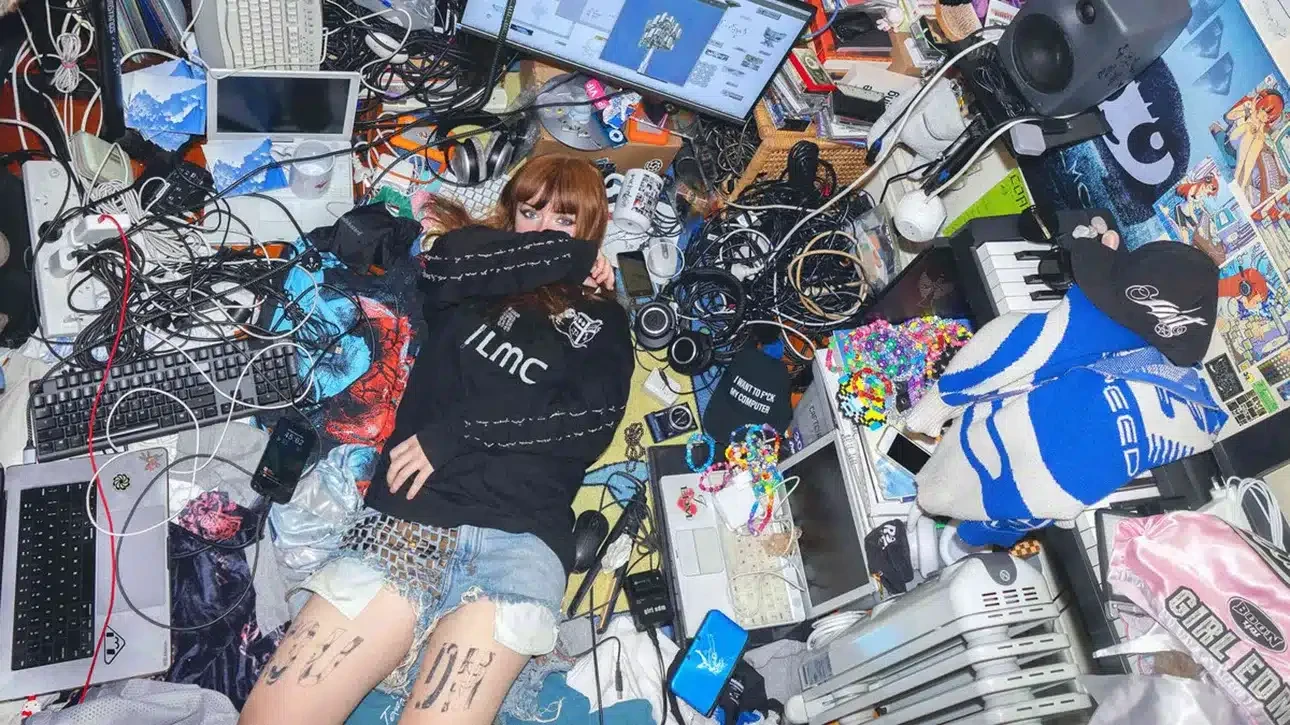
The physical packaging and visual campaign of the album reinforce this motif. The album artwork is an intentional maximalist collage: a claustrophobic sea of vintage monitors, tangled cables, glowing keyboards, and faded anime posters, with Ninajirachi sitting serenely at the epicenter. It is a visual manifesto signaling total immersion in the digital subcultures that birthed her artistry.
Future Outlook: The Permanent Legacy of "Internet-Born" Artistry
As we look toward the latter half of the 2020s, I Love My Computer establishes a vital precedent for how contemporary art will process generational memory. For decades, cultural critics categorized generations by their relationship to television ("raised by TV") or film. Ninajirachi and her contemporaries represent the first generation definitively raised by the internet—a cohort whose childhood milestones are inextricably linked to browser histories, software updates, and Wi-Fi signals.
The echoes of the early web continue to reverberate through modern culture, having scaled into multi-billion-dollar infrastructures. The peer-to-peer sharing ethos of Limewire paved the way for decentralized streaming economies; early YouTube skateboard videos laid the groundwork for a multi-generational creator economy; and simple desktop chat windows evolved into global social networks.
I Love My Computer succeeds because it refuses to talk down to its audience or treat digital culture as a novelty act. It is not an album about the internet; it is an album born of it. By translating the hum of the desktop tower and the glow of the monitor into breathtaking dance music, Ninajirachi has provided a vital soundtrack for anyone who ever looked into a glowing screen and finally felt, if only for a fleeting moment, completely understood.








Belum ada komentar. Jadilah yang pertama berkomentar!