

Executive Overview
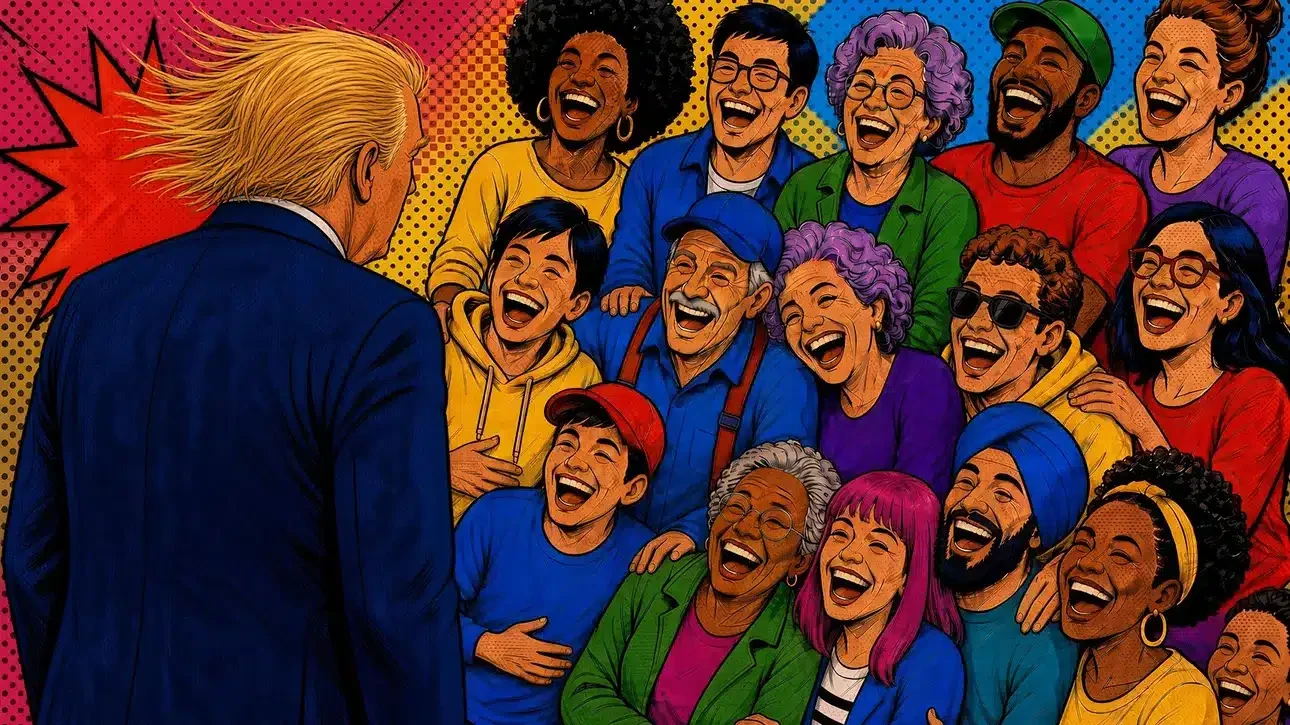
In an era where the traditional boundaries of democratic governance are increasingly strained, the front lines of political resistance have shifted from the hallowed halls of legislative chambers to the soundstages of late-night television. As institutional checks and balances falter—with a divided Congress and a captured Supreme Court frequently enabling authoritarian excesses—frustrated citizens have increasingly looked outside conventional political channels for truth, accountability, and moral clarity.
Enter the political satirist. From street-level protesters donning inflatable frog costumes to prime-time television hosts dissecting executive overreach, humor has emerged as the ultimate antidote to creeping autocracy. Historically, authoritarian regimes have recognized this threat, deploying everything from Soviet-era state censorship to Nazi "joke courts" to silence those who dare to mock the unmockable. Today, as populist strongmen test the structural integrity of American democratic guardrails, late-night comedy has transitioned from mere entertainment into a vital democratic bulwark.
The high-stakes collision between the Trump administration and late-night television—culminating in the dramatic suspension and triumphant return of ABC’s Jimmy Kimmel—illustrates a profound paradigm shift. When traditional journalism faltered under the weight of executive intimidation and access-driven self-censorship, comedians stepped into the vacuum. The ensuing battle over free expression demonstrated that while aspiring autocrats view critical humor as an intolerable challenge to their illusion of omnipotence, an organized and economically empowered public can successfully weaponize consumer resistance to defend the First Amendment.
Detailed Chronology: The Anatomy of a Crackdown
The friction between the modern American executive branch and the late-night comedy community is rooted in a fundamental incompatibility: fascism demands fear, unthinking obedience, and solemn hero-worship, whereas satire relies on exposing hypocrisy, incongruity, and moral failure. Historically, an unspoken social contract existed in American politics, wherein part of the president’s job description included enduring good-natured ribbing from late-night hosts. However, as the political landscape polarized, that contract dissolved.
The Prelude: Normalization and Retaliation
During his 2016 presidential campaign, Donald Trump notably appeared on Jimmy Fallon’s The Tonight Show, an episode that featured the host playfully mussing the candidate’s hair. While it generated easy laughs, critics later pointed to the moment as a watershed error that normalized a budding autocrat.
As executive power expanded, however, Trump’s tolerance for satire evaporated. Recognizing that late-night hosts were successfully landing rhetorical punches that mainstream journalists often avoided, the administration pivoted from passive annoyance to active suppression. The first domino fell in July 2025, when Stephen Colbert faced imminent cancellation at CBS amid parent company Paramount’s pursuit of a lucrative business merger requiring federal regulatory approval.
The Escalation: The Kimmel-Kirk Crisis
If the quiet sidelining of Colbert signaled a chilling effect across the broadcast networks, the assault on Jimmy Kimmel represented a full-frontal collision between state power and free speech.
The flashpoint arrived in the wake of the high-profile Charlie Kirk assassination, an incident that galvanized the MAGA movement’s thirst for political retribution. On his September 25, 2025 monologue, Kimmel addressed the aftermath of the shooting, bluntly asserting that the "MAGA gang" was aggressively exploiting the tragedy to score political points regardless of the facts.
The response from the administration was swift and calculated. FCC Chairman Brendan Carr was deployed to threaten regulatory penalties against ABC and its parent company, Disney, fulfilling Kimmel’s prescient warnings. Seizing upon the vulnerability of corporate mergers, Nexstar Media Group pulled Jimmy Kimmel Live! from its network affiliates. Under intense pressure, Disney instructed ABC to halt all broadcasts and indefinitely suspend the host.
Declaring victory, a triumphant Trump celebrated the removal of what he viewed as a relentless political thorn. Yet, this victory lap proved premature.
The Counter-Offensive: People Power Prevails
Unlike previous instances of administrative overreach, the opposition forces mounted a fierce, asymmetric counter-offensive. The broader comedy community instantly rallied around Kimmel, with competing hosts delivering blistering condemnations of the suspension. More importantly, years of accumulated public trust paid immediate dividends.
Ordinary citizens—recognizing the assault on the First Amendment for what it was—mobilized en masse. Threats of widespread consumer boycotts against Disney triggered a sharp, immediate plummet in the company’s stock value. Faced with catastrophic financial fallout and intense public backlash, the corporate-state alliance buckled. ABC, Disney, Carr, and the administration executed a tactical retreat, clearing the way for Kimmel’s return to the airwaves as a national hero, with his public approval ratings soaring to unprecedented heights.
Supporting Context & Metrics: The Rise of Satirical Journalism
The public’s migration from traditional news networks to comedy-centric commentary is not an accidental cultural quirk; it is a direct consequence of institutional journalism’s failure to hold power to account.
The Collapse of Traditional Accountability
In robust democracies—such as the United Kingdom—journalists routinely subject politicians to relentless, adversarial questioning. In contrast, the contemporary American media ecosystem has frequently succumbed to access journalism. Fearing exclusion from favored press pools, mainstream reporters have often folded under the weight of dismissive executive insults.
Scholar Geoffrey Baym, in his seminal analysis of political communication regarding The Daily Show, argues that late-night satirists provide a "rhetoric of challenge" that transcends traditional partisan divides. By interrogating both politics and the failures of modern journalism, fake correspondents and monologists expose the false equivalencies of "objective" reporting. They meet audiences on a moral plane rather than a strictly political one, creating a model of deliberative democracy that encourages active civic participation.
Historical Evolution of the Late-Night Forum
To understand the gravity of this medium, one must trace its evolution from 1940s radio variety shows:
- 1949: CBS broadcasts The Faye Emerson Show, a 15-minute program widely recognized as the earliest television precursor to the modern talk show, introducing subtle political commentary.
- 1954: Steve Allen expands the format on NBC, injecting a wry, patrician brand of observational humor directed at Washington figures.
- 1962: Johnny Carson assumes the helm of The Tonight Show, pioneering parity impersonations. During the Watergate scandal, Carson’s biting commentary visibly eroded Richard Nixon’s public approval ratings, cementing the idea that comedians offered a clearer lens on reality than straight news.
- 1970s & Beyond: Dick Cavett and subsequent generations transformed the late-night desk into a platform for rigorous intellectual and ideological sparring, paving the way for the deeply political monologues defining the medium today.
Official Statements and Institutional Reactions
The battle over the airwaves generated intense commentary from constitutional scholars, media watchdogs, and political figures alike:
-
On Executive Overreach and Censorship:
In an interview with Time magazine, political analyst Philip Elliott noted the historical echoes of the post-9/11 silencing of Bill Maher, while stressing a vital distinction: "Jimmy Kimmel’s silencing echoes Bill Maher’s after 9/11—but Trump is no Bush." Elliott emphasized that while past political pressures were driven by patriotic fervor during national crises, the modern crackdown represents a targeted, institutional effort by an aspiring autocrat to dismantle critical dissent. -
On the Weaponization of Regulatory Bodies:
Media critics expressed profound alarm over the FCC’s involvement in corporate content decisions. Andrew Lawrence of The Guardian observed that Trump’s obsessive focus on late-night hosts stems from a deep-seated vulnerability: "Once, an unspoken agreement existed: part of the president’s job is to get ridiculed in late-night monologues. Nowadays, the would-be king no longer tolerates these court jesters, using whatever levers of government he has at his disposal to silence them permanently." -
On the Resilience of Public Trust:
Following his reinstatement, Jimmy Kimmel addressed his audience not merely as an entertainer, but as a reluctant custodian of the public square, thanking viewers for demonstrating that corporate boardrooms and executive orders cannot override the collective will of an engaged citizenry.
Future Outlook: A Cautionary Tale for Would-Be Autocrats
The Kimmel-Kirk saga serves as a watershed moment for modern democratic resilience. It underscores both the extreme fragility of corporate media conglomerates under pressure from authoritarian executives and the remarkable durability of grassroots democratic resistance.
Several key takeaways define the future of political satire and free speech in America:
- The Economic Leverage of the Electorate:
As demonstrated by the rapid reversal of Disney and ABC, consumer power remains one of the most effective non-violent deterrents against corporate capitulation to authoritarian demands. When citizens organize economic boycotts to defend constitutional principles, corporate ledgers quickly align with democratic values. - The Incompatibility of Humor and Fascism:
As philosopher John Morreall observed, individuals armed with a sense of humor and imagination can never be fully dominated. Because satire inherently targets hypocrisy, narcissism, and unthinking obedience, it functions as administrative kryptonite. Aspiring dictators will continue to attempt the creation of "humor-free zones," but as long as comedy flourishes, total thought control remains impossible. - The Re-Definition of Journalistic Duty:
Until traditional media organizations rediscover their collective backbone and shed the paralyzing fear of executive retaliation, late-night comedians will continue to fill the void as spokespeople for the public conscience.
Ultimately, the preservation of American democracy will rely heavily on the vigilance of its citizens. The lesson of the late-night wars is clear: autocrats may command regulatory agencies, corporate mergers, and state apparatuses, but they can never legislate away laughter—and in the battle for the human mind, laughter just might save the republic.







Belum ada komentar. Jadilah yang pertama berkomentar!