

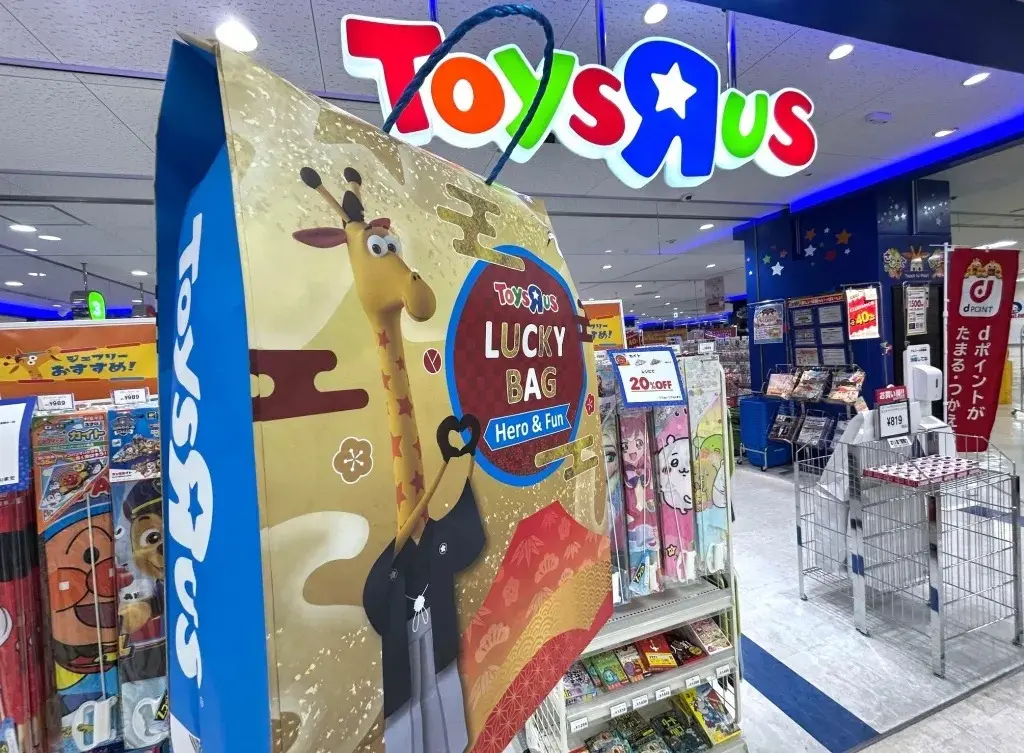
Executive Overview
For nearly a decade, Geoffrey the Giraffe stood as an international anomaly. While the iconic mascot’s American home dissolved into bankruptcy and liquidation back in 2018, the Japanese subsidiary of Toys “R” Us continued to thrive across the Pacific. Operating independently as a cultural and retail touchstone for families, Toys “R” Us Japan managed to defy the gravity that dragged down its parent company, serving generations of Japanese children who grew up walking down aisles packed with plastic packaging and bright primary colors.
That remarkable era is officially coming to a close. Following years of relentless financial pressure, structural demographic shifts, and the unyielding march of e-commerce, Toys “R” Us Japan has announced it is exiting the Japanese market. The decision marks the end of an extraordinary 35-year run that began when the American retail behemoth first landed in the country in 1991.
However, this is not a sudden bankruptcy liquidation reminiscent of the 2017–2018 U.S. collapse. Instead, a massive retail lifeline has emerged. Pan Pacific International Holdings—the powerhouse parent company behind Japan’s ubiquitous discount retail king, Don Quijote—is poised to acquire Toys “R” Us Japan’s physical assets, operations, and workforce. While the iconic American toy brand is set to disappear from Japanese storefronts, the transition offers a glimmer of hope for the roughly 6,000 full-time and part-time employees whose livelihoods hang in the balance.
This comprehensive report examines the factors leading to the fall of Toys “R” Us Japan, the broader socioeconomic trends reshaping the Japanese retail landscape, and what the future holds for the spaces and personnel left behind by a disappearing retail giant.
Detailed Chronology: From U.S. Pioneer to Japanese Survivor
1991–2000s: The Golden Age of Big-Box Retail in Japan
When Toys “R” Us first expanded into Japan in 1991, it arrived as an absolute trailblazer. At the time, Japan’s retail sector was heavily fragmented, dominated by small, independent neighborhood toy shops (omochaya) and traditional department stores where toys were sold in tightly restricted, high-priced sections.
Toys “R” Us shattered this paradigm. By introducing the American "Category Killer" big-box format—vast warehouses filled from floor to ceiling with an unprecedented inventory of goods—the company revolutionized the market. Consumers flocked to sprawling suburban locations equipped with massive parking lots, drawn in by lower prices, incredible selection, and an experiential shopping model that turned buying a toy into an event.
The strategy worked brilliantly. Over the next two decades, the brand expanded to approximately 150 stores nationwide. It deeply embedded itself into the fabric of Japanese consumer culture, even localizing its famous American commercial jingle with catchy Japanese lyrics that remain nostalgic earworms for millennials today.
2017–2018: The American Collapse and the Great Divergence
While the Japanese arm of the business enjoyed steady footing, the global enterprise was unraveling. Crushed under a staggering mountain of debt stemming from a 2005 leveraged buyout, and unable to effectively compete with Amazon and big-box rivals like Walmart and Target in the United States, Toys “R” Us filed for Chapter 11 bankruptcy protection in late 2017. By mid-2018, all 735 U.S. stores were closed or sold off, liquidating a brand that had defined childhood for millions of Americans.
Uniquely, Toys “R” Us Japan was shielded from this catastrophe. Because it operated with separate financial structures and maintained strong domestic profitability, the Japanese branch survived the global purge. For the next nine years, it stood proudly as an international outlier—a ghost ship sailing on long after its home fleet had sunk. During this period, foreign tourists and nostalgic expatriates living in America frequently marveled at the existence of Japanese Toys “R” Us locations, treating them like living museum exhibits of 1990s retail culture.
2026: Reaching the Breaking Point
Despite its valiant solo run, economic gravity finally caught up with Toys “R” Us Japan. Following extended operating losses compounded by post-pandemic economic shifts, inflationary pressures, and rising operational costs, corporate leadership acknowledged that the current business model was no longer viable. The announcement to exit the Japanese market marks the definitive end of the road for the standalone brand in the country, setting the stage for a massive corporate handover.
Supporting Context & Metrics: Why the Big-Box Model Cracked
The downfall of Toys “R” Us Japan cannot be attributed to a single misstep; rather, it is the result of a "perfect storm" of macroeconomic headwinds, demographic changes, and shifting consumer habits unique to modern Japan.
1. The Demographic Crisis: A Shrinking Pool of Children
The most foundational challenge facing Toys “R” Us Japan is the nation’s severe demographic decline. Japan’s birthrate has been falling for decades, resulting in a rapidly aging society and a shrinking population of young children.

While headlines occasionally highlight minor, short-term statistical bumps—such as a brief, marginal rise in births during the first half of a given year—the overarching trajectory is a steep, irreversible downward slope. Toys “R” Us focused primarily on toys for younger children, toddlers, and infants, rather than pivoting entirely toward the high-end, high-margin anime and collector markets that appeal to adults. Consequently, as the absolute number of children plummeted, the total addressable market for traditional toy retail shrank proportionally, starving the massive big-box footprint of the foot traffic it required to turn a profit.
2. The E-Commerce Revolution
For decades, the core competitive advantage of Toys “R” Us was physical scale: parents had to visit massive suburban warehouses to find a comprehensive selection of goods in one place.
However, Japanese consumer behavior has undergone a profound digital transformation. E-commerce giants like Amazon Japan, Rakuten, and specialized online storefronts have captured an increasingly massive share of retail spending. Parents pressed for time in a high-stress working culture increasingly prefer to order birthday and holiday gifts online from the comfort of their homes, bypassing the need to drive out to sprawling suburban shopping malls.
3. Intense Domestic Competition
Even when modern Japanese families do venture out for brick-and-mortar shopping, Toys “R” Us faces ferocious competition from an unexpected quarter: consumer electronics mass-merchants, commonly known as kaden量販店 (kaden ryohanten).
Retailers like Yodobashi Camera and Bic Camera have aggressively expanded their footprints into prime, highly accessible, central urban railway hubs. Crucially, these electronics giants often reserve massive floor space for extensive toy, hobby, and video game sections. Because their primary business lines—televisions, home appliances, smartphones, and computers—generate significantly higher profit margins, these electronics chains can afford to absorb lower margins on toys. Furthermore, their central, station-adjacent locations offer vastly superior convenience compared to the suburban, car-dependent warehouses that define the traditional Toys “R” Us real estate strategy.
Official Statements and Industry Reactions
As news of the market exit broke across Japanese media outlets including Kyodo News, Yahoo! Japan, and the Yomiuri Shimbun, industry analysts and consumers alike expressed a mixture of sorrow and pragmatism.
Retail economists noted that the closure signals the final evolution of the 1990s-era American big-box invasion of Japan. While warehouse-style concepts revolutionized Japanese distribution decades ago, the modern consumer values either hyper-convenient urban locations (exemplified by electronics megastores) or digital frictionless shopping.
Crucially, corporate stakeholders have emphasized that the transition is being structured to minimize disruption to the broader economy. The impending acquisition by Pan Pacific International Holdings serves as a vital corporate safety net.
While Pan Pacific has yet to issue an exhaustive public roadmap regarding its specific plans for the acquired infrastructure, industry insiders note that the conglomerate is uniquely positioned to absorb the blow. Pan Pacific operates the wildly successful Don Quijote discount chain—affectionately known as "Donki"—which is famous for its labyrinthine aisles, eclectic inventory, and late-night operating hours. Although Don Quijote does not operate a dedicated toy specialty chain, its vast retail ecosystem has plenty of room to integrate popular toy lines, utilize large-scale retail real estate, and—most importantly—redeploy a skilled, customer-service-oriented workforce.
Future Outlook: What Happens Next?
The departure of Toys “R” Us from Japan closes a 35-year chapter in the nation’s commercial history. For consumers, the sentimental loss is palpable. Generations of Japanese shoppers who grew up hearing the localized jingle and marveling at the towering shelves of board games, dolls, and action figures will mourn the passing of an icon.
However, the physical infrastructure left behind will not sit vacant for long. The transition of approximately 150 stores and around 6,000 employees to Pan Pacific International Holdings suggests a pragmatic, market-driven evolution rather than a catastrophic collapse.
For the retail sector, the lesson is clear: even legendary global brands cannot indefinitely resist the combined pressures of demographic decline and digital disruption. As Geoffrey the Giraffe prepares to wave his final goodbye to the Japanese archipelago, the spaces he once occupied will inevitably be reshaped to meet the demands of a new generation of shoppers—proving that in modern retail, adaptability is the only guarantee of survival.








Belum ada komentar. Jadilah yang pertama berkomentar!